

That’s an unusual title for a post unless you’re Canadian in which case you probably already know more than me.
“Miss Lorrie Dunington is well known as a designer of gardens. This sounds a delightful profession, and, indeed, it is, though there are very few women in England practising it at present.”
So begins an article about Miss Dunington in The Girl’s Realm – not my usual reading matter – which I discovered while getting ready for a lecture about horticultural training for women a century or more ago. Obviously I was intrigued and and decided to investigate further.

The story of her life and work can be found in several places but all similarly worded and based on the same original source which omits many of the details, which all goes to show how difficult it can be to research comparatively recent people and events. So dotted through the post are requests for more information if anyone has it. The quotes come from The Girl’s Realm article unless otherwise cited.
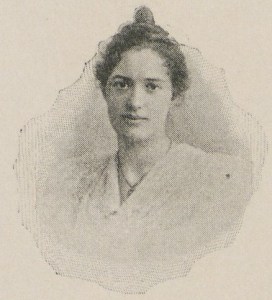
Lorrie Alfreda Dunington was born in Wimbledon in 1877 and according to the 1891 census her parents made patented medicines. She “began by studying drawing with the intention of being an artist, but was told by the doctor that her health could not stand studio life, and that she must be out of doors as much as possible”
So, at just 16 years of age, she went to Swanley Horticultural College for two years. Swanley had only opened in 1889 and initially would not admit women, although it began to do so in 1891 when ‘Ladies…should be provided with a hand magnifier, pruning-knife and bee-veil…’.

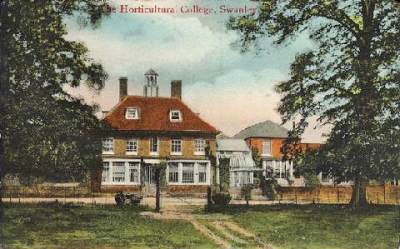
In 1893 she wo0uld probably still have been in a minority although by 1896 there were more women students than men and from 1904 it became a female only establishment. There was one unfortunate downside to her time at Swanley as, according to the local history group, while she was there she contracted bovine tuberculosis.
After that she is said to have obtained an appointment as head gardener and manager of an estate in Ireland, [anyone know where?] which sounds an extraordinary achievement for someone so young, especially in those days, a woman.
According to the interview in Girl’s Realm ”All this time, however, she was still hankering after drawing, and her present profession resulted from the desire to combine our knowledge of this with that of gardening. She incurred great opposition and many difficulties, as there was there and nowhere she could go to be trained, and her education had to be done in a piecemeal fashion.”
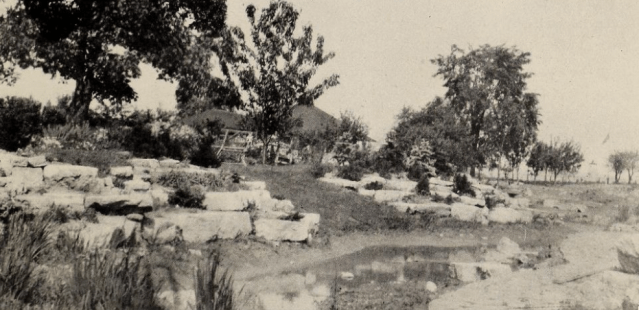
Nevertheless she persevered, and at some point she had a formative encounter with Henry Self Leonard, a solicitor who retired from the law and opened The Hardy Plant Nursery in Guildford. Leonard took a particular interest in newly fashionable alpine plants including staging the first rock garden in the open air at an RHS show in 1893. Its became a productive friendship and the 1901 census records her as being a boarder at a house in Guildford and already practicing as a “landscape gardener on own account. According to Girls Realm Lorrie “went round the country” with Leonard, he designing the rock gardens and she planning the remainder of the garden. In this work she soon began to find that a knowledge of architecture was necessary, so she studied at a technical institution” , [Does anyone knows where]. But she “also had some private tuition as an architects office.” [Ditto]

She certainly became a pupil of Fanny Wilkinson, described by Girls Realm as “the pioneer of women garden designers” who was landscape gardener to the Metropolitan Public Gardens Association. Under Miss Wilkinson’s watchful eye she “gained a knowledge of plan drawing and estimate making.” She would also have learned one of Wilkinson’s underlying principles outlined in an interview in 1890 : ’I certainly do not let myself be underpaid as many women do. … I know my profession and charge accordingly, as all women should do.’[3]

When Wilkinson became principal of Swanley, in 1902 “Miss Dunington took an office in London, in an imposing building in Victoria Street, where she now has pupils of her own.” I can’t find her in street directories although there are several well-known landscape firms in Victoria Street, including Lakeland Nurseries [run by Thomas Mawson and his brother] at 72, Cheal’s at 53, and Milner, Son & White at no 7, so perhaps she was working in association with one of them. By this point she certainly seems to have known Thomas Mawson, the most eminent landscape designer of the day.
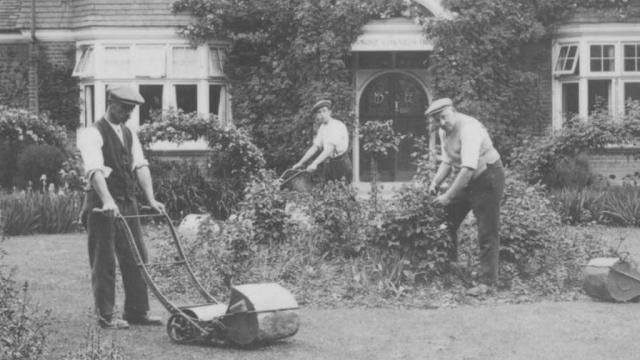

The article goes on to say she “designed gardens in all parts of England as well as Ireland”, although there are no mentions of her on the Parks and Gardens database so perhaps one of our County Gardens Trust researchers might know more?
She also had a couple of more prestigious mentions, firstly for being ” a prize winner at Letchworth Garden City competition two years ago competing among the score of men”, and secondly for being appointed “garden advisor for the estate of the epileptic colony at Chalfont St Peter, comprising 360 acres.” The Chalfont site still exists but there has been considerable building development and there is no mention of her role in the Epilepsy Society’s history of the site.
Additionally Lorrie also started to make a name for herself a speaker. She spoke, for example, about beekeeping as an occupation for women at the Internal Women’s Conference in London in 1899 and on one occasion was asked to give a lecture on garden design and civic planning to students at the Architectural Association, where she was introduced by Thomas Mawson. For her this was to be a life-changing event.
This started out as a blog about Lorrie alone but I decided I couldn’t ignore the Grubb part of the title which relates to Howard Burlingham Grubb who was born into a Quaker family in York in 1881. Howard didnt excel at school and and became unsure about what to do for a career. He was later to write “At a family gathering called at the end of the last century it was unanimously decided to ship the problem child out to the colonies. There, after many years, I stumbled, by accident and without qualifications into society’s worst paid profession![landscape Architecture]”

In fact it he went the United States in 1899 where he eventually enrolled at Cornell University in 1904 to study agriculture. Before he graduated in 1907 he wrote to Thomas Mawson asking for a job. Mawson advised him to stay in America where prospects in landscape design were, he thought, substantially better. Ignoiring this Grubb simply worked his passage back to England and showed up unannounced at Mawson’s door and begged for an opportunity to work for him.
Mawson later wrote”What could I do in a case like this. It would be wrong not to give such an audacious youth its chance. Within two years Grubb was in charge of my London office.”
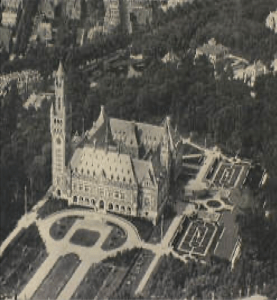
In 1908 Mawson won a competition to design the grounds the Palace of Peace in the Hague, now the HQ of the International Courts of Justice. He had to pare down his design but still created a gradual transition between garden and palace, with spacious brick terraces which matched those of the building He also left the adjoining woodland to stand as a stark contrast to his formal gardens. Grubb worked on the project from then until its completion in 1910. It helped determine his later approach.

In 1910 Grubb went with Mawson to that lecture at the Architectural Association in London, and afterwards Mawson introduced him to Lorrie. Three months later they were engaged, and the following spring they married before emigrating to Canada. This may have something to do with Mawson who already had contracts there but was looking to further expand his business. They had no fixed plans of where to settle but having crossed the continent by train to explore the west coast and central plains belt they fixed on Toronto, then Canada’s second largest city which had a population of around 300,000. They quickly set up their own practice – H.B. & L.A. Dunington-Grubb, Landscape Architects and advertised as “Consultants on all matters relating to Park and Garden Design, Real Estate and Suburban Development, Civic Art and Town Planning.”

They arrived a fortuitous point in Canadian planning and urban development, with a lot of discussion about creating “The City Beautiful” which followed in the footsteps of the Garden City Movement in Britain. From the 1890s until the Great Depression there were an effort to promote civic beauty through architectural harmony, unified design and visual variety. The movement’s legacy is the persistence of certain ideals in the public mind, those of municipal parks, tree-lined streets, well-tended front lawns and public plantings. It suited the couple’s philosophy very well. In 1914 one of their first major schemes was to produce a masterplan for the green transformation of the City of Brantford which unfortunately never materialised because of the cost during wartime. For more on their plans see Elaina Rossettis’ Brantford City Planning, 2014
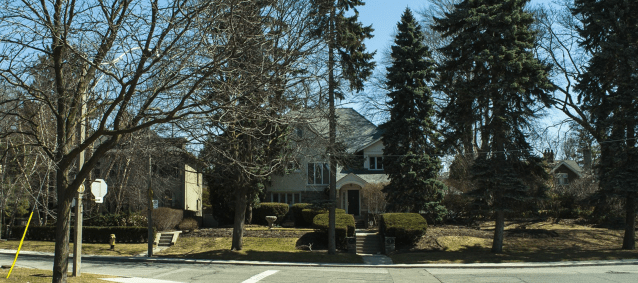
While Lorrie and Howard almost certainly helped promote Mawson’s interests in Canada, and perhaps because of that connection, they were soon hired on their own account by Wilfred Dinnick who had laid out the upmarket Lawrence Park estate, in the style of an English Garden City. Their brief was to design plantings for the streets, parks, and many of the residences. It was ranked as the wealthiest neighbourhood in Canada in 2011 and part of it has now been designated a Heritage Conservation District. Their work on Lawrence Park introduced them to the upper echelons of Toronto society, who of course gave them more commissions.
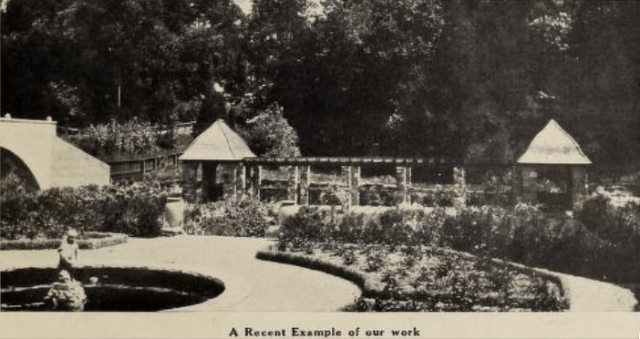

What they immediately discovered was that Canada was not a country of gardeners – Indeed there wasn’t a single ornamental plant nursery in the country. Plant choice was very restricted and in limited supply so they set up a 10 acre nursery near Lawrence Park, importing plants from Britain to propagate not only for the estate but to sell elsewhere commercially.
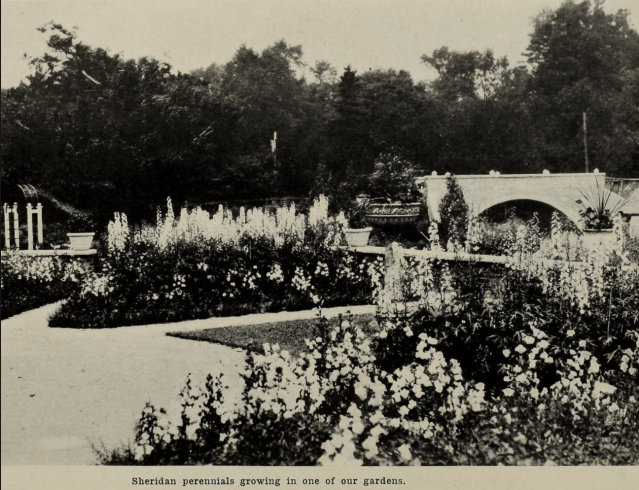
Their first attempts were not that successful but they risked trying again and borrowed money to buy a hundred acres near the hamlet of Sheridan, west of Toronto and embarked on the risky business of growing purely ornamental stock. Their first garden catalogue was issued for the 1914-1915 planting season. This time they met with great success and by 1926 Sheridan Nurseries had expanded to to 250 acres growing an extensive selection of trees, shrubs, roses and perennials.

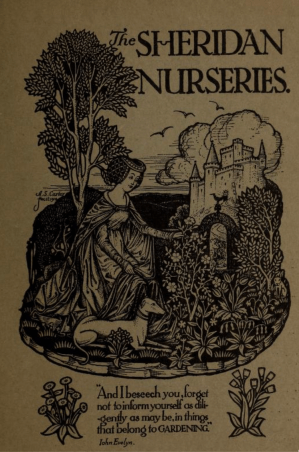
As the nursery developed their workload obviously increased so they advertised in Gardeners Chronicle back in Britain in the hope of finding a manager to run the place while they concentrated on their landscaping commissions which were coming in thick and fast.
The person appointed was not who one might have expected from an ad in the British gardening press. Sven Herman Stensson was chief gardener for the Crown Prince of Denmark at Knuteburg Castle, although he had worked at Kew and knew a lot about the English style. He arrived with his wife and 5 sons and later became a partner in what became Dunington-Grubb and Stensson, and after Howard’s death in 1965 he and his family took over the nursery and landscaping business which they still run today.
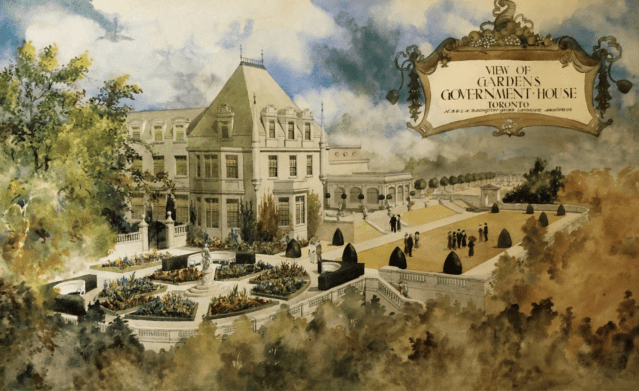
In 1915 the Dunington-Grubbs won another prestigious commission: the landscaping of Chorley Park, the official residence of the Lt-Govenor of Ontario. The French chateau style mansion was immediately controversial because it was huge and very expensive to build. An American designer Charles Leavitt had produced a proposal for the landscaping but these were rejected as too costly and Lorrie and Howard were commissioned to produce new ones. These too were rejected as too expensive during wartime and so they resorted to something much cheaper but which nonetheless were hailed as “the finest in the Dominion”. In fact Chorley Park was soon abandoned to become a hospital, then police HQ and later a refugee centre before being demolished. Virtually all their work was swept away and the site is now a natural park.

Their landscape practice produced hundreds of designs and masterplans over the years, mostly for private gardens for wealthy clients.Their style, was said a contemporary “classic and aristocratic, with broad terraces and steps, topiary hedges, sculptures, vistas, and an “Art Deco” sensibility.”
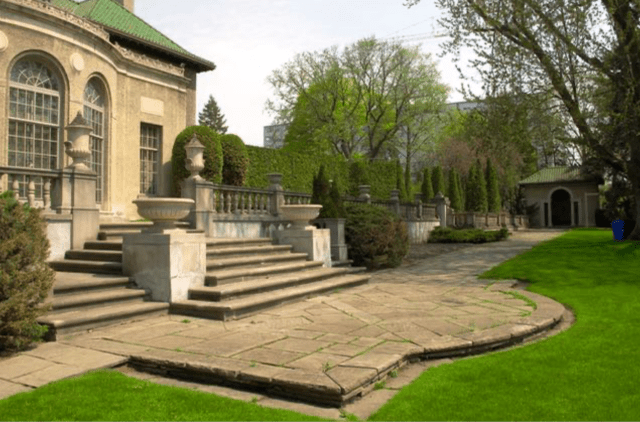

Most of these private gardens have long since disappeared but one, at Parkwood, built for the car magnate Sam McLaughlin, and his wife Adelaide, between 1915 and 1917 has been listed as one of Canada’s National Historic Sites. The couple had an avid interest in horticulture and the estate had eleven greenhouses and a staff of 24 gardeners.
The Dunington-Grub team created spectacular outdoor “garden rooms” including the Italian Garden, Sundial Garden, Summer House and the Sunken Garden. They also refined the South Terrace and designed the intricate lattice fencing for the tennis court and Italian Garden.
The estate’s website has several short video clips which show their work.

The rest of their commissions covered an extremely wide range of business and government projects. The best known being at Hamilton, Ontario and Niagara Falls.
In Hamilton they created Gage Park between 1919 and 1927 very much in the City Beautiful style with a Great Lawn, broad meandering walkways, a mix of of formal and informal spaces, and the preservation of important vistas, and the opening up of new ones.

They worked too at the city’s McMaster University in the late 1920s creating an entrance landscape which included a Sunken Garden which was unfortunately built over later.


They laid out an extraordinary tiered garden at Battlefield Park which was on the site of the Battle of Stoney Creek, one of the key battles of the War of 1812. It was commissioned by a group of women who wished to commemorate the British victory over the Americans in style. Unfortunately their original ambitious plans were only about 90% completed before the money ran out, although not before the 30m high obelisk [not by them] was finished in 1913.
Changing ownerships saw the gardens gradually fall in to disrepair with most features grassed over. But reflecting changing attitudes to the conservation of gardens, and their tourist value, in 2011 a major reconstruction scheme was launched to preserve and complete the original planned landscape at a cost of over 500,000 Canadian dollars.


At Niagara they designed the Oakes Garden Theatre in Beaux Arts Style which was completed in about 1933, and capitalized on the contours of the landscape to create a curved pergola overlooking a central amphitheatre. The pergola has recently been reconstructed and the whole garden restored.
Later Howard with Svensson designed nearby Rainbow Bridge gardens between 1935 and 1944) in a similar style.


Lorrie not only worked in partnership with her husband on landscapes and gardens but she lectured about housing and town planning for Toronto University and about beautifying cities for the Department of Agriculture. She also workedpromoting the arts, and served as president of the Women’s Art Association of Canada, and membership of several other societies promoting women’s roles within the artistic community. On top of that she wrote prolifically for a wide range of magazines [most of which have unfortunately not yet been digitized] but you can see the range and extent of both her and Howard’s work on a webpage compiled by Pleasance Kaufman Crawford, a Toronto-based landscape design historian.

She had to slow down drastically after contracting tuberculosis again in 1928 but still became a founding member of the Canadian Society of Landscape Architects in 1934, being elected its president in 1944, a few months before she died in 1945. Howard was then elected to complete 1his wife’s term of office.
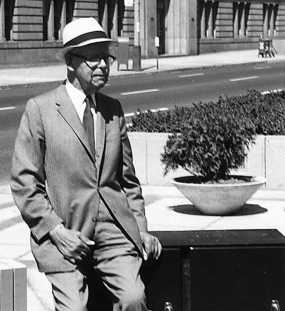
He gradually incorporated more modernist elements into his work after her death but still described his designs as “a world of fantasy, of make-believe, where decorative nature under the control of art provides both pleasure and rest.” That for him was the whole point: In a garden we have left the real world and entered the world… of pleasure and rest”. The Canadian Encyclopaedia is perhaps a little less than enthusiastic about the man it also described as the father of landscape gardening in Canada saying that “as a designer he was neither innovative nor particularly imaginative, but he was very good at tastefully amalgamating eclectic design elements.”
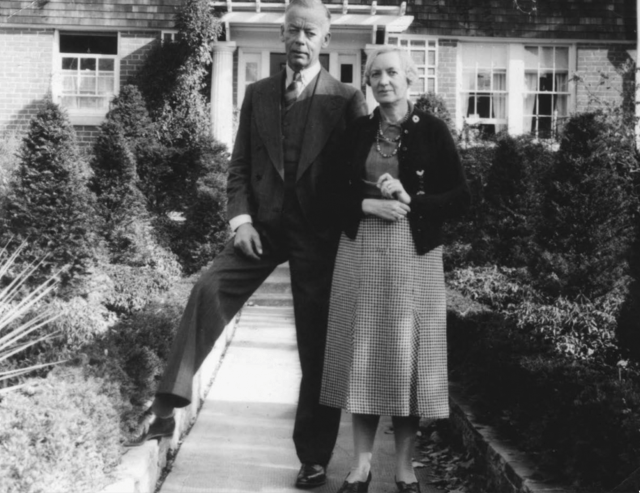
While many of Lorrie and Howard’s gardens have disappeared, the landscapes that remain are impressive. Together with their help founding the Canadian Society of Landscape Architects and their work with Toronto University, they mark the coming of age of landscape architecture as a profession in Canada.
They are remembered too through Landscaping Ontario’s annual Dunington-Grubb Award. Not a bad legacy for two pioneering Brits even if I can’t help wondering if her death twenty years before his caused his legacy to overshadow hers?



 The Garden History Blog

You must be logged in to post a comment.