

We saw last week how the story of the Golden Apples from the legendary Garden the Hesperides was adapted by 17thc gardening writers to imply that Hercules didn’t steal apples but golden oranges and lemons instead. That switch from apples to oranges is clearly echoes in the first English book on growing citrus, published in 1683. The author talks of these “outlandish Trees” and goes on…” under the Name of Hesperides is nothing else Understood by Modern Authors, but the Ordering and Management of Citron, Limon, and Orange Trees.”
At roughly the same time there were two other books about growing citrus , both called Hesperides – one Dutch and one German – both full of beautiful detailed engravings showing not just fruit as you might expect but also a large number of gardens and other plates which hark back to the classical myths and legends.

As so often at this period the English book wasn’t original. As its title The Belgic or Netherlandish Hesperides implies it was a translation of a beautifully illustrated Dutch book on growing citrus, unsurprisingly called Nederlantze Hesperides written in 1676 by Jan Commelin an Amsterdam merchant who with his nephew Caspar founded Amsterdam’s botanic garden, the Hortus Medicus. Dutch trade networks brought exotic plants from all around the world, but particularly the Cape, Sri Lanka and the East Indies, to the city and Commelin grew many of them at his estate at ‘Zuyderhout’ near Haarlem.

He also wrote about them, with Nederlantze Hesperides merely one of several publications. Like Ferrari’s Hesperides which I looked at last week, the images in Commelin’s book are invaluable to modern scholars and if you’ve ever read anything about how people grew oranges and lemons in the past you’re almost sure to have seen some of them.

The English translation was done cheaply by someone known known only by their initials GVN, and dedicated to Thomas, Viscount Fauconberg, a prominent politician and keen gardener whose London garden I’ve mentioned before.
Amongst much else, it had a greenhouse where he presumably grew citrus, that was described by a visitor as “well made” but “ill set” because it did not get direct sunlight in winter.” As Commelin had pointed out that was essential for success!

As today, the Dutch were the most advanced horticulturists in Europe, certainly in technical terms, and they excelled in citrus cultivation. This is evident in Commelin’s book, where apart from a large array of fruit of all sorts he also illustrates the orangeries and shelters in which they were grown.
Apart from the one in the University of Leiden’s botanical garden these were in the gardens of wealthy private collectors including his own.

They show considerable advances on earlier examples of protective structures such as the temporary orangery designed Salomon de Caus which were put up round citrus trees planted in open ground.
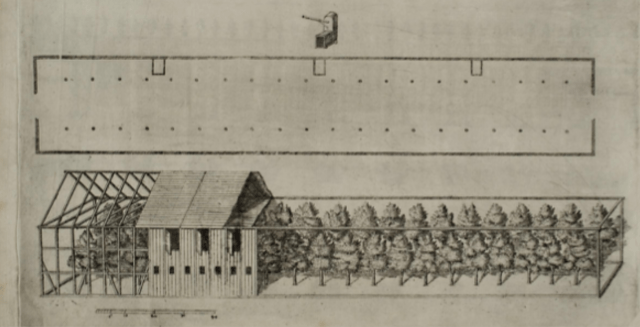
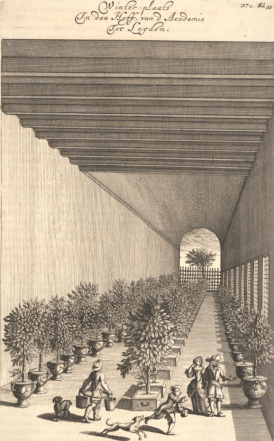
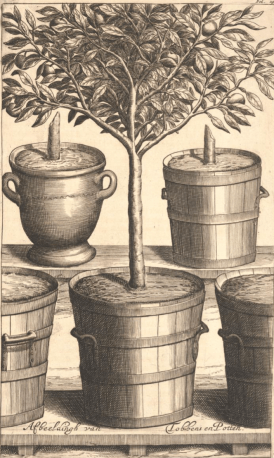
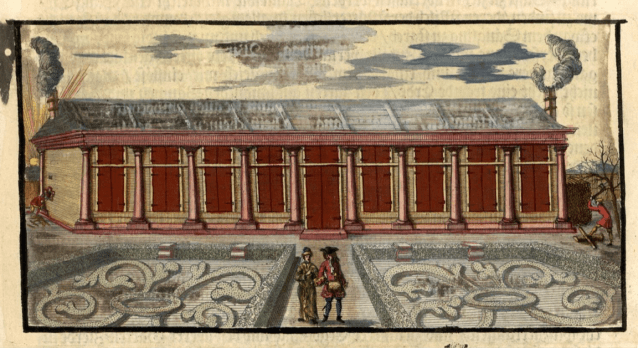
By Commelin’s day orangeries had evolved into permanent structures usually with large windows on the southern side to increase the amount of sunlight reaching the plants, and were using advanced forms of heating such as stoves instead of open fires. His engravings show how container grown trees were cared for, moved around and arranged, both outside in the summer and inside during the winters.
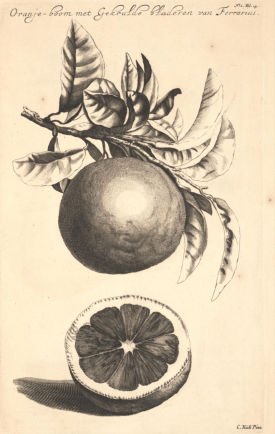
Dutch supremacy in citrus growing was later severely challenged by Jean de la Quintinye. He was Director of the fruit and vegetable gardens at Versailles for Louis XIV, and thus had an almost endless supply of money to achieve perfection. His book Le parfait jardinier – The Perfect Gardener – was published posthumously in 1690 and then quickly translated into English as The Compleat Gardener by John Evelyn in 1693 before being re-published “compendiously Abridg’d, and made of more Use, with very Considerable Improvements” by George London and Henry Wise which ran to several editions. What is not quite so well known is that de la Quintinye’s instructions for growing fruit and vegetables was accompanied by a separate treatise on growing oranges and other citrus.

Unfortunately the treatise only has one illustration but this shows the orangery at Versailles with the trees in tub laid out around the fountain in the courtyard in front, with workmen attending to others.

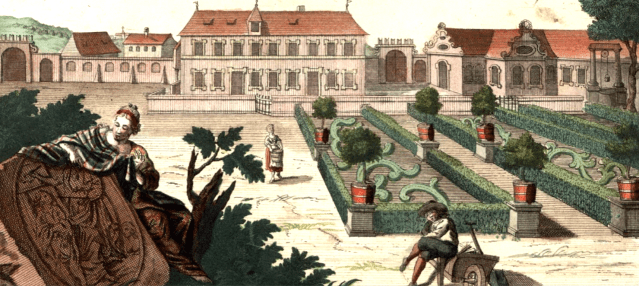
Other illustrations you’re quite likely to have seen come from an otherwise obscure German book Nürnbergische Hesperides or The Nuremberg Hesperides by Johann Christoph Volkamer which was published in two volumes in 1708 and 1714.
While the Dutch had a long and highly advanced horticultural tradition that’s not really the case for Nuremberg. The city had suffered a lot during the Thirty Years War which disrupted trade and civic life between 1618 and 1648. Recovery was slow but in the aftermath the land immediately outside the city’s walls was bought up by wealthy families who built about 360 gardens and houses there, which became collectively as the Hesperides gardens, partly because of the large number of citrus trees grown there.
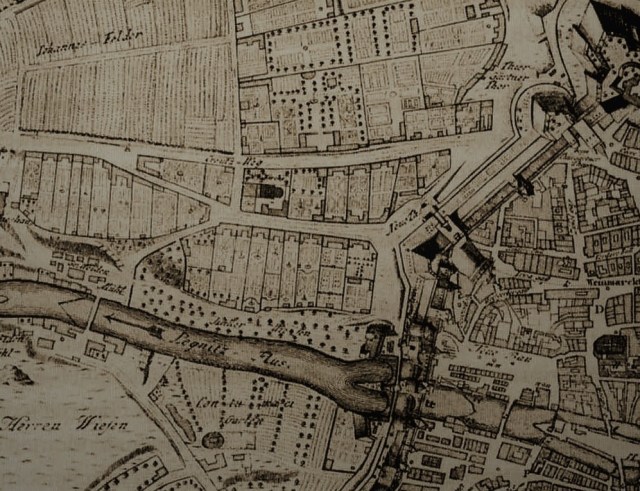
One of them at Gostenhof was owned by the Volkammer family, headed by a physician and amateur naturalist, Johann Georg Volkammer.
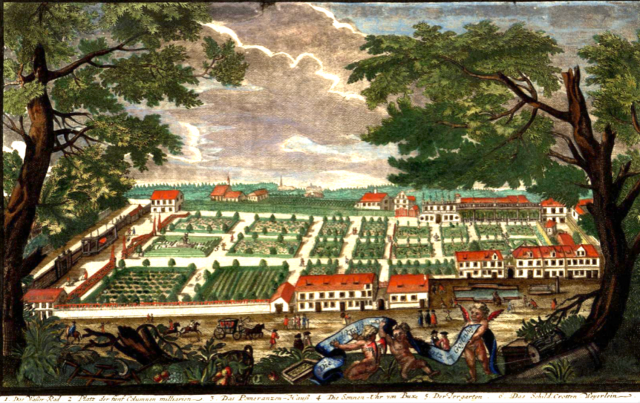

His son Johann Christoph obviously learned gardening from him, and was also fortunate enough to to inherit a successful silk shop in the city, but also a silk factory in Italy. Later he had a factory that made gilded brass tiles which were popular for the roofs of mosques and temples in the eastern Mediterranean and south Asia. As a result Volkamer was not only extremely wealthy but travelled regularly to Italy and Constantinople, where he was able to buy exotic plants for his garden. In particular he developed a passion for citrus of all kinds. It must have been quite a shock to bring them back to Bavaria and really have to struggle to grow them there.
That passion extended to writing a book about them, which was based, as the full title shows, on his own experience in his garden at Gostenhof: “Nuremberg Hesperides, or thorough description of the noble Citron, Lemon, and Bitter Orange fruits, How to, in this and neighbouring areas, correctly plant, tend, maintain and reproduce them, Together with a comprehensive enumeration of most cultivars, partly actually grown at Nuremberg, partly imported to there from various foreign places …” As far as I can see it has never been translated, although its main value to us today lies in the images rather than the text.
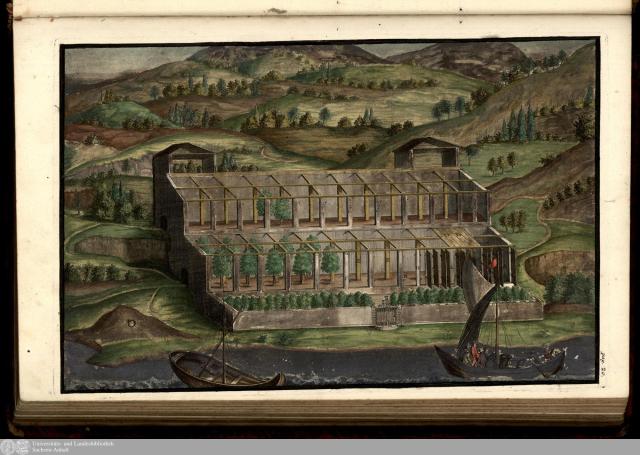
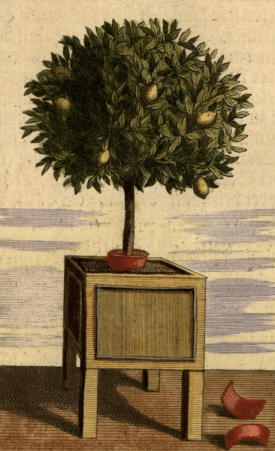
The large-format volume is ornamented with high-quality copper engravings not only of the various fruits, but also some mythical and allegorical stories connected to them, as well as other aspects of garden art, from the planning of a garden in general to the creation of sundials. I’ve only been able to include a fraction of them here but they are definitely worth closer look, so do check them out if you have time.

What is equally interesting is that the botanical illustrations incorporate little snapshot sketches of the gardens, buildings and landscapes in and around Nuremberg, which together create a picture of the city’s garden culture at the beginning of the 18thc which I do not think is paralleled by images of any other location. It’s estimated that over 70% of these gardens grew exotic plants including citrus.


They are generally overlooked because the book is only normally consulted for its fruit engravings, but I suspect the landscape and garden scenes are much more important and certainly worthy of a proper analysis. In all, There are as many as 256 plates which cover 170 sorts of fruit, including some other exotic non-citrus plants. Originally published in black and white the plates can often to be found in hand-coloured versions, and are now very collectible.


The first volume of the Nuremberg Hesperides was published in 1708 and, if you have read last week’s post you’ll probably realise from the style of the botanical elements that it’s clearly modelled largely on Ferrari’s Hesperides of 1646. It was evidently a great success, and six years later Volkamer followed it up with a second volume, that he called The Continuation, in 1714.

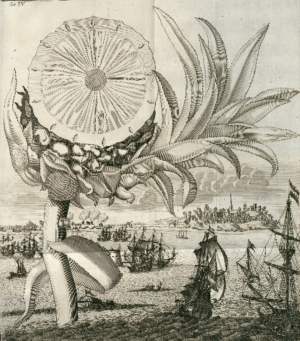
Now, in addition to dozens more citrus fruits, he included other exotic plants, including pineapple, coconut and cotton which he was presumably trying to grow in his own garden. The landscape sketches in this volume are are mostly of Italian country houses and gardens, and there are still the occasional mythical references.

Volkammer also managed to sneak in another short treatise that related to his garden. This was Obeliscus Constantinopolitanvs, a description of a famous obelisk from the time of Thutmosis III who died in 1425 BC, and which stands in the centre of Constantinople. Volkammer had presumably seen and admired this on one of his visits to the Ottoman capital and in 1709 he put up a reduced scale copy of it in the Gostenhof garden. At the time no-one could read the hieroglyphs although he believed it was a monument to peace while his description was apparently not original but based on that of Father Athanasius Kircher. The obelisk is now the only surviving remnant of his estate, the once famous Hesperidengarten Volkamer’s, and stands in the centre of a heritage industrial area.


If you’re wondering why there was such a fascination with citrus over other exotics perhaps it because as art historian Iris Lauterbach, argues “ trees that bloom and fruit at the same time… evoke the idea of a timeless paradise of blissful happiness.” You can certainly see echos of that sentiment in another account of citrus growing written in 1703 [and not called a Hesperides] by Hendryck van Oosten, a gardener from Leiden. Den Nederlandtsen hovenier, or The Dutch gardener claims that “there is not a Plant or Tree, that affords such extensive and lasting pleasure; for there is not a Day in the Year when Orange-Trees, may not, and indeed ought not, to afford matter of Delight: whether it be in the Greenness of their Leaves, or in the Agreeableness of their Form and Figure, or in the pleasant Scent of their Flowers, or in the Beauty and Duration of their Fruit.”


As horticultural technology continued to improve so growing citrus became easier to manage. With oranges and lemons more easily available and less challenging, the attention of adventurous gardeners eager to show off their skills and wreath now turned to pineapples and then to the myriad of other warm climate exotics being bought into Western European gardens and greenhouses.
After these early books about citrus Perhaps as a result of that the number of books specifically about growing citrus declines, with, as far as I can see only a couple of unillustrated treatises published after Volkammer until the late 19thc. Then, as the commercial development of citrus based agriculture develops in the United States, but also Australia and India from the 1870s onwards there is a real boom in publications about them. Catalogues begin to proliferate, along with scientific papers on diseases and growing techniques. Biodiversity Heritage Library has just 3 entries for citrus between 1800 and 1875 then 43 between 1875 and 1900 and a whopping 305 from 1900-1925. But that’s another story!

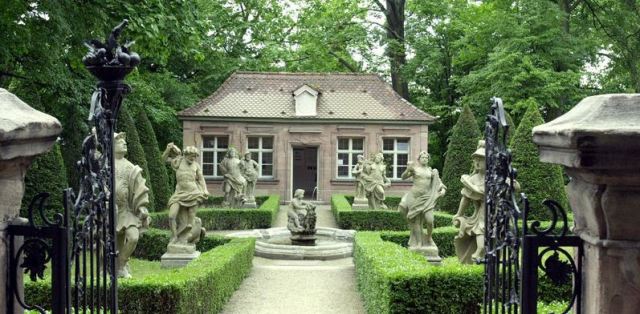
Instead let’s end on a happier note. Although Volkammer’s garden has long gone – apart from the obelisk – a very mall part of of those 360 Nuremberg Hesperides gardens were recreated in the early 1980s behind some of the surviving baroque houses, and opened as a tourist attraction. If you read German check them out on the city’s tourism site or look at the photos on Trip Advisor – but definitely a good reason to add Nuremberg to your list of holiday destinations!


 The Garden History Blog

You must be logged in to post a comment.