

Last week I looked at the origins of Margery Fish’s garden at East Lambrook, which led to all sorts of mind-struggling with her husband Walter. This week I want to turn to questions of planting the garden where, you probably won’t be surprised to hear there was also a clash of wills. It meant that although she undoubtedly learned some lessons from him, and was always prepared to gratefully admit that, she must have needed all her patience to cope with his diktats.
Luckily she was a fast learner and a shrewd judge of when to make a stand. Her growing confidence gradually allowed her innate plantsmanship to develop and shine, so that after his death, when she had a completely free hand she could make an inspirational garden on her own terms and without worrying about what Walter would say!

Let’s start with clothing the bare walls of both house and outbuildings. As you might expect Walter had strong favourites and Margery recalls being sent “to the local nursery for ampelopsis by the dozen, we bought roses, pyracantha, cotoneaster and clematis.”

Even within these broad confines he had strong views. For example, “on the subject of clematis Walter was convinced that the ordinary blue Clematis jackmanii was the only one worth growing. One day I was sent to the nursery for six of them.” However, you get a sense that Margery was developing her own taste and here was a case in point. She saw “a red one I admired very much so I bought Walter his six blue ones and a “Ville de Lyons” for myself.”

Of course as she must have known when she got home “there was much head shaking and I was warned that I was wasting my time and I should never get the results from my child that he would get from his little family.” He was right but only for a while. She planted hers “with great care on the top terrace of the rock garden. Dainty little morsels of limy rubble were incorporated in the soil, a small bush of lavender was planted in front of it to keep the sun from its brittle stem, and I never allowed it to get dry. But in spite of all my cosseting it did not have a very robust childhood and it was some time before it began to enjoy life. Of course Walter’s Jackmaniis went ahead without a hitch….People I met used to ask me if ours was the house with the wonderful blue clematis over the front door.”
As you might expect from a control freak “Walter took infinite trouble in training his clematis. Every day he would indicate to each leaf over which wire it should go and he got obedience. Under his management each trail was separate and each clematis covered vast surfaces of wall, with each bloom getting its full value.” So you can imagine her smile when she “saw Walter standing on the rock garden coaxing my Ville de Lyons to spread her wings. I said nothing but I recognised it as a major triumph.” Even better, “in time they were referred to as ‘our red clematises’ instead of a rather snooty ‘your poor clematis’.”

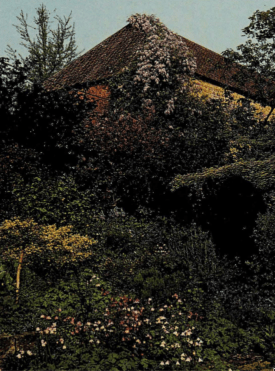
Walter loved ampelopsis and clearly she didnt. [There are several sorts and she doesn’t specify which, although I suspect its the one we know commonly as Virginia Creeper] After he died Marjorie cut these down because “they were trying to push off the roof.”
Nor could Walter ever be persuaded to have a wisteria because he said they would take too long to flower. She soon proved him wrong and had two which flowered two years after she planted them, with one of them having pride of place around the front door.
She also wanted a Bignonia [again she doesn’t mention which] but she admits in this case “Walter was quite right not to indulge me. I’ve put one in myself but it grew so robust … I was always hacking at it to enable me to see out of my bedroom windows but it never flowered so it had to go.”

Walter Fish, 1933.
Photo by Sir Henry and Lady Boyd-Carpenter
There is another amusing anecdote about Walter’s taste. Realising that the climbers would take some time to cover the walls “one day, without telling me, he bought a collection of stuffed heads and mounted horns at the London sale room. Very soon heads, antlers and horns sprouted from every available wall, inside and out… Very soon our house wasn’t known as the one with the lovely blue clematis on the front but has the house with all the heads.” Of course this turned into a bit of a disaster because “not being intended to withstand rain and snow the skin soon came apart and flapped open before falling on the drive, the fillings disintegrated, the painted mouths and red nostrils were washed away and before long all that was left were the horns starkly mounted on a narrow length of wood. When they got to this stage I was allowed to put them on the bonfire.”
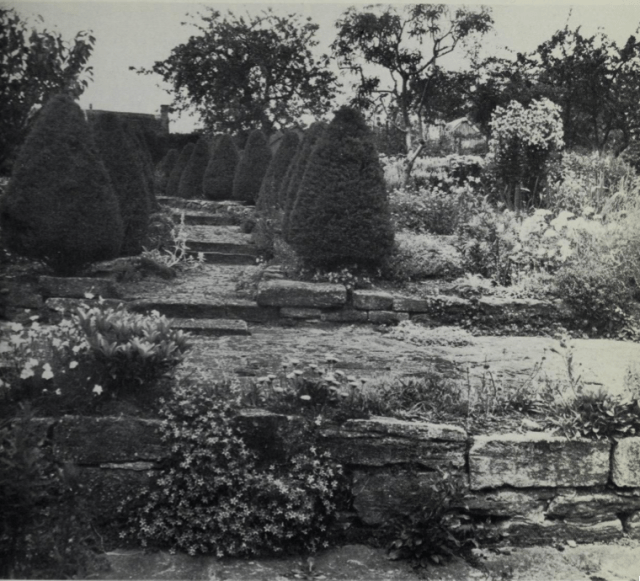
After the walls Margery began work on a terraced garden where she says ominously “my only thought was to get the project under way before Walter took an interest in what I was doing and complicated matters with too much criticism and advice.” She planned it as a series of dry stone walls and started building them herself in the winter as “Walter was a fair weather gardener and I knew he’d busy himself with indoor jobs while the weather was bad and leave me to my own devices.” He didn’t quite do that and at various stages “was quite horrified” and even when the layout was finished “it didn’t meet with approval.”

Rosa Cupid, one of roses Walter planted. Margery said “it is one of the loveliest of climbers … but has the most devastating thorns”
Then came the planting which she had planned to be “low growing plants to give a tapestry effect” . Walter shocked her by announcing “now we’ll put in the pole roses.” They would be “the making of your garden and I’d like them in the end.” Sadly she noted “there was nothing I could do to stop them, no argument had any effect”, and she had to adapt her plans around them. All the more annoying “there was nothing very outstanding among them.” To make matters worse “Walter believed in manuring with a very generous hand and woe betide any little plant of mine that grew nearby, as it would surely die of suffocation under the great gollops of manure that were plastered round every rose.”

However during the war “the roses had forgotten they were meant to climb up poles and had sent out long clutching feelers in every direction.” Luckily for her plans, following an intervention by Malcolm Keen [I think the MK who was a leading film actor of the day] “one happy triumphant day saw the roses and their beastly poles summarily removed from my garden and planted again the high walls surrounding the garden. Shapely little cypresses were installed in stead. The improvement was startling and the effect never ceases to please me.” They are today one of the iconic features of the garden.
It was not only the roses that were fortunate in getting so much attention. Walter’s other passion was dahlias, “the bigger, brighter and the fleshier the better “and Margery “was told to leave plenty of large spaces” for them in the new terrace garden. “Unfortunately they were never labelled, so I had no idea what colours they were. Walter said they were all so lovely that it didn’t matter.” She said quite sadly, if tartly, “I held other views but was not clever enough to evolve a way of labelling them. … The consequence was that I got great blobs of the wrong colour in my carefully planned schemes, which did not endear them to me. They were the most flashy collection of dahlias I have seen, only fit for a circus, as I often told my husband.” However he didnt care and “it didn’t matter what my beds looked like as long as each dahlia was given all the comfort that was humanly possible.” You wont be surprised to know that after Walter died they soon disappeared although she noted there were still “one or two left… in spite of my callous way of leaving them in the ground.”
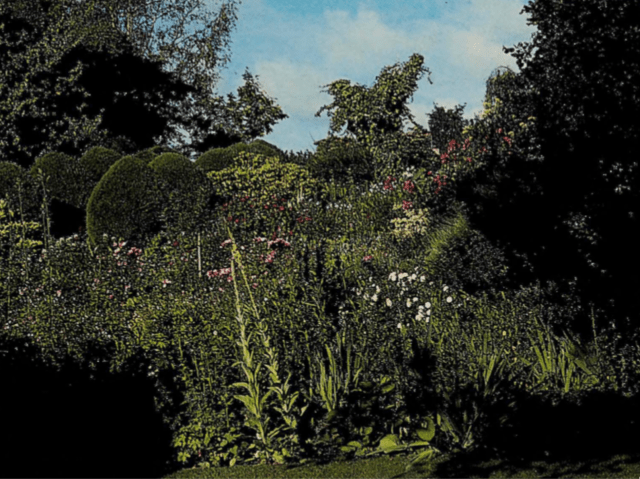
But despite all his annoying superiority Margery admits she “learnt a great deal from Walter that first year of gardening. The first thing I learnt was that he knew a great deal more about the subject than I thought he did. I was a complete novice, and I thought that he was too.” But he had gardeners who “always did all the jobs that needed doing at the right time.” The result was that “as a gardener I was a great trial to my husband and I marvel now that he was so patient with me. He wanted me to concentrate on the straightforward things like delphiniums and lupins instead of … the small, unshowy plants that I liked to try, and liked a good return for his money. The only way I could get round this was to keep up the fiction that I did not buy plants and anything new that appeared in the garden had been given to me. It wasn’t that he minded the cost, but he took the line that as I did not look after properly the plants that I had (i.e. didn’t water the dahlias enough) it was silly to keep getting more plants.” It came down to his belief that, like his previous paid gardeners, Margery had nothing else to do. “It was no good for me to tell Walter that I had to sandwich my gardening between housekeeping, household jobs and a certain amount of social life. In his opinion there was no excuse for not getting things done at the right time.”

There was also a fundamental disagreement about when the garden should be at its best. Margery attempted to have flowers blooming all the year round, and later was to write books on how to achieve that. Walter, on the other hand “felt very strongly that a good summer garden was what one really wanted, because to him the summer was the time when one enjoyed a garden. He seldom put his nose outside in the winter, and he felt that by filling the garden with things that bloomed early and late I was not leaving enough room for that terrific summer display…. and thought I was attempting the impossible” so , “for his sake I had to cram as many of the showy summer flowers into the beds, but I tried to extend the season by planting as much as I could in the walls and between the stones”


Tellimia and Solomon’s Seal in the Ditch garden, from A Flower for Every Day
I realised as I re-read We Made a Garden that mentions of Walter begin to diminish chapter by chapter and by the last few he doesn’t feature at all, with the exception of a parting shot in the last paragraph when she calls him “My philistine of a husband.” As far as I can see he’s not mentioned at all in any of her other seven books.
Walter died in 1947 and from then on Margery could follow her on instincts without worrying or constantly looking over her shoulder.

Hellebous orientalis in the front garden from A Flower for Every Day
As her entry by Catherine Horwood in the Oxford Dictionary of National Biography says, East Lambrook “became the cottage garden Margery Fish had dreamed of, full of unfashionable ‘green’ flowers, and shady corners packed with hellebores, snowdrops, primroses, and epimediums. Throughout the year there was always some small delight to be found nestling near the stream or falling over the stone paths and walls.”
It was definitely her garden and not Walter’s.
After Margery died in 1969 the manor was inherited by her nephew Henry Boyd Carpenter who with his parents lovingly cared for the gardens, for as long as they were able. It was sold in 1985 to Andrew and Dodo Norton who launched a major project to catalogue and re-find many of plants Margery had originally planted, and who did much restoration work which the Williams family, who bought the property in 1999, continued. In 2008 East Lambrook Manor was sold to Gail & Mike Werkmeister who have kept the garden open to the public and continued the restoration work whilst enhancing and improving the garden wherever possible. Although now more mature, the garden is still essentially as Margery left it, and to recognise its significance it was given Grade 1 status by English Heritage in 1992.
Although I thought I’d be able to say everything I wanted about Margery Fish in two posts I haven’t, so there will be one more post about her legacy soon.


 The Garden History Blog
You must be logged in to post a comment.