
 I helped lead a Gardens Trust tour last autumn round gardens of the Loire Valley. Almost our last port of call was the great early Renaissance chateau of Amboise where a series of new gardens have been installed in recent years. It’s not often these days that money can be found for new garden projects like this especially in such a sensitive historic site. The chateau is former royal residence and overlooks a UNESCO World Heritage site, but its grounds were rather neglected until the great storm of 1999 wreaked such havoc that was no choice but a total rethink. It took a while to decide what to do but it was worth the wait and the new gardens have already been listed as being of national significance.
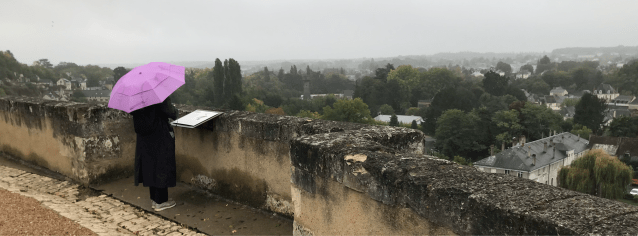
Despite the fact it rained much of the time we were there, like me, the Gardens Trust members on the tour all seem to have been impressed… read on to see if you agree with them…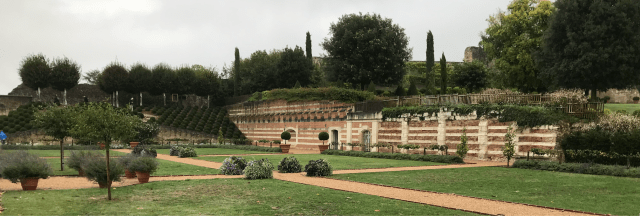
As usual the photos are mine unless otherwise acknowldged.


As you can see from the photos the chateau sits on a rocky outcrop more than 30m [100ft] high above the town and the Loire. The site has been occupied since at least the Iron Age when a large fort was built there.
By the 9thc there was a castle and there’s a surviving 12thc account, the Book of the Construction of the Castle of Amboise and the Deeds of Its Lords, which explains how it was later strengthened and enlarged.
But the story of the current building really begins in 1434 when its owner foolishly plotted against the French crown and only saved his life by handing over Amboise to the king.

At this time the French monarchy based themselves and their court in the Loire Valley – hence the string of grand chateaux along the length of the river – as much as Paris, and Amboise soon became one of their favourite homes. A recent book on the history of the chateaux suggests that its very unlikely there wasn’t a garden at this earlier date but there is no evidence of it, so perhaps, as at the Louvre and elsewhere it was outside the walls or in, or the other side of, the dry moat.


Charles VIII in one of the new painted and stained glass windows at Chateau Gaillard
In 1492 the young king Charles VIII started to rebuild in the latest fashionable style – now known as late Gothic Flamboyant – using not just French but also some Italian craftsmen who introduced some of the first signs of Renaissance ornamentation in France.
Charles later invaded Italy and coming home victorious in 1495 brought back more Italian artisans to continue work on the château. Amazingly given its later history about 75% of this original building still survives.
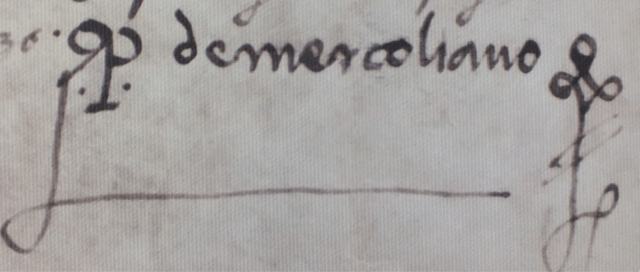
Amongst them was Dom Pacello da Mercogliano a 50 year old Benedictine monk who was both a skilled engineer and gardener. He laid out the first Renaissance style gardens in France at the royal chateaux at Blois and Amboise as well as at the nearby Chateau Gaillard where he created the first orangery in France.

The orangery built into the cliff underneath Chateau Gaillard – although obviously then it didnt have the bars or the glazing!
It’s Dom Pacello da Mercogliano‘s late 15thc garden that was the inspiration for one of the new gardens at Amboise. It could only be inspiration rather than recreation because unfortunately there is no visual evidence from his time although there are some documentary records, some surviving walls and other archaeology.
The new garden occupies the same space and is nearly 100m long and 35m wide, about the same size as the then royal gardens at the Louvre in Paris, although nowhere near as big as those of Blois, the principal royal palace. The eastern end of the chateau grounds rises quite steeply and to create the original garden the slope had to be cut away – with an estimated 7,000 m3 of earth being removed – to lower the ground level lowered by nearly 5m [15ft]. A brick and stone wall, originally topped with decorative mock battlements, which is still largely intact, was built along the southern side to retain the higher ground and had buildings on top to give amazing views out over the Loire Valley.


Dom Pacello, imagined in a stained lass window at Chateau Gaillard
Dom Pacello’s garden consisted of a large parterre, divided into sections edged with flower beds which symbolised the 4 rivers of paradise – milk, honey, water and wine around a large fountain called Jouvance [meaning rejuvenation or eternal youth]. Unfortunately although there is evidence for the purchase of the stone for the fountain there are also reports of that there was never enough water to make it work.
The whole ensemble which was surrounded by treillage [or trelliswork which I’ve written about before] and a number of small pavilions with windows overlooking the river. This was unusual and only possible because of its elevated position since most mediaeval gardens were enclosed and inward-looking. It certainly attracted a comment by a visitor in 1501 who said:”At the highest point is the most beautiful garden that I have ever seen and more than that one can see well ten leagues away , and beautiful big rivers. It is a paradise in this world, with good air and beautiful works.”
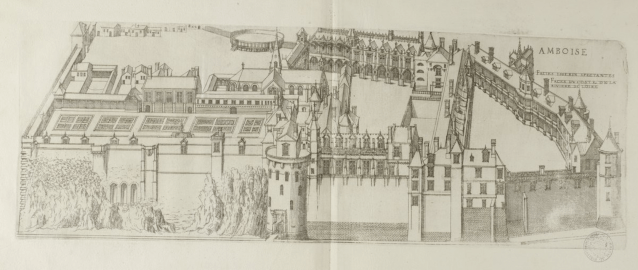
Work on the garden started in 1492, alongside the work on the rebuilding of the chateau and was still ongoing in 1498 when Charles managed to bash his head on a stone lintel in the chateau, and died a few days later aged only 28. His cousin and successor Louis XII not only married Charles’s widow [Anne of Brittany] but continued to employ Dom Pacello and added a newly fashionable gallery round the parterre rather like the one that Henry VII was to build at his new palace at Richmond at about the same time.
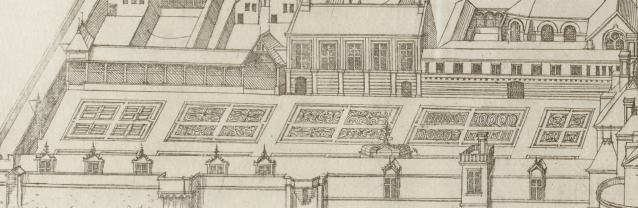
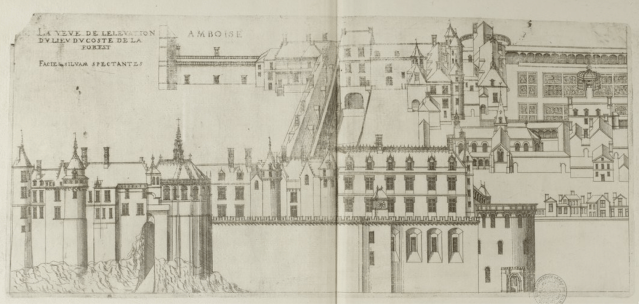
The gardens are recorded by Jacques Androuet du Cerceau, who included two engravings and a plan of Amboise in Les plus excellens bastimens de France first published in 1576. You can just see the top of a central arbour in the garden which was probably built round the Jouvances fountain. Unfortunately detailed though du Cerceau’s engravings undoubtedly are, recent research suggests that there are a few doubts about his total accuracy, and that he may have “adapted” things slightly to make a more “perfect” picture. [For more info on that, if you read French, see Amboise:Un château dans la ville: by Lucie Gaugain, 2014. esp chapter 5]
Louis’s cousin and successor Francois I also continued to employ Dom Pacello, referring to him as “cher et bien-aimé Pacello” [dear and well-beloved ] and even leased him Chateau Gaillard the secondary royal chateau at Amboise for 60 sols and an annual bouquet of orange flowers. Pacello died in 1534 aged just over 80.
Francois invited more Italian artists and artisans to work in France, including Michelangelo – who did not take up the offer – and Leonardo da Vinci who did. Leonardo lived nearby at the Clos Lucé, which was connected to the château by an underground passage. [ Clos Lucé is now a museum dedicated to Leonardo and science.] There isn’t much evidence of any involvement by Leonardo in the garden but he does note that the fountain still did not work despite Francois employing an Italian hydraulic engineer to try and fix the problem.
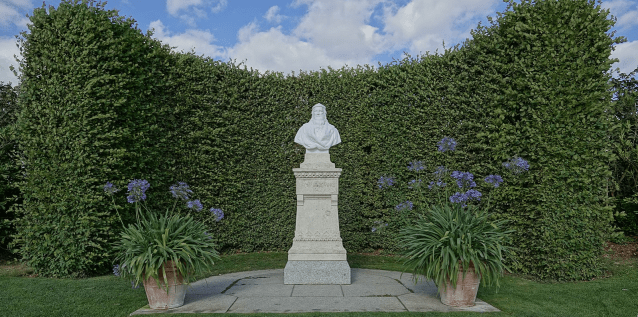
[As a quick aside – someone who would have met Leonardo is Anne Boleyn who lived at Amboise for several years as a lady in waiting to the French queen.] Leonardo was buried in a chapel on the site, that was demolished in the early 19thc. What was thought to be his grave was discovered during later archaeology and his remains were reburied in the Chapelle of St Hubert which stands on a corner of the wall, overlooking the town below. It is currently undergoing major restoration.

Amboise remained a favourite haunt of the monarch until 1560, when during the French Wars of Religion, 1,200 Protestants were executed or hung from iron hooks from the chateau and town walls. The smell of the rotting corpses caused the court to leave and Amboise fell out of favour.

After that Amboise has had a very chequered history, yo-yoing between royal, state and occasionally private ownership, Within a few decades of the massacre it was completely abandoned by the crown and handed over to become a prison, with the garden, of course, completely neglected. It was here that Nicholas Fouquet the disgraced finance minister of Louis XIV and the creator of Vaux le Vicomte was locked up.

Napoleon later gave Amboise to one of his fellow consuls Roger Ducos who couldn’t afford to repair it and instead spent several years knocking most of it down.

This means that what can be seen today is just a fraction of the once full extent of building. However it does mean that this meant there was plenty of room for new gardens later.
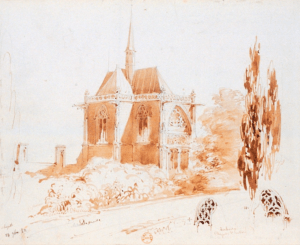
With the downfall of Napoleon and the restoration of the monarchy the chateau was reclaimed by the mother of future King Louis Philippe. He, in turn, began a round of restoration and had the chateau listed as a monument historique but he also had the grounds redesigned. Unfortunately there are no detailed images of what was done but from descriptions and a couple of sketches it was very much of its time, a small-scale jardin anglais with trees and shrubs in a parkland setting. However, as you can see, by the 1920s it had been allowed to become so dense that it almost appears to have been overgrown.
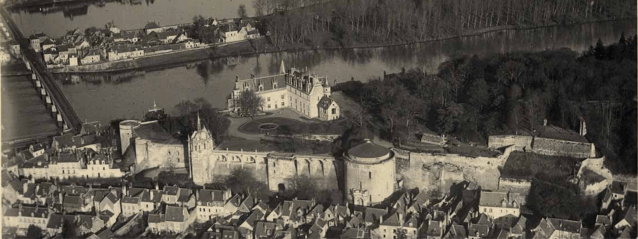
aerial view, 1925
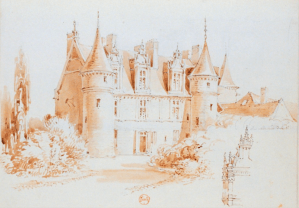
Louis Philippe also opened the chateau to the public and quickly became a popular tourist attraction. An English magazine, Bentley’s Miscellany [writing in 1852 after Louis Philippe’s exile] commented that “Amboise… was a smiling, lively little town, and the castle was a pleasure residence of the last king; the gardens were delicious, the little chapter of St. Hubert a gem, restored in all its lustre, and the glory of artists and amateurs.”
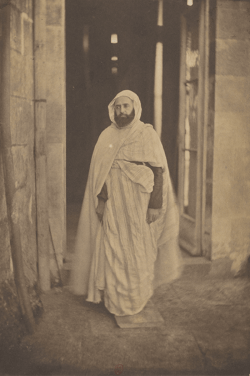
With the forced abdication of Louis Philippe in 1848 the chateau was once again taken back by the state and used to house Abd El-Kader, a north African ruler who had forcibly resisted the French colonisation of his country and, as a result, is now seen as one of the founding fathers of modern Algeria.
Bentley’s Miscellany noted what this meant: “All is now changed: a gloom has fallen on the scene, the flowers are faded, the gates are closed, the pretty pavilions are shut-up; there are guards instead of gardeners, and a dreary prison frowns over the reflecting waters, which glide mournfully past the towers.”

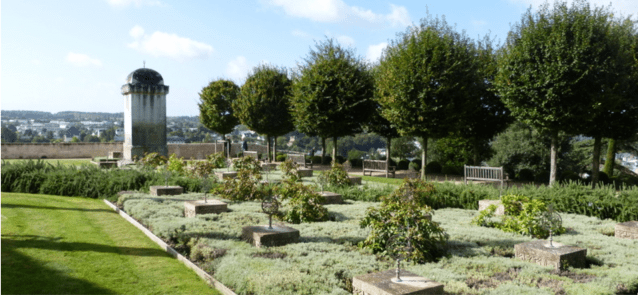
El-Kader’s imprisonment at Amboise has been commemorated with a new garden.
The Jardin d’Orient was designed in 2005 by the Algerian artist-sculptor Rachid Koraichi and pays tribute to those in the Emir’s entourage who died during his captivity at Amboise.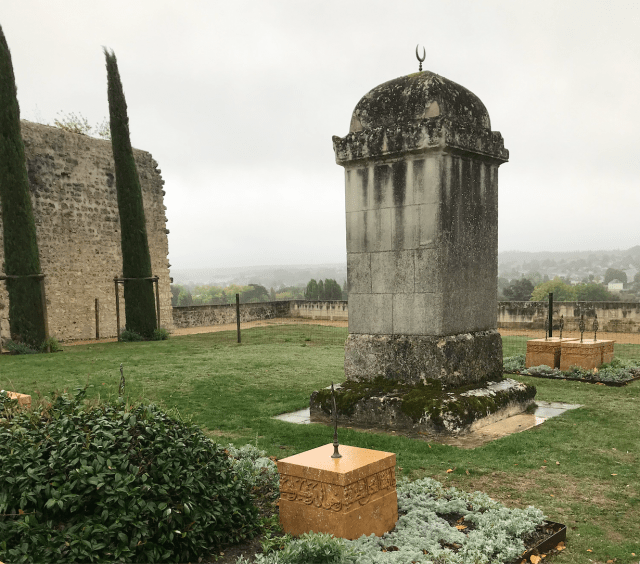
It is highly symbolic with an ancient cenotaph topped by a crescent, as well as 25 contemporary engraved steles. A line of rosemary plants is aligned to the direction of Mecca, while seven cypress trees represent the seven pillars of wisdom. Much of the other planting is fragrant, notably the clipped balls of star jasmine [Trachelospermum jasminidoides]
Later Amboise was given back to the heirs of Louis Philippe, who set the great French architect Eugène Viollet-le-Duc. to work on yet another restoration project. It remains in the hands of their descendants to this day, and is administered through the Fondation Saint-Louis.
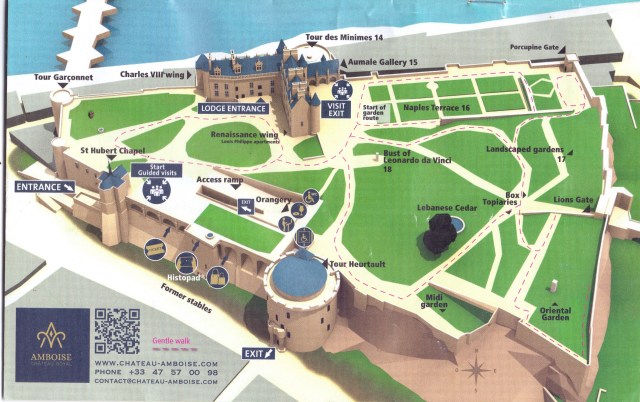
The site plan gives no indication of the greta difference in height between the western [left] and eastern [right] ends of the grounds
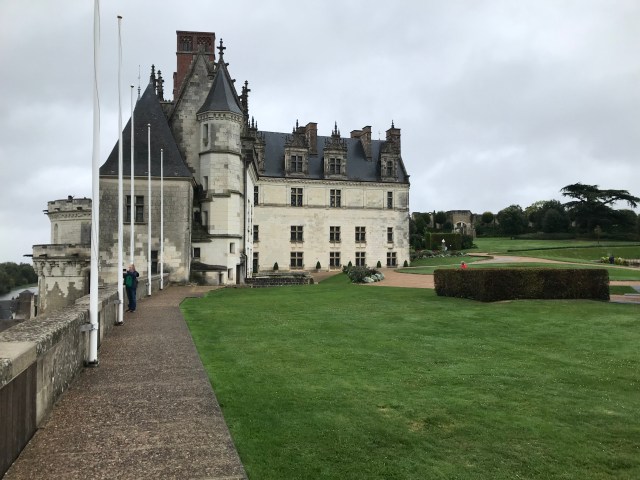
The lawn in front of the royal lodgings, with Louis Philippe’s cedar in the far distance

The entrance ramp, with the chapel under scaffolding at the top
Now when visitors enter the chateau by the long cobbled and ramped tunnel, they arrive at an open sloped continuation that one way leads to the orangery – now, surprise surprise, converted into a cafe – and the other to the open lawned terrace which sets off the royal lodgings. From there the gardens stretch out to the east with on the far side one of the rare surviving trees a large cedar of Lebanon planted by Louis Philippe about 200 years ago.

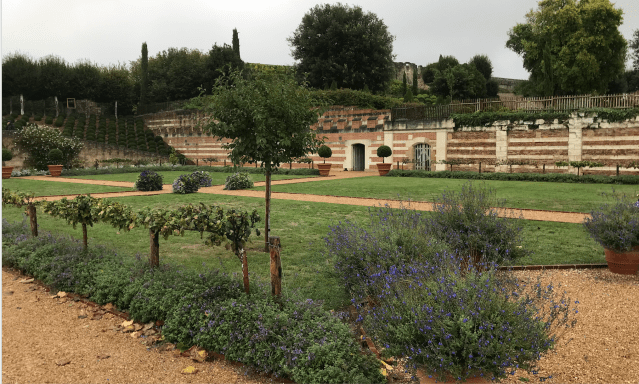
The rest of the gardens run eastwards with the ground rising quite steeply This change of level has been exploited by the designers of the new gardens, as it was by mediaeval architects and military engineers. To the left continuing the line of the buildings is a modern reinterpretation of Pacello’s original parterre on the same site which was completed in 2017. Now known as the Naples Garden it is a simple series of grass rectangles with flower borders, some step-over apple trees and large terracotta pots evocative of the original garden’s Italian origins. A short block of limes separate it from the chateau.

On the southern side is the original late 15thc brick wall which has been adapted to become a belvedere with views out over the ramparts. It incorporates a small room decorated with porcupines, the badge of Louis XII.

But the most striking feature is the new amphitheatre of greenery up the slope to the eastern ramparts, where several hundred box have been clipped beautifully into spheres, almost like a flock of perfectly aligned green sheep. 
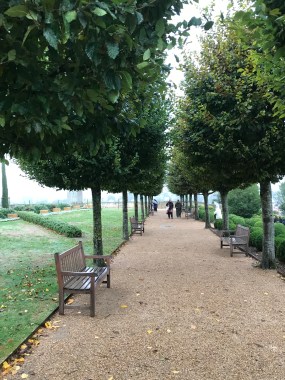
At the top is a walk of lime trees which crosses most of the high ground and gives views back to the chateau and the lower lying areas of the garden. 
The box topiary continues right along the slope through what is called the Landscape Garden on the plan. This has been planted with a range of trees, shrubs and herbaceous plants to give structure and colour throughout a long season. The Jardin d’Orient and a smaller Jardin du Midi [the South, or Mediterranean] lie beyond that. 


The Lion Gate in the eastern wall
The Director of the Fondation St Louis explains in a short video on YouTube that with 350,000 visitors a year the new gardens had to work doubly hard. They needed to reflect the history of the site, provide something of interest every day of the year and encourage people to return, and also be a garden that met modern standards of sustainability and resilience.
The site is run entirely organically with no weed killers or chemical fertilisers. Even boxwood caterpillar, (Cydalima perspectalis) a major problem in every garden with large amount tags of box, seems to be successfully tackled though the use of pheromone traps. The value of the new gardens to wildlife has already been recognised and Amboise has been given the status of an official bird sanctuary.

Nor has the development stopped because there are still large areas outside the present garden area, but still inside the outer ramparts on the eastern side. Last spring a new national collection of mulberries was started at Amboise in honour of the first silk factory in France which was established in the town as early as 1470 by order of Louis XII. The industry flourished through the Touraine region and even now there is still one remaining local silk manufacturer while the mulberry has been adopted as the town’s official tree. When its fully planted it will definitely be worth a return visit and I’m sure Louis XII and Dom Pacello would approve.
For more information a good place to start is the chateau’s website, and there’s also a website that shows the development of the chateau, but if you read French then Amboise:Un château dans la ville: by Lucie Gaugain, 2014. esp chapter 5] gives a very good detailed history of the site.


 The Garden History Blog


You must be logged in to post a comment.