
Whose 2000th birthday should we be celebrating this year?
Here’s a clue. He was a workaholic military officer and civil servant for the Emperor Vespasian, and the author of the first book that resembled an encyclopaedia. Usually known as Natural History it was described by its editor as “a learned and comprehensive work as full of variety as nature itself”. It’s the largest and amongst the most influential texts to have survived from classical times and is made up of 37 separate books covering every aspect of life from astronomy to zoology via art, botany, drugs, metallurgy and of course horticulture.
He is, of course….


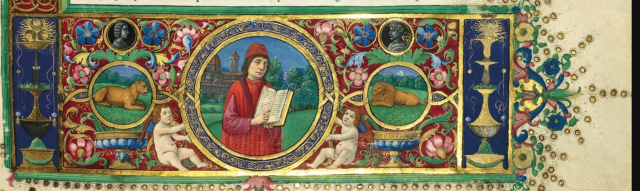
A rather grim looking Pliny studying books on natural history, from Thevet’s “Vrais portraits et vies des hommes illustres” (Paris, 1584)
Gaius Plinius Secundus who is better known as Pliny and if you’re even vaguely interested in the history of gardens, botany or science more generally, you’ll have heard his name because his Natural History is always being quoted because its our best source of information for many subjects in the classical world.
Almost everything we know about him comes from the letters of his nephew and heir, also named Pliny and himself a writer and gardener. [To distinguish them they are usually referred to as Pliny the Elder and Pliny the Younger] The elder Pliny was born in Como in northern Italy and after training as a lawyer he served as an officer with the Roman army in Germany under the future Emperor Vespasian. Later he served as a senior official in Africa, Spain and in northern Gaul before returning to Rome to work directly for Vespasian. Whilst doing all this he also managed to write a number of other books on subjects as diverse as Throwing the javelin on horseback or Problems in Grammar. Unfortunately apart from Historia Naturalis which was his last work all the others have been lost.


Its worth pointing out that the book’s Latin title Historia naturalis isn’t just about animals and plants but probably means something more complex than you might have thought. The word “historia” not only means history in our current meaning, but can also imply a narrative or more significantly an inquiry, so perhaps a better translation of the book’s title would be “An Inquiry into Nature”. Nature too had a wider meaning to Pliny who saw it as divine and all inclusive, which explains what he said in the book’s dedication to the Emperor Titus in 77AD: “My subject is the world of nature … or in other words, life.”

Historia Naturalis is not the sort of book you’d read from cover to cover. Instead it was more like a modern encyclopaedia a book to dip into or to search for specific information. It’s not arranged alphabetically with stand-alone entries but as a series of related chapters which often jump to include references, facts or stories that are sometimes only vaguely related to the supposed topic. The result is that you never quite know what you’re going to encounter.
To help his readers Pliny included a detailed contents section and for those who wanted to check facts or research further he lists his sources saying it was important “to own up to those who were the means of one’s own achievements”. This sense of obligation to his predecessors is, I think, a first for classical authors.
Pliny was obsessed with collecting and passing on knowledge and never missed an opportunity to study. His nephew the Younger Pliny said his uncle always had a book with him, or a slave to read to him wherever he was, even in the baths or on a journey. This was true even in winter, when the reader was allowed to have long sleeves and wear gloves so that he could still work.

In the preface to Historia Naturalis Pliny claims to have imparted 20,000 facts gathered from some 2,000 books and from 100 authors. In fact modern scholarship has shown that the true figure is more than 35,000 separate pieces of information, from over 400 cited authorities, some of whom are only known about because they are mentioned by Pliny. He freely admits that his work was by and large derivative rather than original, which often means he included unverified or even mythical information without much comment. However he excuses this by saying “When I have observed nature she has always induced me to deem no statement about her incredible.”

The monopod and a creature with its single eye in its chest, mentioned by Pliny from an illuminated manuscript version of Natural History, painted in Italy c1460-70
Unfortunately in our eyes this makes him seem gullible at times. For example, he includes accounts of strange peoples and monsters – known collectively as Blemmaye -who live outside the known Roman world. Amongst them were the Cynocephali which were creatures with dogs heads on human bodies. Widely accepted as being real they appeared in accounts from many parts of the world, including ancient Egypt [the god Anubis] , India, Greece, and China.

He includes too a description from of Sciapodae, who are one-footed creatures — but “able to leap with surprising agility who were in the habit of lying on their backs, during the time of the extreme heat, [to] protect themselves from the sun by the shade of their feet.”
Equally unlikely were the Astomi, a race of people who lived in Bengal near the mouth of the Ganges. They had rough hairy bodies but no mouths because they had no need to eat or drink anything. They survived by smell alone, with their favourites being flowers and apples, although of course strong unpleasant odours were likely to kill them.

A collection of Blemmaye from the Psalter World Map (British Library Add MS 28681, f. 9v) late 13thc
Although Pliny never claims to have seen any of these creatures himself the fact that he includes them meant that, as his reputation grew during the mediaeval period, these stories attained more credible status and, rather like the Lamb of Tartary which I wrote about recently, survived as “fact” until the rise of true science from the early 17thc onwards slowly put paid to them.

However, as he said “to be alive is to be watchful” so he also includes his own observations when these are relevant and there are accurate and detailed accounts of all sorts of things from the cultivation of vines, paper-making, the behaviour of bees, methods of preserving fruit, or the different types of bark on trees.
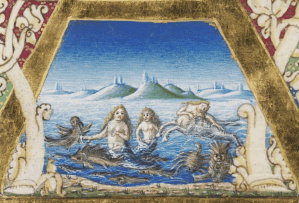
Of the 37 books that make up Historia Naturalis the first is effectively a list of the contents of the other 36. The first 12 deal with cosmology and astronomy, before moving on to physical and historical geography, and then tackling humans, mammals and reptiles, fishes, birds, and insects. At Book 12 you’ll be glad to hear we finally reach plants. They take up a considerable amount of the total text with 7 books in all. I’m not going to go through them all in detail — not enough space, time or patience — but instead just summarise a couple so you get a sense of his approach and perhaps even his sense of humour.
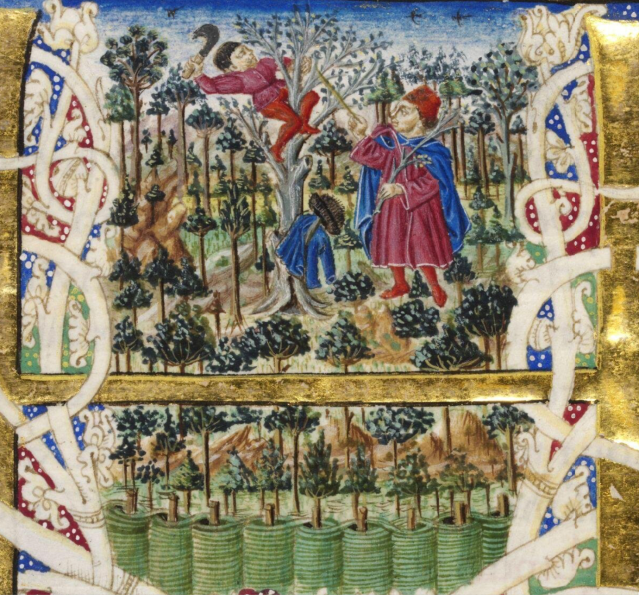

He begins with a book on trees which “have a thousand uses all of which are indispensable to the full enjoyment of life.” In particular he sings the praise of the plane tree and reports on their spread around the Mediterranean saying it was “one of the very first exotic trees that were introduced into Italy… and such high honour, in the course of time, did the plane tree attain, that it was nurtured by pouring wine upon it, it being found that the roots were greatly strengthened by doing so. Thus have we taught the very trees, even, to be wine-bibbers!”
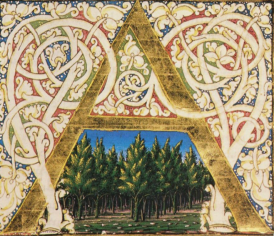
He notes too that some planes remain stunted or could be deliberately dwarfed “This result is obtained in trees, by a peculiar method adopted in planting and lopping them. C. Matius, a member of the Equestrian order, and a friend of the late Emperor Augustus, invented the art of clipping arbours, within the last eighty years.”
Other exotics included “the cherry and the peach, and all those trees which have either Greek or foreign names,” and he includes a lengthy description of the many different trees encountered by Alexander the Great on his expedition to India, which was derived from Herodotus. We also get a mention of a tree which “in leaf resembles the mulberry-tree, while the calix of the fruit is similar to the dog-rose…… which, when arrived at maturity, bursts asunder and discloses a ball of down, from which a costly kind of linen cloth is made. This tree is known by the name of gossypinus”. It is of course cotton.
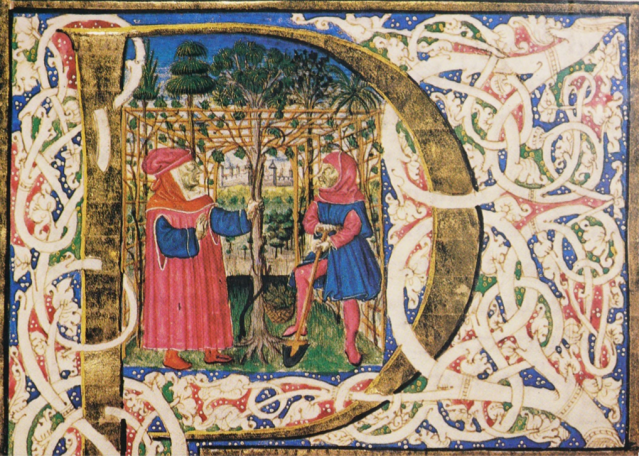
For some reason the books about trees also includes sections on several spices. Pepper had reached Rome by Pliny’s day although he doesn’t seem very impressed because “pepper has nothing in it that can plead as a recommendation to either fruit or berry, its only desirable quality being a certain pungency; and yet it is for this that we import it all the way from India! Who was the first to make trial of it as an article of food?”
Ginger, cardamom, sugar and cinnamon, had also reached Rome, and here we see him challenge the accepted story that “cinnamomum and cassia are found in the nests of certain birds, and principally that of the phoenix,… and these substances either fall from the inaccessible rocks and trees in which the nests are built… or else are brought down by the aid of arrows loaded with lead.” He’s clear that “all these tales, have been evidently invented for the purpose of enhancing the prices of these commodities.” Instead he claims that cinnamon “grows in the country of the Ethiopians, who are united by intermarriages with the Troglodytæ.” No one knows quite who the Troglodytæ were but its possible they were the cave dwelling inhabitants of Petra who were great traders and who had developed links with Sri Lanka and the Indian sub-continent where cinnamon is indigenous.
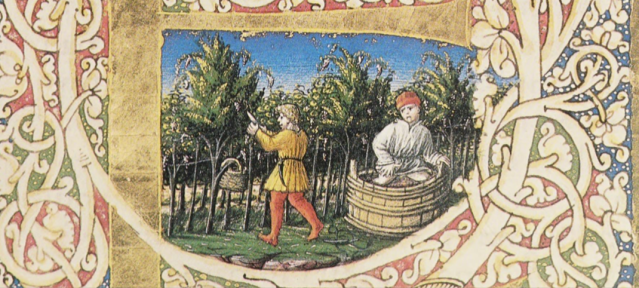

The book on trees ends with him proudly telling the reader he’d given them 974 remarkable facts, narratives, and observations, derived from 19 Roman and 42 foreign authors. He loves giving such information as can be seen in the following books such as the lengthy one on vines — all 91 varieties of them — and wines – 50 kinds from Italy, 38 foreign kinds, 7 salted wines, 18 sweet ones and 3 second-rate. After that comes a book about the olive and other useful fruit trees — including 29 varieties of fig, and 41 of pears, 3 medlars, 4 sorbs, and 9 nuts, 18 chestnuts, and 11 myrtles amongst many others!

In later books Pliny gives practical accounts of manuring, planting, transplanting and grafting but also speculative matters too. Grafting, for example, was thought to be able to create new sorts of fruits but he notes “there is nothing further in this department that can possibly be devised, and it is a long time since any new variety of fruit has been discovered.”

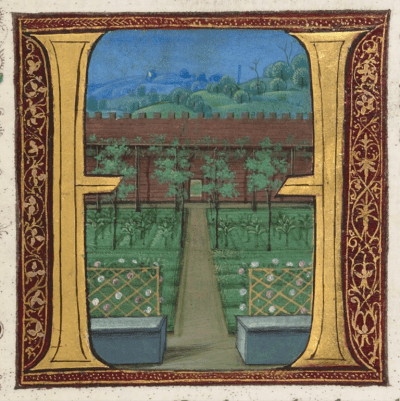
Detail from the image accompanying the book on crops. Plants recognisable inc palm, umbrella pine, strawberry, carnation and orchid
Finally we reach the books on “the nature of the various kinds of grain and of gardens and flowers and the other products of Earth’s bounty beside trees or shrubs, the study of herbaceous plants being itself of boundless scope.” This begins with agriculture taken mainly from Cato’s De Agri Cultura, but goes on to describe all known cultivated crops and vegetables, as well as herbs and their medicinal products.
Although there is nothing on garden design or ornament Pliny clearly liked gardening, but especially for the kitchen. “At Rome at all events a garden was in itself a poor man’s farm; the lower classes got their market-supplies from a garden…how little does garden produce cost, how adequate it is for pleasure and for plenty.”
“The fact that one set of herbs is devoted to seasoning shows that it used to be customary to do one’s borrowing at home, and that there was no demand for Indian pepper and the luxuries that we import from overseas. Indeed the lower classes in the city used to give their eyes a daily view of country scenes by means of imitation gardens in their windows.”
But he’s clear that there must have been selective breeding of vegetables going on. “Nature had made asparagus to grow wild, for anybody to gather at random; but lo and behold! now we see a cultivated variety, and Ravenna produces heads weighing three to a pound”. Elsewhere there was “kale being fattened up to such a size that there is not room for it on a poor man’s table,” before concluding “Alas for the monstrosities of gluttony!”
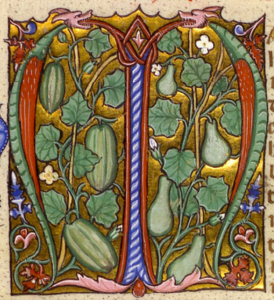
There are comments on many kinds of vegetables and herbs and longer sections on several such as asparagus, radishes, the onion family, cucumbers and gourds because, for example, “growing cabbages is also one of the ways of supplying table luxuries, so it will not be out of place to pursue the subject at greater length.”
Practical information is also given and it seems as if he’s writing from experience. Germination time for seed, for example is spelled out: ” the quickest to grow are basil, … rape and rocket; these break out of the ground two days after they are sown.” Others are then listed in order of germination until he reaches “the most difficult of all… parsley, for it comes up in 39 days at the quickest, and in the majority of cases in 49 days”. Viability too is discussed “as fresh seed comes up more quickly in the case of leek, long onion, cucumber and gourd, but parsley, beet, cress, cunila, wild marjoram and coriander grow more quickly from old seed. There is a curious thing about beet seed that the whole of it does not germinate in the same year but some only in the year following, and some even two years later.”

There are also assertions that, for example, the seeds of gourds “that were nearest the neck of the plant produce long gourds, and so do those next to the bottom … the seeds in the middle grow into round gourds, and those at the sides into thick and shorter ones.”
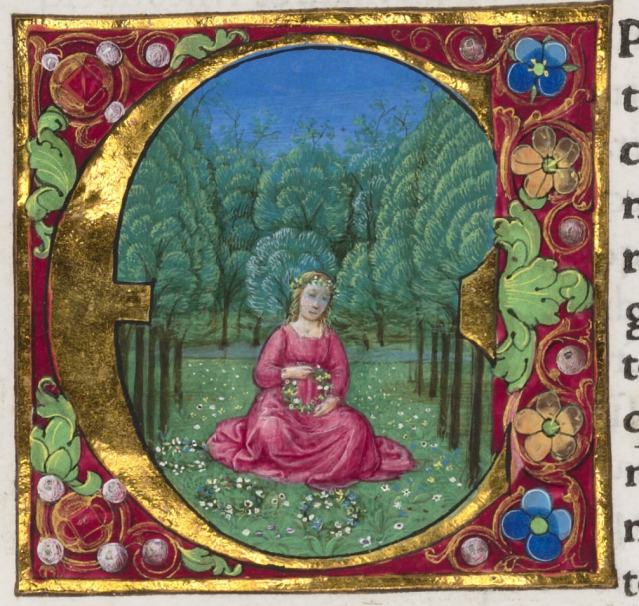

Flowers grown for ornament don’t get anywhere near as much attention, other than those used for chaplets. Nevertheless you can get a sense of some of what is growing in Roman gardens including iris, helenium, anemone, lychnis, eryngium, anchusa, acanthus and asphodel. Roses get a lengthier mention as do amaranths, valerian and lilies in which group Pliny includes narcissus – leading the way for 16th and 17thc botanists to do the same. This leads on to a discussion of bees and their importance before returning to plants we might consider as weeds, including thistles and nettles.


Later books discuss the medicinal uses of many plants, and finally Pliny moves on to discuss the arts, largely through a discussion of the materials used.
Pliny died in the aftermath of the volcanic eruption from Vesuvius that destroyed Pompeii in 79AD.. He was commander of the Roman fleet at Naples and the traditional story is that he went down to investigate, landed on the beach to help rescue inhabitants, was overcome by fumes and died. More recently scholars have doubted this and suggest that since he was known to be rather corpulent he may have suffered a heart attack. We’ll probably never know.

It was his nephew [and adopted son] Pliny the Younger who inherited his estate and edited the remaining books – which were “As full of variety as nature itself” – before releasing them for copying. We know the text became quite widespread – there are about 200 surviving copies – and it became the leading work on natural history right up to the end of the Middle Ages.
Historia Naturalis was among the first books to be printed in 1469, and it was eventually translated into English by Philemon Holland in 1601.
So why is Pliny important? Not much of his work is original or that creative unlike other great classical writers such as Aristotle or Theophrastus. He’s more interested in cataloguing natural wonders, rather than, like them, worrying about what caused them. However he sets new standards for the collection and compilation of material, drawing on a wide range of sources and even if he is inconsistent in his arrangement or analysis. Historia Naturalis is the only ancient Rome source on the history of art and also includes descriptions of contemporary technology, such as the construction of the aqueducts. His style is chatty and readable in an antiquarian way making the text a unique cultural record of its time.

The preface concludes “Hail, Nature, Mother of all Creation! Mindful that I alone of the men of Rome have praised thee in all thy manifestation, be gracious unto me.” And by the attention and praise his work is still getting almost two millennia later I think Nature and History have indeed done just that.
Happy 2000th Birthday Pliny!
For more information on Pliny a good place to start is the Radio 4 In Our Time programme first broadcast in 2010
The English text of Historia Naturalis is available in several versions including: https://topostext.org/work/148 which covers the first 12 books and https://topostext.org/work/153 which covering the remainder, including all the plant and gardening related ones.


 The Garden History Blog
Every new entry is a great joy to receive – especially because of the rich illustrations.
Thank you!