

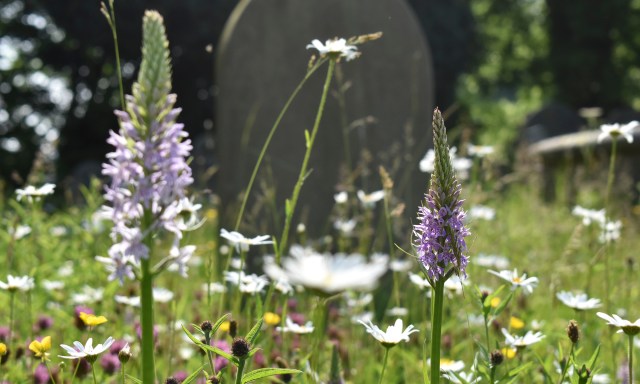
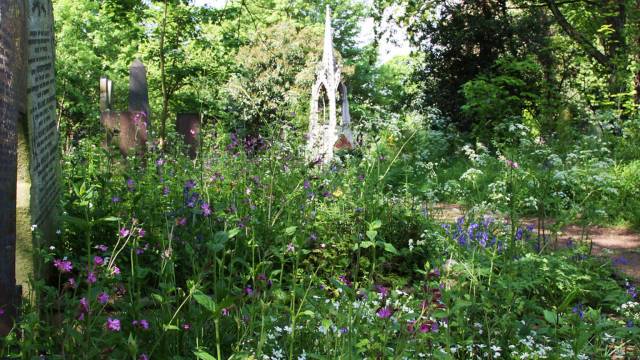
Lockdown walks in London cemeteries and some visits more recently to country churchyards set me thinking about how differently such sites are maintained these days. No more sterile hard-mown grass everywhere with just a few plastic flowers to brighten the scene but what seemed to be a more lightly managed approach. Wild flowers growing in longer grass with some cut paths through to get to graves but at the same time not by any means unkempt or overgrown.
It reminded me of an inspirational scheme called The Beautiful Burial Ground Project which aimed to reveal the hidden heritage of burial grounds across England and Wales, show their importance to biodiversity and encourage and support people to learn about, research and survey them.
 The title of the project’s website, Caringforgodsacre.com comes from the late 15th/early 16thc term God’s Acre to describe churchyards as literally God’s field, and that in turn reminded me of William Robinson’s book God’s Acre Beautiful published in 1880 in support of his campaign for beautiful gardens to hold ashes from cremation rather than burial of the dead.

There is, of course, considerable overlap between the work of Caring for Gods Acre and the Gardens Trust, and indeed that of Historic England which recognises the importance of churchyards as one type of Landscapes of Remembrance, and has set out criteria for their inclusion on the Register of Parks and Gardens .
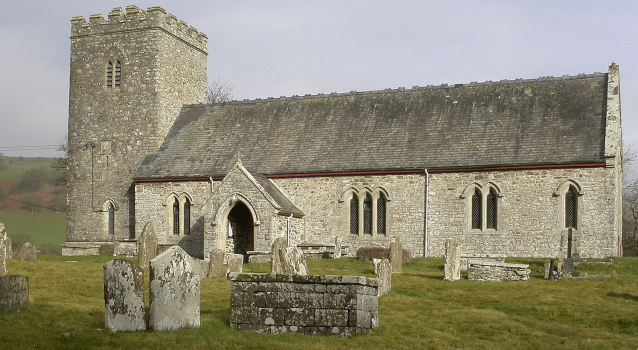
Their guidance includes an excellent summary of the history and significance of churchyards and other burial grounds. They “constitute some of our most sensitive historical open spaces, and a high proportion have Anglo-Saxon origins. Many, both rural and urban, occupy clearly planned compartments in settlements, and in the Middle Ages were open spaces used for a variety of functions, generally without permanent grave markers until the seventeenth century or later. Churchyards are places with natural, as well as man-made, importance.” Although it is yew trees which are most famous for their connection with them churchyards also offer much needed refuge to much of our native flora and fauna of all kinds.
It was the latter which seems to have inspired the Beautiful Burial Ground project. It started small some 25 years ago in Shropshire but by 2000 Caring for God’s Acre had been established as a national charity, supporting the volunteers who look after and maintain the 20,000 or so burial grounds in England and Wales. These are not just tiny rural medieval churchyards but the whole spectrum of burial sites right through to large Victorian city cemeteries, and of course those from different cultures and religions. More recently it has been spreading its wings with a new Shropshire-based project Opening the Ark which aims to see the fantastic biodiversity found within churchyards and cemeteries spreading back out into our towns, villages, verges, gardens and school grounds.

Churchyards are equally important from a slightly different viewpoint – that of their significance as designed landscapes. Although there is little evidence of anything other than fairly ad hoc layout in many urban churchyards until the 17thc, from then on design begins to pay a role. Exeter’s Bartholomew Yard, just outside the city’s Roman and mediaeval walls is probably the earliest, dating from the 1630s and it also has an early set of catacombs, while St George’s Gardens on the edge of Bloomsbury which opened in 1714 is regarded as the first deliberately planned Anglican cemetery in England.

But even if they weren’t planned that doesn’t mean there was no care taken over burial sites. Although there aren’t any really early images of London churchyards I’ve researched their care through churchwarden’s account books and the minutes of parish vestries [the forerunner of parish councils] and there’s clear evidence from at least as far back as the early 17thc that churchyards were sown and mown for hay, and often had trees and “vines” [maybe grapes or maybe just ivy?] planted.

Indeed at St Helen Bishopsgate the trees and vines were even used as reference points when describing burial sites in the parish register. After the Great Fire churchyard care declined drastically for a decade or so, but as churches were rebuilt so the things gradually begin to improve. Trees were planted and grass cut for hay again, although pollution from coal smoke which led to “great stinking fogs” made things difficult.

St Mary Somerset, City of London, William Pearson, c1815
By the early 18thc planting of trees, shrubs and climbing plants was fairly common and later there is, in some churchyards, evidence for tree-lined paths as well as even some organised flower beds. At the church of St Mary Bothaw, for example, gravelled walks with properly edged borders of painted wooden planks, and associated planting and grass plats were laid out in 1709, while “flowers and greens” were planted at St Michael Queenhithe a few years later. Some parishes even appointed named gardeners for their burial space. Thomas Ricketts, a well known Hackney nurseryman, maintained the churchyard at St Nicholas Acon for at least 25 years until his death in 1731.

Certainly by the end of the 18thc it was much more common for there to be proper planned maintenance and organised planting. A good example of this is planting of formal clipped yews in the burial ground around St Mary’s at Painswick, Gloucestershire in 1792. They still survive and Historic England goes so far as to claim that Painswick has probably the finest churchyard in England, which has been registered as a designed landscape at Grade II.

It would be interesting to know if anyone has researched the early care of churchyards outside of London this early – please let me know if you have more information.
Almost all of these sites were, of course, under the aegis of the established Church of England. After the Reformation a few private Catholic chapels and burial grounds survived, largely under the radar, but as more and more Protestant sects began to diverge during the 17thc and beyond, graveyards without a principal place of worship began to be established by minority groups including the Quakers and the Moravian Brethren.


Tewkesbury’s Old Baptist Chapel burial ground was amongst the first of these opening in 1655 while Bunhill Fields on the then outskirts of the City of London opened the following year.
When Jews were allowed back to England by Cromwell in 1656 they too established separate burial sites, starting with the Sephardi Velho Cemetery on Mile End Road, London which opened in 1657.

Monuments really only begin to appear from the mid-17thc onwards partly because the parish authorities saw them as a way of fundraising and partly because as burial space inside churches, the burial place of wealthier citizens, filled up more and more of them had to be interred outside. Having a permanent memorial was one way of asserting status, and they become much more common from the mid-18thc onwards.
Non-denominational cemeteries are a comparatively recent innovation. The establishment of Père Lachaise Cemetery in Paris which opened 1804 may perhaps have planted the seed but the idea was gradually taken up the non-conformists in Britain and when The Rosary was established in Norwich in 1819 people were able to have funerals conducted with a service of their own choosing or indeed none at all. That trend has of course continued to grow.

These days we have a rather romanticised image of churchyards, even in big cities, as green havens of peace and tranquility. However, let it not be thought that was true in the past. Far from it. There were frequent complaints about the state of burial space from at least the time of the rebuilding of London after the Great Fire and greener solutions were already being advocated.

John Evelyn, for example, argued “that there none so fitt places to bury in, than our Groves and Gardens, where our Graves may bedecked with…fragrant flowers… verdures, & perenniall plants, the most naturall Hieroglyphicks of our future Resurrection and Immortalitie; besides what they will conduce to meditation…” [Elysium Britannicum f.157] Meanwhile his friend Christopher Wren suggested something much more formal. Burials should be “in Cemeteries seated in the Out-skirts of the Town… This being inclosed with a strong Brick Wall, and having a Walk round, and two cross Walks, decently planted with Yew-trees, the four Quarters may serve four Parishes, where the Dead need not be disturbed at the Pleasure of the Sexton, or piled four or five upon one another, or Bones thrown out to gain Room.” [Letter of advice to the Commissioners for Building Fifty New City Churches, 1711]
Of course none of these ideas were taken up. Instead, things steadily got worse until the squalor of inner-city churchyards led to campaigns in the 1830s and 1840s to get them drastically improved or closed.
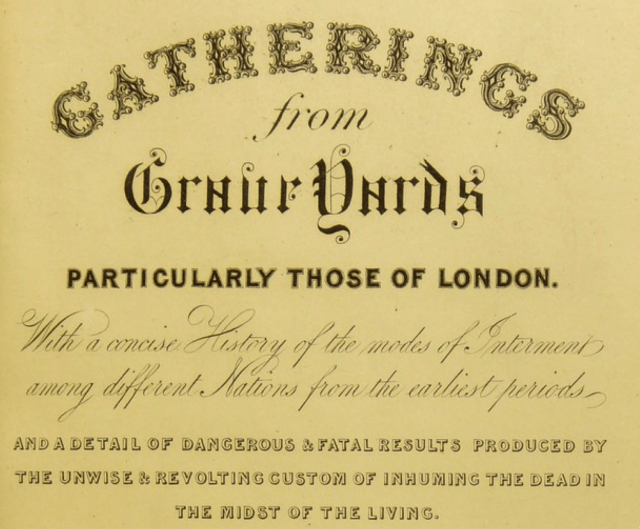
xxx

The most significant proponents of radical reform were Dr George Walker whose Gatherings from Graveyards shocked many people. He followed it up with several other books and a series of lectures “On the actual condition of the metropolitan grave-yards” and was quickly backed up by Edwin Chadwick the great advocate of wider public health reform who in 1843 wrote A Supplementary Report on the Results of a Special Inquiry into the Practice of Interment in Towns, which laid down the principles and practice of scientific cemetery management. It helped that Dickens weighed in too, with the account of the burial in Oliver Twist, first published in 1837.
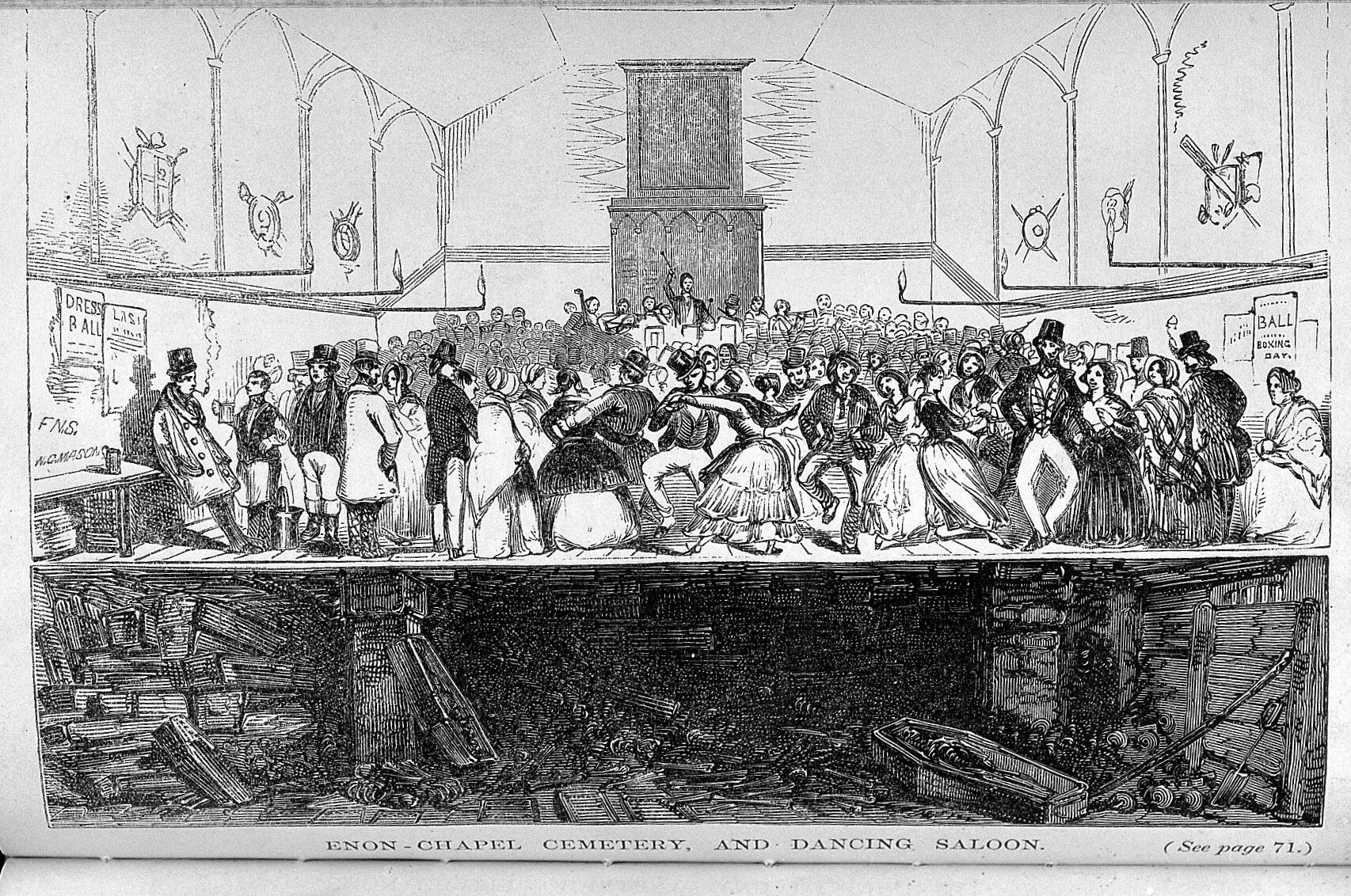
If you want a really good or really rather horrible example of what Walker was campaigning against look at the story of what happened at Enon Chapel in St Clements Lane.
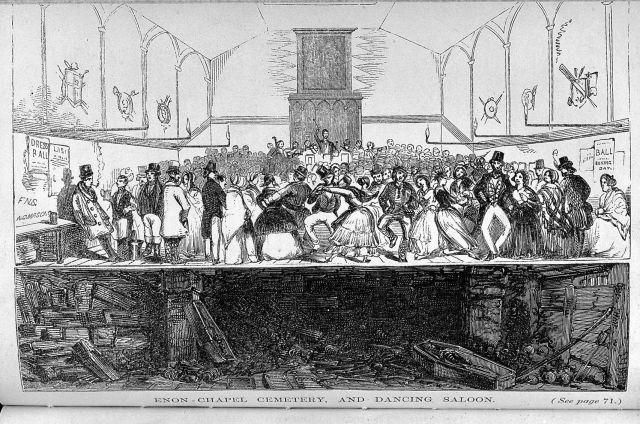
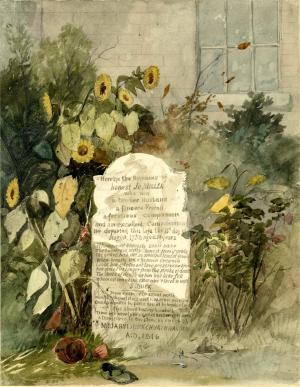
The upshot of all this was a series of Burial Acts and the closure of many city churchyards, which went hand-in-hand with the development of a range of much larger burial sites as wren had proposed outside built-up areas. Some of these were run by the equivalent of local authorities and others by private companies. Burial, especially in towns and cities, became big business.
For more info see Julie Rugg, Nineteenth-Century Burial Reform in England: A Reappraisal, 2019 which is freely available on-line.
John Claudius Loudon’s book On the Laying Out, Planting and Managing of Cemeteries(1843), helped establish a pattern. He took Horace’s injunction dulce et utile – useful and beautiful – and applied it to burial places.
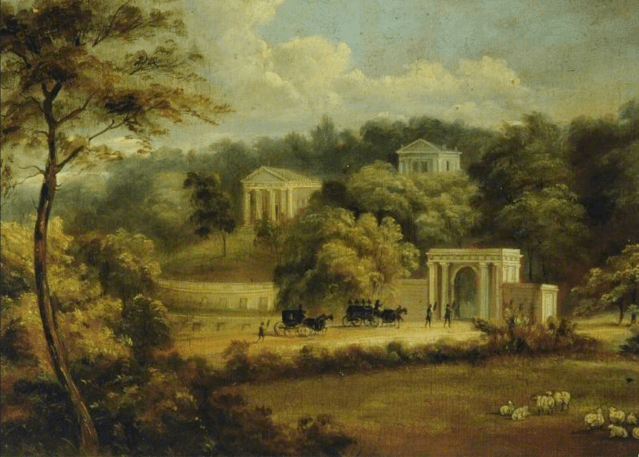
Cemeteries, he argued, should be a combination of efficient, even regimented, design, able to meet necessary sanitary requirements and at the same time should be offering an attractive reverential and morally instructive landscape to visitors. Coupled with a change in attitude to memorialisation these new Victorian cemeteries allowed, perhaps even encouraged, elaborate monuments and were well designed with ornamental, largely evergreen, planting. Meanwhile older sites became more appreciated for their picturesque qualities and antiquarian interest.
[See these previous posts for more info: Loudon and cemeteries and Loudon and cemeteries continued.]
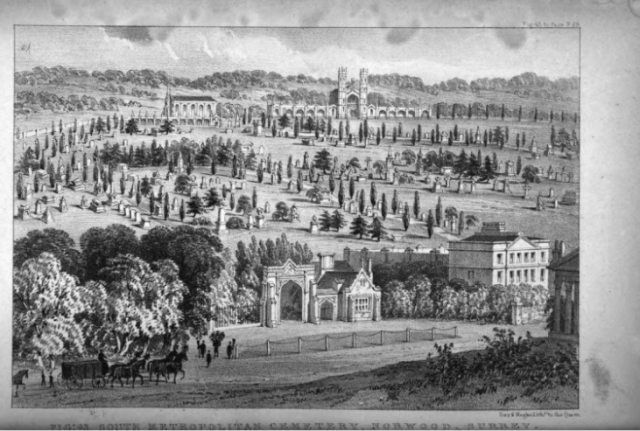
Loudon’s “Improvements” to Norwood Cemetery, from On the Laying Out, Planting and Managing of Cemeteries, 1843
But burial requires space and even in the 19thc it was in short supply. The cremation movement emerged as one response – the Cremation Society was established in 1872 – and that allowed a completely different approach to cemetery design. William Robinson who was a strong proponent of cremation argued that “By the common consent of mankind ‘God’s acre’ is most fittingly arranged as a garden”. However this was difficult in crowded cities “as the present way of using the ground often leaves no room for either garden or planting.”

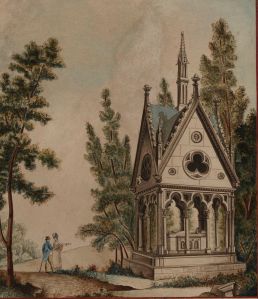
Where did Robinson get these ideas from? Partly I’m sure from the time he spent in Paris. Apart from writing about the city’s parks and gardens he also wrote about the horrors of the city’s fosse communales, or mass graves, as well as the greenery and order of the vast planned and ordered cemetery of Pere Lachaise. But he’d also been to Edinburgh in 1863 and seen Dean Cemetery which had opened in 1846. This too was laid out along formal lines with many trees which gave it a garden-like atmosphere.


Then in 1870 he went to the United States and visited the great green burial sites of Laurel Hill at Philadelphia founded in 1836…
Green-Wood, in New York founded in 1838, and most significantly Mount Auburn in Boston. Dating from 1831 it was deliberately planned by the Massachusetts Horticultural Society who purchased 72 acres of mature woodland for the creation of a “rural cemetery” and experimental garden. The idea worked and it quickly became the model for the American “rural” cemetery movement.

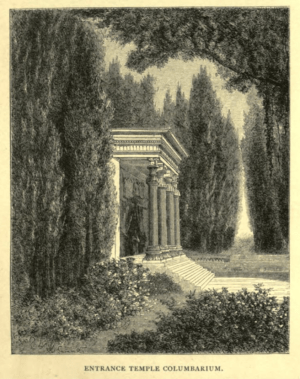
However, these cemeteries, well planted as they were, were also full of large monuments and memorials often crowded together, all part of what we would probably now regard as Victorian excess and over-sentimentality. Robinson’s ideas were perhaps just a part of an almost inevitable reaction against that but he took the garden idea one stage further. He advocated cremation. Since ashes and their urns take up much less space than conventional burials this meant cemeteries need not be cluttered and there would be considerable “free space for gardens and groves of trees. The cemetery of the future must not only be a garden in the best sense of the word, but the most beautiful and best cared-for of all gardens.”

Woking Crematorium, undated postcard
https://en.wikipedia.org/wiki/Woking_Crematorium#/media/File:Woking_Crematorium_early_20th_century.jpg
The Cremation Society built the first crematorium at Woking in 1878 but it took a considerable amount of campaigning trying to legalise cremation with the first not taking place until 1885, and then to win over an unwilling public to the advantages of cremation over burial. Now of course nearly 80% of funerals are cremations. It was not until 1902 that local authorities were given the power to build crematoria, and only 14 had been opened before the outbreak of war in 1914. One of the 14 was at Golders Green which opened in 1902. The building was designed by Sir Ernest George and Robinson laid out the grounds.
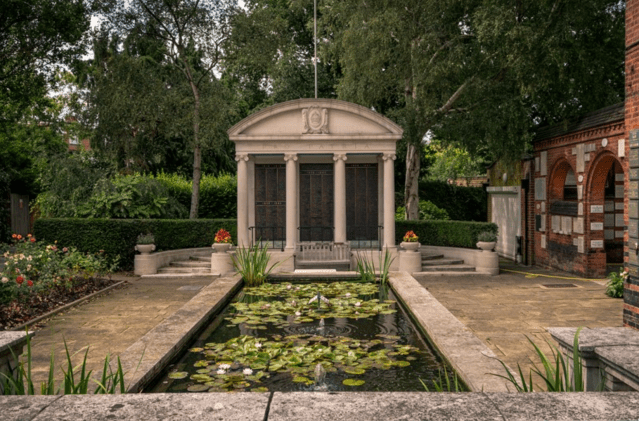
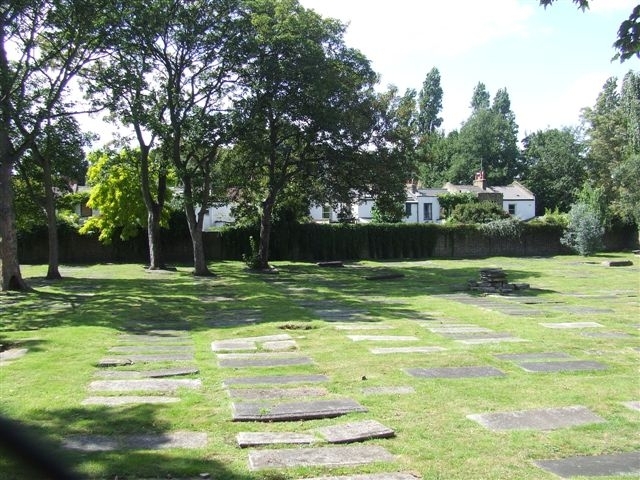
The First World War marked a significant change in burial practice because of the need for mass interment during and after the conflict. Although perhaps more akin to Robinson’s ideals than the Victorian model, these new landscapes of burial and commemoration and burial are still markedly different, with new terminology such as ‘gardens of rest’ or ‘gardens of remembrance’ being used to reflect this new design style. These new sites were as Historic England notes where “the tradition of mounded graves was replaced by flat lawn which made maintenance easier to achieve, particularly where new mowing equipment was introduced…. Monuments were deliberately modest, with inscriptions and imagery becoming more restrained and private.” Whereas on the one hand these streamlined landscapes were closer in appearance to domestic gardens, with their flat lawns the sheer scale of them made them both grandly impressive and very moving.

Woking Muslim Military Cemetery – now the Peace Garden -was opened in 1917

As overcrowding once again became a problem in cemeteries despite cremation becoming the norm, another new trend developed in the late twentieth century: the woodland, or natural, burial ground. The first in the UK was opened in 1993 at Carlisle Cemetery and there are now over 300 sites in the UK who have even formed an Association of Natural Burial Grounds with a code of conduct.

The survival of burial grounds as open space and their heritage value, cannot be taken for granted. Many are under threat from closure and subsequent development, or from under-management or general mismanagement. The beautiful Burial Project which was Heritage Lottery grant funded and ran until last December, has really help change that, and while it has finished its work it has left a substantial legacy which can be found on the Caring for God’s Acre website.


Once I started researching this I was amazed at how much information is out there. Much of the wider public interest was sparked by Francesca Greenock’s God’s Acre first published in 1986, but now almost all county wildlife trusts and Church of England dioceses now have extensive sections on churchyards , as do many church heritage organisations. Caring for God’s Acre offers guidance on how best to conserve and maintain burial sites whilst still allowing access to visitors and relatives. They offer help on management of issues such as grass and other vegetation, lichen on gravestones and monuments falling into disrepair and have developed a fascinating database of their research https://burialgrounds.nbnatlas.org/ ;
Take a look & you’ll quickly become absorbed.


 The Garden History Blog




You must be logged in to post a comment.