
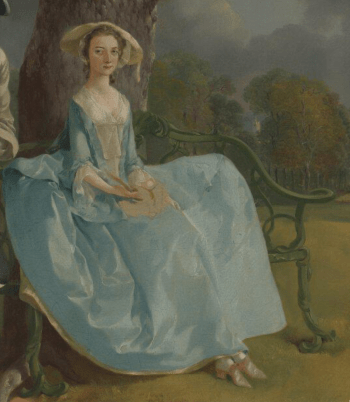
Mrs Andrews in the garden at Auberies, a detail from Gainsborough’s Mr & Mrs Andrews. But what is she holding? and why was the portrait painted outside? All may be revealed on the post!
APOLOGIES IF YOU ARE RECEIVING THIS POST LATE OR FOR A SECOND TIME
WordPress discovered a glitch which blocked about half my mailing list so they have told me to repost it.
Continuing my trip down Memory Lane this week I want to recall some of the many gardens I’ve covered in these posts. I’ve written about 120 as the main subject but with many more looked at incidentally. Although most have been in Britain I’ve also written about several in other parts of the world. They’ve included gardens from the early medieval period to contemporary creations as well as a few from ancient civilisations. There are historic survivals, adaptations, restorations, re-imaginings and even gardens which no longer exist. If you’re a regular reader see how many you recall or know and if you’re a recent discoverer of the blog, just look and see what you’ve been missing. To discover more click on the links, but don’t worry I’m not planning on covering all 121+ in what can only be a lightning tour! Instead to make life simpler for myself I”m concentrating on those where women had a significant role in their creation or survival.
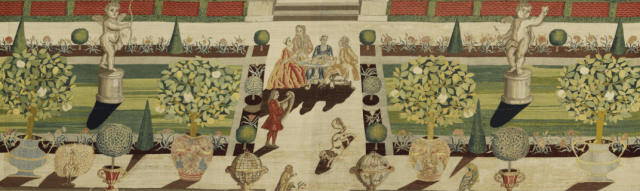
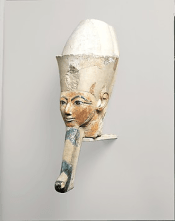
The earliest gardens I’ve covered have been from the great civilisations of the ancient world. Hatshepsut The first known woman pharaoh ruled Egypt around 1500-1450BC. She is known to have sent ships to the mysterious Land of Punt to collect plants which ended up in the gardens of her own funerary temple complex. Her step-son/nephew and heir Thutmosis III also collected plants and had a botanic garden carved into the walls of his temple at Karnak.

But they were latecomers to garden making because a thousand or so years earlier Pharaoh Snefaru probably the greatest of all of Egypt’s early rulers constructed the first “true” pyramid.
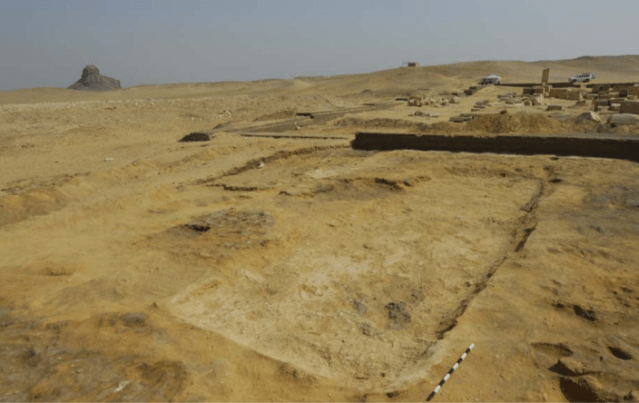
It was high on the plateau overlooking the Nile and had a large walled garden laid out with a central pool despite being well away from the river or any natural water supply. Recent archaeology has revealed that there were 300 trees in the garden as well as flower beds but do you recall where the water to keep the plants alive came from?

The ‘Garden Party’ relief from the North Palace of Ashurbanipal, Nineveh, Iraq, about 645 BC,
British Museum
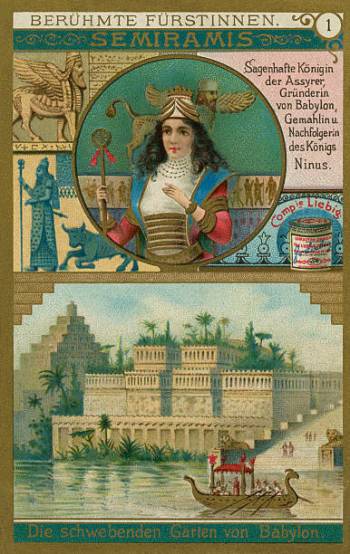
I’ve written too about the gardens of the Assyrian kings which can be seen on the carved panels taken from their palaces at Nimrod and Nineveh which are now in the British Museum. Are they connected in anyway with the Hanging Gardens of Babylon, an empire conquered and incorporated into the Assyrian empire? Legend has it these were constructed by Nebuchadnezzar for his wife Amitis, or perhaps for the Assyrian queen Semiramis – but of course no-one knows! However I wrote up several theories which you can read on two posts about these legendary gardens which, in fact, were probably neither hanging nor even at Babylon.
However, these gardens of the ancient Middle East are now merely archaeological sites so where are the oldest surviving gardens in the world?


DM 2008
You might have been surprised to read they are those at the Lion Rock at Sigiriya in Sri Lanka. They lie at the base of a towering rock with a palace on top reached by vertiginous paths and stairways. The complex dates from the late 5thc and include elaborate water gardens with a network of cisterns and shallow pools which once housed brick and stone pavilions on islands. There is also what must be the world’s oldest rock garden, and many wall and cave paintings of women and flowers.

Moving from the ancient to the mediaeval world you might remember the posts about the gardens of two early monastic sites – the idealised ones at St Gall a Benedictine foundation in Switzerland, and the very real and still largely extant grounds around Canterbury Cathedral with its amazing 9thc water and drainage system, while you can find out what was grown in such monastic gardens in the post about Walafrid Strabo, a monk from the 9thc Reichenau Abbey in Germany.

Aerial photo of Bodiam Castle , from 1800 feet
Creative Commons Licence [Some Rights Reserved] © Copyright Phil Laycock 2007 and licensed for reuse under this Creative Commons Licence.

from xxxx
If the water works at Canterbury make you rethink your ideas of mediaeval sanitation and engineering more generally, you might have been equally surprised by what I wrote about Bodiam Castle. It’s always been assumed that this was a defensive stronghold built to guard the Rother estuary from French invaders. In fact it’s deceptive because it’s not really that at all. Recent archaeology has suggested the castle should perhaps be seen as a kind of retirement project for an ex-soldier, Sir Edward Dallingridge. It’s also likely that since he spent much of his time away at court it’s likely to have been his wife Elizabeth, who actually oversaw the castle’s construction and landscaping.
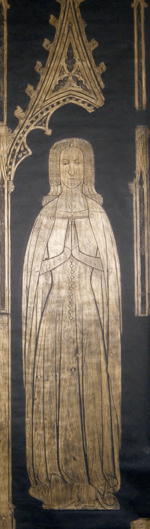
The memorial brass for Elizabeth, Lady Dallingridge in Fletching church,
The landscape has carefully contrived views, a series of water gardens which can be seen best from her private quarters in the castle. There was even a platform on the hillside high above the castle which commanded extensive views not only over the castle but the vast Rother estuary. Bodiam shows how it’s quite likely we have seriously underestimated the role of elite women in garden creation in the Middle Ages.
Another mediaeval site where a woman was likely to have been involved is Hulne Priory, part of the Alnwick estate. Not of course at the time the priory grounds were first laid out, but in the mid/late 18thc when the post-Reformation ruins were reconsidered as an integral part of the landscape, and repurposed as a summer lodge for the estate’s owners the Duke and Duchess of Northumberland.

Coadstone plaque of Duchess Elizabeth at Hulne
Duchess Elizabeth was the driving force behind much of the landscaping that took place at Alnwick which included work by Capability Brown on the main castle site and Robert Adam on the priory which stands several miles away.

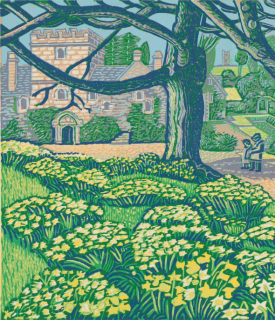
Another late mediaeval survival is Cothele in Cornwall which became a secondary home from the 1530s, after the owners built a new house – Mount Edgcumbe – overlooking Plymouth Sound. The current layout dates from the later 19thc when Cothele once again became a permanent home, this time for the widowed countess Caroline Fox Talbot. She was an inveterate correspondent as well as keen gardener and some 400 letters to her brother, William, the pioneer photographer whose seat was Laycock Abbey. Most of their letters which have been digitised have mentions of the gardens and its plants. Cothele was also the subject of a series of beautiful linocuts by the printmaker Rena Gardiner who I’ve also written about and whose work has recently been re-evaluated by a new biography.
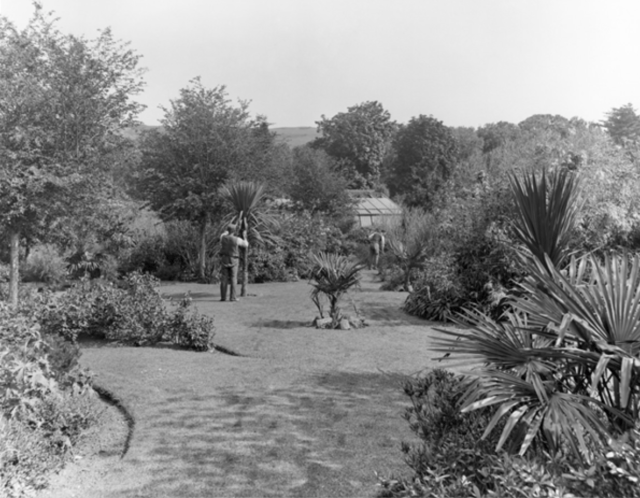
A gardener in the sub-tropical garden at Abbotsbury Castle. from Country Life 9th Dec 1899
The Fox Talbots were also connected to the wonderful gardens at Abbotsbury on the Dorset coast. Unsurprisingly given its name, Abbotsbury was the site of a monastery sold, and along with the famous Swannery, to Sir Giles Strangways at the Dissolution in 1539 and then largely demolished. In the 18thc Caroline and William’s grandmother Elizabeth, the first Countess of Ilchester, had Strangways Castle built as a seaside home in the newly fashionable Gothick style. It stood on the hill commanding extensive sea and had “a neat bathing-house on the beach, which is accommodated with hot and cold baths, dressing rooms, etc.”

Information board at Abbotsbury with the Countess Elizabeth
More importantly, Elizabeth and her daughter Susan laid out a walled garden planted with “exotics” and built one of the earliest rock gardens in the country. They also laid out another garden further up the valley in a more sheltered spot. The gardens were to feature in Country Life and although the mansion was demolished and the gardens were levelled in 1936 the secondary site survives and is home to today’s subtropical garden
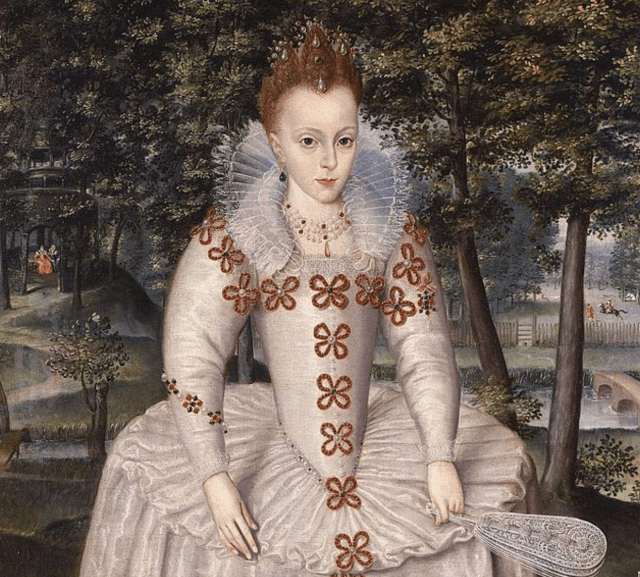
Another woman is prominent in the history of another converted monastic site, Coombe Abbey in Warwickshire. She wasn’t the creator but instead the subject of a portrait which includes part of the garden and parkland in the background. And she’s yet another Elizabeth! Princess Elizabeth was the daughter of James I and Anne of Denmark and as was customary her education was farmed out to a respectable courtier. In her case it was Sir John Harrington who lived at Coombe. Luckily Elizabeth’s stay was recorded by one of her ladies in waiting, so that we know “her Garden and Green house, were as well stored with Curiosities, and exotic Plants, as her Minagerie, with Creatures.” In particular the princess was very fond of birds and had an aviary built with a rustic cottage for “a poor widow and her children” to live in, “take care of the different sort of Fowls that were-to be kept there. The garden also had a grotto “the Adorning of which with Shells and Moss, was the Amusement of many of her leisure Hours” and the extraordinary treehouse on a spiral mount that can be seen on the left in her portrait.

Princess Elizabeth went on to marry Frederick, the Elector Palatine in 1613 and move to his castle in Heidelberg. There, the young couple, with the help of Salomon de Caus, began to create one of the most celebrated gardens of the early modern period that became known as the eighth wonder of world. They were immortalised in a much-reproduced painting and engraving, and in considerable detail in de Caus own book about them, the Hortus Palatinus. Yet they were as much legendary gardens as real ones because they remained unfinished because of the Thirty Years War.


De Caus also had connections with Thomas Howard, earl of Arundel, known as the collector earl, who has been honoured with a new garden at Arundel Castle. His formidable wife, Aletheia Talbot, constructed her own London HQ at Tart Hall roughly on the site of Buckingham Palace. We’d know very little about it or its garden BUT its a rare example of a site where we have two images from roughly the same period: a contemporary map and a fashion plate by Wenceslaus Hollar, the great Bohemian engraver. The garden can be seen in the background of the fashion plate behind the model, who was his wife, Margaret, the countess’s maid.

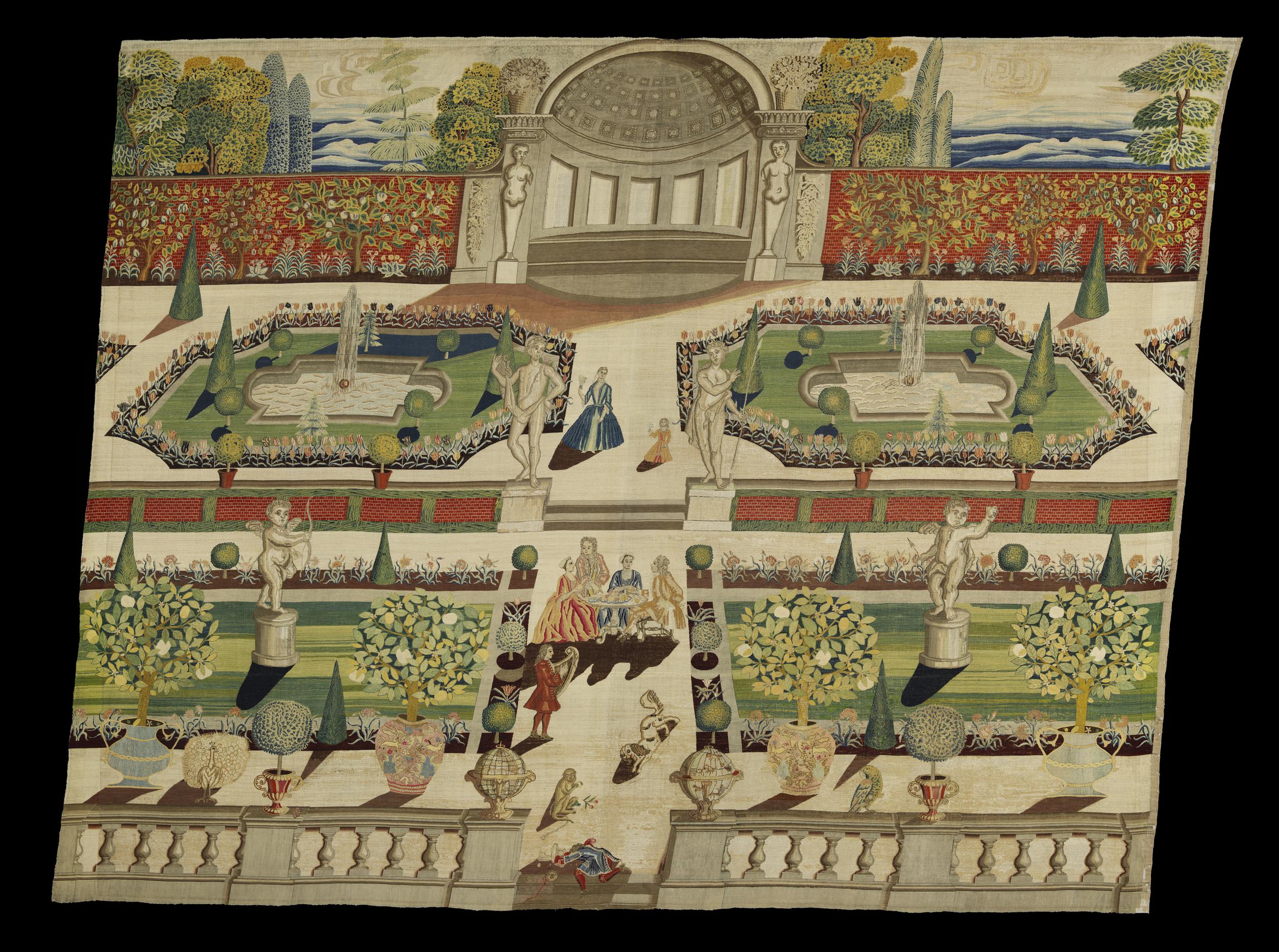
A formidable woman in a completely different sense was connected with the house and gardens at Stoke Edith in Herefordshire. Stoke Edith is now famous for the two large hangings commissioned for the house which are now in the Victoria and Albert Museum but that’s not why Lady Anne was famous – or rather infamous. She had married into the family, but after discovering that her husband was a gambler and a rake, she took a string of lovers including the Earl of Peterborough, himself a notorious womaniser and libertine. Their liaison was soon reported in the press and became the object of ribald cartoons.
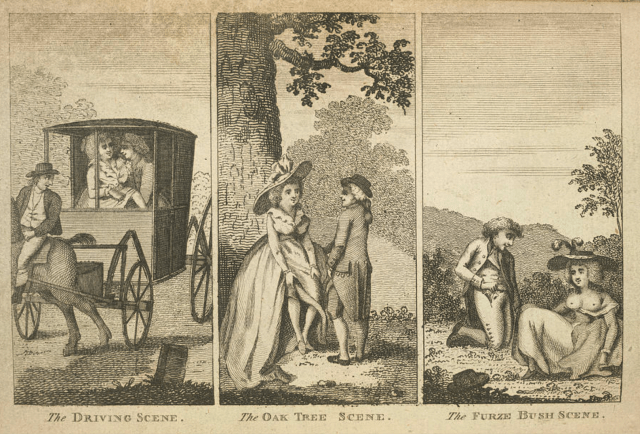
Divorce proceeding followed and during the hearing an estate worker said he had seen the earl “standing in the said walk with the said Rt Hon Lady Anne Foley in his arms”. That might have been fairly innocent I suppose except that “her legs were round his with her clothes up to her waist and her nakedness exposed from her waist down, and their bodies were in motion.” Shocking stuff even then.

You can’t imagine Mrs Andrews carrying on like that – or maybe you can? Certainly recent research on the painting suggests that there was more going on than a just simple portrait newly married couple of ato hang over the fireplace at Auberies, their home on the borders of Essex and Suffolk. Do you remember why the painting was never quite finished? Or what she was holding, or when and why it became the iconic English landscape scene? Check out the post to discover the answers!

Harriet’s Gothick Temple at Bramham
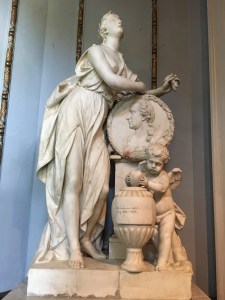
The memorial to Harriet Bingley in the chapel. Photo courtesy of Susan Kellerman
Several major restoration projects also seem to have been led by women. At Bramham where in the early and mid-18thc Harriet Bingley carried on the development of her father’s estate adding the chapel and a beautiful octagonal Gothick Temple, things had sadly declined by the Second World War. Afterwards, however, the owner Marcia Lane Fox, with her husband, started a programme of conservation including not only the repair of the buildings, ponds and stonework, but the replanting of trees on a grand scale.
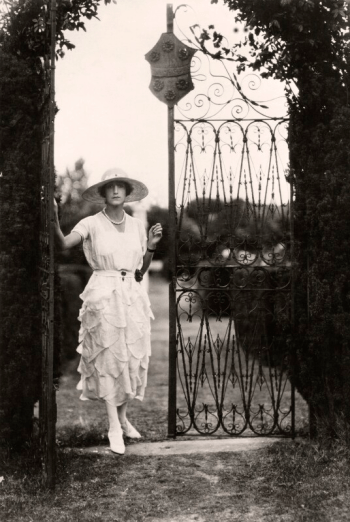
Houghton had similar good fortune after Sybil Sassoon married the future 5th Marquess of Cholmondeley in 1913. It helped that she was extremely rich but more importantly that she had good taste and a sense of history. For the rest of her long life she devoted herself to restoring of the house and estate, overseeing new parkland planting, the recreation of the formal lines of the early 18thc layout, as well as opening the estate to the public in 1976.

Kitty Lloyd Jones
Upton in Warwickshire was another house and garden that benefitted from a woman with taste and money. It was bought by Walter Samuel Viscount Bearsted and his wife Dorothea to house their art collection and as base for entertaining. Having remodelled the house Lady Bearsted took the lead in remodelling the garden, with advice from Kitty Lloyd Jones. Unfortunately Kitty did not write about her commission so apart from some letters between the two women there is very little evidence of how things were organised but the late John Sales the former National Trust’s garden advisor, argued that Upton was “one of the most under-visited gems”of the Trust and its “garden features, colour schemes and plantsmanship are of the highest order.”

Mrs Beale and a gardener in the quarry garden
National Trust

Another woman with but maybe n to quite so m much money was Margaret Beale at Standen in S uses. The wife of a wealthy lawyers was a plantswoman in her own right who kept a meticulous garden diary for nearly 50 years. She corresponded with William Robinson who lived nearby at Gravetye, and he probably influenced some of the planting at Standen, particularly the mass planting of bulbs to naturalise in the lawns and banks but elsewhere she used plants many of which would have been quite unusual and exotic in the 1920s. However with its unpretentious framework of hedges, trellising and informal pathways it blends harmoniously with the landscape and is as typical of the Arts and Crafts movement as the house.


The priory ruins, house and garden from Ben Oronsay from Jane Smith, The Wild Island
My final garden, which as you’ll see, almost completes the circle, is one by Penelope Hobhouse on Oronsay, a small island in the Inner Hebrides. Although its extremely remote nowadays and with only one main house and a couple of small cottages Oronsay was once on the main sea route from Scotland to Ireland that was much used by itinerant monks. The island became home to a small priory, the ruins of which still exist. Acquired in 1984 almost by chance by an American architect and his wife, Hobhouse, who has family connections with the neighbouring island of Colonsay, was commissioned to lay out a new garden.
Her design was a return to monastic simplicity.

photo courtesy of Derek Hosie from the Journal of the Professional Gardeners Guild,Jan 2020
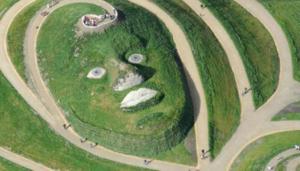
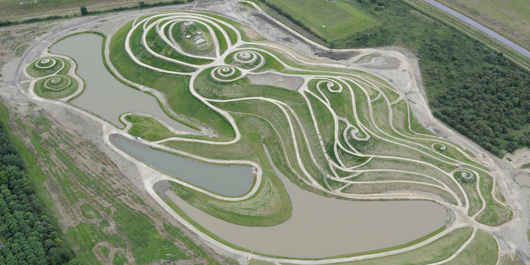
And to end today’s reminiscences of the sites I’ve covered I hope you’ll remember the largest woman in Britain. She’s about 34m tall and 400m long, covered in grass and weighs at least 1.5 million tons – well she would if you could find scales big enough to weigh her. The lady in question is of course Northumberlandia ‘the largest landscape replica of the human body ever seen in the world’…indeed the ‘largest ever piece of landform art’. It has to be seen, and climbed over, to be believed.
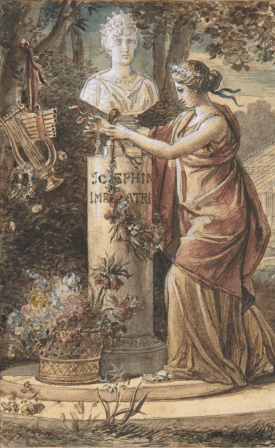
Sadly no time to mention any non-British gardens such as the Empress Josephine’s garden and enormous greenhouse [what’s left now converted into a house] at Malmaison, or Gertrude Jekyll’s only garden in France, at Boismoutiers and still largely intact. It means too no mention of the Bloedel Reserve across the Puget Sound from Seattle co-created by Virginia and Prentice Bloedel, or the only botanic garden I know off that was laid out and managed by a woman, or even what must be a contender for the finest garden in Africa at Babylonstoren masterminded [mistressminded?] byKaren Roos.
And of course there are plenty of other posts which include information about women and their involvement in horticulture and gardens – you’ll just have to look through and see who else you can find.


 The Garden History Blog
You must be logged in to post a comment.