

The Castle from the Rose Garden, DM August 2022
Alan Titchmarsh calls Belvoir “everyone’s idea of what a castle should be”. However, while it might look like an impregnable fortress in fact it’s a “fake” stronghold, built in the mediaeval style in the early 19thc. It is the fourth castle on the site which has been home to the Manners family, earls and later dukes of Rutland, and their ancestors, since 1247.
Described by Gardeners Magazine around the time of its completion as “a magnificent castellated structure on the summit of a lofty hill” it appears to be surrounded by thick woodland but again that’s a slightly false impression because there are also a series of interesting gardens terraced down the slopes. The whole castle complex is set in a much wider landscape, partly designed by Cabability Brown whose plans were never fully completed.

In the last decade a huge renovation and improvement project has been taking place overseen by the current Duchess who you may have seen on the telly a few years ago with Alan Titchmarsh, explaining how more of Brown’s plans were being implemented even if about 250 years late! But as you’ll see she’s not the first of the Manners family to take a big interest in the estates gardens, plants and landscape.


The original castle was one of the first to be built after the Norman Conquest and its extensive outlook over the East Midlands countryside explains the meaning of its name – “beautiful view” – in old French. Belvoir passed to the Ros family in 1247, but during the War of the Roses, Thomas, Lord Ros, supported the Lancastrians and was executed in 1464, and his lands forfeited. Then as the antiquary John Leland, noted in about 1540 “:fell all the castle to ruin, and the timber of the roofs uncovered rotted away, and the soil between the walls at the last grew full of elders’.
When Henry VII came to power in 1485 Belvoir was returned to the Ros family, and subsequently passed to the Manners family through marriage. In 1525 Thomas Manners, a loyal supporter of Henry VIII, was created 1st Earl of Rutland, and began rebuilding the Castle with advice from the King’s mason, carpenter and plumber. At the dissolution of the monasteries he acquired, amongst others, both Belvoir Priory which stood at the bottom of the hill and nearby Croxton Abbey. The building accounts survive and show they were plundered for stone for the new castle. The accounts also show that the earl moved a wooden banqueting house from Nottingham Castle to the garden at Belvoir. Leland reported that the new castle “was made fairer than ever it was… with a garden plot in the middle”
Unfortunately the earl’s new castle only lasted a century before it too was demolished during the Civil War.
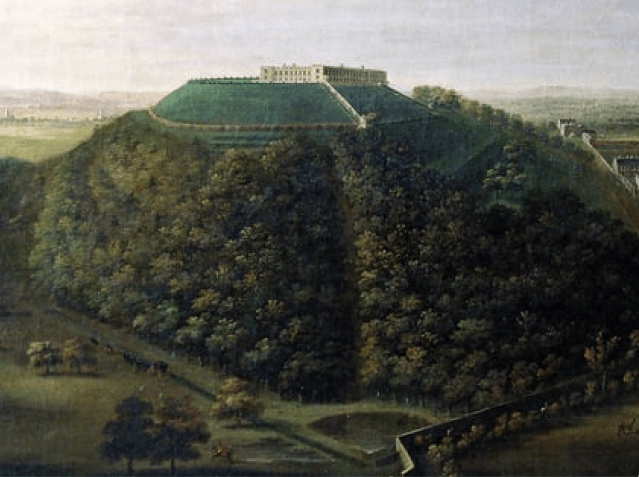
By then the title and estate had passed to a collateral branch of the family whose seat was at Haddon Hall in Derbyshire and Belvoir became their second seat, which might explain why, when a new “castle’ was then built between 1654 and 1668 by John Webb it appears somewhat low-key and low-rise for scale of the site rather than something more grandiose.

Webb’s stables block is still intact, and there are a collection of floor plans and sketches for the mansion held by the RIBA library.

Four of Cibber’s statues from Country Life 27th Sept 1930
Despite the move to Haddon, Belvoir wasn’t completely neglected and in 1680 the then earl commissioned the sculptor Caius Gabriel Cibber to create seven statues at £35 each. These can be seen in contemporary engravings in prominent positions snd are still extant, although they have since been moved about.

South View of Belvoir after Nathaniel and Samuel Buck c1765-70 with the statues lined up on one of the terraces
In 1703 the earldom of Rutland was elevated to a Dukedom and the family decided to abandon Haddon and make Belvoir their main seat once again. Perhaps to celebrate, some improvements were made including the planting of a formal “wilderness”.

Belvoir from the South West, with Belvoir Hunt in Full Cry, Thomas Badeslade, 1730. The wilderness can clearly be seen in the centre at the foot of the hill.
The castle was praised by Daniel Defoe in his Tour Through the Whole Island of Great Britain in the mid-1720s: “The castle or palace (for such it now is) of Bevoir, is now the seat of the noble family of Mannors, Dukes of Rutland, who have also a very noble estate, equal to the demesnes of some sovereign princes, …and in which estate they have an immense subterranean treasure, never to be exhausted; I mean the lead mines and coal-pits.”


The frontispiece to Fruit-Walls. Unfortunately I don’t think the complete text has been digitised.
But Belvoir had other claims to fame even then, because of the duke’s interest in fruit-growing, particularly grapes. In 1697 a member of the Royal Society, Nicholas Fatio de Duillier, explored the effects of the use of sloping surfaces to maximize the sun’s heat for plants growing upon them. He oversaw the building of such a sloping wall for fruit trees at Belvoir, and two years later published Fruit-Walls Improved.
In 1718 the Rev. John Laurence records that although he has not seen it himself that “the Duke … has done so much justice to the vine as to have fires constantly burning behind his slope walls, from Lady-day to Michaelmas; whereby he is rewarded by the largest grapes, and even the best Frontignacs, in July.” In fact “his Grace was refolv’d to be fure” and as Stephen Switzer notes in his Practical Fruit Gardenr of 1724 ” he glafs’d them [ie the vents] all before as you do Stoves, which penn’d in the Heat to a great Degree , and from this they had presently good Success .”

Webb’s mansion almost insignificant in this engraving by Thomas Badeslade, from Vitruvius Brittanicus, Volume the Fourth, 1739
Yet this horticultural interest doesn’t seem to have lasted and by the end of the century, the agricultural commentator and travel writer Arthur Young who visited in 1776: wrote that ‘The house is now almost entirely unfurnished and the gardens neglected, so that it looks more like the habitation of one in distress than the seat of one of our most opulent nobles.’ Perhaps the 4th Duke read Young’s comments because just three years later a surveyor, Jonathan Spyers drew up ‘a very neat fair Drawing’, of the estate which extended to nearly 4000 acres.

That in itself would have been nothing unusual except for the fact that Spyers worked for none other than Capability Brown. When the survey was complete the Duke commissioned Brown to draw up plans for improvements to the castle itself but more importantly to completely redesign the surrounding landscape. For his advice on improvements to the castle and estate, Brown charged a total of £516.8s.

The end of Brown’s letter to the 4th Duke, Still from Belvoir Castle’s Capability Brown Landscape on Youtube

Yet nothing happened. Brown wrote to the duke in 1783. ending this letter with a PS: “Brown grows very old and has done nothing towards the ornament of the castle. Since it is denied to us to live long, let us do something to shew that we have lived.” The reason that there wasn’t much to show is because Young was quite right. Belvoir was a habitation in distress. The duke may have wanted to carry out improvements and asked Brown for his ideas but he had absolutely no money to pay for any work. Not only had he inherited large debts, but they were made worse by his passions for art, gambling, women and entertaining. He wasn’t even living at Belvoir. Such was the scale of his financial problems that Horace Walpole commented in a letter to Lady Ossory: ‘Mr Brown has shown his designs for improving Belvoir Castle. They show judgement and would be magnificent. I asked where the funds were to arise for I hear the Duke’s exchequer is extremely empty.’

Luckily for the family and estate their agents and lawyers were extremely capable. The duke’s debts neared the equivalent of a million pounds when Joseph Hill took charge and implemented emergency plans, including selling off large amounts of estate timber, to stave off bankruptcy. He also saw the huge potential befits of new reservoirs and a canal to serve Grantham, writing to the Duke in 1787 suggesting that the valley at nearby Knipton could supply ‘your Graces River & Lake with any Quantity of Water – I should be glad to see such a work well executed – for that Country seems to want such assistance, as well as Shade & Shelter – & a little Dress & Ornament’. Given Brown’s known interest in water engineering its quite possible that ideas for such large scale water features – both ornamental and practical – had been discussed with him.

Meanwhile the Duke was made Lord Lieutenant of Ireland in Dublin, and so had a sizeable salary even though he had to spend much of it to carry out his duties. He was to prove a popular viceroy but died in Dublin, probably from drink, in 1787. Since his eldest son and heir was only nine, his widow and her brother, the Duke of Beaufort, took over the estate as trustees. Major work was impossible but using Brown’s plans as a guide slow progress was made of planting woodland, clumps, and specimen trees with his suggested perimeter belts of trees being completed around the end of the century. Loudon’s Arboretum 1844 mentions lots of more unusual trees with planting dates/heights etc from this period.

William King, another ducal agent also played an important role in generating funds through the late 18th and early 19th centuries, which included exploiting coal and overseeing the construction of the Grantham Canal through the estate between 1793 and 1799. It is believed to be the first canal in England predominantly supplied by reservoirs, with the first sizable lake constructed in 1794 at Knipton, as suggested by Hill, to supply water to both the canal and the estate.

In 2017 following detailed research by landscape historian Steffie Shields and LDA Design, Historic England extended their listing of Belvoir to include the reservoir on their Register of Parks and Gardens.
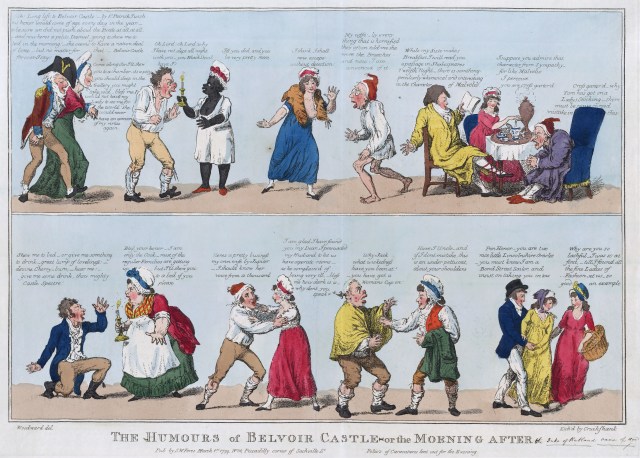

By the time the 5th Duke came of age in 1799, careful management meant his father’s debts were largely repaid and the family fortunes improved. This enabled him not only to marry in style but also to carry out further major works on the estate. His wife was the young Lady Elizabeth Howard, daughter of the Earl of Carlisle of Castle Howard. It must have been quite a shock to come from such an impressive house, garden and landscape to Belvoir described by the current duchess as “a squat two-storey mid-17thc mansion [with] relatively small formal gardens…and both castle and gardens in a desperate state of neglect.”

Duchess Elizabeth was not only industrious and ambitious but she was well read and had a well developed sense of taste that was not just governed by fashion. She had read not only Uvedale Price and Edmund Burke, but William Mason and William Shenstone and formed her own opinions on their merits or otherwise and now she had a chance to turn them into action. The young couple decided to re-invigorate the estate and completely remodel the castle but Harriet Arbuthnot, a society hostess and diarist, visited in 1823 and is clear who was behind it: “The Castle has been built from the foundations by the present Dss who has made the place, the Duke taking no part in the improvement of the place.”
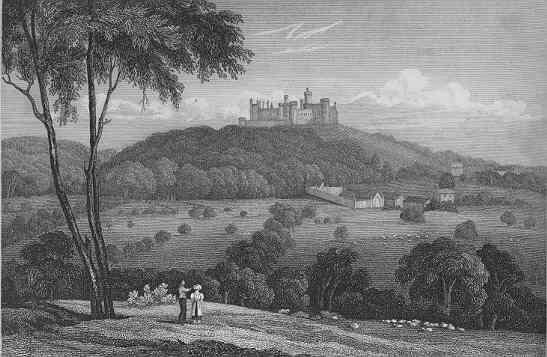
There were already several plans for a new castle, including one drawn up by Capability Brown for the 4th Duke. A local clergyman, Bowyer Edward Sparke, sometime tutor to the new duke recalled talking to Samuel Wyatt, the architect and brother of the more famous James. “He laughs at the idea of a Grecian building (according to Brown’s plan) or indeed of any regular building upon such an eminence, when he says there should be nothing but a castle, or at least what has the appearance of a castle, and the more rough and broken the appearance is, the more striking will be the effect.”
In the end, although the chapel and one elevation were based on designs by Brown and Frederick Trench the family followed Samuel’s advice and picked up on the castle’s genuine mediaeval past. James Wyatt, who had just finished working on Windsor Castle was commissioned to rebuild in Gothic Revival style. The result was what John Goodall [Country Life 2019] “one of the most expensive and fantastical creations of the Regency”. It cost a staggering £200,000. By 1813, work on the new castle was sufficiently far advanced for Duke and Duchess to welcome the Prince Regent on a visit.


The Root and M oss House, DM August 2022
While the castle was getting its makeover the grounds she and the Duke also “improved” the local villages, laying out village greens and building furnished cottages with gardens. The duchess also began a transformation of the castle’s grounds. It used to be thought that she designed and laid out the parkland, woods and water to her own design but it has recently been discovered that quite a lot of the work, especially tree planting had already been done and that she was using Brown’s plan as her template. Neverthless she seems to have adapted them in a more romantically wild way with what Duchess Emma calls “sublime drama in jagged rocks and rugged planting.” She probably used Adam Mickle who had worked with both Brown and Wyatt to supervise work. It included creating the Ladies Garden [now the Statue Garden], the Root and Moss House and what is now known as the Duchess’s Garden for flowers.


Brown’s 5 arch bridge between the two lakes
Further out on the estate, work began to “improve” the new Knipton Reservoir. It was stocked with fish and an ornamental boat was brought from London in 1801, with a thatched boathouse built to house it the following year . At the same time a large number of trees were planted around it including 5000 spruce, 1000 larch, 1000 alders and 1000 birch. A fishing lodge followed in 1806 as well as a woodman’s cottage.
Brown’s plans were also the inspiration for the creation of two more lakes in the valley of the river Devon in the early 1820s, with a typical Brownian device, a five-arched bridge, concealing a change of level between the two bodies of water.

New kennels for the hunting pack were built near the castle in 1802 about which our old friend John Claudius Loudon noted: “Every useful building is always an apology to the improver for finding a picturesque object or composition. Even Dog Kennels will effcet this purpose. They should always be placed distant from the mansion as well as excluded from the most exquisite passages of scenery. Those at Belvoir are excellent, but their situation will probably be regretted by some. ” {Treatise on Country residences 1806]

A model farm with a working dairy was designed by Wyatt for the duchess and built in 1813. It followed in the tradition of similar establishments at Kenwood, Holkham and Woburn.


from Derby Mercury – Thursday 31 October 1816
The castle was not the only family property on the Belvoir estate. There was a hunting lodge at Croxton Park to the south – [now available to rent at £5000 a month] – and between 1802 and 1804 the two were linked by a private carriage drive along the embankment of the reservoir. It created a dramatic approach to the castle and was chosen for the arrival of the Dowager Queen Adelaide to Belvoir in 1839, and again in 1843 when Queen Victoria and Prince Albert visited.
On October 26 1816 fate intervened. Just as the new castle was being completed a catastrophic fire – even possibly arson by local Luddites – saw much of the building including the picture gallery, with some thirty paintings by such famous artists as Reynolds, Titian and Van Dyck, completely destroyed. It was long thought that Spyers’ survey, and Brown’s plans and architectural drawings went up in smoke at the same time. The hero of the hour was Rev. John Thoroton, an illegitimate son of the 4th Duke, and the new duke’s chaplain, who saved the Rutlands’ children from the flames. It transpired that although the building was insured it was only for £35,000!

Elizabeth, Duchess of Rutland, by George Sanders. Browns 5 arch bridge can be seen on the left of the background
Luckily the ducal couple were not completely disheartened and rebuilding commenced immediately. Since James Wyatt had died in 1813 Thoroton was asked to supervise the work, adding his own touches to the design.
It was largely completed by 1832 by which time Duchess Elizabeth had died. She was just 45 leaving the duke forlorn and with 8 surviving children to care for. He never remarried and died aged 79 in 1856.
But I’m afraid you’ll have to wait for next week to find out what happened next!


 The Garden History Blog

You must be logged in to post a comment.