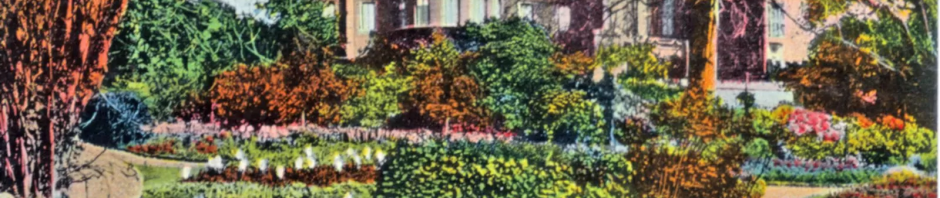
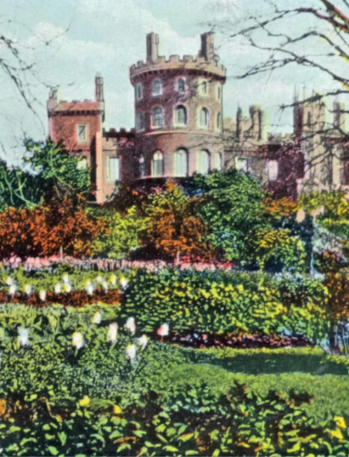
This week’s post is going to continue the story of the gardens at Belvoir from the rebuilding of the castle in the early 19th century through to the current ambitious restoration project.
Historic England’s description of the site gives no indication of anything much of significance happening at Belvoir for the rest of the 19th century. In fact there was more going on than is usually acknowledged because the Dukes of Rutland were lucky enough to have at least three head gardeners who deserve much better recognition. And although things slowed down for most of the 20thc they have taken off again in spectacular style under the auspices of the present Duchess of Rutland.
There are historic photos of the gardens from Country Life in 1898 but unfortunately the quality of the publicly available digitised versions of them is so poor that they’re not worth using, so I’ve used a range of other images. The modern photos are my own from August 2022 unless otherwise acknowledged.
The rebuilding of the castle was finally finished in about 1832, and by then work done to the gardens and grounds by the late Duchess Elizabeth who had died in 1825 had begun to mature as planned. In 1831 the Gardener’s Magazine carried a lengthy report on their state by Alexander Gordon. They were, he wrote, “as far as neatness and keeping go, in good order, and do Mr. Buckwell, the gardener, the greatest credit.” He went on to described how “on the southern slope are enclosed terraces, on which there are several flower-gardens, tastefully laid out, the beds on gravel, and well stocked with choice old herbaceous plants; the whole surrounded by extensive shrubberies.”


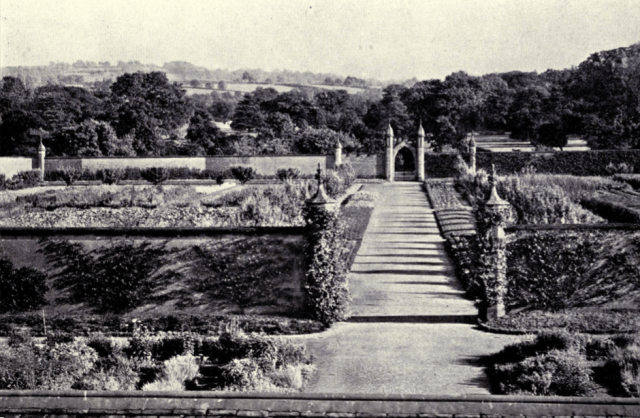
Like all great houses Belvoir had a large walled kitchen, extending to about 8 acres. Gordon thought the entrance “good, built in the castellated style, to correspond with the mansion. The walls are excellent, and now well covered with fruit trees, well trained, and in good condition. There are several good ranges of hot-houses for growing pines, grapes, peaches, &c.; in all of which the crops were excellent, with the exception of the pines.”
It wasn’t all entirely positive because: “in front of the houses there is a very extensive flower-garden; the beds on gravel: but, although the plan is good, the whole suffers materially from injudiciously filling several of the beds with strawberries and other things better adapted for the kitchen-garden.”
But in a sign that perhaps after Duchess Elizabeth’s death the gardens had assumed lesser priority Gordon said their “greatest fault …. is that they remain stationary; for, notwithstanding the many very ornamental plants that have been recently introduced to and spread over England, I scarcely saw any of them here.” This would make the duke the odd man out amongst his peers, most of whom were voraciously acquiring exotics from plant hunting nurseries such as Loddiges and Veitch if not actively sponsoring plant hunting trips themselves. Of course there is always the possibility, as has been suggested by the current Duchess, that Elizabeth’s widower did not want to alter anything and decided out of respect to keep the garden exactly as she left it.
Nevertheless, Gordon concluded, that “Taking Belvoir as a whole, [and all] these things considered, it presents the person who possesses the smallest portion of taste or discrimination with such a treat as few places in England can supply.”
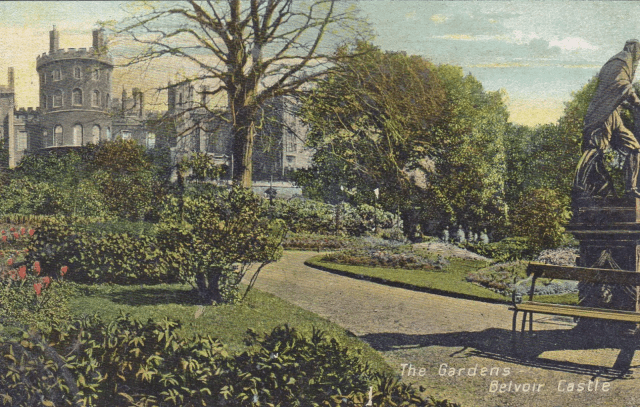

By the early 1840s Mr Buckwell had been succeeded by William Ingram, who seems to have been something of a go-getter. This was the time of Pteridomania and Ingram was acknowledged for supplying specimens of unusual ferns to Edward Lowe for inclusion in his 6 volume Ferns: British and exotic

Ingram was still there when Charles Manners became the 6th Duke in 1857. A Tory politician he seems to have taken an interest in horticulture, although Duchess Emma suggests that the gardens continued to be largely preserved as they were in his mother’s day. Nevertheless Belvoir regularly exhibited at horticultural shows and in 1868 the duke sponsored a prize at RHS for a group of stove/greenhouse plants. By this point William Ingram who Country Life later called “one of the great flower gardeners of England” was a regular correspondent and writer for the gardening press with articles on a wide range of subjects.
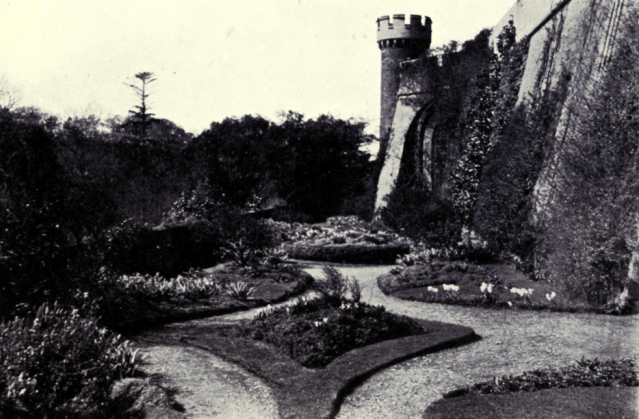

In 1870 for example he wrote to The Field about the best ways of growing mushrooms, and was cited as a successful grower by William Robinson in his book Mushroom Culture. There was a Belvoir Kidney potato which he wrote about the Belvoir method of growing potatoes in 1872 and the following year in Journal of Horticulture about how he grew violets in huge quantities to gather through the winter. He also seems to have been doing some hybridising or at least careful plant selection. There was a Belvoir Castle cabbage, a Belvolir Castle beet which was “the best coloured for bedding” and a dwarf wallflower named Belvoir Castle Yellow – listed in the catalogues of amongst others William Bull and Sugden & Barr in 1873. There were also Belvoir strains of bedding pansies and oxlips. All of them seem to have disappeared from cultivation, although the wallflower was still available in the 1930s.
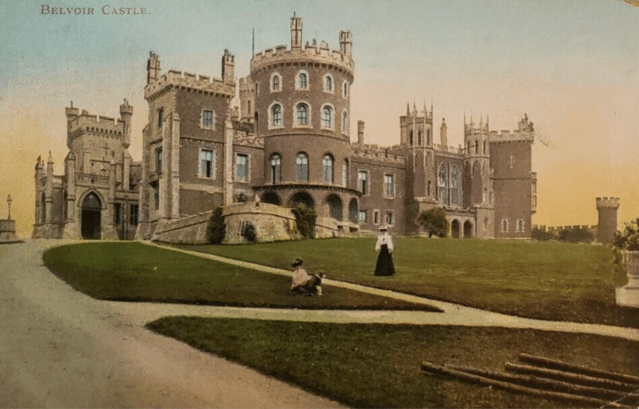
Attitudes to new introductions also seem to have changed because in 1875 there’s an article in Gardener’s Chronicle about new hardy plants in the castle’s gardens. Belvoir and Ingram also got frequent mentions in The Garden perhaps because Ingram was a friend of Frank Miles who worked for William Robinson its founder and owner.

Is this the scalloped hedge referred to below?
Ingram was obviously quite adventurous because the same year he’s experimenting with grafting, and asks readers for “useful information [or] a list of shrubs that might be grafted on Privet, or Thorn, or other hedge material. I have Pears growing and fruiting on a Quick hedge. On a Privet hedge here I grafted Lilacs at certain distances apart, in order to break its monotonous and formal appearance, thus rendering it more ornamental. The Privet was formed into a series of scollops several years since, and no difficulty exists in maintaining the desired shape. On the crest of each curve Lilac was grafted, [and] this has continued to grow and bloom with considerable vigour, and is a very pleasing feature in the garden.”
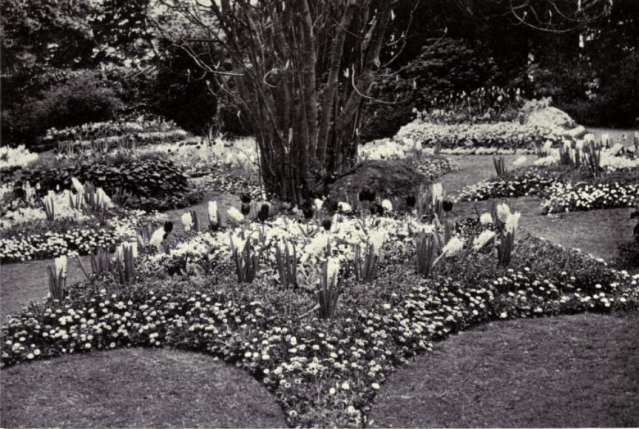
1875 also saw a report of a visit to Belvoir by “D Deal” who wrote for the Journal of Horticulture. [This I’m sure is Rev Henry Dombrain, one of the founders of the National Rose Society who I have written about before.] After writing about the range of hothouses he went onto to declare that “it is in spring that Belvoir is in its glory. Its spring gardening is famous, and a mass of beauty greets the eye as one comes upon terrace and glade.” But in an interesting echo of Gordon’s earlier criticism about not being up-to-date with the latest plant introductions, he goes on that these flowers were the ones “one used to meet with in earlier days, but which have been shoved aside as not fit for their aristocratic congeners,” but which nevertheless “amply repay the care bestowed upon them by Mr. Ingram…”

Ingram’s interest in mass spring bedding was perhaps prompted by the fact that the family were traditionally at Belvoir at that time, often with many visitors, before heading off to another of their properties Cheveley at Newmarket for the racing season.

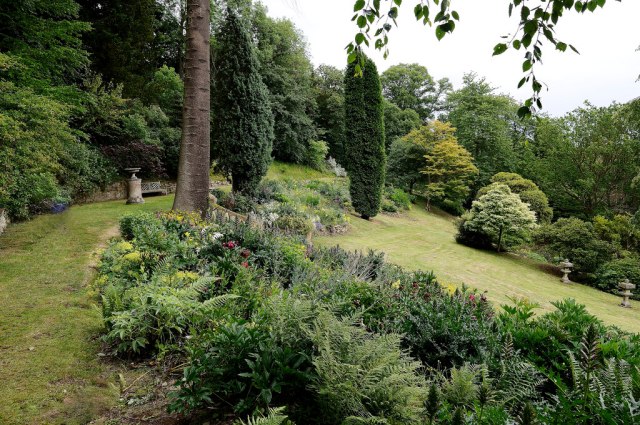
Dombrain was also particularly struck by “one of the latest additions to the already ample beauties of Belvoir, the Duchess’s garden — an irregular and extensive plot scooped out from the well-wooded slopes, sheltered on all sides by well developed forest trees and ornamental shrubs, fringed with feathery Birch and Yews, and now jewelled with thousands of the most beautiful hardy flowers, the soft, yet rich, colouring of which no combination of Geraniums, Calceolarias, or other summer bedding plants can excel. It was a happy idea which induced Mr. Ingram to enamel the fresh green turf of this sheltered glade with spring flowers, the position being precisely similar to that which Nature herself selects for them…. the combinations were numerous and beautiful, although, as I have said, the wilder and more natural portion of the garden pleased me most. As these slopes are so extensive Mr. Ingram is able to have masses of colour.”
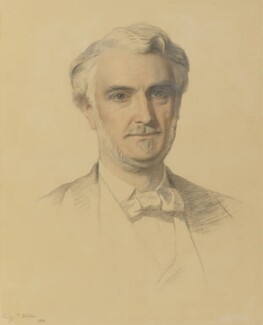
After the death of the 6th Duke in 1888 the estate and title passed to his brother John. He was a friend of Disraeli and another prominent Tory politician who had taken an interest in improving conditions for the industrial working classes including advocating the provision of allotments. Again Duchess Emma believes that little was done to alter his mother’s overall design. However horticulturally the gardens did more than just tick over under the new head gardener William Divers who had taken over in 1894 after the death of William Ingram..

Divers had initially trained at Burghley with Richard Gilbert the head gardener, also marrying his daughter and had arrived at Belvoir following a series of jobs at much smaller estates. He was to bring real national acclaim to the gardens at Belvoir where he managed a team of 40 gardeners.
Country Life visited in September 1898 and noted there were “pleasure gardens reproducing Nature, not after the manner of the old landscape gardeners who strove for rural landscapes… but those who hold that garden are the home of flowers… blooms of some kind flourish in every available nook.” In other words it seems Brown’s vision had almost been forgotten.
You can read the full Country Life piece and see the poor quality digitised photos by following this link.

In 1903 Divers took a step into the murky world of horticultural politics when he suggested the setting up of an Association of Head Gardeners, which wouldn’t be a trade union but designed to enhance professional standards. The British Gardeners Association was set up the following June and he was chosen to head its council. He was to remain involved until his retirement in 1917. [One day there will be a post about the BGA but until then if you want to know more read Brent Elliott’s, Horticulture and the First World War, one of the RHS Lindley Library’s Occasional Papers published in 2014]

Like Ingram before him Divers wrote regularly for the gardening press, notably a column for Gardener’s Chronicle and also carried out hybridisation programmes, although his work was mainly with apples. Amongst his introductions were Belvoir Seedling [created from a. cross between Annie Elizabeth x Dumelow’s Seedling], and [a cross between Barnack Beauty and Cox’s Orange Pippin].

Barnack Orange, still available but has to be grafted to order from Keepers Nnursery
He was also responsible for a catalogue of trees, shrubs and other plants growing at Belvoir [which I can’t track down anywhere on-line] which apparently included 2000 different species.

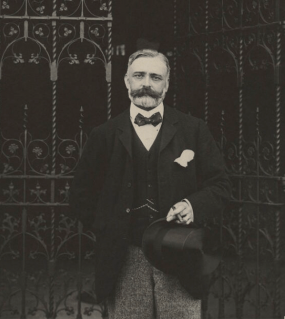
He was still in post when the next major phase of garden development got under way.
In 1906 Duke John died and was succeeded by his son Henry the 8th Duke and his wife Violet. She was a talented artist, a member of The Souls and a keen gardener.
Eighty years after Duchess Elizabeth’s death, any sense of preserving the estate as it was left by her had vanished and Duchess Violet set to work.

Both the castle and gardens, despite the horticultural efforts of those three head gardeners, needed some intervention and updating. Electricity and Plumbing were installed inside while outside, shortly after she arrived, Violet called in Harold Peto.

Cibbers Winter overlooking the garden
Peto’s main task was to redesign the Rose Garden. This had been created originally by the Rev Sir John Thoroton on the terraced slope of the hill in 1814. The original plan has recently been discovered in the archives. 
Peto commandeered Cibber’s statue of Winter to stand at its east end, while more statues were introduced including a Corinthian column bought by the Duchess on a trip to Bologna in 1907, and a marble statue of a horse, that had been presented to the 5th Duke in 1851. 
Meanwhile the remaining six Cibber statues were moved to the Statue Garden lower down the slope.

The couple were also obviously impressed by Divers’work and especially by the grand annual spring display, so commissioned him to write ‘Spring Flowers at Belvoir’, which was published in 1909. It was well illustrated with black and white photos which form a detailed account of what the garden was like, and was the best account of spring planting schemes anywhere in the country to date.
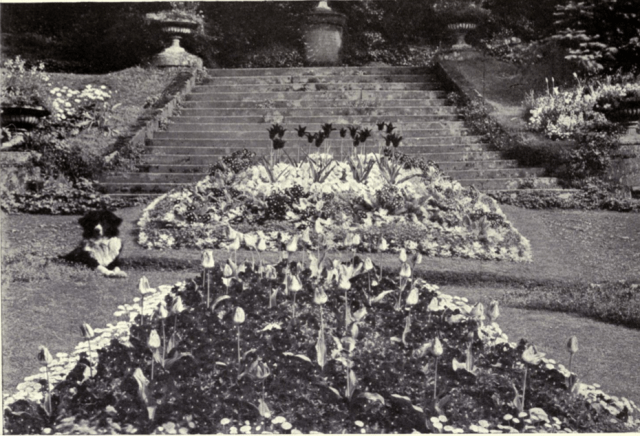
Divers was awarded VMH by the RHS in 1913. 1916 he was one of those who supplied seeds for prisoners of war at Ruhleben, just before he retired in 1917.
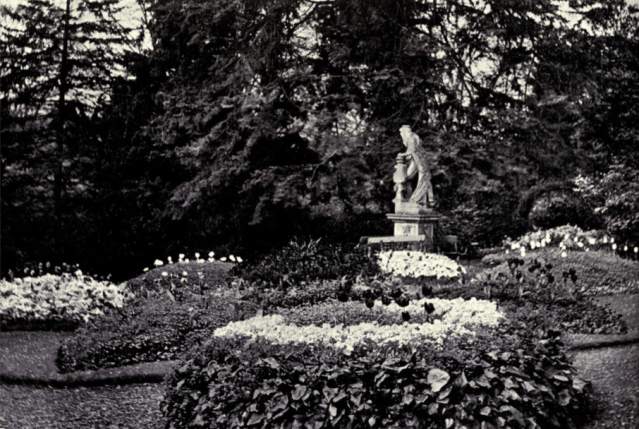
Unfortunately after Peto’s involvement and Divers retirement there was another century of quietude. Not because Duchess Violet and her successors lost interest – far from it as can be seen from what Duchess Emma calls her “sparse but informative garden notes” which have become “a priceless source of inspiration.” Instead it was from force of circumstance. The First World War ended the era of cheap labour. Many Gardeners did not return from the conflict and massive readjustments had to be made. Costs rose. Hothouses were shut down and many of the ornate flower beds had already been grassed over during the war. Equally significantly was the severe lack of cash. Death Duties were crippling and post-war the estate was forced to sell over 13,000 acres to pay them. The result was that, “ironically”, as Duchess Emma comments “the gardens returned to the naturalistic style that Brown had intended.”

This is not the place for an account of the virtual disappearance from public view of Lancelot Brown in the century and a half after his death. He was soon half-forgotten and it wasn’t until first Christopher Hussey in 1927 and then more firmly with Dorothy Stroud in 1950 that he began to return to wider notice. The tercentenary of his birth in 2016 put him firmly back on the pedestal he deserves. At Belvoir this coincided neatly with the amazing rediscovery in the estate archives of both Spyers survey and Brown’s original plans.
Not only was it an immense surprise but a great joy because the estate had been working on a major restoration project which it tuned out were pretty close to Brown’s ideas. Duchess Emma sought advice from John Phibbs, probably the country’s leading expert on Brown. After seeing and analysing the plans it became clear that this was not another carbon copy scheme but something far more radical. They were created by a Brown who was still experimenting. It is plausibly argued that Brown’s letter to the duke: “Brown grows very old and has done nothing towards the ornament of the castle. Since it is denied to us to live long, let us do something to shew that we have lived” was actually a wish to do something new.
It shows Brown moving with the times, taking up the fashion for medievalism and a return to the sites historical roots. He proposed the Gothic castellation of the castle, the addition of an entire new attic storey and a service tunnel, new woodland ridings, and new approach roads with lodges. But whereas in so many cases of Georgian estate improvements whole villages were cleared away and rebuilt on new sites out of sight, at Belvoir Brown instead suggested incorporating the nearby village of Woolsthorpe into his plan, merely screening it with a light belt of woodland and allowing the church to remain visible as an eye-catcher. Nor did he, as so often accused, want to sweep away the existing formal gardens. Instead although he proposed laying out new pleasure gardens, the old formal gardens were to be kept, although the wilderness was to be modified into a more Brownian scheme with clumps of trees in more open parkland. More Surprisingly perhaps he also suggested creating a ‘chase’ – open land for hunting – and reinstating Belvoir’s free warren, for hunting with hawks, again to reflect Belvoir’s medieval past.
This was Brown as never seen before. Experimenting rather than formulaic. He was as radical but in different ways at Belvoir, as he had been in his first commissions at Stowe and Croome . Now, as you may have seen in a TV show with Alan Titchmarsh, Duchess Emma’s plans are to carry on the good work and create or reinstate features on Brown’s original plan.

So far, this has included planting new woodlands and avenues, filling in gaps in the tree belt and opening up long views across the landscape, and partially creating Brown’s planned lake. It is an impressive performance and I’m sure Brown would be cheering them on!
For more information, especially for the restoration/completion of Brown’s work as you might have guessed the best place to start is Youtube where Duchess has a series of videos and podcasts. There is also the beautifully illustrated book on the Capability Brown Landscape project. You might also like a series of modern paintings of Belvoir by Charles Neal.


 The Garden History Blog


You must be logged in to post a comment.