

. Holdenby in Northamptonshire was one of the greatest houses and gardens of Elizabethan England, in fact of the whole of 16thc Europe. Although largely demolished within about 80 years a small part of the mansion survives as part of the current Victorian house. However, the main reason I was so keen to visit recently with friends from the Birkbeck Garden History Group was to see what, if anything was left of the original gardens. These were recorded in the 1580s by Ralph Treswell, the leading surveyor of his day, not just once but twice so we have almost got before and after plans of what they were like, and amazingly the main features can still be made out so it was definitely worth the trip.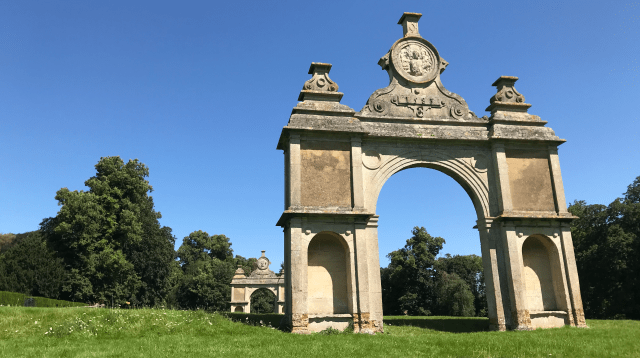
As usual the photos are mine unless otherwise attributed

Holdenby House stood prominently on top of a hill, but before it was built there was a flourishing village complete with mediaeval church and manor house at the bottom of the slope. The manor was one of several in the hands of the Hatton family and it was at Holdenby that Christopher Hatton was born in 1540.
Somehow Hatton managed to find his way into court circles at the age of 21 and through the favour of the Queen rose rapidly. He was made one of her Gentlemen Pensioners in 1564, Captain of the Guard in 1572, was knighted in 1578 and from 1587 until his death in 1591 he was Lord Chancellor.

Sir Christopher was one of a small core of courtiers who wielded enormous influence and power under Elizabeth, perhaps second only to William Cecil, later Lord Burghley, the other great builder and gardener of late 16thc England. Hatton had already acquired Kirby Hall 25miles to the north east in 1570 where he had remodelled and enlarged the existing house with a design based on those in French architectural pattern books but as he rose at court so his architectural ambitions grew and towards the end of that decade he began building an even grander mansion at Holdenby. But whereas Kirby was to be his own residence Holdenby was built entirely for the potential, but in the end unrealised, entertainment of Queen Elizabeth on one of her many progresses. It even had the royal arms rather than his over the main entrance.
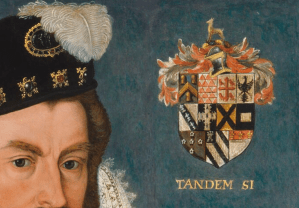
As so often the cost of construction almost bankrupted the builder, especially since he was still building at Kirby, and also owned a string of other houses, included Ely Place in Holborn and Corfe Castle. He was, furthermore, extremely lavish in his patronage of the arts, and also helped sponsor Francis Drake’s voyages, with the Golden Hind being named after Hatton’s crest.
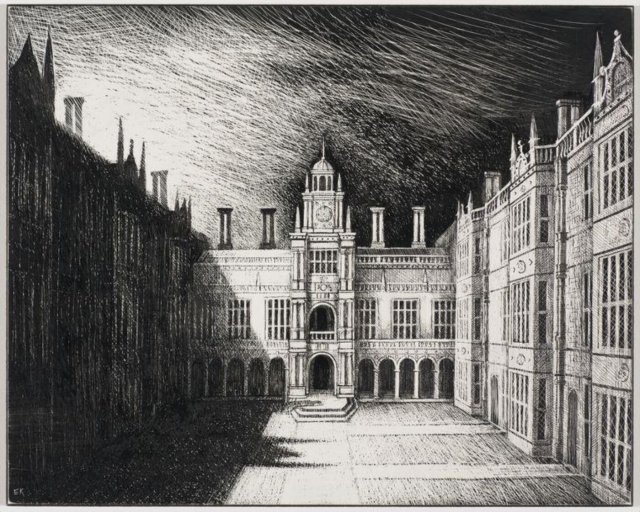

Work was evidently well underway by August 1578 when a friend wrote to Hatton saying that he had ridden nearby and “had a little sight from afar of of your fair house.” Described by Hatton himself as “a young Theobalds” built “in direct observation” of Lord Burghley’s mansion, it was still in 1579 as “unbuilt, through newness, dampish and full of evil air.” Nonetheless when Burghley visited in August that year he was full of praise for this of “this goodly perfect though not perfected work”. A ground plan by John Thorpe shows Holdenby was arranged around two large internal courts, making it the largest private house of its day in the whole country with a ground plan of 78,000 ft.² or 7300 m². Apart from Hampton Court its only rivals were Theobalds and the Howard family’s Audley End.


Sadly there is no surviving documentary evidence for the contsruction and there are no contemporary images, apart from the thumbnail sketch on Treswell’s two surveys so we have to make do with artists impressions based on later drawings of the ruins. The exact appearance of the house has been analysed in detail by Mark Girouard in two Country Life articles – October 17th and 25th 1979- from which it has been deduced that it was in large part symmetrical with mullioned windows, bay windows and two-storeyed open arcading on the garden front.

Like Hardwick the garden frontage probably had more glass than wall and gave rise to a local expression of things being “as bright as Holdenby”. To those various sketches can be added the detailed descriptions in a repairs survey carried out for James I in 1610, the extent of which suggests the whole building was actually a bit of a jerry-built job.
As the house went up so the existing village, apart from the church, came down with a replacement settlement built out of sight some way to the north east.

The great gardens and parkland took much longer to complete. They are shown on Treswell’s first survey in 1580 but alterations and remodelling were still taking place when Treswell returned to undertake a second survey in 1587. They are, with the possible exception of Lyveden, the best preserved 16thc gardens in Britain, and were claimed by Hatton to have been modelled on those of Theobalds. In 1597 their design was attributed by Lyveden’s owner Thomas Tresham to a Catholic priest, who has more recently been identified as Hugh Hall.
[For more on him see Susan Cogan’s article”Gardens, Religion and Clerical By-Employments: the dual careers of Hugh Hall, Priest-Gardener of the West Midlands” in British Catholic History, June 2022.]

The only fault that you might find with Treswell’s two portrayals of the estate is that there is no sense of the topography, although of course that is typical with plans and surveys for the whole period, so its difficult to appreciate the steep nature of the site. Nor is the map aligned north-south as we would normally expect nowadays. Instead north is to the right, south to the left. As those two factors are crucial to understanding the layout and design I’m glad the Royal Commission on Historic Monuments [now part of Historic England] created a plan that shows the marked change in levels within the site.
Ralph Treswell’s surveys are in Northamptonshire’s Record Office but the 1580 survey doesn’t seem to be available digitally, so the images I’m using are scanned from Paula Henderson’s The Tudor House and Garden [2005]

The central section of the 1580 Survey

So let’s look at the 1580 survey. The house was approached through two courts – a large loosely open fenced outer court namend “The Greene”, which led to a smaller Base Court in front of the main entrance to the house. When Cecil visited in 1579 he much have been impressed because he later wrote to Hatton saying that “approaching the house, being led by a large straight fairway, I found a great magnificence in the front or front pieces of the house, and so every part answer well to another, to allure liking.”
Beyond the house, along the hilltop to the west was a garden with 9 compartments – either flower beds or grass squares intersected by walks and then a Cistern House with water diverted from the river some distance away.
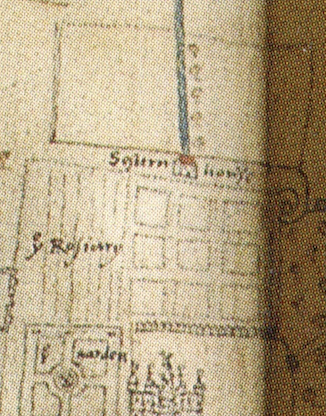
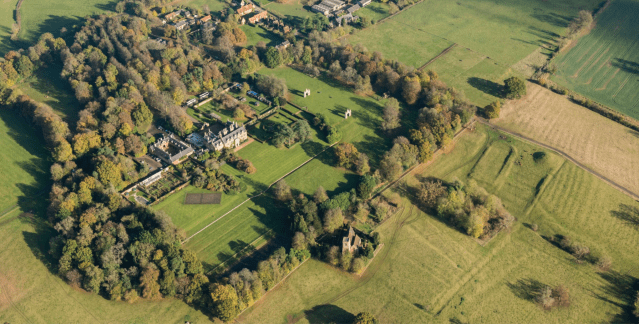
The main gardens were laid out on the south side of the house. Thousands of tons of earth had to be moved to level the the hilltop for the house, and they were used to create a large level platform, about 100m x 80m, projecting in to the valley.

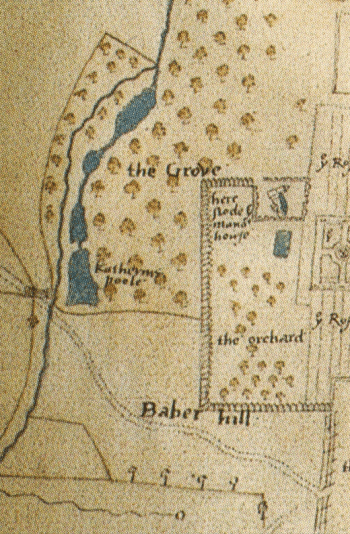
This was laid out as a fairly conventional quadripartite parterre with a central feature although it’s difficult to tell what that might have been. On either side of the platform were a series of seven terraces going down in parallel with the steep valley sides. These were labelled “ye Rosiary” which could mean it was for roses or, alternatively perhaps a kind of apple as mentioned by Thomas Venner in his 1620 book Via recta ad vitam longam, or A plaine philosophical discourse.
At the bottom of the slope on the old village site is a rather erratically planted orchard – perhaps incorporating the orchard for the old manor and the village houses – palisaded in presumably against deer – and a small pond. Beyond that open countryside, woods and water.

By 1587 when Treswell was commissioned to draw up a second survey there had been a lot of changes, suggesting that perhaps Hatton wasn’t happy with his original plans and how they worked out or that he’d had a better idea!
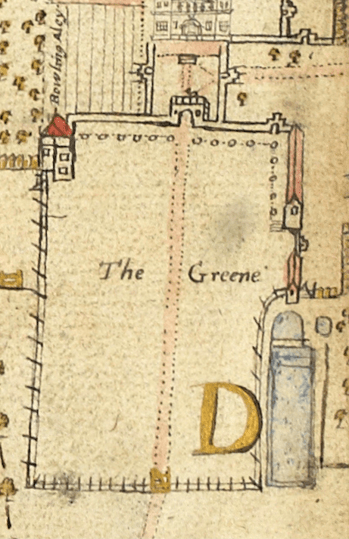
Looking at it all in the same order we can see the boundary of The Greene court has been altered and a large rectangular pond created outside. Although it was still largely fenced the western end has been walled and there are a range of what I assume are service buildings in the north west corner. In the south west corner is a three storied red-roofed lodge or banqueting house, which would have commanded extensive views over the gardens below as well as the surrounding countryside. Hatton never spent a night at Holdenby although he may well have stayed in the lodge. If that seems strange it’s nothing unusual for the time, having a private retreat within a great house or on the estate William Cecil had one at Burley and Sir Thomas Tresham was building another at Lyveden.

The Banqueting House drawn by John Thorpe, [Sir John Soane’s Museum]

A new gatehouse had been erected between the two courts, and from the base court there was an impressive arched gateway on the south side which led directly into the gardens while another on the north led to the new village hidden away on the right.
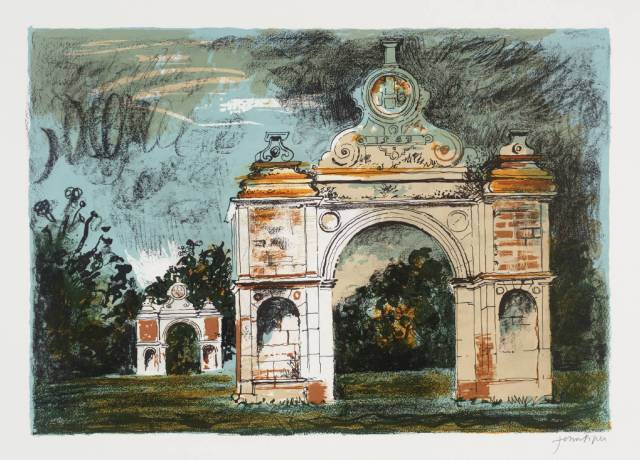
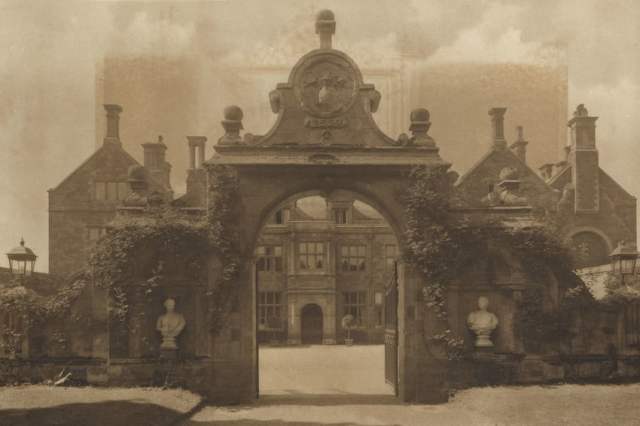
The gatehouse is gone but the two original impressive archways still survive, and bear the date 1583. Their designs were probably inspired by the triumphal arches in Serlio’s Archittura first published between 1537 and 1551.

A new walled court had been constructed behind the house and the former compartments had been turned into an orchard. Treswell also shows close palisade fencing round almost the whole site, as part of the creation of a new deer park.
On the southern side, overlooking the valley, the large flat platform is now shown with a schematic knot design in each of the quadrants. The central feature, previously indeterminate, is now clearly a large circular mount about 30 m in diameter.
There’s back-up proof because it’s mentioned in the survey carried out by Parliamentary Commissioners of 1651 prior to the estate being sold. Nowadays, like the flower beds and raised walks, the mount is scarcely discernable above the surrounding grass. [See these two earlier posts for more on Mounts and Mounds in Elizabethan and later gardens]

Part of the platform today, with a much later ha-ha running across
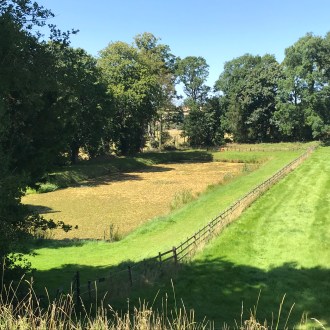
The lowest of the terraces and the pond
The terraces down the slope were still there – indeed they still are – although below the last terrace on the west a large rectangular pond had been created. It was fed by water from a spring a mile away, and is still there today having been restored in 2016.
The last terrace on the east overlooked a bowling alley.

The church still stood isolated and almost entirely fenced in as is the former orchard which had several more rectangular ponds – presumably for fish – fed from the rectangular pond at the foot of the terraces. There appear to be more trees and the whole design looks a bit more organized .

Hatton also created a large deer park, which is shown complete with deer, rabbits and a hunter! All that remains in this area today are some earthworks and small ponds. [For a detailed description of these see British History On-line]

Hatton hardly lived long enough to enjoy the fruits of his labours. He had not married and on his death in 1591 the estate passed to his nephew Sir William Newport who immediately changed his name to Hatton. Sir William had no need of such a huge palace, and, because he also inherited his uncle’s massive debts which amount to over £42,000, he was forced to start selling land and property, including the contents of the house. The empty mansion was then sold to James I who planned it to be the future home for his young second son, Charles, the Duke of York, later Charles I. James also decided “to allowe unto him that hath charge of the garden orchardes and walkes twelve pence by the daie and unto his man six pence by the daie.”

The following year John Norden wrote “with what industrye and toyle of man, the Garden hath bene raised, levelled, and formed out of a most craggye and unfitable Grounde now framed a most pleasante, sweete, and princely Place with divers walks, manie ascendings and descendings replenished also with manie delightfull trees of Fruit, artificially composed Arbors.”
The royal connection continued when Charles I was bought as a prisoner for 5 months in 1647 until he was “kidnapped” and taken to London. [More on that story here] It was a comfortable captivity, as apparently he was attended by 108 servants, and able to take exercise in the grounds as well as ride to neighbouring great houses such as Althorpe and Boughton. Charles was a “quick and lively” walker and his keeper, Lord Pembroke, had difficulty keeping up with him. His favourite walk was along the top of the terraces and is now known as the King’s Walk.

Like all crown property, Holdenby was seized by Parliament at the end of the Civil War, and in 1651 was surveyed and valued for sale by Parliamentary commissioners.

The “royal mansion-house … with its appurtenances, gardens, orchards, and walks, containing in the whole by estimation 38 acres 1 rood” was bought by Adam Baynes, a Parliamentary Army officer, for £22,299. He demolished almost the entire house, for the building materials which were estimated to be worth £6000 over and above the expense of taking them down. The stone was taken to build houses in Northampton. All he left standing was one small section of the offices which were converted in a small house.

He also acquired the 500 acres of well-wooded park which had 200 deer and a few wild cattle, valued at around £500 and with timber worth £2776. He sold the trees for their timber and abandoned the gardens. Although the house was returned to the crown at the Restoration it was, without the mansion, of no great interest or value and so quickly disposed of.
John Evelyn visited nearby Althorpe in July 1675 where, from the gardens, there was ” a prospect to Holmby House, which being demolished in the late civil wars, shows like a Roman ruin shaded by the trees about it, a stately, solemn, and pleasing view.” The ruin was visited by the Buck brothers who published a view of the palace in 1729 and by James Thornhill who sketched the remains around the same time.
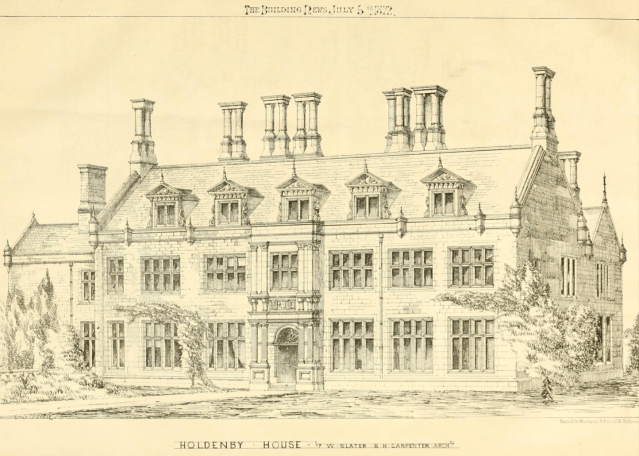
In 1709 the estate was bought by the Duke of Marlborough since when it has descended the female line to the Lowther family who remain its steadfast guardians today. There were no significant changes until between 1873 and 1875, when Viscount Clifden, the then owner extended and restored the surviving portion of the house in Elizabethan style.
This led to a nice story about architectural criticism. Building News was scathing about the architects Slater and Carpenter “pretending to carry us back to the days of the Tudors, with a porch built up with pilasters one above another like acrobats performing in the circus; dormers with pediments, like porkpie hats flattened down…. Eclecticism! Eclecticism! What horrors have not ere this been perpetrated in thy euphonious name!”
The following issue carried a response from Herbert Carpenter saying they read the comments with “some surprise and not a little amusement” since had the critic read the paragraph that accompanied the design he would have seen the work condemned was by John Thorpe who was presumed to be the original Elizabethan architect, and “he would have been spared the grief he says he felt at seeing such a building coming from our firm.! Criticism! Criticism! What horrors have not ere this been perpetrated in thy euphonious name.”
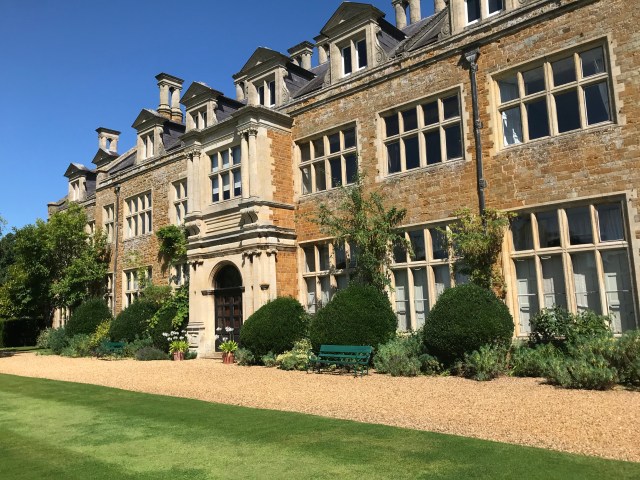
Although it was further extended in 1887-88 it still only occupies about one eighth of the footprint of Hatton’s mansion. There is a short video [1m 30s] on YouTube which shows the building’s history really well
The area immediately round the house was still littered with fragments of the old mansion when it was laid out as gardens by Clifden but he followed the advice of the architects “For the sake of preserving the lines of the ancient mention, that the gardens be laid out on the site of the quadrangles, preserving their shape.” This meant that the remains of the Elizabethan garden remained largely untouched.

The Elizabethan Garden

The Pond Garden
These late Victorian gardens have been updated and added to, modern designers including Rosemary Verey who, in 1980 designed a new Elizabethan Garden using plants only available in 1583, when the original house was completed. Its shape was copied from the centrepiece of Hatton’s garden. Working with Rupert Golby she also designed a Fragrant Garden and then in 1995 replanned the Pond Garden.
Holdenby is now run as an events venue and has a falconry centre, but the gardens are well worth a visit on their own account, as is the excellent tearoom in the Victorian stable yard.



 The Garden History Blog
You must be logged in to post a comment.