
 A family wedding took me to County Durham recently and on the way we passed The Angel of the North. It is such an extraordinary addition to the landscape that on the way home we did a detour and went to see it close up.
Now 25 years old its open arms greet visitors as they near Gateshead by road or rail and it’s pretty clear why The Angel has been voted year after year as one of the top UK landmarks in national newspapers and polls. It is also one of the most viewed pieces of art in the world, seen by more than one person every second. That’s at least 90,000 every day or 33 million every year! Not even the Mona Lisa can top that.
But what also intrigued me was the way that the landscape immediately around about the Angel has been transformed in a way that I’d guess neither Anthony Gormley who created it or Gateshead Council who commissioned it are likely to have expected.

From Making an angel [full reference at the end of the post]
As usual they are my own photos unless otherwise acknowledged

For those few of you who don’t know it, The Angel is a vast sculpture made from Cor-Ten steel designed by the artist Antony Gormley. It stands 20m [65ft] high, and spreads 54m [175ft] wide] beside the A1 in Gateshead in the North East of England. Just by way of comparison that’s taller than four double decker buses stacked up, and a wingspan as big as a jumbo jet.
Gateshead Council have a long and enviable reputation for developing flagship projects to give their town a sense of identity and confidence following post industrial decline, and also living in the shadow of nearby Newcastle. This had begun quite early with the building in 1955 of the first phase of what is now the Gateshead International Stadium on the site of a long defunct chemical works . The first stage of the huge Metrocentre followed in 1986 but in that same year the council also decided that because because it did not have its own contemporary art gallery, it would launch a formal Public Art Programme to take art out into the streets.

This was given a tremendous boost when, in 1990 Gateshead hosted the fourth National Garden Festival, [another post will follow one day on the 5 National Garden Festivals that were held between 1984 and 1992 ]. The Festival grounds occupied 200 acres and one and a half miles of largely abandoned riverside land, just 1,500 metres from the Tyne Bridge and had more than 70 temporary artworks on display. Both the gardens and art proved popular and successful and had a long term effect on the town and its culture,

The then Environment Minister, Chris Patten, called it “Britain’s environmental showpiece” and said it was ” a signpost to the future.” Prophetic words, because with those 70 artworks the festival paved the way for Gateshead’s increasing involvement in the field of public art which was to lead to The Angel of the North. The idea took off quickly with the Sunday Times declaring that “if you are at all interested in art and where it is going Gateshead is at the moment the centre of activity… a genuine attempt to wrest art out of the gallery and into our daily lives.”
Since then the town’s public art programme has led to the winning of a string of awards, and put it firmly on the arts map as a leading national innovator. Additionally, of course, all these projects have bought in new employment, reclaimed derelict land or buildings, enhanced the surroundings, generally improved the environment and raised civic and public morale.
 Having said all that you might be surprised by the question posed by Mike White who was the assistant director for arts and libraries at the time: “How long does it take a borough council to put up an angel?” The answer was, he said, “an almost biblical” seven years. Indeed the site of The Angel was chosen years before the artist or the subject of the piece had even been suggested.
While the Garden Festival was still running the public art panel decided that the site should be earmarked for a future landmark sculpture because of its prominence and clear visibility from the newly rerouted/upgraded A1 and A167 roads, as well as the main East Coast rail line. It was where the bathhouse for the Teams Colliery had stood but after the mines closed in the late 1960s it had been abandoned and become derelict. The buildings were cleared and a long low earth mound created waiting for something!
It was site in need of an artist with grand scale vision.

From Making an angel
Mike White went on to say that “we did not even know we were getting an angel for the first two years of our search.” It wasn’t until the end of 1993 that the panel drew up a list of potential artists who worked on such an enormous scale, but in the end it was narrowed down to just two – Anthony Caro who worked largely with abstract subjects and Anthony Gormley whose work was more figurative.
In the end it was Gormley’s vision that prevailed even though he was initially reluctant saying he didn’t make “roundabout art”. Thankfully he was persuaded to at least see the site. It was that changed his mind saying that that the hillock that had been piled up waiting for a sculpture “has the feeling of being a megalithic mound” and so he agreed to consider the idea further.
He had already been toying with ideas around angels and somehow this seemed to resonate with everybody else too. In an interview later he was clear that “it was the place that made the piece.”

From Making an angel

From Making an angel
For the council it was, as the then leader later said, ” a step in the dark … We thought of art before jobs, knowing that one would bring the other. It was an act of faith; but when we started to deliver, funding bodies knew we were solid. We certainly learned some collective lessons about the importance of having a vision”.
Much of the local media was rather negative at first about the idea of a giant and rather abstract angel – almost encouraging of opposition amongst the public. However, this tone changed as things became clearer and more was seen and understood about Gormley’s other works – one of which ‘Field for the British Isles’ was opened early in 1996.

From Making an angel
The result was a shift in popular opinion and even before The Angel was erected, the reception was much more positive. The Economist [27 January 1996] was typical in its view: “What nobody will do…is fail to notice it…it will proclaim to the 90,000 motorists who will pass its hilltop site next to the A1 each day that the arts in north-east England, unlike the grassed-over coal mine upon which it stands, are alive and kicking”.
Now of course Gormley didn’t physically make The Angel himself, although he and his studio were responsible for the maquettes and models which preceded it.
Like much of his other work, the figure is based on a cast of Gormley’s own body. That cast was then scanned by the Geomatics Department at Newcastle University and the precise co-ordinates plotted to create an electronic three-dimensional ‘Virtual Reality’ Angel. This in turn was converted into a three-dimensional computer-aided design model so that computerised profiling machines were able to cut the main body into ribs following the exact curves of the artist’s original castings. Those ribs were then supplied to Hartlepool Steel Fabrications for construction in weather resistant CVor-ten steel which contain copper so the surface oxidises and mellows to a rich rusty red-brown colour.

From Making an angel
The foundations for The Angel are almost as impressive as the artwork itself. Given that this was a former mine it was necessary to fill the old workings, and then add a series of 8 steel reinforced concrete piles with 150 tonnes of concrete poured to bond the sculpture into solid rock 20 metres below. Next came a concrete slab one and a half metres thick on top of the foundations and finally a concrete plinth another 5.3 metres high on which The Angel stands. Its wings are capable of withstanding a wind force of 100 mph by transmitting it along the ribs, down the body and into these foundations.

From Making an angel

From Making an angel
When the main elements – the body and two wings – were finished they arrived overnight on three low loaders from Hartlepool at a maximum speed of 15 mph. A 500 tonne crane then lowered the 100 tonne body of the Angel carefully into place. Once the body was secure, the 50 tonne wings were craned up, added and fixed into position before the “skin” was welded on . All this was carefully calculated and monitored by consulting engineers Ove Arup & Partners.
The Angel has quickly become a major tourist attraction and put Gateshead on the map. Gateshead Council’s most recent research suggests it’s actually visited by 8,000 per week (416,000 people every year). whereas prior to installation, visitors were estimated at only 150,000 a year. This is despite the fact that the Council, backed by Gormley, have not allowed any commercialisation of the site, apart from the local pub changing its name to the Angel View. Otherwise the biggest change is that one of six northern long distance walking routes, known as the Northern Saints Trails because they are based on ancient pilgrimage routes , is now The Angel Way.
Success breeds success and together with the Garden Festival the Angel became the precursor to one of the largest urban regeneration programmes in Europe. This has included the Gateshead Millennium Bridge , the BALTIC Centre for Contemporary Art, the Sage Gateshead and the Northern Design Centre. Who says that gardens and the arts can’t change economies as well as lives?
And on that note, initially there were a lot of critics of the cost. The whole project came in at about £800,000 all of which came from money already allocated for arts projects because the Council were adept at raising grant funding. The exploratory stages were funded by Northern Arts and it was awarded £584,000 by the Lottery Fund with the European Regional Development Fund giving another £150,000, so despite what people were told or believed, no local council taxes were spent on the sculpture at all.


So what’s it actually like “close-up”? It would be easy to dismiss it as just “The Colossus of Roads” but it is pretty overwhelming really. What particularly interested me was that while visitors were clearly expected perhaps to stroll around and perhaps gawp for a few minutes the whole area around it has assumed a new quality.
The original landscaping was pretty minimal, a few dozen car parking spaces, and a bit of “native ” planting and lots of grass. The “woodland” area is now pretty straggly but its been adapted by paths trodden through it, clearings made, and what can onlybe described as shrines set up in and around the fringes.
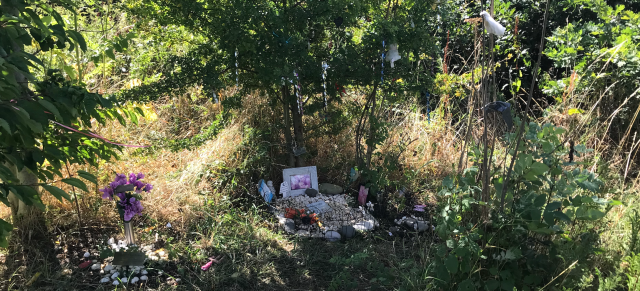
Flowers, painted stones and  signs, messages and poems usually in memory of loved ones are hung on and around trees, or indeed almost anywhere. And in the here and now there were people clambering up round its feet, being photographed against it, or in its shadow, Kids were chasing each round it while couples held hands gazing up. Clearly The Angel has got into the hearts and minds of locals.
I said in the opening paragraph that this was probably not something that either the Council or the artist would have expected, but perhaps I’m wrong in assuming that.
Interviewed in 2015 in the Independent Sir Anthony, as he has been since 2014, said he went back to see to The Angel: “And, you know, people are spreading ashes, leaving tokens for lost loved ones… It’s clear that the work is doing something that people need to be done. A place to think about the thresholds between life and death, a place where the provisional nature of daily human life can somehow make contact with something bigger, or wider, or whatever. That’s a function that religious or sacred buildings have had in the past. And I think that’s a vital job.”
“I want to make something that we can live with and that becomes a reservoir for feelings…feelings that we hadn’t known about until this thing was there, or feelings that couldn’t arise until it was.” In that he certainly seems to have succeeded.


 The Garden History Blog

You must be logged in to post a comment.