

Like most gardeners I’m used to discovering that various crops have been attacked by insects. This summer it was particularly that old favourite the flea beetle on brassicas – no broccoli or rocket survived their depredations almost overnight.
I don’t like spraying but there are times when I feel ready to say “organic gardening be damned!” It made me wonder how our ancestors coped with garden pests so this week and next I’m going to explore some of the ways they did.
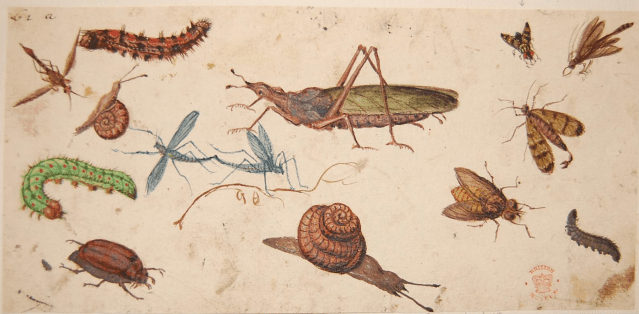

I was prompted to write about this by a talk earlier this year by Jill Francis in the Gardens Trust on-line programme. She showed how problems with pests and diseases are as old as agriculture and gardening itself. When humans started domesticating plants they went into competition with insects and other creatures who, just like us, were using plants as their food source. That’s clearly evidenced in the Bible with, amongst other things, the plague of locusts in ancient Egypt but there are plenty of other examples….

…including this wonderful image on a 13thc illuminated manuscript showing the prophet Joel admonishing a locust feeding on diseased wheat while another bug is about to start work eating the top of a neighbouring plant.

So how did people in the past deal with these nuisances? Basically there are only 3 ways -physically removing pests, biological controls or chemicals, although in the distant past there were 4 because many civilisations invoked the supernatural, religion and magic. In most parts of the world agricultural and horticultural crops were thought to be the responsibility of deities whose protection was invoked at various ceremonies. Pests and diseases led to poor harvests and were thought to be the punishment for sin or lack of piety. Egyptian pharaohs would invoke the Nile to promote fertility while the Romans had the festival of Robigalia, to hail the growing season, with sacrificial elements to prevent crop failure. Such beliefs and practices lasted a very long time although nowadays they are rare. When, for example, was the last time you attended a Rogation Sunday service or even heard about one taking place even on that hotbed of tradition in agriculture The Archers?
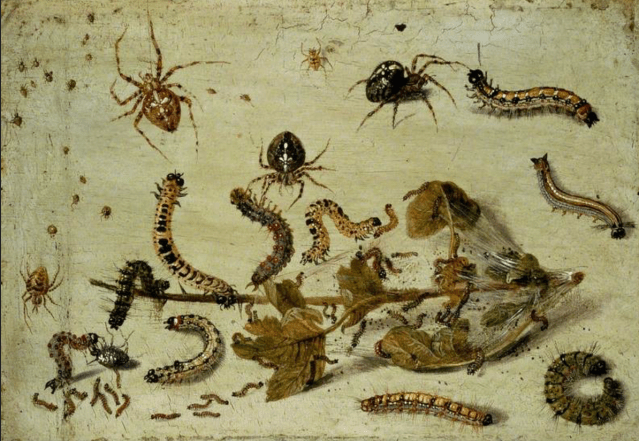
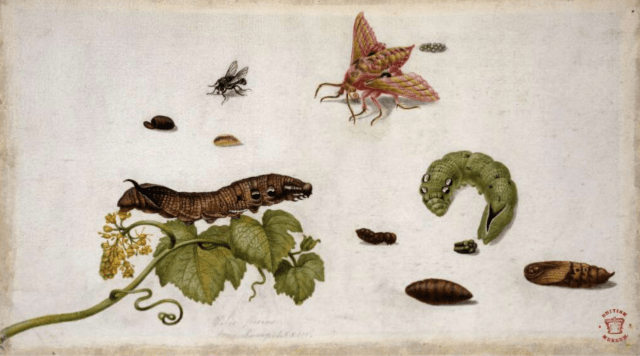
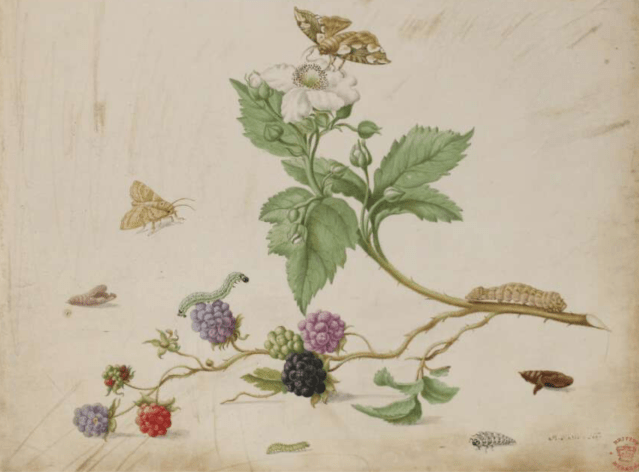
Various Spiders and Caterpillars, with a Sprig of Gooseberry
by Jan van Kessel the elder (1626–1679), Ashmolean Museum, Oxford

At the same time there was a belief that certain animals were responsible and they should be dealt with. Toads always used to get a bad press and were buried in pots, or nailed to doors on barns to keep pests away and ward off lightning. But they’re not the only ones, almost all “creepy-crawlies” and “worms” were also considered a nuisance as were every kind of mole, vole or mouse and almost every bird. Many were in competition with man for valuable food resources.
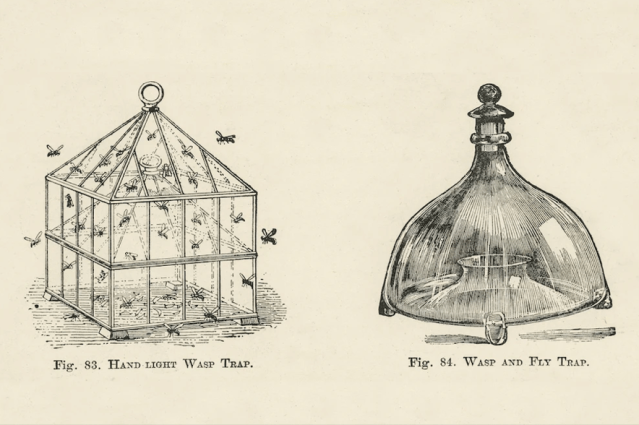
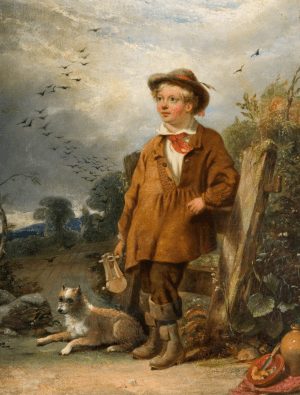
They had to be dealt with. Obviously the main ways to do that are what we all probably do now. We scare them off if we can. We physically remove and deal with those we can’t, or we can always do as many Victorian and Edwardian gardeners did and resort to some simple technology, which has often not changed much since their day.

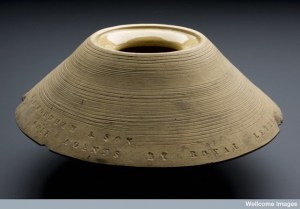
Earthenware beetle trap, late 19thc Encouraged by food placed within the trap, beetles and other crawling insects climb up the ridged sides and fall into the hole, & become trapped as the inside is smooth, so they are unable to climb out again.
If possible we physically prevent the pest from reaching the plant in the first place – netting, cloches etc, if those don’t work we might try companion planting. If none of that works either unless we can find pest resistant varieties we’re more likely to simply stop growing a particular plant. I can’t be the only person who doesn’t bother with lilies any more because of those pesky vermillion lily beetles whose foul-looking grubs left every stem gnawed and leafless almost overnight.
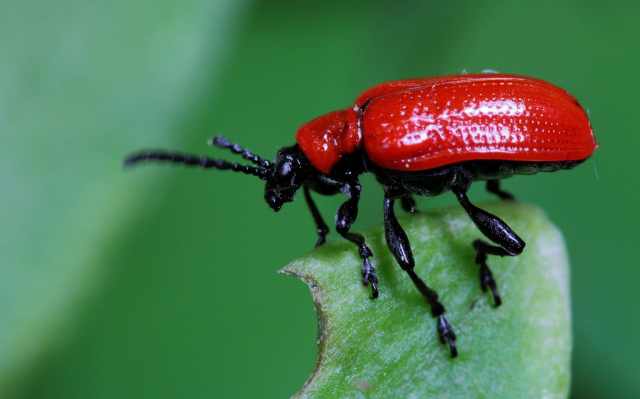
I don’t have the time, energy or patience, and in fact these days as older age creeps on and the joints get a bit creakier and stiffer I’m quite zen about most garden pests, taking a lesson from Shirley Hibberd:
“We must confess we do not trouble ourselves much about vermin, for life seems to be too short for such small things to interfere with our happiness. We mentally ignore their existence, and they probably sicken through loss of importance, for we so rarely suffer by their depredations, that we know of no better way than to persuade oneself that such things exist only in morbid imaginations.”
However not everyone takes the same view. Cleverer people than me in the past saved themselves a lot of effort when they noticed that some pests have predators so they introduced or encouraged them to come and deal with the problem. These days this is part of what we’d call “biological control” although as a term that was only first used in 1919. Of course the concept is probably as old as the domestication of plants for food in prehistory because most gardeners and farmers had some understanding the balance of nature involved and were able to manipulate it to their own advantage.
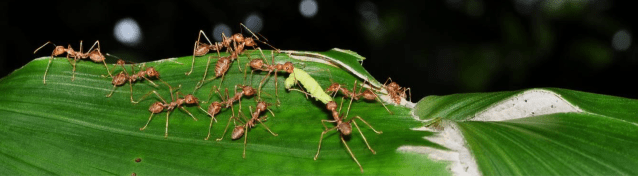
A group of weaver ants bringing a green noctuid caterpillar back to its aerial nest
https://lkcnhm.nus.edu.sg/wp-content/uploads/sites/10/app/uploads/2017/04/2012nis039-056.pdf
The earliest documentary evidence of the deliberate introductions of a predator comes from a Chinese botanical text Nanfang caomu zhuang or Plants of the Southern Regions supposedly dating from as early as 304. [Some scholars dispute its age and claim its is actually from the 12thc but even so its very early]. It contains an entry about mandarin oranges and how to protect the trees and fruit using weaver ants.

These tree-dwelling ants, officially Oecophylla smaragdina, and known as the “yellow fear ant” bind leaves and twigs together with silk to form tight nests where they live at night. Nests could be bought in the market and placed into the orange trees where the ants would forage during the day for various insects particularly caterpillars that attack the trees and their fruit. But better than that, if ropes were tied between trees to act as miniature bridges the ants would then colonise neighbouring trees, and continue their good work.
Since then their use has spread and they are still a fairly common form of crop protection used by indigenous farmers through the whole of south east Asia on many commercial crops including mango, cocoa, coffee, cashew as well as citrus.

[For more information see: “A historical review of research on the weaver ant Oecophylla in biological control”, by Paul Van Male, in Agricultural and Forest Entomology, Feb 2008, and Biological Control of Pests in China, US Department of Agriculture 1979]
A similar story was reported by the Finnish naturalist Pehr Forsskål, a pupil of Linnaeus, who went plant hunting in the Yemen.
In his Flora Aegyptiaco-Arabica published in 1775 he mentions that each year date farmers there brought colonies of a predatory ant down from the mountains and put them among their date palms to help control pests insects.
Although there’s no time here to go into in any depth its also worth noting the long and complex relationship between ants and caterpillars of many species across the globe, which is often symbiotic or perhaps parasitic rather than predatory. If you’re interested in knowing more there’s a good but heavily scientific article, “The Natural History of Caterpillar-Ant Associations”, by Naomi E Pierce & Even Dankowicz [2022]
Europe seems to have been a long way behind in recognising the value of harnessing such natural predators, with the first person to do so probably being none other than Carl Linnaeus, who wrote in 1752: “since people noted the damage done by insects, thought has been given to ways of getting rid of them, but so far nobody has thought of getting rid of insects with insects. Every insect has its predator which follows and destroys it. Such predatory insects should be caught and used for disinfesting crop-plants.’ [ “Linnaeus, animals and man”, Sven Horstadius, Biological Journal of the Linnean Society, Dec 1974]
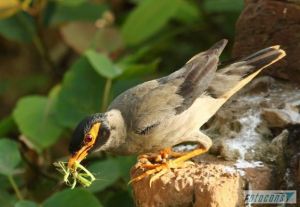
The next logical step was taken with the introduction of a non-native predator to deal with pests. That first occurred just a decade later but it wasn’t done by deliberately bringing in “foreign” insects to deal with a problem but instead by bringing in “foreign” birds. In the mid-18thc the sugarcane plantations on Mauritius suffered from periodic invasions by red locusts which caused immense damage. In 1762 in order to find a solution to the problem, a French colonial official, Louis Laurent de Féderbe, Comte de Modave, bought over mynah birds from India, and by 1770 they were credited with the successful control of the locust. Its success led to mynahs being introduced into many other places in the tropics outside their original range, including Southern Africa, Indonesia, Australasia, and various island groups in the Pacific. Of course there is always a downside. Not only were they in competition for food, nest sites and territory with indigenous birds but while they do eat significant numbers of insect pests, they also cause considerable crop damage themselves, particularly in orchards and vegetable gardens. The pest problem solver became a pest itself. [See CABI Digital Library for more information]
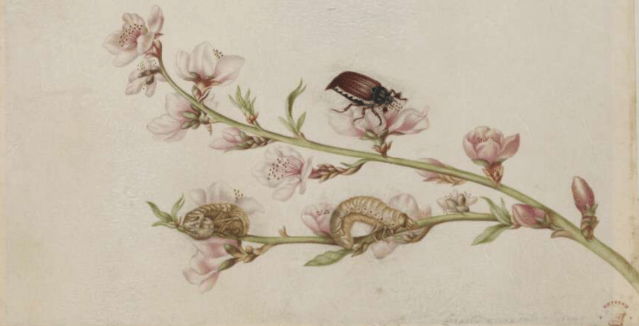

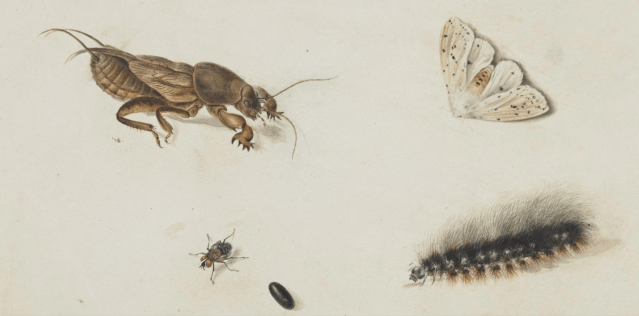
Alongside this there was an increasing understanding of insects which were parasitic on other insects. In Europe this was first documented by an Italian naturalist Ulisse Aldrovandi in 1602 although it was another 60 years before, in 1662, Johannes Goedart published an illustration in Metamorphosis Naturalis and described “small flies” emerging from butterfly pupae although he had little understanding of what was actually going on. In fact it’s an important stage in evolutionary biology technically known as Parasitoidism. This is when an organism lives in/on a host organism at the host’s expense, and which eventually leads to the host’s death. It is just one step away from being a predator.
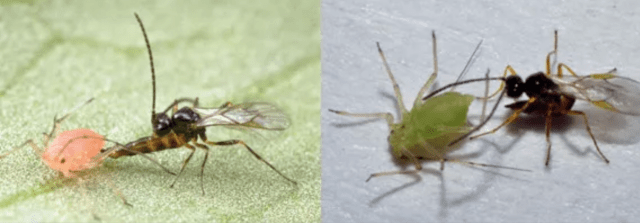
Observations and experiments continued throughout the 18thc until in Erasmus Darwin (1800), the grandfather of Charles, published Phytologia in which he discussed the possible role of these parasitic insects in regulating other insect pests such as aphids in hothouses. This is picked up in by William Kirby and William Spence in An Introduction to Entomology published between 1815 and 1826 and which is a crucial text for the establishment of entomology as a science.

They give a rather vivid account of the devouring of aphids by a predatory larva: “When disposed to feed, he fixes himself by his tail, and, being blind, gropes ‘about on every side, as the Cyclops did for Ulysses and his companions, till he touches one, which he immediately transfixes with his trident, elevates into the air, that he may not be disturbed by its struggles, and soon devours. The havoc which these grubs make amongst the Aphides is astonishing. Later “not an individual remained; but beneath each leaf are three or four full-fed larvae of aphidivorous flies, surrounded with heaps of the skins of the slain, the trophies of their successful warfare; and the young shoots, whose progress had been entirely checked by the abstraction of sap, are again expanding vigorously.”
However even then one other insect was recognised as a being a super-predator: “the lady-bird or lady-cow the favourite of our childhood.” The value of ladybirds was already clear to Kirby and Spence. They were known to be moved around by gardeners and farmers and when, for example, hop-fields were attacked by aphids the owners employed boys to scare away the birds that were eating the ladybirds.
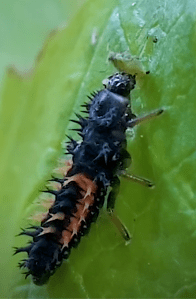
By the 1840s there were experiments across Europe notably by a Professor Boisgiraud of Poitiers in France who collected and translocated insect predators to his garden to control gypsy moth larvae and earwigs. Thats fine on a local scale but the risks of moving insects round on a larger scale soon became apparent, notably in the USA where by the mid 19thc accidentally imported European insect pests began to ravage gardens and fields and were uncontrollable because, unlike in Europe, they had no predators. The decision was made to try and import some of these natural predators with one entomologist arguing that as “Accident has furnished us with the ban; science must furnish us with the remedy… so … wherever a Noxious European Insect becomes accidentally domiciled among us, we should at once import the parasites and Cannibals that prey upon it at home.’ [Benjamin Walsh, state entomologist for mIllinois 1866]

Several cases where this happened stand out. Probably the first known deliberate intercontinental transfer of an insect predator was when in 1883 a large batch of Apanteles glomeratus, a common and fairly effective parasite of the cabbage white butterfly was sent over from Britain. This was, as it happens, the same species observed by Aldrovandi in 1602. It was soon established at several locations across the US and is now very widely spread and remains today one of the more effective enemies of the cabbage white. [For a close-up view of how this happens see The Body Invaders on Youtube]
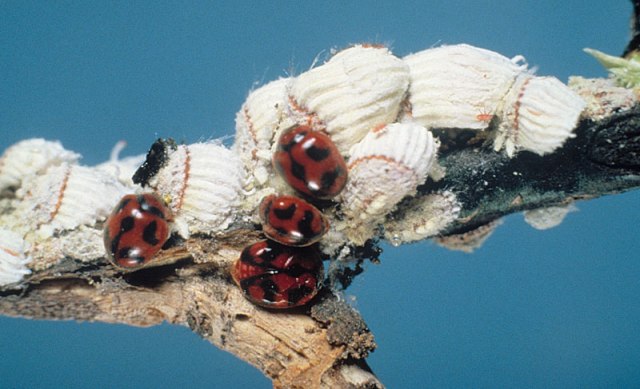
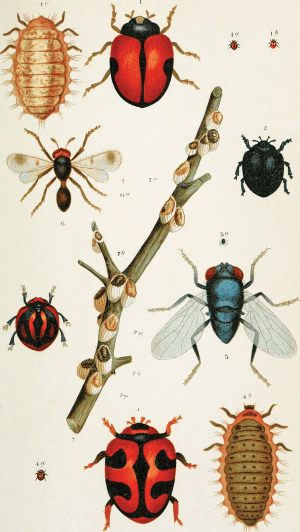
The second major import was in response to a major crisis. In the late 1860s a pest called cottony-cushion scale, [Icerya purchasi] was discovered in California the home of a new and rapidly growing citrus growing industry. It spread rapidly and attacked citrus trees almost to the point of destruction. Government entomologists began to work on its control and sent a parasite collector, Albert Koebele to Australia where it was thought the scale had originated. It was quite rare there because, as he eventually discovered it was kept in check by the vedalia beetle, a variety of ladybird [now technically as Novius cardinalis ]. Larvae were imported and the scale insect became the first pest to be beaten by importation of a natural enemy, and saving the California citrus industry in the process.
But believe it or not there were those, who as we’ll see next week, preferred chemical controls to natural ones. From the 1940s DDT began to be used to protect citrus crops, but at the price of the virtual extinction of the vedalia beetle. Without its predator the cottony-cushion scale bug resumed its attacks, almost immune to the DDT. One observer described the orange groves as appearing to be covered in snow because of the density of the cottony egg masses. Many trees died, while groves were defoliated and crops lost and within 3 years the use of DDT was abandoned although to regain control quickly, growers were forced to pay up to a dollar for each new vedalia beetle. [For more on this see an article by Martin Kernan in Smithsonian Magazine, Jan 2022]

It worked both ways of course and in the first international shipment of an insect as a biological control agent was made by Charles V. Riley in 1873, the state entomologist of Missouri who sent batches of the predatory mites Tyroglyphus phylloxera to France to help fight the grapevine phylloxera that was destroying grapevines there.
After that it was almost open house with insects in particular, being moved around the world often in the tracks of the plants they had “protected” in their place of origin. BUT alongside these “natural” methods insecticides and other other chemical controls were also in use in ever increasing quantities as we will see in another post soon.


 The Garden History Blog


You must be logged in to post a comment.