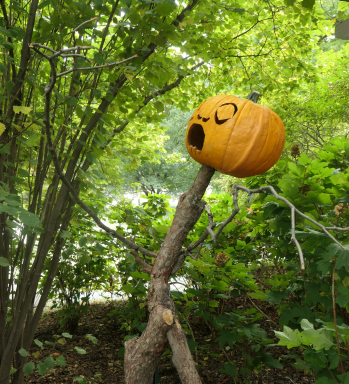
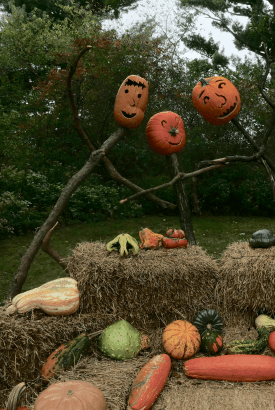
In New York Botanical Garden 2019
It’s that time of the year again when, in most parts of the western world, shops have been stocking up on pumpkins for Halloween. I admit its not a celebration I particularly like but even so I’ve often wondered why a big orange fruit from North America should have anything to do with All Saints Eve, so I thought I’d investigate a bit further.
What I discovered is that although man’s association with pumpkins and squash of all kinds goes back more than 10,000 years their association with Halloween is much much more recent and, of course, is really nothing to do with pumpkins at all!
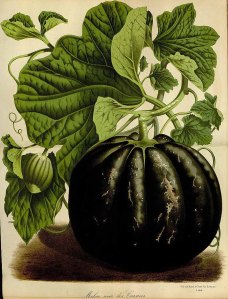
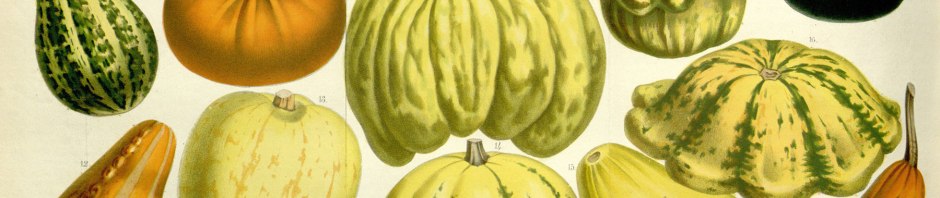
If you go to a decent farmers market, or even a good supermarket you’ll find several varieties of squash on sale not just the standard orange football. And if you go to a good seed merchants catalogue you’ll find dozens more sorts for growing in your own garden. Despite the enormous diversity of size shape and colour they all belong to one genus Cucurbita – which is divided into just half a dozen main crop species or subspecies. One of them Cucurbita pepo contains most of the ones we eat. And it’s worth pointing out that although most people probably think of pumpkins and squash as a vegetable they are all actually fruit because, like berries and apples, a pumpkin is simply a seed pod that develops from a flower.
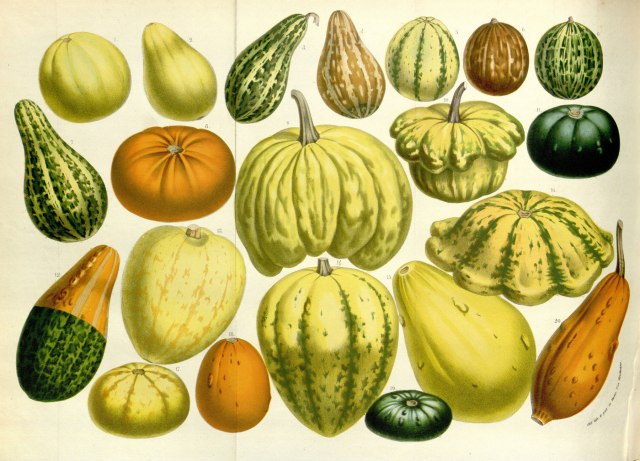
Their ancestors originated in Central America and neighbouring regions in both north and south America, and it’s there, particularly in Mexico, that there is still the greatest diversity of wild squashes surviving. These wild species tend to be bitter in taste, with small hard-skinned round fruit although the seeds inside are both tasty and nutritious. Their evolutionary history is complex but suffice it to say the various “wild” species easily cross with each other and once man had intervened in that process it has enabled the development of drought- and disease-resistant cultivars.
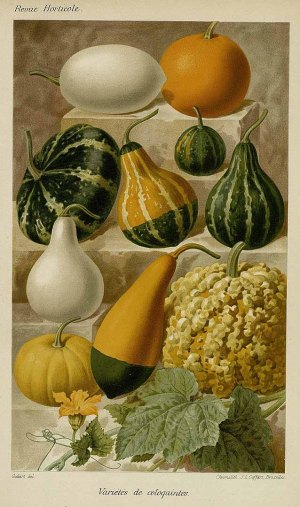
The earliest archaeological evidence of man’s involvement with cucurbits is also from Mexico 10,000 years ago, and suggests that C. pepo was one of the earliest food-crops to be domesticated. That’s roughly the same time period that crops such as wheat and barley were being domesticated in the Middle East’s Fertile Crescent, but much earlier than the emergence of the other two indigenous staple crops of early Americans- maize and beans.
Around 5000 years later there was a second independent domestication of C. pepo this time in the eastern parts of North America when the indigenous people domesticated a group of yellow and green squashes which later evolved into the softer skinned pattypans, acorn squash and ornamental gourds. [For more on this see “Domesticated Plants in Early Virginia Indian Society” in Encyclopaedia Virginia]
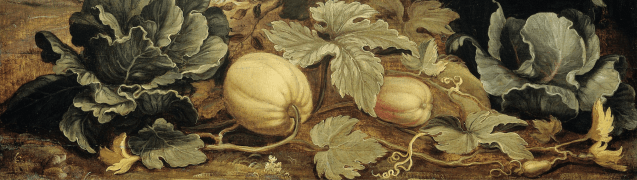
Both these events were part of the move from a nomadic to a more settled agricultural lifestyle. By 2500 BC Native Americans in the Southwest were cultivating corn, beans and squash on farms, and given the bitterness of the wild sorts, that was probably for their seeds rather than the flesh.
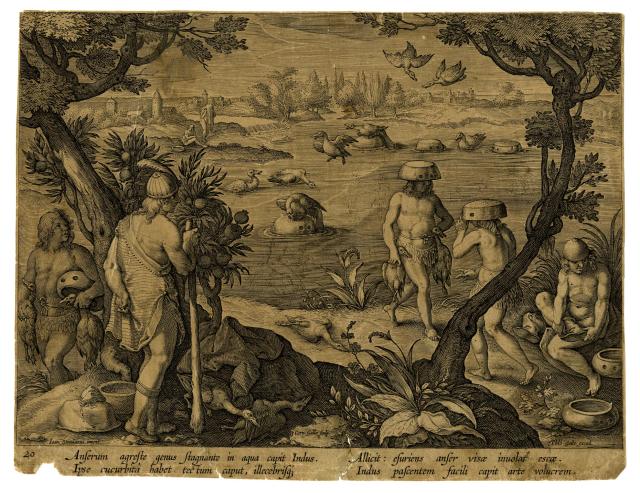
Indians Catching Ducks with Pumpkins, 1596 the hunters submerge themselves in the water wearing carved out pumpkins on their heads, if/when the ducks land on them they can then be caught
Somehow -and no one knows how when and why – these early small bitter fruit evolved into the big fat edible squashes and pumpkins which were being grown in many parts of the Americas when the first Europeans arrived in the early 16th century. Journals and letters record how they were sufficiently improved to be able to be stored for use during cold weather or times of scarcity, or even to be used for other purposes such as catching ducks! However, ethnobotanists are working on new research methods to track plant movements and explain how these changes might have happened. [For more on this see Gayle Fritz, “Gender and the Early Cultivation of Gourds in Eastern North America”, in American Antiquity July 1999]
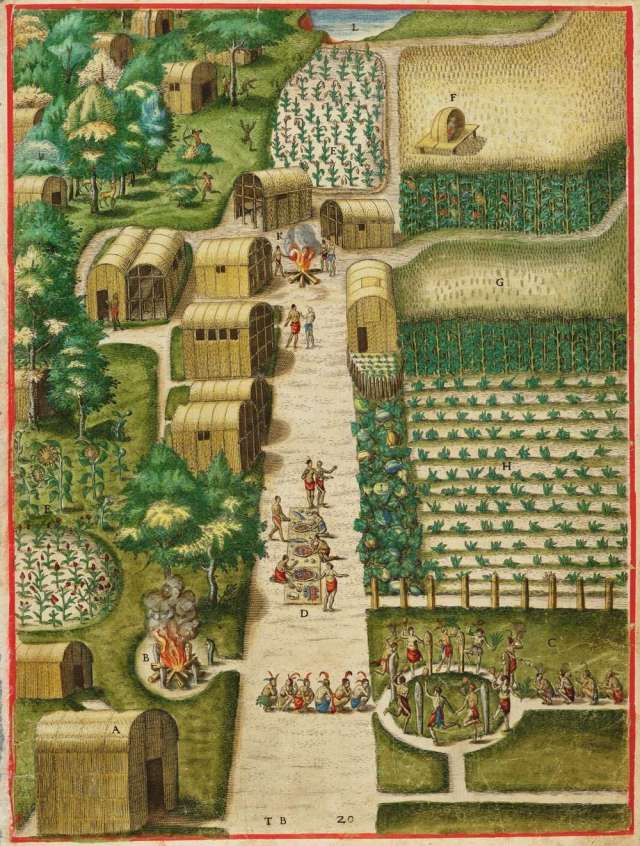
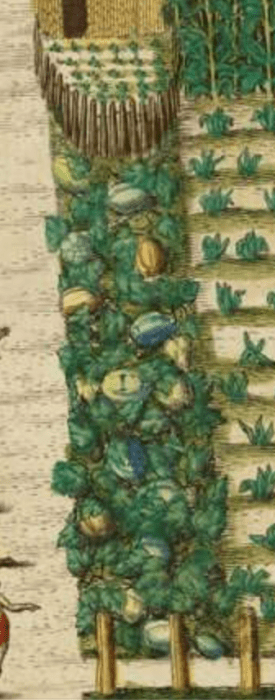
As we can see from the engraving in Thomas Harriot, Briefe and True Report of the New Found Land of Virginia (1588) pumpkins had become an important basic food stuff – one of what the Iroquois called the three sisters – with maize and beans which were grown together, and often cooked together. All three were dependable, easy to grow, prolific and good to eat.
The engraving is based on a water colour by Captain John Smith the leader of the Roanoke expedition and its shows three fields of maize growing along the right side of the image. In the topmost field there’s a watchman in a hut on stilts to scare birds away. There are also fields of tobacco (top centre), some sunflowers and a large pumpkin patch containing several different sorts.
According to Harriot, the Algonquians used a single term, macocqwer, for what he called “Pompoins, Mellions, and Gourdes” although of course there were no melons in the Americas at this time. In 1584 another early visitor Arthur Barlowe had already mistakenly described some kind of squash as cucumbers, although they too had not really reached the Americas by this time.
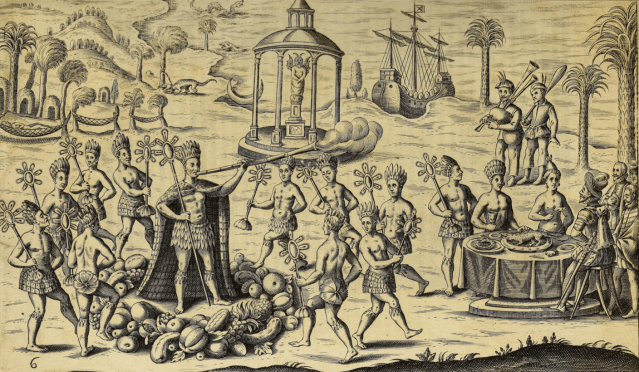
Another sign of their importance can be seen in this 1621 engraving where fruits of all kinds, including several sorts of squash, surround the local chief while his people prepare a feast for the Spanish. Incidentally the word squash derives from the Narragansett language word, askutasquash, which rather surprisingly meant “eaten raw or uncooked.”
So when and how did pumpkins reach Europe? Pretty quickly is the short answer. We know that when Columbus returned he bought “all kinds of seeds’” which were distributed not just to the Spanish crown but other important figures as diplomatic gifts. Over the next twenty years there were literally scores of expeditions to the Americas all of which are likely to have done the same. Because squash are annuals and each fruit contains hundreds of seed which are easy to propagate and share with others, they soon spread round Western Europe.
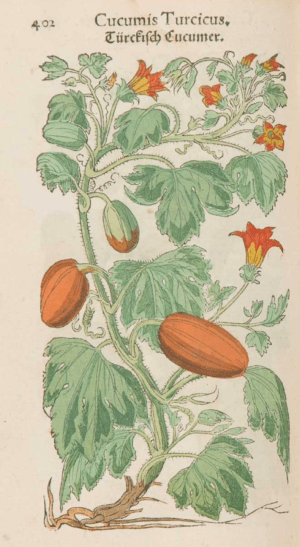
We know, for example, that some were sent to the French king because Cucurbita pepo subsp. texana, which as its name implies comes from the coastal region of southern Texas, was soon growing in one of the royal gardens in the Loire Valley.
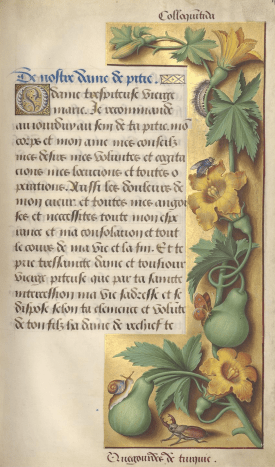
In the earliest depiction of any American squash the plant appears in the private prayer book of the French queen which was painted between 1503 and 1508. You’ll see they are described there as quegourdes de turquie implying that they came from Turkey. Quegourdes was a term the name given to European gourds [now technically Lagenaria] but because this new plant was recognised as being different it was given the label “Turkish” a generic term used for many new exotics.
For example, one of the two C. pepo pumpkins appearing in Leonhard Fuchs Herbal of 1542) is labelled “Turkish cucumber” (‘Türckisch Cucumer’) while maize is described as “Turkish corn” (‘Türckisch Korn”) although both are native American plants.
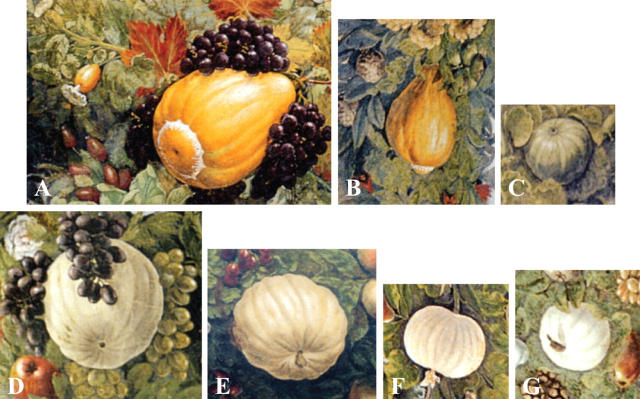
Squash from the Villa Farnesina ceiling, by Giovanni da Udine, 1515-1518 Cucurbita maxima (pumpkin): (A and B) orange show pumpkin; (C) grey pumpkin; (D–G) white show pumpkin. Caneva (1992b) classified (A) and (B) as Cucurbita moschata, (C) as Citrullus colocynthis and (D)–(G) as Cucumis melo var. inodorus.
Not long afterwards an even greater variety of squash of all kinds are depicted in murals at the Villa Farnesina in Rome, built between 1506 and 1510 for Agostino Chigi, who was the the Pope’s banker. These paintings include several sorts of Old World members of the family but also two or three species of New World ones in various forms. Analysis suggests they are portraits of real fruits, complete with all their defects and diseases, which were growing in the villa’s garden.
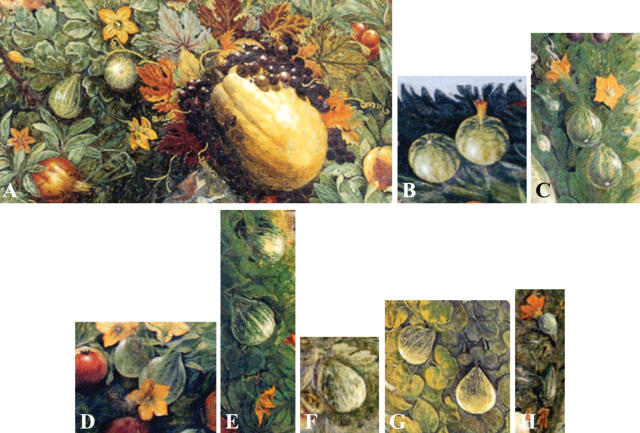
Squash from the Villa Farnesina ceiling, by Giovanni da Udine 1515-1518 Cucurbita pepo (pumpkin, gourd): (A and B) pumpkin group; (C–H) oviform and pyriform gourds. Caneva (1992b) classified (A) as Cucurbita maxima and (B)–(H) as C. pepo.
There was one big problem. No-one knew how to classify all these new plants and so tried to fit them into existing botanical families, using the name of what they thought was the nearest European equivalent. Pepo in Latin and Pepon in Greek were already terms used for large gourds or melons so it was easy to apply them to their American relatives. This became Popon in French and then by 1526 they are referred to as pompons in English and later as pompine, pumpians, pompeons and several other variants. The Oxford English Dictionary has 1647 as marking the first use of the word pumpkin: “our pumpkin blasted braines” which in another edition of the same book becomes “our bewildered brains”.
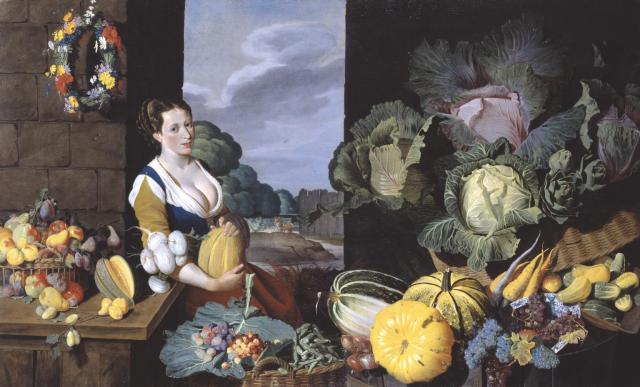
What perhaps is equally surprising is that when squash first arrived in Western Europe they didn’t catch on as a food crop, despite being known as part of the diet of native Americans. It’s also worth remembering that much the same is true of potatoes, tomatoes and maize. They rarely appear in early cookbooks and when, from the later 16thc there is evidence of pumpkins being eaten, it’s mainly by peasants rather than the elite. They were however grown for use in medicine and as ornamentals hence their appearance in still lifes.
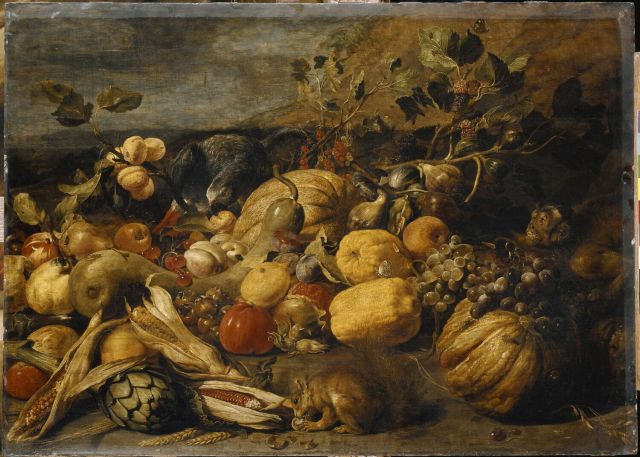
In the Americas the first European settlers had very little choice but to adapt to what was grown even though they still hankered after familiar foodstuffs from home. “The want of English graine, Wheate, Barly and Rie proved a fore affliction to some stomacks, who could not live upon Indian Bread and water, yet were they compelled to it …instead of Apples and Peares, they had Pomkins and Squashes of divers kinds, their lonesome condition was very grievous.” [ from Edward Johnson Wonder-working providence of Sions Saviour in New England, 1654]
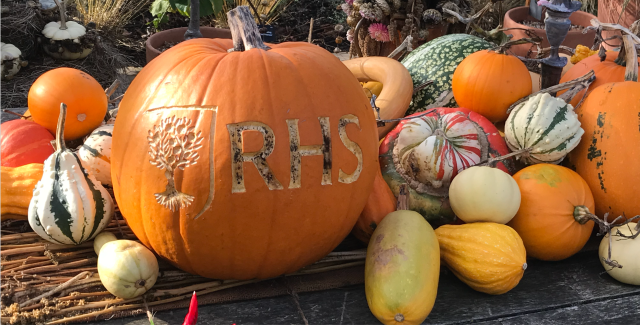
Part of a display at Wisley this week
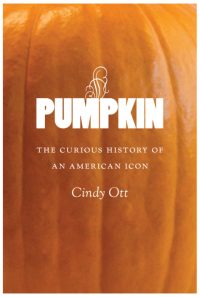
It’s widely believed that Thanksgiving day in America with its Pumpkin Pie is a commemoration of the Pilgrims Fathers first harvest but actually there’s no record of pumpkins being eaten then, or indeed on any of these early celebrations. Indeed Pumpkin Pie doesn’t appear as a recipe until 1796 in American Cookery, by Amelia Simmons. The way that Thanksgiving is celebrated today has, as Cindy Ott points out, “less to do with historic fact them with national mythology is created generations later…” [For more on how that happened see Cindy Ott’s book Pumpkin]
But how and why pumpkins did become associated with Halloween?
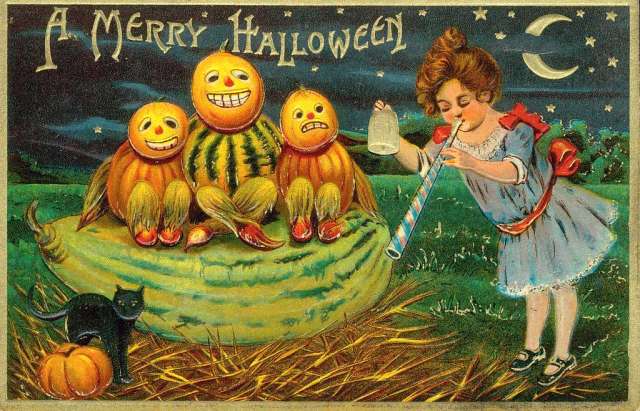
Halloween is another one of those ancient pagan festivals that was appropriated by the Christian Church. It’s origins are probably connected with the Celtic festival of Samhain which not only marked the end of the harvest season and the beginning of winter, but also a time when the boundary between this world and “The Otherworld” was easier to cross making it essentially a festival for the dead. Rather than extinguish old customs, church leaders simply Christianised them, even moving the date of All Saints Day from May to November 1st, so that it and All Souls’ Day replaced Samhain. However there’s plenty of evidence that these “new” feast days, together with the All Saints eve which was often referred to as Hallowmas, co-existed in Europe with the old pagan rites for hundreds of years.
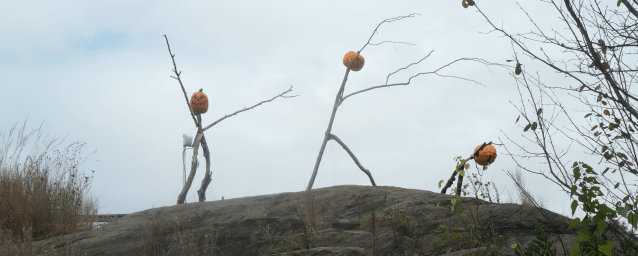
Wisley, Oct 2023
The 19thc saw the rise of interest in creating new national identities all across Europe. Often this was based on folklore with old stories reworked and given new life. One strand of this saw a great revival of interest in Celtic legends and culture and with the mass immigration of Scots and Irish people to North America those stories went with them.
One of them was that of “Stingy Jack” first recorded as far as I can see in the Dublin Penny Journal for January 16th 1836. However, the version there bears little relation to the more commonly circulated version which tell how Jack tricked the Devil and ended up paying the price. Having invited the Devil for a drink with him Jack convinced the Devil to turn himself into a coin to pay for the round. But Jack immediately put the coin into his pocket which also contained a silver cross. That stopped the Devil returning to his original form. He later relented and freed the Devil on condition that he would not bother Jack for one year and that, should Jack die, he would not claim his soul. When the Devil returned the following year, Jack persuaded him to climb an apple tree to pick some fruit. Jack then carved a sign of the cross on the trunk a sign so powerful the Devil was unable to come down. To escape he had to promise Jack ten more years of freedom under the same conditions.
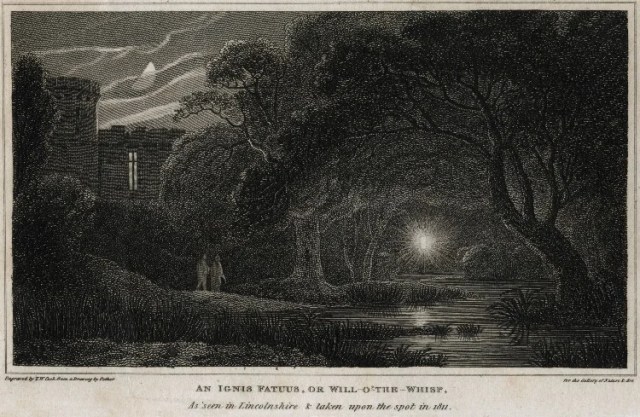
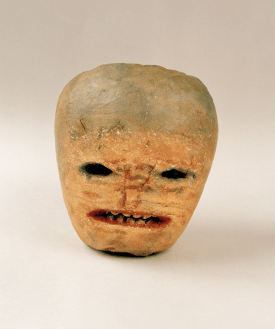
Eventually of course Jack did die. But God would not allow such a trickster into heaven and the Devil was so annoyed he would not let Jack into Hell either. Instead he sent him off into the night with only a burning coal to light his way. To make it easier to carry Jack put the coal into a hole he carved in a turnip [probably actually what the English now call a swede – short for Swedish turnip] and began to wander the earth carrying his ghostly light. This explains his Irish nickname of “Jack O’Lantern.”
Actually that story probably arose as a way of accounting for a strange natural phenomenon: the Will-o’-the-wisp. These are small glowing “clouds” of marsh gas – that sometimes rise out of swampy ground, ignite and appear to float through the night. Because of their ghostly appearance they were once believed to be the spirits of the dead, wandering through the countryside like Jack.
xxx
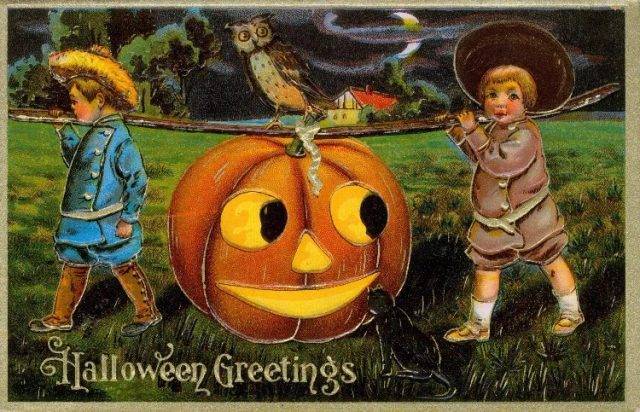
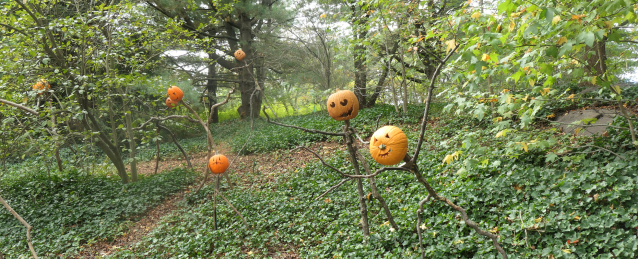
To frighten Jack away people in Scotland and Ireland began to make their own versions of his lantern, carving scary faces into mangels, swedes or turnips leaving them by their doors or in their windows. In their new homes in North American pumpkins were larger and much easier to carve so they switched to using them instead.
The tradition shows up as early as 1835 with a mention in Nathaniel Hawthorne’s short stories “The Great Carbuncle,”and “Feathertop,” in 1852, about a scarecrow with a carved pumpkin head. However a pumpkin had already been used as a head in “The Legend of Sleepy Hollow”, a ghost story by Washington Irvine dating from 1820.
None of these mention Halloween.
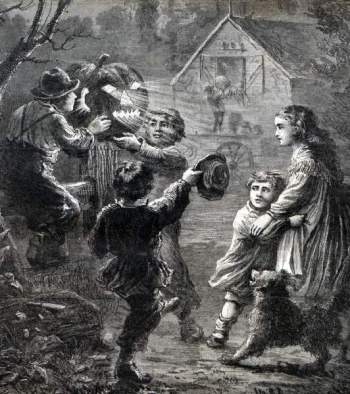
 The first image of a Jack o’lantern made from a pumpkin that I can find isn’t until November 1867, and in the accompanying article its said that the idea came from the use of turnip lanterns on Guy Fawkes Night in England. [That’s a new Guy Fawkes custom to me – anyone heard of it before?] It also reprinted “The Pumpkin” a poem by John Greenleaf Whittier published in 1844 which suggests the custom was much earlier. It includes the lines:
Oh, fruit loved of boyhood! the old days recalling,
When wood-grapes were purpling and brown nuts were falling!
When wild, ugly faces we carved in its skin,
Glaring out through the dark with a candle within!
Pumpkins became ubiquitous, particularly in America, during the 19thc, with pumpkin growing competitions and more recently pumpkin smashing events after Halloween added to the “tradition”. It helped that many in the Hispanic communities of America celebrated the Day of the Dead, and that African Americans in the south had their own version known as Jack-ma-lantern. As the global influence of American culture has spread so these various adaptations of Halloween customs have been transferred back to Europe where they originated, but also to parts of the world, like the Far East which have none of the same traditions. So Happy Halloween!
For more information the best source is Cindy Ott’s Pumpkin, The Curious History of an American Icon, 2012. On-line there’s Lesley Bannatyne’s Halloween : an American holiday, an American history, 1998, although there’s not that much about pumpkins in it.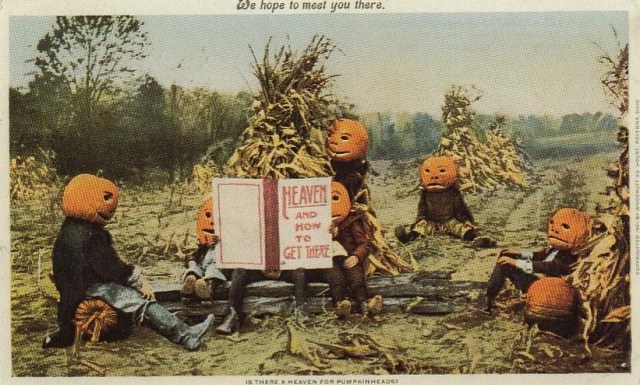


 The Garden History Blog
You must be logged in to post a comment.