Short of space in your home? Love indoor plants but haven’t got enough room to grow many? Want to have goldfish …or maybe frogs or snakes as pets? How about a budgie or a parrot? Any good at DIY? If the answer to any of these questions is yes then you need a Fero-plant.
As its deviser said introducing it to the world: “If a thing of beauty is a joy forever, then whoever adds to the number of beautiful things increases human happiness. And if the “thing” be of one’s own making, and capable of changes and modifications limited only by taste and time, it becomes an almost unlimited source of pleasure.”
Read on to find out how you can get one of these unlimited sources of pleasure…
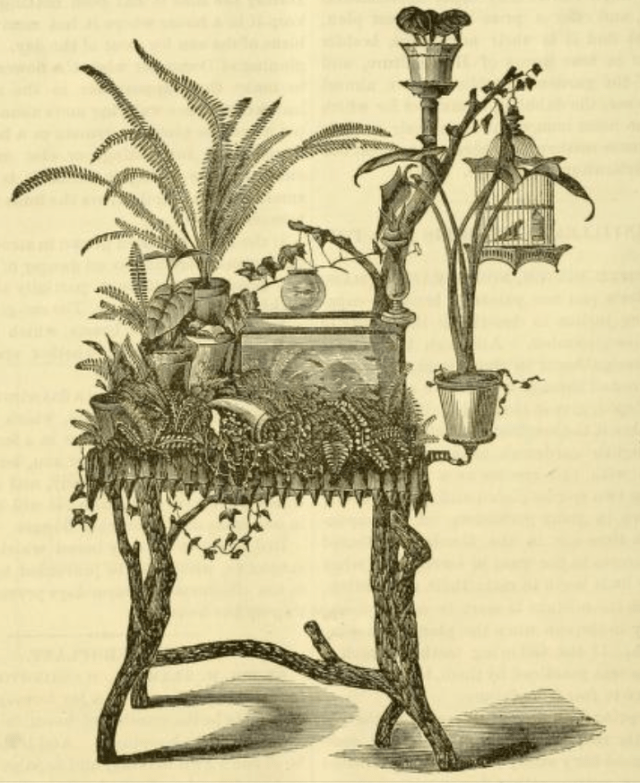
I discovered the wonders of the Fero-plant by pure chance, because as far as I can see it’s only been mentioned once in the British gardening press, in an article in The Journal of horticulture, cottage gardener and country gentlemen on July 1st 1875. That article was a direct steal from the The Gardener’s Monthly and Horticultural Advertiser an American gardening magazine the previous month. It is, to put it mildly, a bizarre object – a mix of plant stand, aquarium and birdcage all in one.

Despite much searching on the internet I have been unable to trace any other mention of the Fero-plant, which was the invention of a certain W.H.Seamans. Nor to the disappointment I’m sure of his shade have I been able to find out much more about Mr Seamans. If anyone knows anything please let me know because it would be nice to honour his memory and celebrate his inventive mind, even if the idea didn’t take off as he might have hoped.
But do not despair because I found lots of other vaguely similar bizarre creations because Mr Seamans was not alone in favouring such a space-saving contraption. Others followed him and he himself had probably followed in the footsteps of others including our old friend Shirley Hibberd, the pioneer of gardening for the middle classes in the mid to late 19th century.
So why did Mr Seamans create such an interesting object? It’s very simple: “Most plants stands are formal affairs, mere skeletons of wood or wire, that detract from the beauty of the flowers and do not readily lend themselves to the adorning of a room, or they are very costly and hold but few pots.”
Surely you might think, there’s always the windowsill or perhaps one might even hang some plants from the ceiling or wall but as Mr Seamans said : “Brackets are well enough in their way, but sometimes inconvenient.” Instead he decided to make his own plant stand by “trying the effect of a bit of rustic work” and you’ll be pleased to hear “the result has been eminently satisfactory.”
He thought of everything, suggesting for example that a “square of oil cloth prevents damage to the carpet” while “on occasion cut flowers and pressed ferns could be added to its living beauties.”

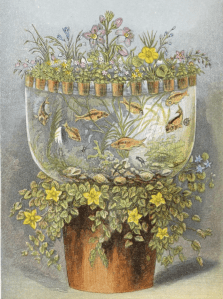
If you’re now inspired to give a go yourself you don’t need much, indeed “some sticks of laurel, a saw, bit and hatchet, with a little mother wit are all the materials and tools necessary.” If you dont have laurel, and what self-respecting Victorian gardener didn’t have a laurel bush in his shrubbery or a laurel hedge “other kinds of wood will answer, but laurel is the best because of its tough and fine grain, and peculiarly suitable manner of growth.” If your shrubbery is lacking laurel no need to despair just go out and “pick out your sticks in the woods.” Wherever you find the laurel its branches probably won’t be growing in the right shape so “you must humor them a little, for you will never find just what you want.”
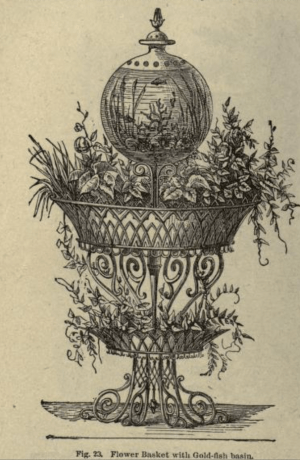
Armed with your sticks, sawn or hacked off the bush, now comes the first serious bit of DIY, making the frame. “For putting them together as a frame, use small carriage bolts, — nuts inside, — one of them is worth several screws or nails, and it must be strong.”
Framework assembled now comes the top. More DIY required to “make a frame of 2 by 3 inches of scantling,” [According to the OED A scantling is “a small beam or piece of wood; specifically one less than five inches square.”] on which you nail “some boards to make a flat platform.” Next a slightly tougher piece of DIY: “take a sheet of zinc three inches larger each way than the top, turn up the sides one and a half inch, bend the corners round, and you have a water tight top without rivets or solder.” But beware “the sides of the frame and top must be hidden by the rustic work.”
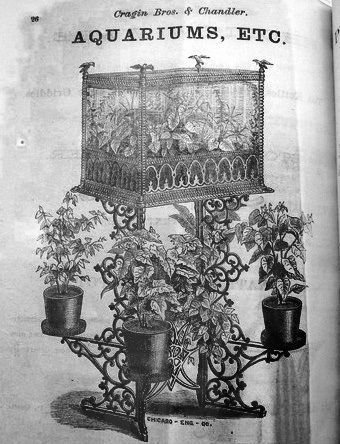
“Now put your aquarium in position” because, if you hadn’t already realised, “the aquarium is an essential part of the fero-plant, though it may be a globe,” rather than a standard tank. Then comes your first real chance to become creative because obviously you won’t want the rest of the platform to be seen. Mr Seamans suggest that “with sand, cinders, and water lime or plaster of paris, colored by some dry paints as yellow ochre or burnt Sienna” that you “build some rock work on a separate board fitted in the space not covered by the aquarium”.
The next chance to be creative comes as you begin to assemble your houseplants around the aquarium. Don’t forget that “the flower pots should stand on wooden blocks, or empty fruit cans turned upside down, which make it much lighter.”
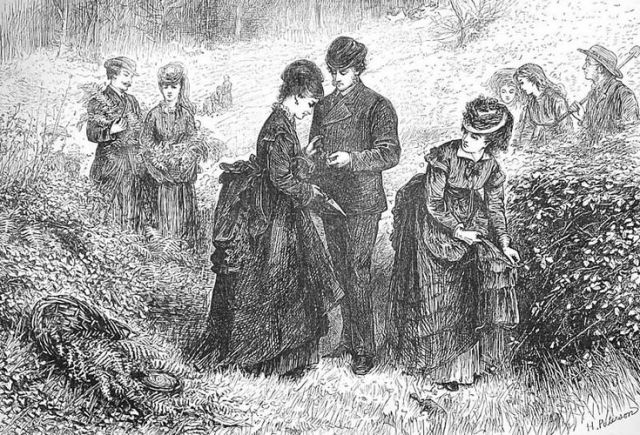
‘Gathering Ferns’ by H Paterson, Illustrated London News July 1 1871.
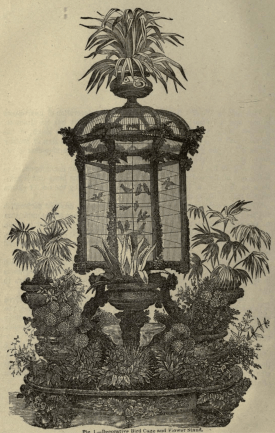
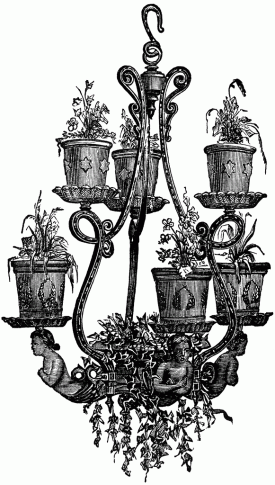
Undoubtedly you’ll have too many plants and not enough space so how about adding a “branch” at one corner, bolted on, which will allow for a couple more at least. Their pots need firm supports so he suggests using “the collars of gas fixtures, which are admirably adapted for the purpose in size and shape.” Be warned many plants, especially hot-house rarities, will be usuitable to put on your fero-plant, so instead “go to our native woods, [where] you will find a wealth of ornament hardly dreamed of.” This probably still leaves the zinc edges visible so to hide them cover them “with moss, for which the thin mats torn from the faces of rocks, and sprinkled with poly pods are most suitable.”
Mr Seamans now refers to his illustration to suggest suitable inhabitants for the fero-plant. He does include some “exotics” such a the calla…but for a long time we had nothing but native plants. The immense fern shown is an Aspidium acrostichoides obtained three years ago at Mount Vernon, the home of Washington, and grown in the house. Some of its fronds now measure three feet in length. The mossy bed will grow almost any fern if kept moist, Cystopteris, Adiantum, Asplenium ebencum, and Trichomanes are among those we have grown, aud the unfolding of their green balls each day is an especial charm in spring.”
In fact its pretty clear that most of Mr Seamon’s specimens come from the wild, and he is also clear that “If the woods are convenient they may serve as a garden of reserve from which to draw new supplies when the old ones fade or fall.”
He recommends Mitchella which “thrives well and droops its little waxen trumpets over the side, while on almost bare rock work last spring a bunch of Sedum ternatura bloomed long before its sisters in the woods, hastened by the unwonted stove heat of our room, and its star like flowers set off by the shiny black anthers were extremely beautiful. We have had Tipularia, Aplectrum and Obolaria, all usually considered rare, growing in our miniature garden,.” No wonder the woods were stripped bare and many rare species pushed to the point of extinction.
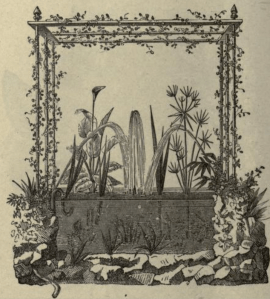
There are just a couple of lines about the other living creatures on the Fero-plant so we have no idea where he sourced them (although I suspect it’s easy to guess ) or how they cope with these unusual conditions. “In the aquarium the fish and salamanders glide among the Proserpinaca and the bird pecks at the leaves of the ivy that seems to grow stronger and more rapidly when it has a branch to which it may cling.”
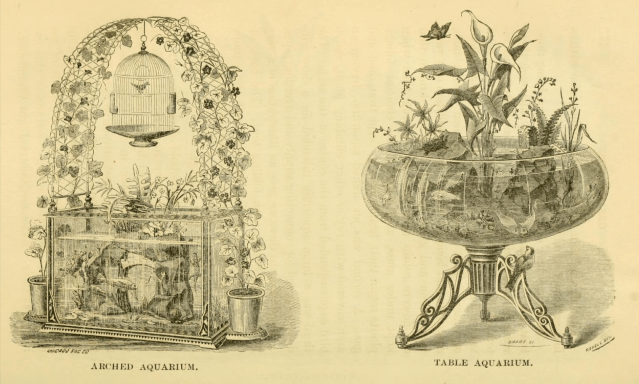

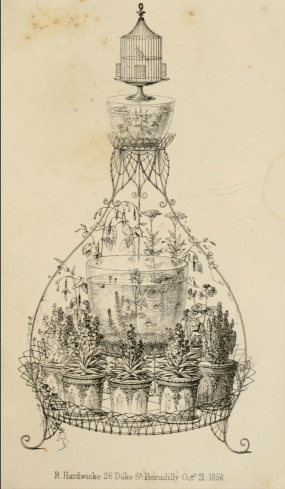
We might laugh at the convoluted arrangement and wonder about the lifespan of the poor salamander as well as birds trapped in tiny cages or the goldfish suspended in a tiny bowl seemingly smaller than a teapot. At least the bird in the image on the right had the equivalent of TV to watch.
There’s obviously been a long tradition of keeping plants and birds indoors, while indoor fish keeping was known about at least as early as the mid-17thc when Samuel Pepys in 1665 described being “shown a fine rarity of fishes kept in a glass of water, that will live so forever, and finely marked they are, being foreign.”
However, the mixing and matching seen in the images in this post was, as far as I can tell, not really tried until the 19thc when Shirley Hibberd encouraged a more adventurous approach.
He might have been encouraged by the fascination with aquaria which really took off in the early 1850s. There were references in 1853 to a “new Fish house [which] has received the somewhat curious title of the ‘Marine Vivarium’, and to an “Aquatic Vivarium” but you might be surprised to learn that the word “aquarium” was only coined in 1854 by Philip Gosse in his book The Aquarium; an Unveiling of the Wonders of the Deep Sea.
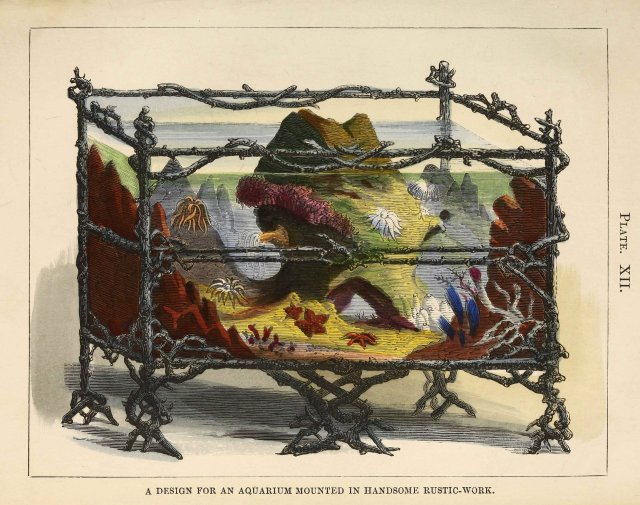
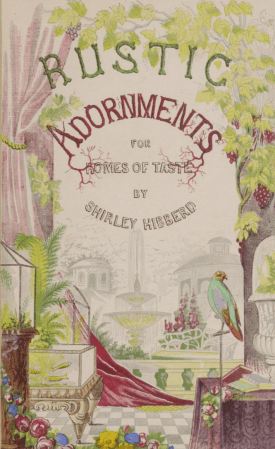
Hibberd wrote The book of the fresh-water aquarium in 1856 which is quite straightforward and has none of the additional paraphenalia mixed up with the fishtanks or bowls. However things changed when he then published Rustic Adornments for the Home of Taste also in 1856. It was such a success a second edition appeared the following year and included chapters on aquaria, both marine and freshwater. One, on the keeping of sea creatures, starts: “Writers on the Aquarium seem to have united in a compact to frown down botanical studies . It is quite true that the animals take precedence in the tank, and that the plants are chiefly used in order to effect that necessary balance on which success depends. Still I can see no reason why we should not make the best of our water-gardens, for the culture of curious and beautiful plants.” And that’s just what he started to suggest.
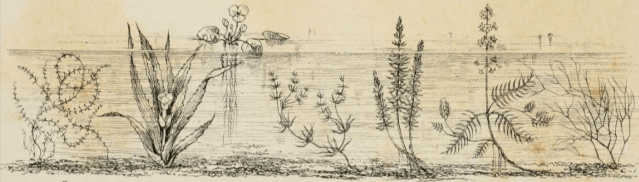
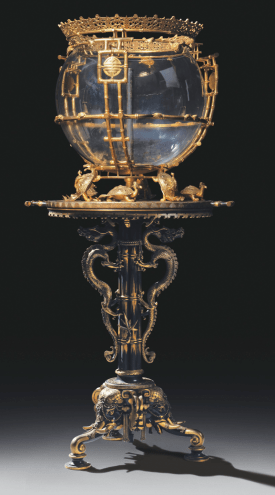
Freshwater aquaria get the same treatment but with a much wider range of plants to choose from. He suggests planting the tank first as a water-garden then when they are settled add the creatures so that it now becomes “a Vivarium for the finny pets which, with proper care, will soon endear themselves to their keeper.”
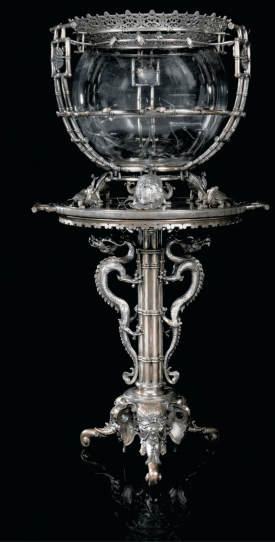
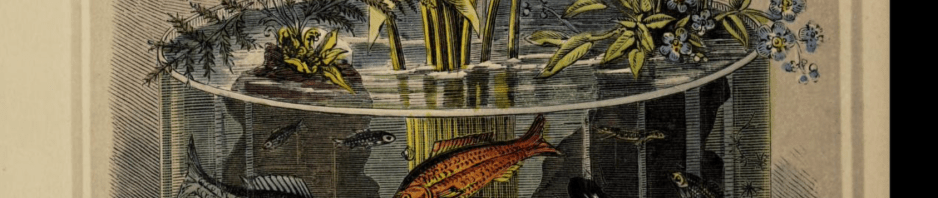
The same year, 1856, the magazine Family Friend carried an article on “Parlour Aquaria” which suggested that the next step in aquarium progress was to “unite the Wardian case and the fish-tank together, for the growth of water-weeds and fish below, and ferns above. This experiment is on the eve of completion, and the public will shortly, be delighted with the spectacle afforded by the combination of two ingenious contrivances – the mimic lake below, with its green banners and aquatic flowers, peopled by the curious creatures of inland waters; and above, the rockery with its waving ferns drooping over the water’s edge, or towering aloft, under the shelter of a spacious glass dome.”
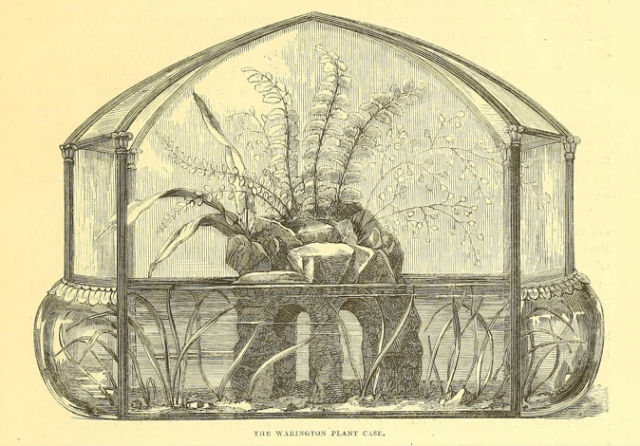
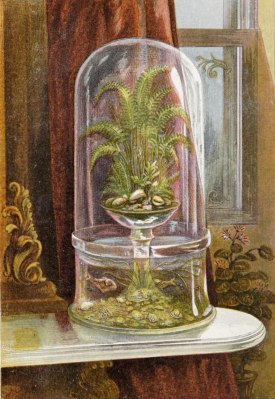
Such an arrangement was later termed a Warrington Case after Robert Warrington a chemist and pioneer of marine aquaria. Henry Hiumphries, author of Ocean Gardens, an early book on the subject said ” they are certainly a much more attractive and instructive addition than the old globe of blank water, with its pair of goldfish swimming round and round in ceaseless gyrations, tiresome to behold, in the vain hope of escaping from their glaring and inconvenient prison.. perished very shortly but for the daily change of water, which, previous to our knowledge of air-emitting plants and their use was absolutely necessary.”
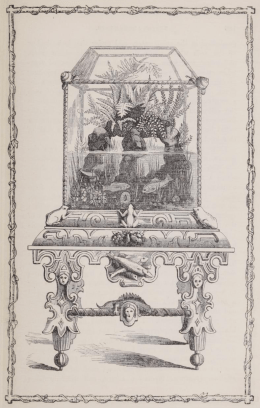
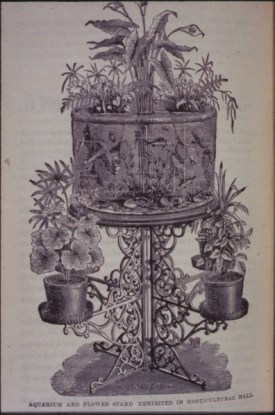
Within ten years aquariums were being mass-produced in every possible shape and combination, often so elaborately decorated that one wondered what was more important – the contents, or the aquarium itself. But sadly although there are many versions which include plants, amphibians and even birds as well as fish all the ones I’ve been able to trace have been well-manufactured rather than rustically assembled DIY from laurel branches in the shrubbery.
If anyone has more information on Mr Seamans or knows of another Fero–plant please let me know.
[For more on the rise of aquaria good places to start are the Parlour Aquariums website which has a history of aquaria and links to books etc, and “Victorian pioneers of the marine aquarium, by


 The Garden History Blog

You must be logged in to post a comment.