

The tomb of William Bligh at the garden Museum
On a recent visit to the Garden Museum in the former church of St Mary next to Lambeth Palace, it was hard to miss the impressive tomb of Admiral William Bligh, which stands in the middle of their courtyard. Better known by his more junior rank of Captain his name will be forever linked with the Mutiny on the Bounty.
You are probably familiar with one or other of the film versions of that story – the first starring Charles Laughton as Bligh from 1935 or the later versions with Trevor Howard in 1962 and Anthony Hopkins in 1984. But there’s more to Bligh than that, much of it quite surprising.
And what do you know about breadfruit? And who are the two Nelsons? One’s obvious the other not so…

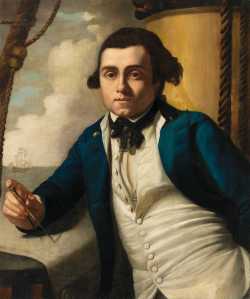
William Bligh was born in 1754 and joined the navy aged 16. In 1776, aged 22, he was chosen by Captain James Cook to accompany him on his third voyage to the Pacific, as sailing master (who was responsible for navigation), of Resolution . Also on the voyage, although on the Discovery, the expedition’s second ship, was a gardener named David Nelson. He had been appointed by Sir Joseph Banks on the recommendation of James Lee, of the Vineyard nursery in Hammersmith, and tasked by Banks to collect as many botanical specimens as possible for the royal gardens at Kew. In that he certainly succeeded, methodically collecting material at every opportunity ashore that Discovery offered, but notably on Hawaii where he collected at least 136 different plant species.

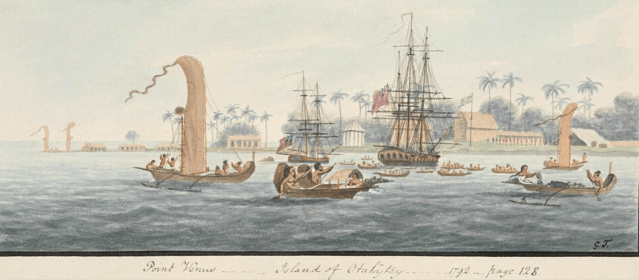
HMS ‘Resolution’ and ‘Discovery’ in Tahiti, John Cleveley the younger (style of)
National Maritime Museum
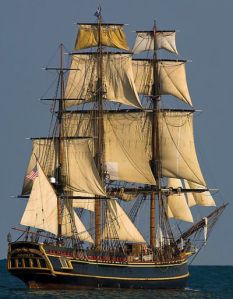
After a spell in merchant navy William Bligh was appointed to command the Bounty. You might have imagined this was a typical grand man o’war laden with guns and a big crew but in fact it was nothing like that. Instead it was, like both Resolution and Discovery a small converted collier [coal carrying ship] of just 215 tons. Nor was it heading off to war. Instead it was adapted as a floating greenhouse and sent to the Pacific to acquire breadfruit plants and take them to the Caribbean.

This was part of an experiment in economic botany championed by Banks who had been with Cook on his first circumnavigation of the world between 1768-1771.
Afterwards Banks had become friends with George III and effectively taken charge of the royal gardens at Kew. From there Banks sent explorers and botanists all over the world, looking for new and economically useful species that could be moved around the globe and cultivated for the benefit of the growing British empire. By transplanting species between countries and continents, Banks saw his influence transform entire landscapes and economies.

A highly sanitised view of life on a British sugar plantation,, William Clark, London, 1823.
One of the first tests of this was the planned movement of breadfruit [Artocarpus altilis]. The American War of Independence had cut off much of the food supply that helped feed the slaves on British sugar plantations in the Caribbean and thousands had died from malnutrition and related diseases. Plantation owners knew that Captain Cook, talking about breadfruit, the staple of many Pacific Islanders, had written: “if a man plants 10 of them in his lifetime, which he may do in an hour, he will … completely fulfil his duty to his own and future generations…” It was too good an opportunity to miss, so a petition was sent to George III asking him to support an expedition that would transplant this wonder-plant to the West Indies in the hope that it would provide a virtually free alternative to imported food for the slaves. Joseph Banks was given responsibility for the planning and organisation of the voyage.
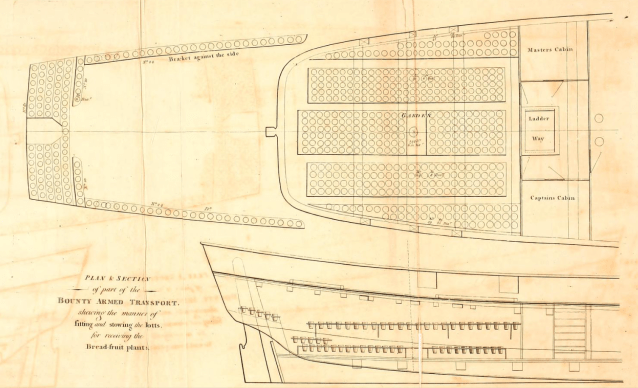
The Bounty was already a small ship but its habitable space was made even smaller as much of the interior was taken over to provide space for the plants. Large gratings and skylights were opened in the deck for ventilation and sunlight while to save freshwater a lead-covered deck had to be installed under the rows of pots to allow the surplus from watering the plants to be reused. As a result the Bounty sailed with a much reduced crew and with Bligh as the only officer. It also sailed without any of the Royal Marines who acted as a fighting force if necessary as well as a back-up for the Captain’s authority.
However, amongst the remaining ship’s complement was David Nelson, again selected by Banks but presumably with Bligh’s approval. It was Nelson who oversaw the adaptations needed to house the plants during their shipping. He had been, said Banks in a letter to the Earl of Sandwich, First Lord of the Admiralty, “regularly educated as a gardener and learned there the art of taking care of plants at sea and guarding against the many accidents to which they are liable which few people but himself have had the opportunity to know practically.”

It was a long voyage. Bounty left Spithead on 23 December, 1787, and reached Tahiti on 26 October, 1788. Nelson had been able to collect plant specimens during stopovers at Tenerife, Cape Town and Tasmania. It was a long stopover in Tahiti too as they had to wait for the breadfruit trees to be collected and grown large enough to be potted for transport.
When they left six months later in April 1789 Bounty must have resembled a floating farm. One of the crew described it as being “lumbered with hogs, coconuts and green plantains for seastores” while Blyth recorded it carried salt pork, 25 hogs, 17 goats and as much fruit as I could stow along with 47 tons of water. Below decks was the cargo of 774 Pots, 39 tubs, and 24 boxes containing in all 1015 breadfruit plants.
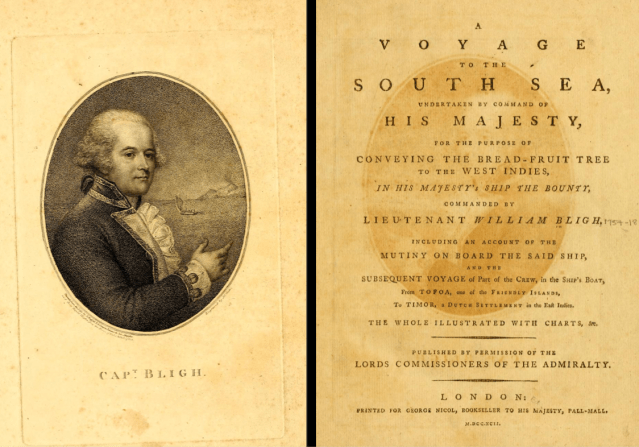
Of course, as we all know, Bounty never reached the Caribbean, as mutiny broke out on board 3 weeks after the ship left Tahiti. Nelson was one of those who stayed with Bligh and had to watch as the mutineers threw the plants overboard. That might have been the end of Bligh and the loyalists in his crew when they were abandoned in an open boat. Somehow most of them survived the horrendous journey and reached Timor 3800 miles away, but several of his crew, including Nelson, died either on the journey or shortly after their arrival. Bligh was later to honour the gardener when he named a prominent hill just outside Hobart after David Nelson while the botanist Robert Brown later dedicated the genus Nelsonia, a tropical plant in the wider acanthus family, in his memory.
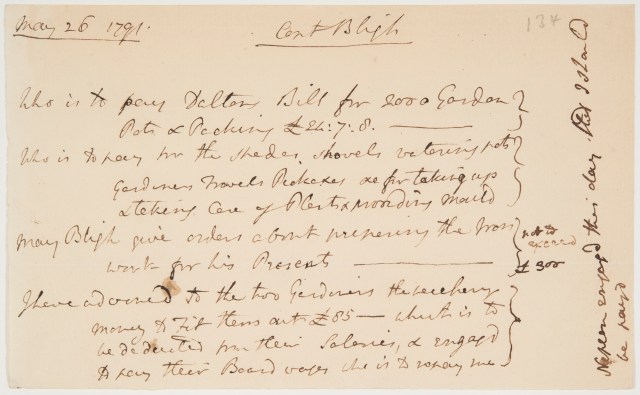
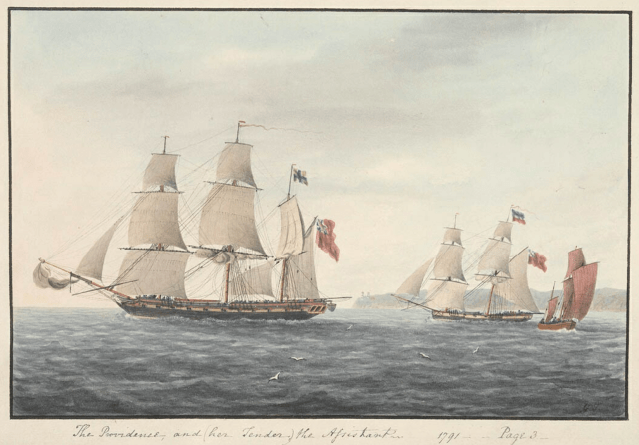
You’d think that after that and his court-martial for losing Bounty would, despite his acquittal, have been the end of Bligh and his breadfruit connection. Far from it. In 1791 he set off again this time as captain of HMS Providence , accompanied by HMS Assistant to Tahiti to try again. A lot of evidence survives for the voyage in the State Library of New South Wales with some of them, including the ship’s logs written by Bligh, now digitised and freely available on-line.
On board Providence were seeds and plants destined for the settlers in Australia. They had been supplied by Hugh Ronalds, a nurseryman in Brentford, and friend of William Aiton superintendent of the royal gardens at Kew on the opposite bank of the Thames. [For more on Ronald’s see Beverley Ronalds’ article in Garden History, 45:1, 2017]
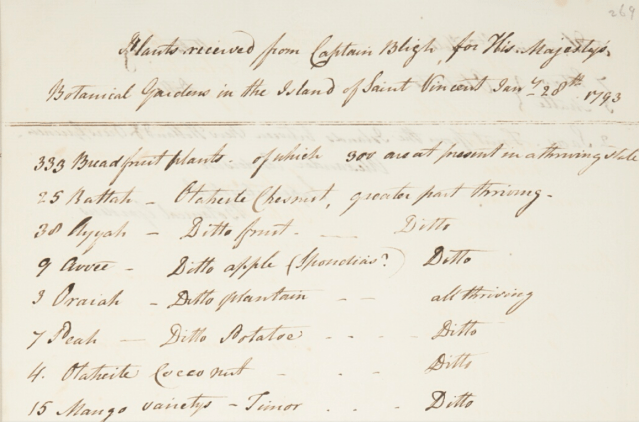
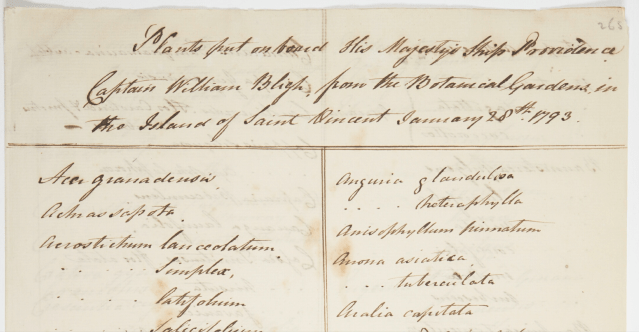
Providence’s voyage passed off without major problems but documents show how breadfruit was not the only plant being moved round the globe. Bligh called at the the newly established botanical garden on St Vincent and delivered a large number of plants and seeds that he collected on his voyage from Tahiti. These included 15 mangoes from Timor, coffee and almond trees from St Helena as well as plants from Tahiti itself. In return he picked up plants and the seeds of hundreds of tropical plants for Kew. [Click on the link in the images for a look at full lists ]
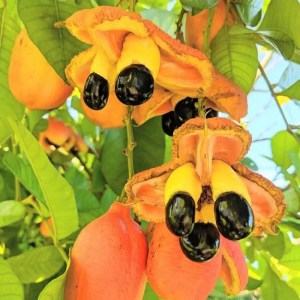
One of them was the ackee which had probably been bought over by a slave ship from its west African homeland. Bligh took samples back to show Banks and the Royal Society and in return was honoured by having it named after himself as Blighia sapida.
The mission was in the long term not a great success as, after the bread fruit were delivered, planted and cropped, the slaves initially turned their noses up at the green, lumpy fruit with its potato-like flesh. It took more than 50 years for breadfruit to become a staple food in the Caribbean.

Bligh went onto serve with distinction during the Napoleonic Wars in particular commanding Glatton a 56-gun ship of the line under Admiral Nelson at the Battle of Copenhagen in 1801. During the fight Nelson famously turned “a blind eye ” to the signal from the commander in chief to cease fighting, and instead signalled to continue. Bligh, having seen both signals chose to followed Nelson’s instruction and ensured that all the vessels behind him kept fighting. Unsurprisingly Nelson personally praised Bligh for his contribution to the victory. The same year Bligh was elected a Fellow of the Royal Society in May 1801 for “distinguished services in navigation, botany, etc.”
A few years later, again on the recommendation of Banks, Bligh was appointed Governor of New South Wales, and took up his post on his arrival in Sydney in 1806. It was a chequered tenure to put it mildly but he ended his career back in Britain as a Vice-Admiral at the end of the Napoleonic Wars. He bought a house in Lambeth just down the road from St Mary’s churchyard in Lambeth where he was buried after his death in 1817. His tomb is made of locally made Coade stone, and contrary to what you might read elsewhere is topped not by a breadfruit [which might have been appropriate] but an eternal flame.

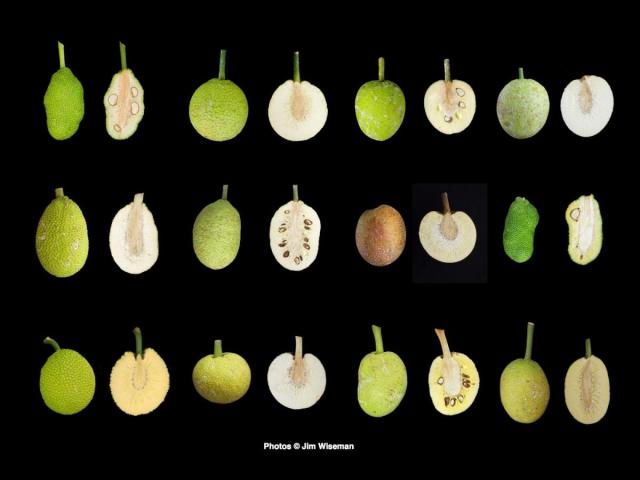
So what of breadfruit today? I’ve been surprised by what I discovered. Firstly that there are hundreds of varieties, and secondly that it’s being hailed as a new wonder-crop. That’s because, as Laura Spinney argued in the New Scientist in June 2014 not only is it protein-packed but it can grow in the ever-saltier soils climate change is bringing especially in low-lying tropical countries.
 Although it fell out of favour in the Caribbean long ago probably because of its association with the evils of slavery, and was eclipsed by cheap imports based on wheat, rice and maize, it is making a comeback. This is in large part due to work carried out over the last forty so years mainly in Hawaii’s National Tropical Botanical Garden. After Bligh took breadfruit to the West Indies it was also transplanted to many other regions. Researchers collected samples from all round the world, but especially the Caribbean and Pacific to try and identify their ancestry and original homelands. Although its thought that Bligh’s plants belonged to just two varieties more than 200 others have been documented and 125 varieties, many of which are sterile, from 34 countries have been propagated for further research. Using DNA analysis their common ancestor turns out to be a seeded plant called the breadnut from New Guinea. It has led to the establishment of the Breadfruit Institute,in Hawaii.
That discovery fits with what has also been emerging from archaeological work about how the Pacific was colonised. The Pacific Islands were amongst the last places on Earth to be settled by humans. It’s thought that migration began in Taiwan then through the Philippines reaching New Guinea c 3-4000 year ago and as they island-hopped further into the ocean the pioneers probably carried provisions with them including chickens, yams and breadfruit and its ancestor, breadnut. However breadnut seeds are not viable for very long but the plant can be easily propagated vegetatively, a process which is thought to be slowly led to a mutation into seedless sterile forms.
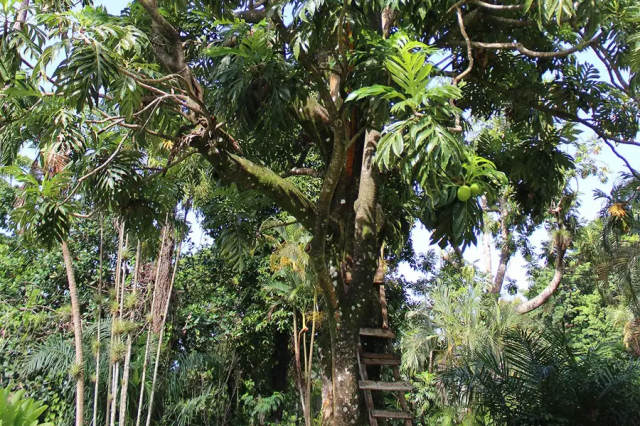

So what makes breadfruit a wonder food. Firstly its amazingly productive and easily outstrips other staples in crops in yield per hectare – with around 320 kilograms of fruit per tree per year. The trees require very little care and provide much needed shade. As one of the researchers said, “Traditionally in Polynesia you would plant a breadfruit when a child was born, because that would guarantee food throughout that child’s life,” The fruit is versatile, either cooked or dried and made into flour. High in vitamins it’s also gluten-free, however, the most widely eaten varieties outside the Pacific islands are too bland and starchy for many western tastes, but by selection and hybridisation, researchers are hoping to come up with varieties that are not just resistant to disease and climate change, but also taste delicious. It took the slaves in Jamaica about 50 years to incorporate breadfruit into their diet the first time around, although that’s nowhere near as long as it took tomatoes and potatoes to be accepted in western cooking. As one of the researchers said, “It has to be something your grandmother cooked.”
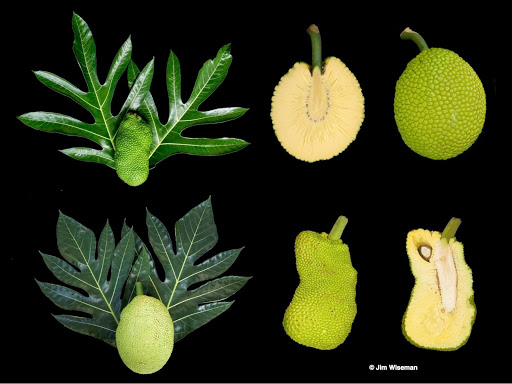
Mass propagation has proved a bit of a stumbling block because the traditional vegetative method isn’t fast enough for large-scale production, so researchers are looking at tissue culture methods which are already in use for many commercial food and flower crops. It’s still a slow process but the resultant trees are disease-free and can start bearing fruit as early as two years of age.
The UN Food and Agriculture Organisation and The Breadfruit Institute are now aiming to give advice and distribute appropriate varieties to food-insecure countries worldwide. If it works then the efforts of William Bligh and David Nelson will not have been in vain.
For more information on Breadfruit a good place to start is the Breadfruit Institute website & for more on Bligh see Sam McKinney, Bligh!: The Whole Story of the Mutiny Aboard H.M.S. Bounty [1989.]


 The Garden History Blog
You must be logged in to post a comment.