
 I caught part of Joaquim Rodrigo’s concerto for guitar on the radio the other day [listen to part of it here if you don’t know it] and it took me back to a visit I made pre-pandemic to the site that inspired him: the Palace and gardens complex at Aranjuez near Madrid.
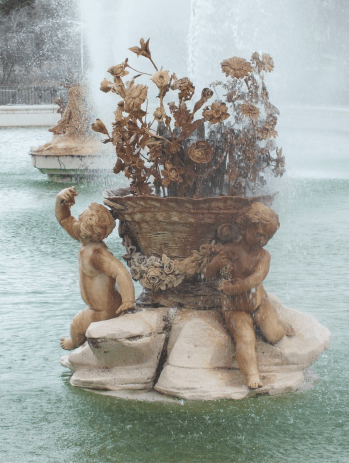
It was partly created during what is known as the Golden Age of Spain in the mid-late 16thc and then largely completed in the later 18thc. Quite rightly it is on the UNESCO World Heritage list with a protected area covering over 20 square kilometres, including the palace and its gardens which, incidentally, contain more amazing fountains than I’ve ever seen before in one place.

The photos are mine unless otherwise acknowledged.
While much of central Spain is rather bleak and arid at Aranjuez about 30 miles south of Madrid where the River Tagus meets the river Jerama there is a leafy green oasis which has been settled since at least the early Middle Ages. Then it was frontier zone between the Christian kingdoms of Castile and Aragon to the north and the Muslim ruled south of Spain. For that reason it was given to the military and religious Order of Santiago, whose Grand Master built a residence, the Casa Maestral, on the site of the present palace in the late 14thc, and installed an irrigation system to water the gardens and surrounding farmland.
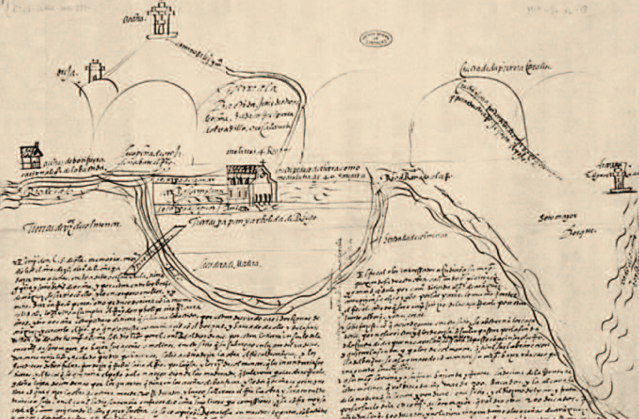
The Casa eventually passed to the crown and was used regularly by the Emperor Charles V [1500-1558]. He enlarged the estate and in 1543 set up a new Royal Forest there, ordering the planting of a lot more trees, both native and imported. The next few years saw a series of other landscaping works including the improvement of roads and bridges to the site from Madrid and Toledo, the establishment of profitable orchards, and investment in agricultural infrastructure.


Charles’s empire included a large chunk of western Europe including the Low Countries and he knew and admired the skill of Flemish and Dutch farmers and gardeners. Meadows were laid out and organised in the Flemish way by Flemish workers. There were large herds of cattle, remembered today in the Casa de Vacas [the House of Cows] and even a herd of camels, employed alongside mules and horses on agricultural work. New species of birds and fish were introduced as were silkworms and mulberry trees to establish a silk industry while saltwater springs were discovered and used for the production of salt. Effectively the estate was on its way to becoming an early example of a model farm.

The Spanish empire was inherited in 1558 by Charles’s son Philip II, and together with his chosen architect Juan Bautista de Toledo, the new king set to work to continue the transformation of the Aranjuez estate which by then stretched to over 2500 hectares or c6,200 acres.
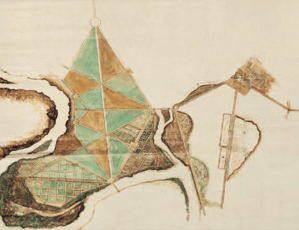
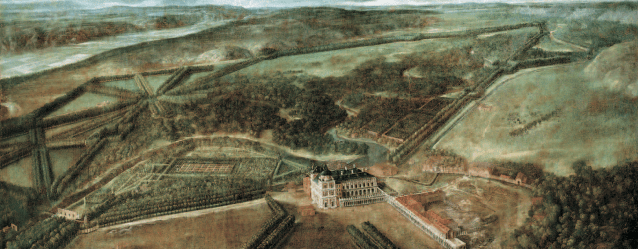
Bautista drew up a master plan that governed the work for about the next 50 years and which involved an annual workforce of over 1000 people.
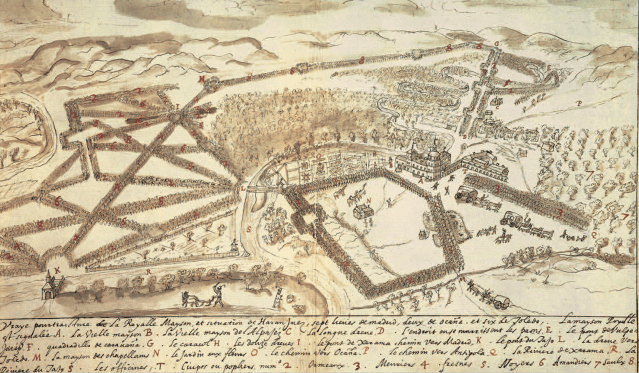
It envisaged work going on simultaneously to greatly extend the palace, create new gardens and lay out the productive areas of the royal domaine. The underlying principles followed the roman poet Horace’s call for estates to be dulce et utile – both beautiful and useful but it would also be a pioneer of employing strict geometric rules for planning the whole space. Luckily we have a very detailed and labelled plan of the estate drawn up in 1586 by Jean L’hermite which shows the progress that had been made, down to the kinds of trees planted in the various avenues.
Juan Bautista de Toledo must have been an extraordinary man. Born probably in Toledo in about 1515 he went to Italy as a young man and secured work with Michelangelo, the Pope and the King of Naples. That led him to be appointed royal architect by Philip in 1559, and to work on a series of churches, public buildings and palaces including the monumental Escorial in addition to Aranjuez. Drawing up the masterplan for plans for Aranjuez took several years so the first stone wasn’t laid until New Years Day 1565. It then became one of four seasonal seats of the court along the palaces of Rascafría, El Escorial and the Royal Alcázar of Madrid.

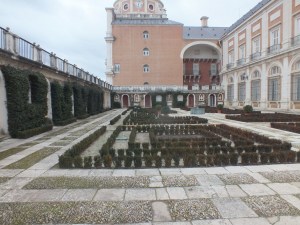
The Ki9ng’s garden today – the ceramic paving was replaced by flagstones and pebble mosaics in 17thc. It recently been overhauled.
Philip had grown up in the Low Countries, and like his father he employed a team of Flemish and Dutch gardeners to create a Dutch style garden in a traditional formal geometric style with box edged squares, ceramic tile paths and fountains.
Aranjuez was also planned to be the site of a botanical garden for Philip. His physician, Andres Laguna, had studied and travelled over much of Western Europe including Italy where he had spent 10 years and served as physician to Pope Julius III. While there he had visited the newly established botanical gardens at Padua and Pisa and when he returned to Spain persuaded Philip to establish one at the new royal palace. To stock it he recommended financing an expedition to New Spain [i.e. Mexico] to collect plants and tree specimens. Nor was it just botanical exotics that captured Philip’s imagination. He also set up a menagerie which included 40 camels, many of them employed as working animals on the farmland.
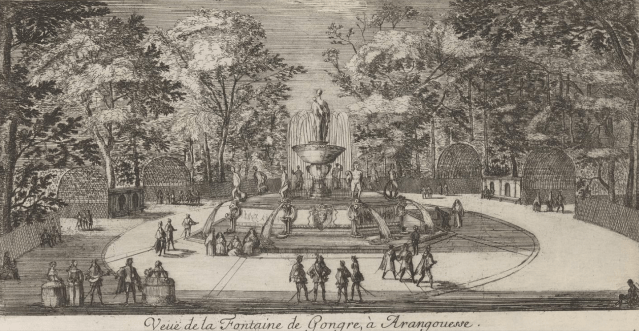
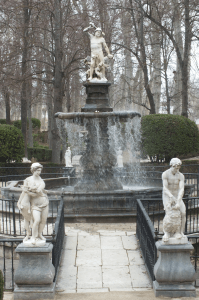
The Hercules Fountain
Philip’s third wife Elizabeth of Valois who he married in 1559 had different tastes and in 1562 work started on another garden at Aranjuez for her, but this time in Italian style. Work continued long after her death on what became known as The Island Garden. Unusually it wasn’t aligned with the main axis of the site but instead laid out using a loop of the river as its boundaries, with an island created by cutting across the bottom of the loop with a canal. The river banks were reinforced with stone embankments and with a terraced walkway and a bridge connecting it to the gardens next to the palace.
Within its irregular framework the garden was laid out geometrically with long walks, tunnel arbours [as seen rather exaggerated in the engraving below] and avenues and ornamented with several “water jokes” and the finest fountains in Spain created by Italian sculptors.

 Juan Bautista must have been a busy man because he was also tasked with improving the estate’s productive capacity, upgrading the hydraulic system that supplied water to the gardens and their fountains as well as the estate’s surrounding orchards and farmland.
He is also responsible for the planting of many long avenues of trees which stretched out for miles along approach roads, and through the productive areas into the surrounding countryside. Most of them have survived to today and give the whole Aranjuez district a very distinctive green character.

Philip also asked Bautista to think about a long-term plan to make the Tagus navigable to the sea if at all possible, although this never got past the drawing board stage because of financial and, as well one suspects, engineering problems. After Bautista died in 1567 work slowed down before finally stopping when Philip himself died in 1598.

The Fountain of the Tritons in the Island Garden
Workshop of Velasquez, 1657
Philip’s grandson Philip IV succeeded in 1622. He was extremely fond of Aranjuez and was a great fan of open-air entertainment, masques and other dramatic performances using the gardens regularly for such events. He commissioned some minor alterations to the gardens, notably replacing the ceramic paths in the Kings Garden with stone tiles and pebble mosaics.

The roman emperors re-used on the Casa del Labrador
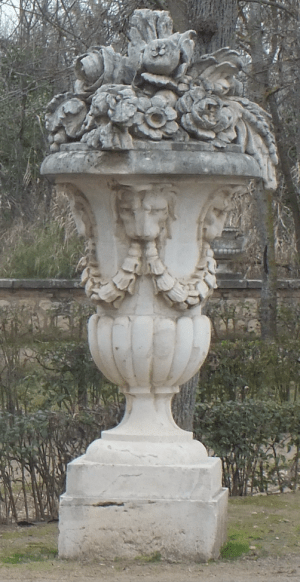
More importantly he sent a large collection of statues down from the royal palace in Madrid to decorate the gardens. These included a set of marble busts of Roman emperors and a marble sculpture of his grandfather by Pompeo Leoni. There were also marble reliefs of his great grandparents Charles V and the Empress Isabel of Portugal, [now in the Prado]. The whole thing was part of an exercise in expressing dynastic power by the new king, then, unsurprisingly, became known as the Statue Garden.
It was unfortunately not a good omen. The Hapsburg dynasty were notorious inbreeders – Philip had married his niece – and they had only one surviving legitimate son, Carlos II, who was ill all his life and whose demise in 1700 led to the War of the Spanish Succession. The new king was 16-year-old Philip of Anjou, grandson of his elder half-sister Maria Theresa and Louis XIV of France, who became the first Bourbon monarch as Philip V. At this point Aranjuez was only a summer residence.
Juan Álvarez de Colmenar in his travel account of Spain Les Délices de l’Espagne published first in 1707 wrote: The royal house, although it is quite beautiful, is currently most neglected. It is only furnished when the King comes; there are some quality paintings, and a very pleasant living room in summer because of the coolness, all made of marble, and supported by columns of the same material.” He goes on to talk at length about the gardens, which were in good order with walks, grottoes, fountains, flowerbeds, gazebos claiming that they turned the palace into “a truly enchanted place”.

When Philip V, [1683 – 1746) visited Aranjuez he decided that while it was nice enough he wanted to create an even grander palace to rival that of his grandfather Louis XIV at Versailles. So work began again. It was at this point that the original Casa Maestral which had been incorporated into the palace was finally demolished. Incidentally by now there were about 200 camels, not kept in a menagerie as at Versailles, but allowed to roam relatively freely or used as beasts of burden, as well as ostriches and peacocks, zebras and an elephant.
The camels and buffaloes caught the attention of the Duc de Saint Simon, the French ambassador and diarist in the 1720s, as did the the water-jokes in the Island garden such as the fake birds in the trees which squirted water at passers-by, and the lion statue which did the same. However his general judgement was that it was all “trifles and childishness” and not up to the standards of Andre Le Notre and Versailles. However Philip and his successors continued to carry out additions in the French style using French gardeners. In particular there a new parterre de broderie – simply grass with elaborate cut work designs which was supposed to resemble embroidery – which were overlooked by the royal apartments.
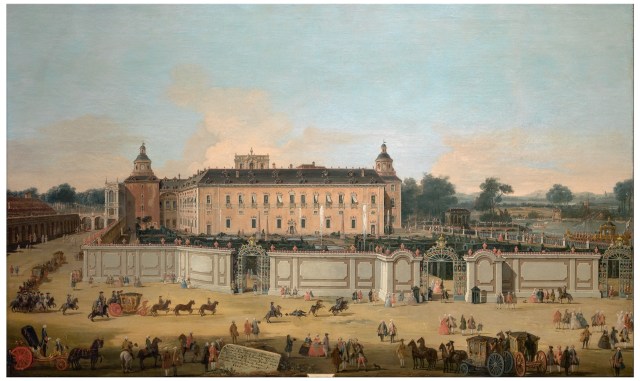
Unfortuantely the new palace was almost destroyed by fire in 1748. Rebuilding on the same foundations started almost immediately but this time in the contemporary late baroque style designed by the Italian architect Francesco Sabatini. Two new wings were added creating the new cour d’honneur in front of the palace. 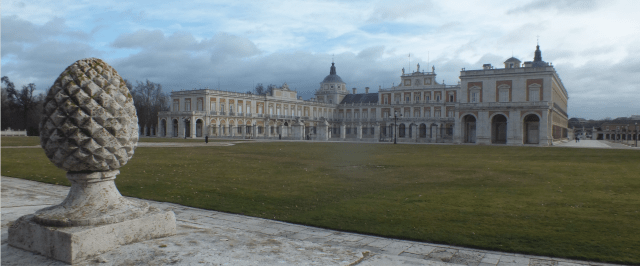
In the gardens there were more improvements carried out including a moat around the parterre garden, new bridges and fountains and a gazebo which can be seen in contemporary paintings and prints.
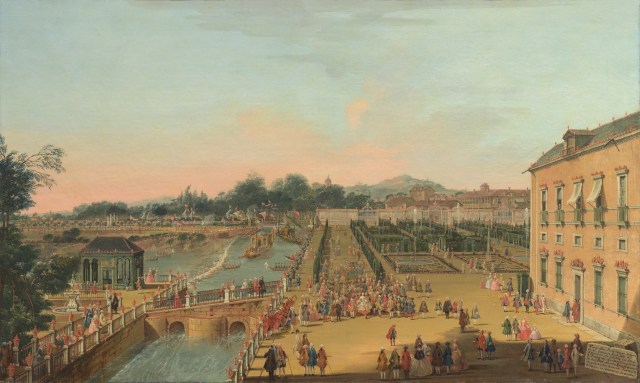
We also have a long and detailed account of the gardens by Joseph Baretti, who travelled through England, Portugal, Spain, and France during the years 1761–1765. He had “seen a great many delightful places in many parts, but none more so than the royal palace and garden of Aranjuez.” It contained “an immense variety of the most beautiful American and European flowers.”


Carlos IV who spent a lot of time at Aranjuez was the last monarch to add substantially to the estate. He began laying out the Princes garden outside the main site in the 1770s while he was still Prince of Asturias [the equivalent of the Prince of Wales ie heir to the throne] and carried on developing it when he became King until his death in 1808. Unlike the other earlier formal gardens it is a series of connected landscape gardens in the then fashionable English style, incorporating some existing pavilions, orchards and woodland sections, and even some touches of Chinoiserie. 
Carlos carried on the family tradition of lavish outdoor entertainments especially on and around the River Tagus. He built a pier which was designed as a miniature fortress with bastions, and cannons, with two armed frigates to complete the warlike feel. His pleasure fleet included a large felucca with sixteen oars, a xebec, a caique from Constantinople, and a collection of highly decorated barges known as falúas. Some of these can still be seen in a museum on the riverbank.

The royal family continued to use Aranjuez every spring and early summer night through until 1890 although the last major element of the estate, the Casa del Labrador, was added in at the turn of the 18th and 19th centuries. It was built in the classical style as their retreat away from the main palace. Otherwise there were no other major changes except for even more fountains and sculptures being added round the site.

Santiago Rusiñol recorded the site in a series of beautiful paintings in the early 20thc. I have added 3 here but there are many more if you follow this link.
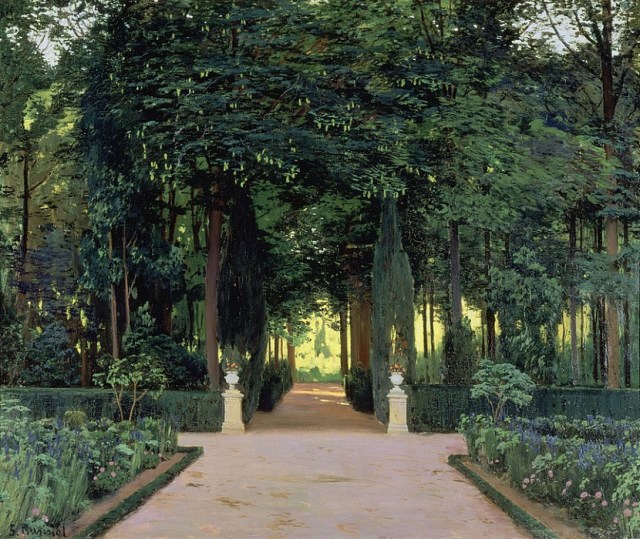


The entire palace complex is now a museum, while the gardens are freely open.

For more information other than those with links included above, the official palace and local tourist websites have lots of images but are mainly in Spanish with poor English translations. World Heritage have some useful but short pages about various aspects of the site. Otherwise unless you have Spanish on-line information is limited. 


 The Garden History Blog
You must be logged in to post a comment.