
Back in October I wrote a piece about how gardeners in the past dealt with garden pests Someone got in touch to ask why I hadn’t mention moles, [thanks John!]. Apart from the fact I’d run out of space in that post, as one grows older I suspect one acquires a more zen approach to gardening. That’s certainly true for me and there are now very few creatures that I consider pestiferous enough to want to deter let alone eliminate – the coypu who are slowly destroying the banks of my lake, the newly arrived asiatic hornets who are threatening to kill off our bees, and maybe the polecats who play football in our roof-space and eat through the wiring – but moles are definitely not among them.
But I thought I’d investigate a bit further anyway…


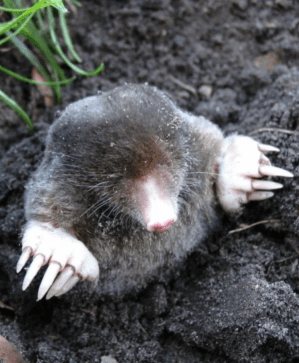
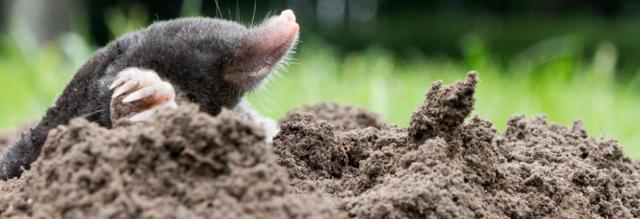
I have very occasionally seen moles – both alive and unfortunately dead – so I knew they were small, but they’re actually tiny at just 12-18cm long. Most gardeners won’t ever see them because moles live almost all their life underground and rarely come to the surface, except perhaps when pushing up a molehill.
Moles are born to dig. Their long front claws scrape away the earth to create a tunnel which they then have to feel their way along with their snouts and whiskers because their eyesight is noxiously poor because of living in almost permanent darkness. Their glossy coats are the subterranean equivalent of aerodynamic and help them glide through the soil, without it sticking to them. They can tunnel up to 200 metres per day creating semi-permanent tunnel networks, usually not more than 50cm down. These are constantly expanded to reach fresh supplies of food because they need to eat at least half their bodyweight in worms a day. What I hadn’t realised is that moles are solitary and very territorial animals only getting together to breed and raise their young . [For more on this see this old but still useful article“An Ecological Study of the Mole” by A V Arlton]


The word “mole” itself is late Middle English and derives from moldwarp, meaning ‘earth thrower’ and it first appears in the early 15thc. Even by then it’s clear, as examples in the Oxford English Dictionary show, the poor creatures were not popular with everyone. In 1483, for example, the accounts of the Duke of Norfolk show that “My Lady gaff Braby for takynge of mulles xij.d.”
Mole control became a national policy in 1532 when Henry VIII introduced the first of a series of acts of Parliament which called for the destruction of a long list of creatures thought to be prejudicial to agriculture or fishing. The most significant of these Tudor vermin laws was “An Acte for the Preservation of Grayne” passed in 1566 under Elizabeth I.

The act, which remained in force for three centuries only being repealed in 1863, covers not just the obvious pests such as rats, mice and foxes but also hedgehogs, kingfishers, and wildcats and put a price on every head. Literally. Amongst other things it laid down a penny for every 12 starlings heads, fourpence for each magpie’s head, a shilling for every badger and a halfpenny a mole. Responsibility for organising payments was, in theory, down to the churchwardens of each parish.
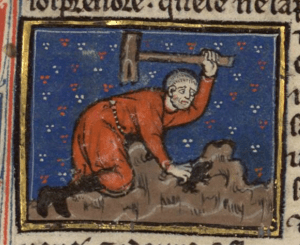
Richard Lovegrove researched the effects of the Tudor vermin acts for Silent Fields his 2007 book, on the decline of wildlife in Britain, writing a chapter each on many of the targeted species including moles. He goes through the very patchy records that survive, suggesting that although some molecatchers often travelled widely looking for work other parishes and communities employed locals on a contract.
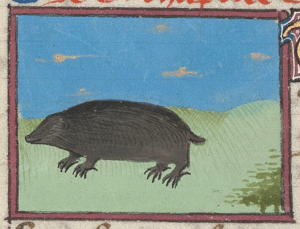
In some parishes there seem to have been no appointments or few moles recorded, perhaps because a large estate nearby employed their own catcher. There was even a royal mole-catcher, although that post lapsed around the early 18thc only to be revived at Sandringham by the late queen in 2002. Lovegrove’s overall conclusion is that while individual parishes might have listed large numbers the overall totals were probably modest by modern standards and amounted to no more than an annual cull without impacting much on the total population.

But why the obsession with destroying moles anyway? Gardeners blame them for damage to lawns or flower beds, and it was thought that they damaged farm crops too. In fact, moles are definitely not interested in eating plants or their roots because their diet consists mainly of earthworms, with whatever grubs and other small creatures they find. Any damage tends to be limited to their tunnelling separating roots from the surrounding soil so the plant wilts and dies, or burying grass under the spoil of the molehill. It’s also true that molehills, if left undisturbed in permanent pasture, provide good conditions for invasive plants and coarse grasses to establish. They can also cause problems for some farm machinery and if silage is collected then soil from the molehill can spoil the stored crop.

Of course they can be a hazard for horse riders. You’ve only got to think of William III who , in 1702, was thrown from his horse when it tripped on a molehill. He broke his collarbone and developed pneumonia, which killed him two weeks later. His enemies are said to have raised toasts to “the little gentleman in the black velvet waistcoat”.
Look carefully at his statue in London’s St. James Square and just near the rear left hoof, you can spot the offending molehill. There’s a similar statue in Queen Square, Bristol.
Yet it’s equally clear that, even in Tudor times, others were less hostile. In Hamlet [i. v. 164 ] William Shakespeare saw another, more beneficial side to their digging “Well said old Mole, can’st worke in the earth? so fast, a worthy Pioneer”. That was echoed in an early translation of Palladius’s De re Rustica “The molde & other suche as diggeth lowe Anoy hem not, in hard land yf they growe.” This is because with their burrowing moles improve soil drainage and aerate the soil and actually help make it healthier, allowing more types of plants to grow. And on a humorous note in 1684 the Royal Society heard a paper showing how moles were thought to dig up diamonds, so maybe we should all be encouraging them and live in hope of one turning up the next Koh-i-Nor!


Despite those small positives it was the bigger negatives that prevailed and mole catching became a recognised occupation although not a particularly pleasant one.
Thomas Hill, the first writer of gardening books in English, tells readers he is going to cite all the “skilful means” used by Greek and Roman writers. These include Paxanus’s advice to smoke them out, the suggestion by others of using dropping things that taste or smell unpleasant into the holes to drive the moles away, or perhaps use kittens or weasels to hunt “this pestiferous annoyance”? He also includes the still crueller method of catching a mole, putting it in an earthenware pot and burning brimstone around it so the creature “is procured to crie” because this will brings others to the site so they can be caught and destroyed too.
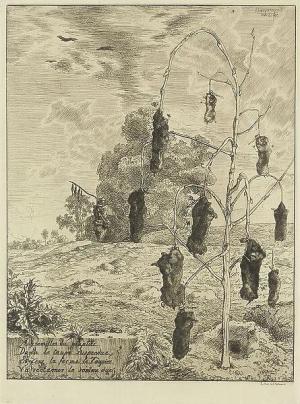
The Moles (Les taupes), Félix Bracquemond, 1854
Gervase Markham in The English Husbandman of 1614 echoes Hill in suggesting nasty smells as the best way of driving away moles. He advised to “plant in divers places of your Garden the hearbe called Palma christi, in other places Garlickes and in other places Onyons, and it is an assured rule that no Moale will come néere where they grow for the strength and violence of their smell, is poysonous and deadly to those blind vermines. “He also suggests a rather strange cure for the “falling evil” is to take a mole in the mating season, dry it in the oven, powder it and give to the sick person twice a day for nine or ten days. Rather you than me, although its not the worst of such early modern remedies by a long way.


Later, Joseph Blagrave even includes “destroying moles” part of the long title of his 1685 book New additions to the art of husbandry. He takes several pages to describe in detail how to go about it, telling readers that in “the first place you must have a Paddle, which must be put upon a Stick five or six feet long”, then in the morning go round your garden looking for the mole’s “trenches” and “tread them down but not too hard”. Look around now for new molehills and tread down the trench that leads to that.

The aim was to drive the mole to the edge of your garden where there is a ditch or a hedge. down where you prepare an elaborate trap. It is so elaborate that even having read the very lengthy instructions several times I can’t work out either what you do or how it works – suffice it to say it involves boring holes in wood, adding some clay, stuffing the tubes with horsehair and setting them in the tunnels. However Blagrave adds that if they don’t work try a spike trap, “which are so generally known and made that there needs no description”.
And of course there’s yet another failsafe remedy, which is to catch a female mole in March, the breeding season, put her in an earthenware pot half filled with soil and lots of worms and bury it in a mole trench. “Buck moles will run quarter of a mile after a doe” so in a short time not one Buck-Mole will be left in the Ground.” Just remember to keeping adding worms for the doe and she will live the whole month and “every time you give her worms you may search the pot to see what company she has got.”

detail showing where to place traps on a simple mole run from L’Art du taupier
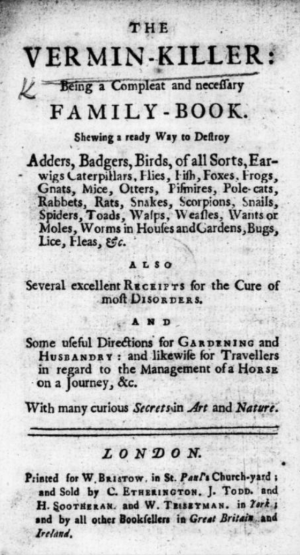
All of these anti-mole “remedies” and many more were collected together in a 1765 book delightfully entitled The Vermin Killer. However there wasn’t much by way of “new” methods throughout the 18th or early 19thc in Britain, and even the usually inventive John Claudius Loudon fails to devise an effective mole remedy. His Encyclopaedia of Gardening of 1825 has a drawing of a simple trap but no explanation of how it might work, and otherwise he merely suggest catching and destroying them as helpless babies in the spring.
However during the revolutionary years in France the first book dedicated to moles and how to deal with them appears in 1797. It was the L’Art du taupier, by Etienne Dralet. It has the first illustration I’ve seen of a mole tunnel network.
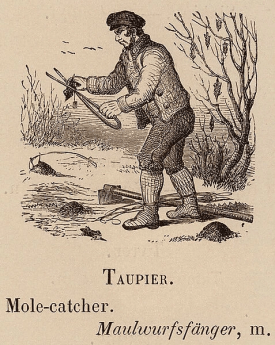
Traps were the main method of catching moles. The earliest ones are primitive and undoubtedly cruel, but our ancestors did not share modern sensibilities about animal welfare. These devices were usually home-made wooden contraptions coupled with twine, or a pitfall tap such as a pot sunk into the ground baited with worms so the mole would fall in but be unable to escape.
I’ve decided not to include images of other common traps here – too unpleasant – but just google mole traps and you can find them if you’re interested.
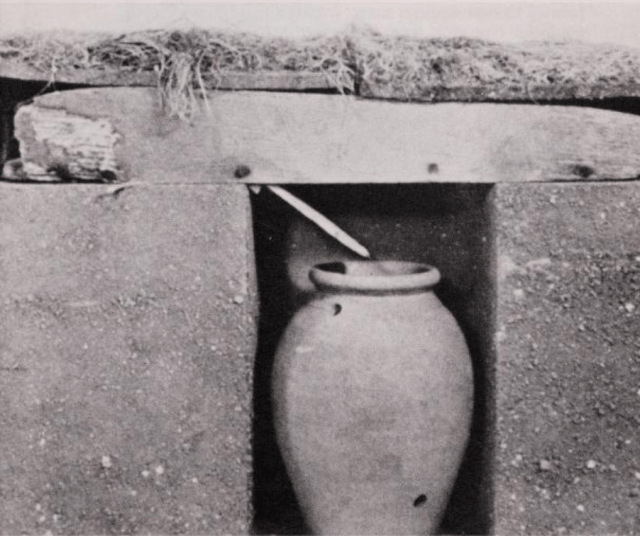

These traditional methods continue to be employed against every creature considered a pest and believe it or not that even included house sparrows with campaigns to exterminate them completely.
Richard Lovegrove gives examples of clubs who paid out prize money for various pests” eg in 1925 one at Vines Cross in Sussex paid, amongst other prizes, 6d per hawk or stoat, 2d for moles, rats or queen wasps and a 1d per sparrow. Indeed he shows that the last of these clubs didn’t shut down until the end of 2003.
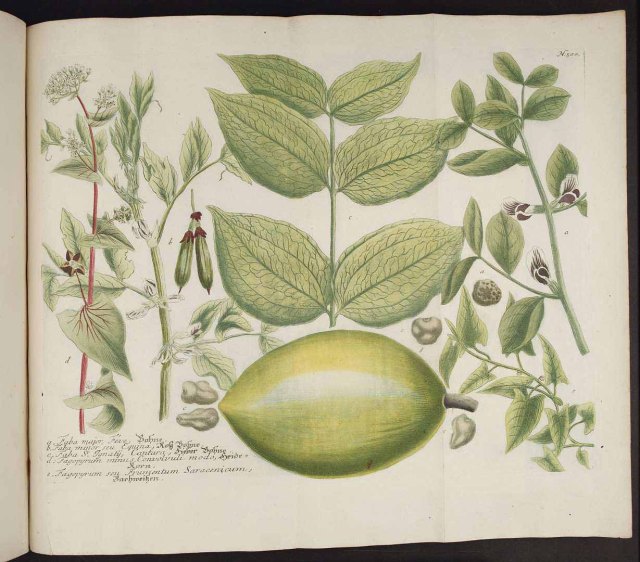

But it was poison that began to take over in the 19thc, particularly the product of a tropical tree [Strychnos nux-vomica] and a tropical climbing bean, named after St Ignatius [Strychnos ignatii]. Its toxic and medicinal effects were known across south and east Asia, and were recorded too in the classical world and many early European herbals and there are reports of the powdered beans being used as a pesticide from the 17thc but in 1818 the active ingredient, strychnine, was identified and isolated from the Saint-Ignatius’ bean by two French chemists.
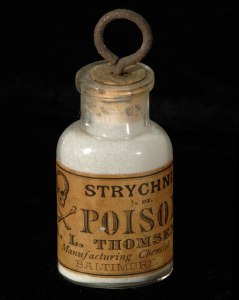
It was apparently simple to create a form which could be used in incredibly minute quantities medicinally but otherwise as a quick-acting poison. It soon entered commercial production and became so readily available over the counter, just like arsenic, from any chemist with no questions asked as I showed in an earlier post.

There were at least two problems with poisoning the poor moles compared with trapping. Firstly, there was no way of the mole-catcher showing the garden owner how many moles they had caught because, of course, the moles died in their tunnels.
More importantly there were welfare concerns because death by strychnine poisoning is slow and agonising, and residual strychnine is highly dangerous to other wildlife, domestic animals and humans. Its use was eventually banned but not until 2006.
Instead the poison of choice these days is Phostoxin which reacts with the damp of the soil in the tunnels to create a short-lived toxic gas.

There was another way that was tried to deal with moles – albeit a short-lived and very eccentric one.
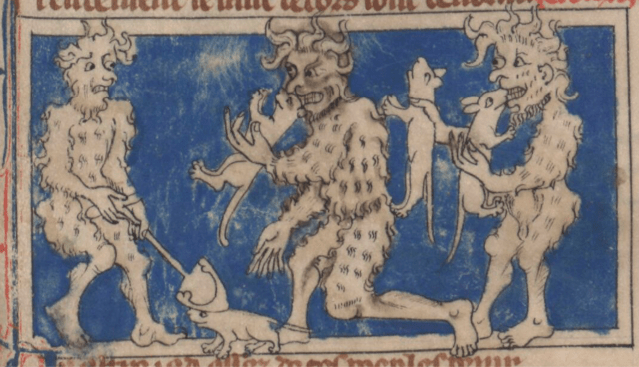
It was promoted by the naturalist Reverend William Buckland (1784 – 1856) , who famously attempted to eat his way through the entire animal kingdom. The reason it was short-lived because he reported that moles were one of the nastiest tasting things he had eaten – alongside bluebottles!


One side benefit of mole catching was the use of their pelts for making into gloves, waistcoats or coats. For that huge numbers are needed – a waistcoat apparently required around 100. Although the market varied Lovegrove cites figures ranging from 1d a skin to 2s6d in times of shortage
But it’s the Edwardian era when moles really make a breakthrough into public attention, mainly thanks to Queen Alexandra, the wife of Edward VII. She was a bit of a fashion icon who set several trends among society ladies, like choker necklaces, high necklines, and “summer muffs”.
At the turn of the 20thc there was apparently a more serious infestation than usual of moles in Scotland. The story goes that the queen decided to order a Scottish moleskin wrap and such was her influence that demand for moleskin went through the roof, and Scotland’s pest problem was turned into a lucrative industry. At the peak of moleskin’s popularity, the US was importing over 4 million pelts a year from the UK. The colour “mole” entered the vocabulary too. In 1903 it’s first recorded as “moleskin-colour”, then by 1906 “mole-colour” and from 1908 as simply “mole”.

Llanboidy Mole-Catcher, by
James Lewis Walters (active c.1900–1922)
Carmarthenshire Museum
Even today there is debate over whether moles are really that harmful and how to deter, or destroy them. Deterrence might include some of the old ways – using garlic, onions down the tunnels, or planting fritillaries or caper spurge. You could try ultrasonic mole repellers, or putting dog hair in the molehills. Otherwise because they have no legal protection in the UK there are still nasty chemicals available or a whole network of professional mole-trappers usually trained in both the theory and practice of mole catching, and who seek to dispose of your moles in as a humane a way as possible. They do however also seem quite an argumentative bunch as can be seen in reports of the rivalry in both the Daily Mail and the Guardian between The British Mole Catchers Register which “supports traditional expertise and skills” , the Association of Professional Mole Catchers which aims for “the sustainability of mole-catching as a viable professional discipline,” and the Guild of British Mole Catchers which is “committed to traditional mole catching skills and the welfare of the mole.”

But personally… I’m not going to make a mountain out of the little sods making molehills on my lawns and paths – after all they have a much right to be there as I do.
For more information I’d suggest starting with Richard Lovegrove’s Silent Fields, or if you want to know more about the “practical” side of mole-catching then try Jeff Nicholl’s Catching Moles: The History and Practice a not too gory account of a mole-catchers life, or Stuart Haddon-Riddoch’s


 The Garden History Blog
What a fascinating article! I am in the ‘Live and let live’ team as far as moles are concerned, but always remember the advice from a friend of a friend who, when moles tunnelled in her lawn, would ask the creatures very politely to please move elsewhere. She swore they always did – but she always thanked them out loud when they moved away.
Thanks for your comment. What a nice idea. I’ll give it a try next time I spot one. David