 MERRY CHRISTMAS!
Over the past ten years I’ve done many of the obvious more glamorous Christmas-related plants so now it’s finally the turn of Brussels Sprouts to star in the blog!
Poor old Brussels Sprouts. They’re a bit like Marmite: you either love them or loathe them. They’re the butt of almost endless jokes even though they’re a traditional part of Christmas. I say traditional but in fact they’re a newcomer to the vegetable kingdom and have probably only been around for a couple of hundred years.
So what’s the story behind this often overcooked and under-loved Christmas stalwart?

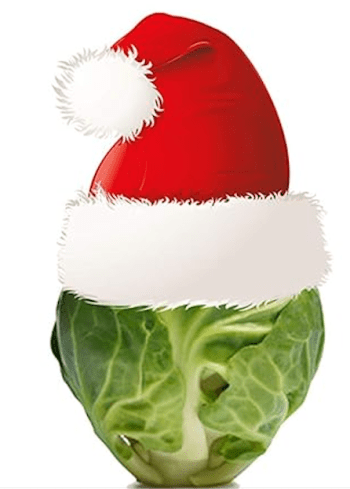
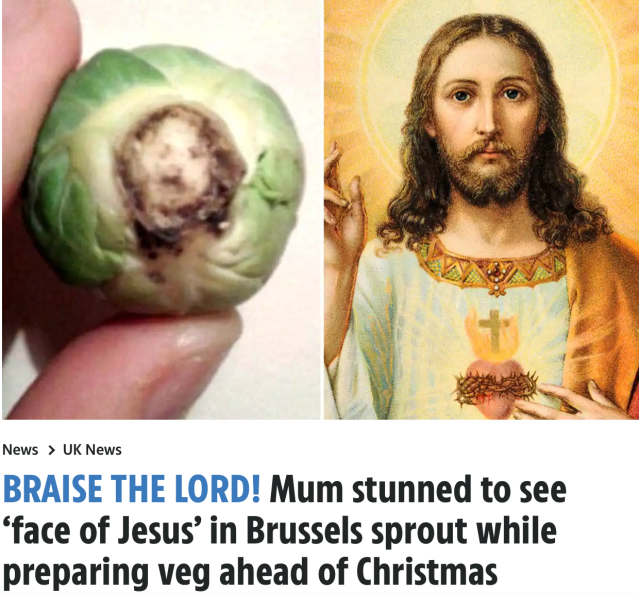
What’s this? Answer at the end of the post.
Where does Zeus come into it?
Why was Charles Darwin so interested in them?
And obviously what, if anything, have sprouts got to do with Brussels?
But if you can’t face reading about sprouts why not check out some of the previous Christmas posts on Amaryllis; Mistletoe ; Ivy ; the Glastonbury Thorn ; Poinsettia ; or even artificial decorations ?

As I’m sure you know Brussels Sprouts are members of the cabbage family so let’s start by explaining their botanical background and then go on to examine their history – if sprouts can be said to have a history. That means starting with Zeus. Greek legend has it that cabbages sprang from the sweat of his brow, which seems a bit unlikely – and hardly in the same romantic league as the story of Amaryllis from a Christmas post a few years back, or the story of Hyacinth but maybe the sweat is why cabbage smells so much when its boiled?

In fact, compared with other food crops, surprisingly little is definitively known about the origin of the domesticated members of the cabbage family. The generally accepted consensus is that all of them have evolved and developed following the domestication of one common ancestor. So whether you are growing and eating Brussels Sprouts or their close relatives cauliflower, Savoy cabbage, broccoli, kale, spring greens or even kohlrabi, they all belong to a single species,Brassica oleracea, although each developed separately and at different times.

This common ancestor almost certainly originated in coastal regions of the eastern Mediterranean. There is some archaeology to show that it was being eaten in western Syria in the Late Bronze Age c1500BC, but we don’t have any literary evidence until the Greek physician Hippocrates(c.460–377 bc) refers to the use of cabbage in a few recipes. His compatriot, the botanist and philosopher,Theophrastus (372BC – 287BC) described three types, one with curly leaves, another with smooth leaves and third with a bitter taste, many branches, and many small round leaves. And in the spirit of Christmas you might also like to know that he thought they would help deal with a hangover.
Like so many other things though, it was the Romans who spread edible cabbages and their relations around the rest of Europe. These domesticated forms then became amongst the earliest escapees from gardens and quickly reverted to an earlier “wild” form. As a result Britain and the coast of Western Europe have feral populations of these “wild” cabbages, which have naturalised and evolved considerably, particularly adapting themselves to coastal conditions, such as high tolerance of salt and lime, as in their original homelands.

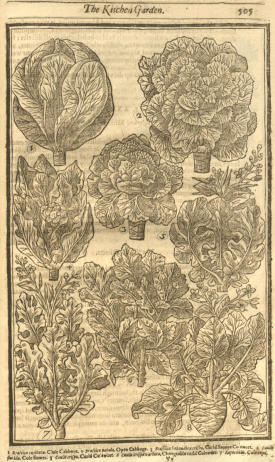
Since then gardeners have selected better forms and we can see lots of different kinds of coleworts, as the whole family was known, in herbals such as John Gerard’s and John Parkinson’s although none of them are remotely like Brussels Sprouts.
So, the next question is obviously when do they make their first appearance in gardens or on the dinner table? The short answer is no-one knows. However the first printed reference to them growing in Britain is in 1796 when they make a brief appearance in Charles Marshall’s Plain and Easy Introduction to Gardening. Marshall describes Brussels sprouts as “winter greens growing much like boorcole [what we would call kale] and by some preferred as more delicate eating, but they are not so hardy or productive.” Comparing them to kale suggests it was the bunch of leaves at the top of the thick stem that was being eaten rather than button-like side shoots. Inclusion in a gardening book would also imply that they’d been in Britain for a while.

Morning Advertiser – Monday 12 July 1819
Not only don’t we know when but we don’t know how they arrived , although the likelihood is they were, like many other plants, bulbs and seeds, probably imported from the Low Countries. However the first newspaper mention I can find is from 1819 when Brussels Sprout plants were being sold by a gardener in Westminster. After that they must have spread rapidly because they are definitely being widely grown in Britain by the 1820s with reports of prizes being awarded for Brussels Sprouts at horticultural shows.
By the early 1830s they are listed amongst “winter greens” by Paxton’s Horticultural Magazine along with other “foreign” names including German Borecole, Chou de Milan, Buda Kale and Egyptian Kale. They also appear in gardening magazines in the regular “what to do this month” columns, as well as the market prices reports.
By the 1840s they are being listed in the catalogues of seed merchants like James Carter and must be being grown on a commercial scale because they are also listed as being on sale at Covent Garden vegetable market.

Despite this Brussels sprouts don’t make it into cookery books by name until 1845 when Eliza Acton, in Modern Cookery calls them “miniature cabbages” to be “gathered when not larger than a common walnut” which should be just “boiled from eight to ten minutes, then well drained”. She didn’t suggest serving them as a side dish but instead rather surprisingly “upon a rather thick round of toasted bread, buttered on both sides.” with “Rich melted butter sent to table with them.” It was she said “the Belgian mode of dressing this excellent vegetable”
However it looks as if sprouts may have been growing here earlier than that although they were not specifically called Brussels. In 1745, a hundred years earlier than Acton, the cookery writer Hannah Glasse refers to “cabbage, and all Sorts of young Sprouts” which “must be boiled in a great deal of Water” and then “Young Sprouts” which should be “sent to Table just as they are, but Cabbage is best chop’d and put into a Sauce-pan with a good Piece of Butter.” Elsewhere she also talks about “the little young Sprouts that grow on the old Cabbage Stalks about as big as the Top of your Thumb”.
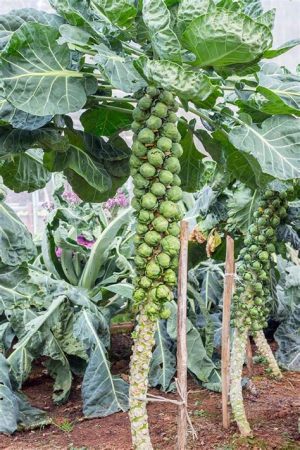
Charles Darwin took a great interest in Brussels Sprouts – well, maybe thats a slight exaggeration – but he was very interested in the diversity and evolution of the whole cabbage family, and he wrote about them in his 1868 book The variation of animals and plants under domestication. What he noticed in particular was that “Although we see such great differences in the shape, size, colour, arrangement, and manner of growth of the leaves and stem…it is remarkable that the flowers themselves, the seed-pods, and seeds, present extremely slight differences or none at all.” It was proof he decided that “many useful variations in their leaves and stems have been noticed and preserved from an extremely remote period.”
Darwin conducted experiments to see how different kinds would hybridise naturally and discover that about two thirds of the seeds from his test crop had “plainly deteriorated and mongrelised” even in the first year. Similar experiments were carried out at Reading University in the 1930s with very similar results – Each sort breeds true if self-pollinated which means wide isolation distances – a kilometre or more – are required between different members of the family, otherwise reversion to “wild” cabbage was extremely rapid if they ere allowed to cross-pollinate.
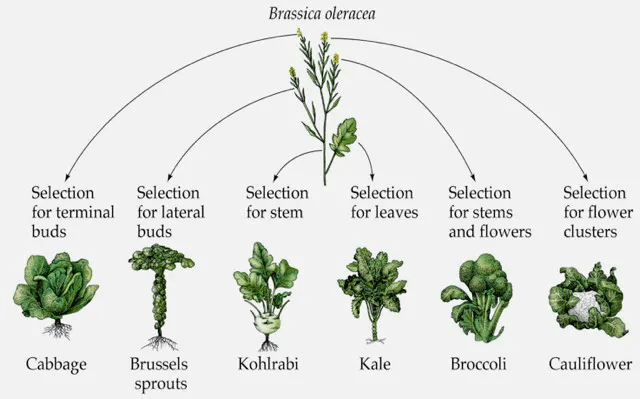
So careful selection over a comparatively short space of time could lead to significant differences emerging, but equally to quick reversion. This explains why if you let the heads of cauliflower or broccoli plants go to seed they reveal themselves to just densely packed cabbage flowers, while Brussels Sprouts simply unfurl the leaves to reveal themselves as miniature cabbages. Similarly if you cut the head of an ordinary cabbage small sprouts will eventually emerge along the stem.
The problem is no-one recorded when any of these changes happened but the likelihood is that Brussels Sprouts emerged in or around that city, perhaps as a mutation of a savoy cabbage or even a type of kale. I’ve seen several dates given for their first appearance in the markets of Brussels ranging from 1300 through to the late 16thc but I’ve not seen any supporting evidence for any of them. However it’s pretty clear they weren’t grown widely outside the Flanders region for quite a while and probably don’t reach Britain until the mid-18thc.

It really only in the second half of the 19thc that Brussels Sprouts became the subject of hybridisation. By 1888 Carters are offering the seed of 8 different varieties and that number remains roughly constant thereafter, and indeed today Thompson and Morgan are still offering 9 which given the drop in the number of varieties offered commercially for most vegetables is quite surprising.
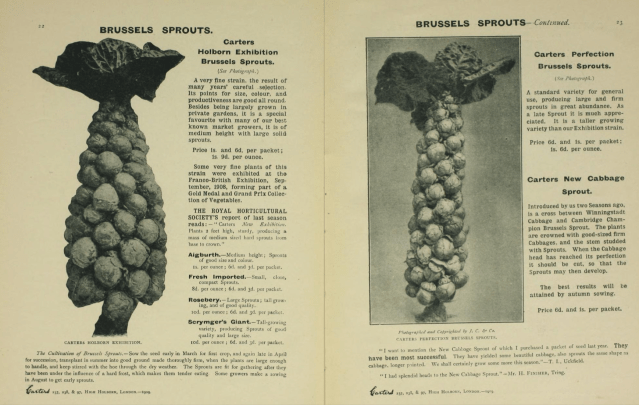
They include a variety named Bedfordshire Fillbasket which the main one grown in the inter-war years. Then about 40% of the crop nationally were grown over 10,000 acres in Bedfordshire, mostly interplanted with potatoes. The other major production are was around Evesham in Worcestershire where the main local variety was Evesham Special first listed in 1926. A third important heritage variety, Wroxton, is describe by Christopher Stocks in his book Forgotten Fruit. It was another example of the hybridising skills of Victorian head gardeners, being was originally developed by a Mr Findlay who ran the gardens at Wroxton Abbey near Banbury the seat of Lord North. It was introduced in 1895 and quickly made its name as one of the first so-called dwarf varieties. I say so called because it grew over a metre tall.

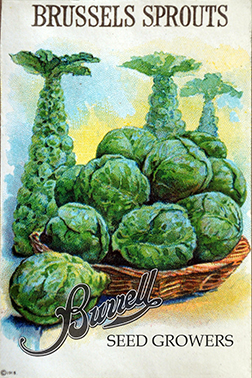
All these varieties were open pollinated but nowadays most of them have been supplanted by F1 hybrids which are the result of the first generation crosses which give the same resulting hybrid each time.
One interesting sideline of this is that unlike F1 hybrids where sprouts are ready to harvest all at the same time, open pollinated sprouts mature from the bottom of the stem towards the top, which of course is very useful if you’re growing them for your own use and only need a few at a time.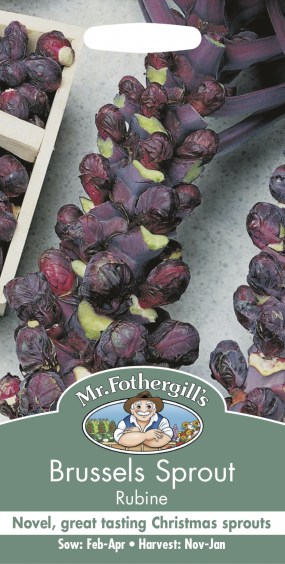
One of the more noticeable developments dates from the late 1940s and early 1950s has been `the emergence of purple Brussels Sprouts.
Cornelis Nicolaas Vreeken, a Dutch seedsman and plant breeder, ran a a series of hybridising experiments. One of these involved crossing a Brussels sprout with a red cabbage and led to “Rubin” the first purple Brussels Sprout. Registered in 1954 it has some of the red cabbage’s purple colouring but crucially greater sweetness. Surprisingly although it’s easy to get the seeds they haven’t really caught on in the commercial market. Instead breeders have concentrated on other ways reducing what was often thought of as a bitter or slightly metallic aftertaste, and making the sprouts sweeter, softer and almost buttery in texture. Unfortunately as the New Scientist pointed out in an article in 2015 there is a downside to that because the same chemicals that make things like green tea, dark chocolate, red wine and some vegetables including sprouts bitter also imbue them with many of their health benefits. But plant breeders under pressure from food manufacturers are now trying to remove them to satisfy most people’s love of sweeter flavours.

Finally a bit about commercial growing. All sorts of experiments are being carried out to improve yield on large scale field crops, particularly to see if “stopping” the stalk has any effect. Its thought the removing the top growth , or even believe it or not just bashing the top bud at an early stage using a sharp tap from a rubber hammer stimulates the growth of the side shoots – the sprouts – by at least 5%.
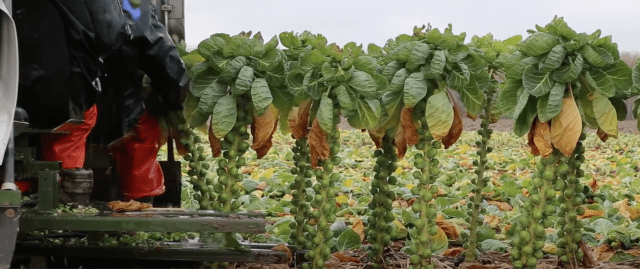
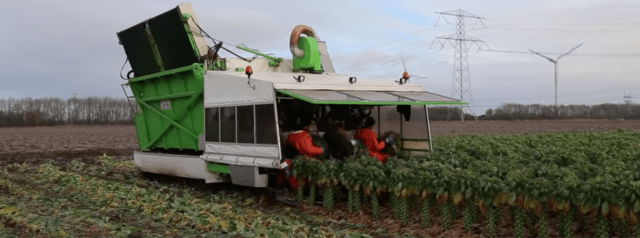
But if you really want to see how sprouts get from the farm to your table take a look at this YouTube video which shows how virtually the whole process is automated….although if you don’t like sprouts be warned there are are awful lot of them throughout the video!
And finally here’s the answer to the question I asked at the beginning of this post…
Merry Christmas!


 The Garden History Blog
Pingback: 10 Astonishing Animal and Plant Relatives: Discover How These Species Are More Connected Than You Think - Crafting Your Home
Pingback: Best Types: Varieties of Brussels Sprouts to Grow
Thanks for the mention