
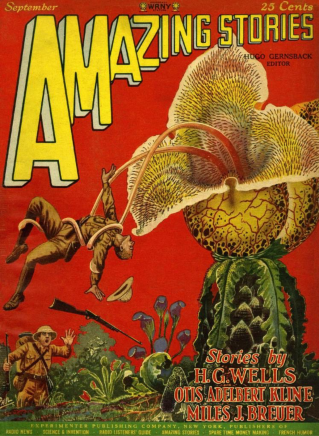
The man-eating tree from Madagascar I wrote about last week turned out to be an elaborate hoax, albeit a very long lasting and successful one. Nevertheless it struck a chord in the public imagination and from then on there has been a constant stream of stories about weird plants gobbling up humans from all round the world.

But is a man-eating plant or a sentient plant capable of moving actually even theoretically possible? Although the science says pretty clearly “no”, quite a lot of people seem to have think it is… if only in their imagination!
As I explained last week, Darwin showing that some plants could be carnivorous opened up the possibility that plants might have shared a common ancestor with man. That meant all things were possible, especially those that play on the uncertainty and even fear that Darwin’s ideas provoked. This fascination also coincides with the great age of gung-ho and derring-do exploration in the remoter regions of the world, where all sorts of strange things were being “discovered” by Europeans for the first time.

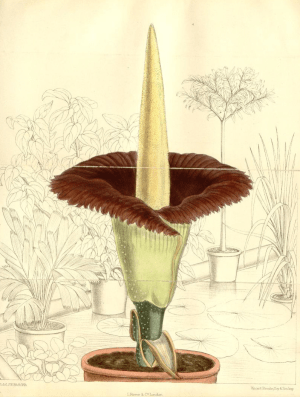
When, for example, the crowds gathered in 1889 to see – and smell – the Titan Arum when it flowered for the first time at Kew they must have felt the real and potential power of plants. A native of the Sumatran rain forests it had only been described scientifically a few years earlier and was unlike anything they would have ever seen or experienced before.
It is the largest flower in the world with the central spike standing several metres high and it stinks of rotting flesh. Commonly known as the corpse flower for that very reason the foul smell had a purpose: to attract carrion insects which act as pollinators. [I half expected it to eat them as well!] If plants could be this spectacular and bizarre surely they could evolve to devour animals and humans too?

The Titan Arum still hold a fascination for us today but for the Victorians seeing it for the first time it must have seen what Zoe Chadwick called “a Gothic structure made not of stone or brick but of petals and stems, which Nature had painted in garish hues of green, red, and purple in seeming sharp contrast to its funerary scent and function.” Given that, what was so unusual about travelogues or newspaper reports which described the man-eating plant from Madagascar?


Other monster plants appear increasingly in fiction too. They come in all sorts of shapes and sizes but generally are growing in far-flung and difficult-to-find locations, and bear a passing resemblance to known plants, carnivorous or otherwise. There are those that grab, impale or smother with their leaves, there are those that have tentacles and choke or crush, there are those that are poisonous in some way, and there are those that drown their prey…and of course even a few that combine these murderous ways.
Such stories poured out during the late 19thc including some from great writers such as HG Wells and Arthur Conan Doyle, and carried on through the 20thc with sci-fi comic books, and then books such as The Day of the Triffids and more recently Little Shop of Horrors.

But are plants that move even theoretically possible? The short answer is probably no because while human and animal bodies are powered by food and oxygen which are both available almost anywhere, allowing us to be mobile, almost all plants get their nutrients from the soil in which they are rooted and their energy from the sun. The result is plants are generally limited in what they can do and where they can be. Plants that can move location, or mimic animals or human behaviour, probably only grow in one place -the realm of the imagination. But who knows…maybe writers know something the rest of us don’t.

Let’s have a look at what some of them have imagined. First up, in this catalogue of monsters, was just a couple of years after the appearance of the Madagascar man-eater in 1881. This time the plant is growing “in the central solitude of a Nubian fern forest.” Although the tree is nameless it is deadly. It stood alone and looked as if it would provide shelter from the heat of the sun, and bears “wondrous fruit”. Underneath it “a rank growth of grasses… concealed the fearful secret of the charnel-house within, and draw round the black roots of the murderous plant a decent screen of living green.” A European hunter and his African servant boy are following a herd of antelope but the boy runs close to the tree “and the next instant … The tree was convulsed with motion, leaned forward, swept its thick foliaged boughs to the ground, and …There was one stifled, strangling scream, and except for the agitation of the leaves where they had closed upon the boy, there was not a sign of life.”

The hunter moved closer and saw “the tree was quivering through every branch, muttering for blood, and, helpless with rooted feet.” As he neared “the tree seemed to have become a live beast” and went after him too. “Each of its thousand hands reached downwards towards me, fumbling. It strained, shivered, rocked, and heaved. It flung itself about in despair”. And so on and so on for several more paragraphs until “Leaning over towards me, it seemed to be pulling up its roots from the softened ground, and to be moving towards me. A mountainous monster, with myriad lips, mumbling together for my life, was upon me!” Luckily his companions come to save him and shot and slashed the tree until it gave him up and died itself.

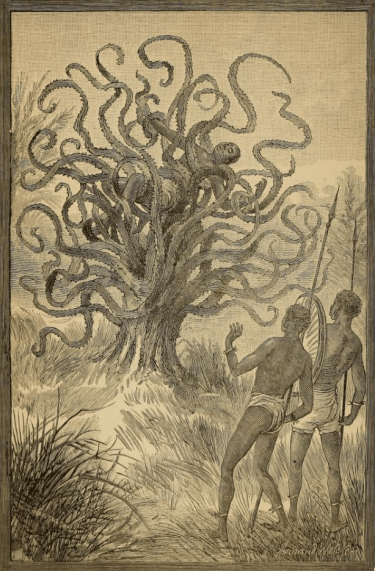
If you’re not cowering already how about an encounter with the ghastly “Ya-te-veo” which made its first appearance in print in 1887, in Sea and Land : an illustrated history of the wonderful and curious things of nature existing before and since the deluge by James Buel.
His account of a “marvellous vegetable Minotaur” with a “voracity that extends to making even humans its prey” was based on a series of travellers tales from “hundreds of responsible travellers [who] declare they have frequently seen it.” Most apparently located the plant on a remote mountain in Guyana.
The consensus was that the plant had “a short, thick trunk, from the top of which radiate giant spines, narrow and flexible, … armed with barbs, or dagger-like teeth [which] lay their outer ends upon the ground, and so that the trunk resembles an easy couch with green drapery around it.” This of course fools “the unfortunate traveler” who, “ignorant of the monstrous creation which lies in his way, and curious to examine the strange plant, or to rest himself upon its inviting stalk approaches without a suspicion of his certain doom.”

Then ” the plant strikes” and “the horrid spines rise up, like gigantic serpents, and entwine themselves about him until he is drawn upon the stump, when they speedily drive their daggers into his body and thus complete the massacre.”
Its method of impaling the victim was compared to the Iron Maiden, a mediaeval instrument of torture and death, so sometimes the plant was nicknamed the maiden but usually it was known as Ya-te-veo because the hissing sound its stems made when rubbing together sounded like a Spanish expression, meaning “I see you.”
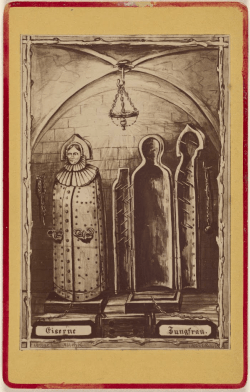
Another version of the Iron Maiden plant was reported in the Kansas City Gazette in 1906.
Described as a “terrible minotaur tree” resembling “a large cactus with long thorny arms”. As you might have guessed by now the main character “had no sooner touched one of the stems than a long arm, like the horrible tentacle of the octopus, hissed through the air and wrapped about his body”. Then “powerless and screaming… he felt himself being drawn into an awful tangle of crushing leaves.”
He is saved by others shouting “Yateveo” and shooting, and slashing at the plant until they managed to pull him out of its grip.


The reference to the tentacles of an octopus is another echo of 19thc discoveries. Giant squid and octopi can be seen in contemporary fiction – Jules Verne’s Twenty Thousand Leagues under the Sea is a good example – where these creatures are often seen as attempting to kill sailors, sink their boats and generally cause mayhem. It’s not that far for the author or artist to transfer the suckers and barbs on a squid’s tentacles onto the branches or fronds of a giant plant.
Another one of these octopus-like nasties was reported from Nicaragua. However, instead of using spikes to impale or strong leaves to crush it sucks the life blood from its victims. Accounts begin to appear in late 1889 in US newspapers but soon spread more widely. Here’s the version from The Spectator of October 24th 1891. Headed A Cannibal Plant it tells of a naturalist, a Mr Dunstan who had spent two years botanising and collecting insects in central America who discovered “a singular growth in one of the swamps which surround the great lakes of Nicaragua.”
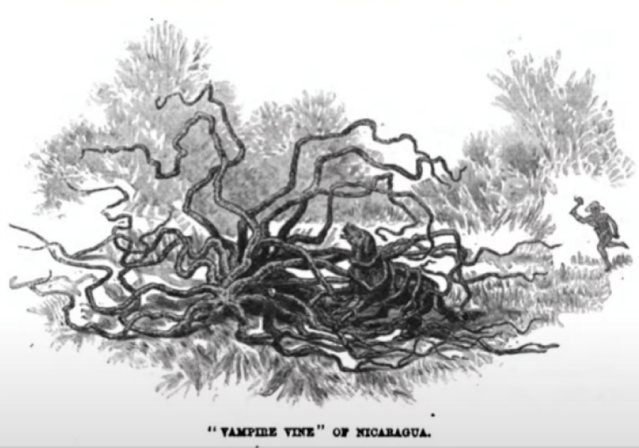
Having “heard his dog cry out, as if in agony” he ran to towards the sound and found the poor creature “enveloped in a perfect network of what seemed to be a fine rope- like tissue of roots and fibres….covered with a thick viscid gum that had was “nauseating to inhale..”
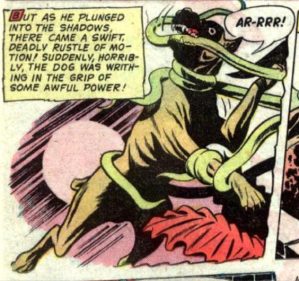
Cutting the dog free with difficulty because the vine tried to wrap itself round his hands leaving them red and blistered. He discovered “its grasp can only be torn away with the loss of skin and even of flesh”, because its tentacles were covered by “a number of infinitesimal mouths or little suckers, which, ordinarily closed, open for the reception of food.” It was no wonder “the native servants who accompanied Mr. Dunstan manifested the greatest horror of the vine, which they call “the devil’s snare”, and were full of stories of its death-dealing powers.”
The story was later noted by Dr Andrew Wilson in Illustrated London News in 1892.
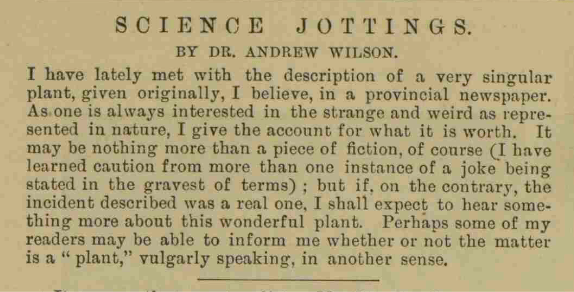
Even then there were sceptics – this is from Illustrated London News 27th August 1892
That coverage elicited further stories from readers. One about a “snake-tree” in Mexico, which was seen by “a traveller” to snatch and suck the life blood from a bird. To see how this was possible he then “fed” the tree with chickens and saw that it had suckers on its branches rather like those on an octopus’s tentacles. However Dr Wilson’s scepticism continued…

Nevertheless the story continues to be repeated and embroidered. For example in 1933 the exotic sounding amateur explorer and archaeologist Count Byron Khun de Prorok led a party into the jungles of southern Mexico. In his book In quest of lost worlds : five archeological expeditions, 1925-1934 he told readers it was there that he had his “first glimpse of the vampire plant which, two or three days earlier, had trapped a bright little bird on its treacherous leaf, and now was in the process of taking its meal.” The party get closer, wearing gauntlets lest they brush against the plant which was “beautiful with fine, red flowers” but de Prorok himself is scratched by a thorn which “blinded me until the doctor patched it up”, while the cameraman ” had taken off his gauntlet, the better to take a particular shot, and touched a plant. Half an hour later, his arm was covered with huge water-blisters, and the pain was agonising.”

You’d have thought that merited a newspaper scoop at the very least but actually there is no further mention of the plant in the book and, surprise surprise, there are no photos or drawings despite having a cameraman to record the expedition. Actually maybe not so surprising since his critics say Byron De Prorok had “a vivid imagination” and “was given to gross exaggeration.”
Even more bizarrely, modern commentators have taken Andrew Wilson’s comments completely taken out of context citing them as an accurate scientific sighting of the plant by Wilson himself. Watch this video on youtube for one example of how evidence can easily be twisted.


Slightly later we have a similar sounding plant but this time on a remote island. Published in Black Cat magazine in Sept 1896, The Guardian of Mystery Island is a much longer story and one of the better reads of all these weird stories. It’s told by Edmond Nolcini and includes superstitious fishermen, pirate treasure, a tumbledown house, a mysterious old woman who disappears and of course “a devil-plant”. Sadly it’s unillustrated.

Australia, also had a tale of “one of the rarest and most terrible species of the vegetable kingdom ever discovered. It is known as the octopus plant, called by the natives “the devil tree.” The narrator of “The Devil Plant ” published in 1923 was to use it to exact revenge on someone who had just stolen his wife. In a novel twist on the standard version he tells his rival that “the name is somewhat of a misnomer. It is said that it is rather a tree of heaven, for it distills a rare and delicious nectar which has a wonderful rejuvenating power. At the same time it intoxicates in a strange and mysterious manner,[so that] he who sips is actually loved by any of the female sex whose eyes look upon him.” I leave you to ponder on what happened next!

I could go on adding to the list for ages of but I’ll leave you with just one more. This is the strange plant from the appropriately named Flytrap Gulch, in Arizona. Its told by Sir Arthur Conan Doyle and called simply The American’s Tale and describes the death of a man who was caught by a plant with “leaves like a brace of boats with a hinge between ’em and thorns at the bottom.” (Sounds like Sir Arthur had seen a Venus fly-trap)
“We passed down the gulch to the place where the great one grows, and there we seed it with the leaves, some open, some shut….I think we won’t get that picter out of our minds agin. One of the great leaves of the flytrap, that had been shut and touchin’ the ground as it lay, was slowly rolling back upon its hinges. There, lying like a child in its cradle, was Alabama Joe in the hollow of the leaf. The great thorns had been slowly driven through his heart as it shut upon him. We could see as he’d tried to cut his way out, for there was a slit in the thick fleshy leaf, an’ his bowie was in his hand; but … it had closed on him as you’ve seen your little hothouse ones do on a fly; an there he were as we found him, torn and crushed into pulp by the great jagged teeth of the man-eatin’ plant. There, sirs, I think you’ll own as that’s a curious story.”
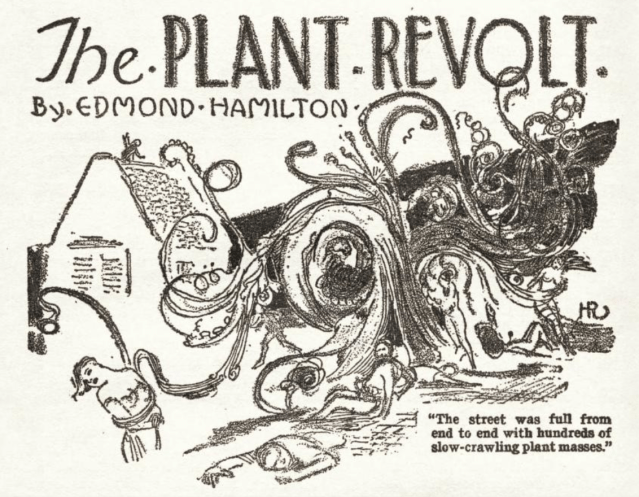
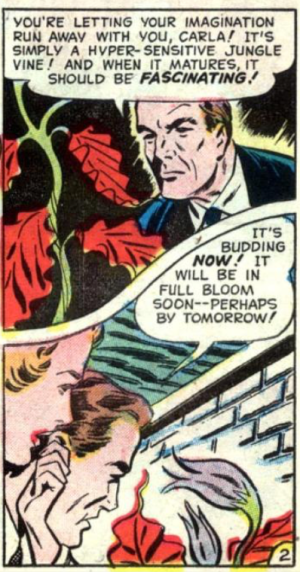
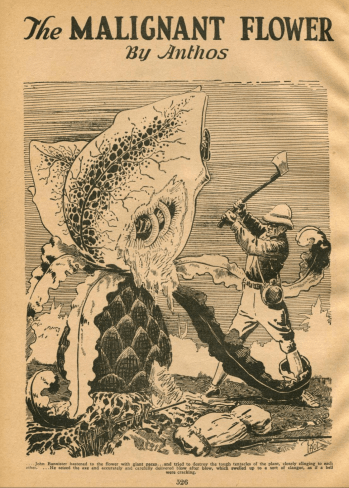
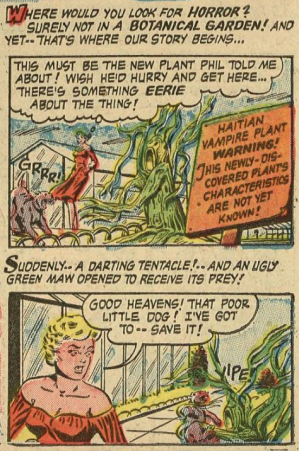
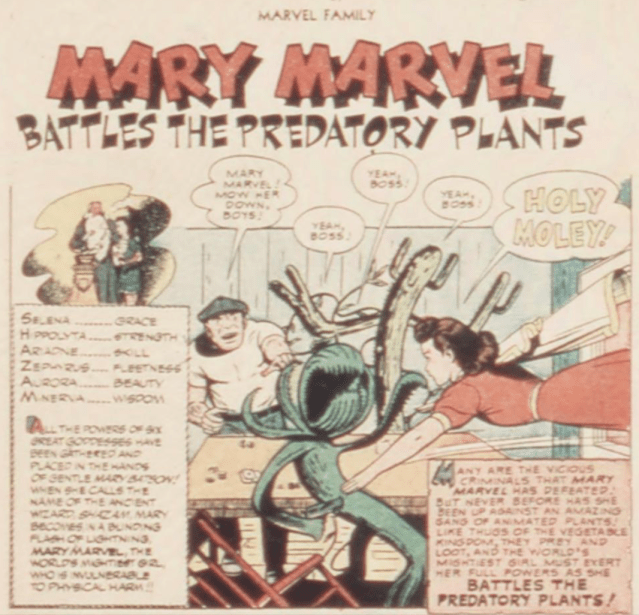
As you can see from the images I’ve used all these stories are later taken up and “re-invented” by the writers and artists of sci-fi and comic magazines and the references at the end will lead you to even more versions if you’re interested.
I think we’ve had enough of such curious stories for the moment but maybe one day I’ll come back to them if there’s sufficient interest.
But let’s leave the last word with James Buel : It is a singular thing, and much to be deplored, if such a voracious plant exists, that we can find no description of it in the most elaborate works on botany [so] I am inclined to doubt ; not that there is no foundation for such statements as travelers sometimes make about this astonishing growth, but that the facts are greatly exaggerated.”
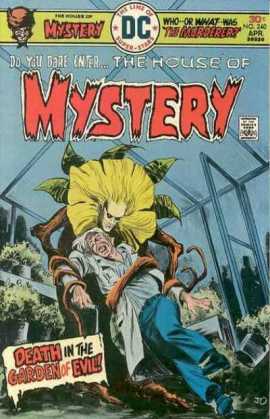
For more information good places to start are, for a more academic approach, Perilous Plants, Botanical Monsters and Reverse Imperialism in Fin-de-Siecle Literature, Zoe Chadwick 2017 [readable on-line]; T.Miller “Lives of the Monster Plants: The Revenge of the Vegetable in the Age of Animal Studies” in Journal of the Fantastic in the Arts, Vol. 23, (2012) .
For a lighter touch Plant Monsters in fantasy and sci-fi comics are really well investigated by Dark World Quarterly, who have produced several well-illustrated blog posts including The Beast Plants; Plant Monsters in The House of Mystery; Plant Monsters in the 1950s; Even More Plant Monsters in Comics!; and Plant Monsters of ACG ; but there are several more too! Another good collection of well-researched blogposts – especially those published on Tentacle Tuesdays – can be found at whosoutthere .


 The Garden History Blog
You must be logged in to post a comment.