

We’re all heard of Charles Darwin, and indeed the last couple of blogs have been about one impact of his ideas on evolution, but who knows much about his grandfather?
I certainly didn’t until I chanced across something he’d written which made me think I ought to find out a bit more about him. Somewhat to my surprise I discovered that he was at least as multi-talented as the more famous Charles and, in his own way, almost as important.
Erasmus Darwin was not only a man of extraordinary intellectual insight with his own pioneering ideas on evolution, he was a successful doctor, an inventor, a “lunartick” scientist, gardener, botanist and later in life he became the most famous poet of his day. Often accused of atheism he also had radical views neither of which was a good idea during the wars with revolutionary France at the very end of the 18thc.
The result has been that for the last 150 years he has largely been overshadowed his grandson, and, I think, unfairly so.

Erasmus was born near Nottingham in 1731 the son of a lawyer. He went to Cambridge and then in 1753 went to Edinburgh to study medicine. After qualifying he set up practice in the cathedral city of Lichfield, then more important than its near southern neighbour Birmingham. Conscientious and sympathetic he proved a good doctor and became sufficiently celebrated that he was approached to become physician to King George III – an opportunity he declined. He promoted treatments that were then unusual, taking a keen interest in exercise regimes and the benefits of good ventilation.
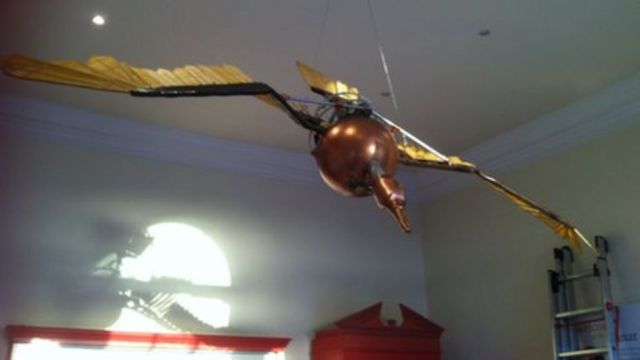
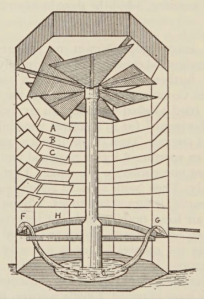
In his spare time he developed a great interest in science and technology, writing a paper for the Royal Society “On the ascent of vapour”, aged just 26, and being elected a Fellow of the Society in 1761. He was to go on and invent a three-wheeled steam-carriage which was never built because of the cost, a speaking machine , a canal lift, a vertical-axis windmill which was put into use by Josiah Wedgwood, a copy-writing machine, a diving bell, and numerous designs for horse-drawn carriages with improved systems of steering, springing and traction. Many of Darwin’s other inventions were just sketches adapted and developed later by others, such as an artificial bird powered by gunpowder, a multi-mirror telescope and a rocket motor powered by hydrogen and oxygen. However, presumably because he was fearful of ruining his hard-won reputation as a doctor, these were usually done anonymously.
Around 1760 he became one of the founding members of what became known as the Lunar Society of Birmingham, a group which also included the engineer and businessman Matthew Boulton, the engineer James Watt, the potter Josiah Wedgwood, and the chemist Joseph Priestly. Another famous name who met with them was the American Benjamin Franklin who spent most of mid-1750s to the mid-1770s in Britain.
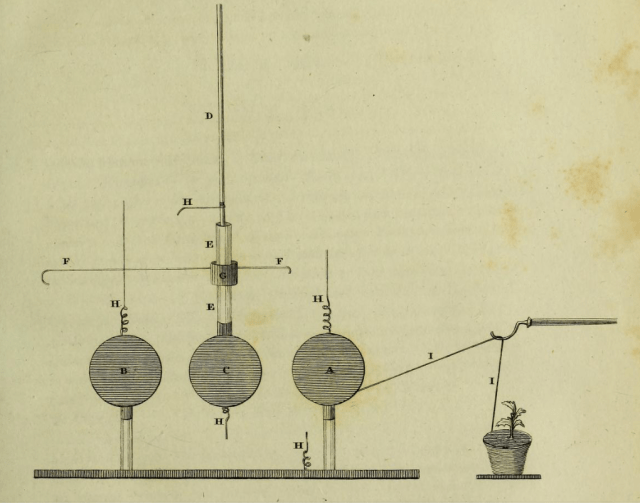

Darwin’s electrostatic doubler 1776
https://archive.org/details/doctorofrevoluti0000king/page/117/mode/1up
Darwin’s friendship with Boulton and Franklin helped lead to a great interest in electricity, which as I have shown in earlier posts was being “discovered” in the mid-18thc, with experiments into its effects on both plant growth and human medicine. Incidentally He also took the lead in ensuring an early lightening conductor was fitted on Lichfield’s cathedral.
The aim of these “Lunarticks” as they nicknamed themselves was to improve science and technology. Although the group was very informal and kept no records they became one of the chief intellectual drivers of the Industrial Revolution. They were also radical reformers, supporting the freedom of the press, religious toleration, parliamentary reform and abolition of the slave-trade. This was to bring them considerable trouble in later years when the French Revolution got under way.
For more on the Lunar Society take a look at Jenny Uglow’s The Lunar Men (20xx) or listen to the Radio 4 In Our Time programme broadcast in 2003


Darwin and his wife Polly, who he married in 1758, lived in a house in Cathedral Close Lichfield. When they moved in, the front garden which contained part of the moat that surrounded the close, was overgrown and a friend described how he “flung a broad bridge of shallow steps with Chinese paling descending from his hall door to the pavement.” He cleared the moat “rendering it with Lawny smoothness” and planted it with lilacs and Roses.
He also rented another piece of ground to install a pond for cold water bathing. That might sound a bit weird to us – although think of wild water swimming – but it was a familiar treatment suggested by Georgian doctors.

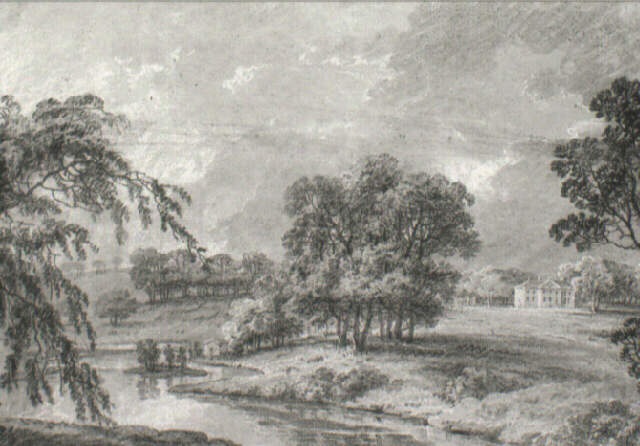
Another prominent medic and former Lichfield resident was Sir John Floyer (1649-1734). He was an earlier proponent of cold baths, wrote about them enthusiastically, and built one for himself in a little valley, on the western outskirts of Lichfield. In 1777 Darwin bought about eight acres of land there including Floyer’s bath describing the valley as ‘irriguous from various springs, and swampy from their plenitude’ with a ‘mossy fountain of the purest and coldest water imaginable’. He dammed the tiny stream to form ‘small lakes that mirrored the valley’ and teaching ‘it to wind between shrubby margins’. He also cut into the steep rocky sides of the valley to form a grotto which had “a perpetual dribbling of water… like a shower from a weeping rock’..
For more on the Georgian fashion for Cold Baths see Clare Hickman’s online article Taking the Plunge, (2010)

This was all preliminary to laying out what he called a botanic garden. Unfortunately there is no plant list, nor any sketches of what it look like but there are a couple of brief contemporary descriptions: ” after leaving the bath, the stream was conducted by several falls of highly picturesque appearance to a small pool surrounded by a shrubbery [with] a mazy path …[and] all the effects of an extensive wilderness.” More important though is the comment by Anna Seward, a family friend who said “it was laid out with ” various classes of plants, uniting the Linnaean science with the charm of the landscape.”

This was highly unusual because traditionally most botanic collections were laid out geometrically, or perhaps divided into four zones to represent the quarters of the globe. It was only from the 1760s onwards that a new style emerged with botanical gardens such as those at Cambridge and Edinburgh using regular shaped beds laid out in plant families according to the Linnaean system. Darwin’s botanical garden went one stage further, because he not only laid out the plants according to Linnaean rules but he did so in a decidedly ungeometric way, adopting instead the principles of a picturesque landscape rather like that of William Shenstone of The Leasowes estate. It’s likely that he used it, in part at least, for growing medicinal plants for use in his medical practice.
After Polly died in 1770, leaving him with a young family he threw himself into the work of the Lunar Society but also began to take a bigger interest in systematic botany, acquiring Linnaeus’ Systema Naturae and on a bigger scale the twenty-seven volumes of Comte de Buffon’s Histoire Naturelle for his library and helping fellow medic William Withering produce his arrangement’ of Britain’s flora according to the ‘celebrated’ Linnaean system.
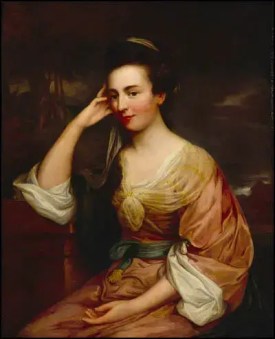
After fathering two more daughters by his children’s nanny, in 1781 he remarried. Elizabeth Pole. She and her late husband had been patients of Darwin and he had long admired her. She was “thirty-three, dashing, witty and rich: half the young men in the country were after her”. Darwin was “forty-nine, stout, stuttering and lame, with two grown sons, and two illegitimate daughters” but to everyone’s surprise they had a long and happy marriage and had 7 more children. They moved to her late husband’s home Radbourne Hall near Derby.
The botanic garden was left in the hands of a friend John Jackson who ‘maintained’ it ‘on the original plan’ until his death in 1798.
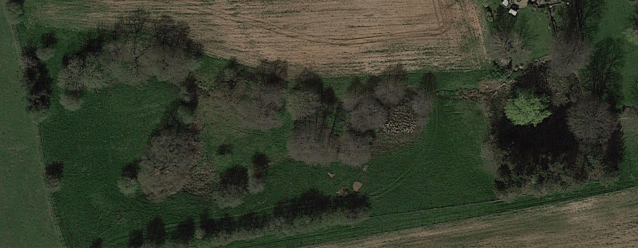
It was reported that people continued to visit the site and that both the ‘Bath and Botanic Garden’ were ‘much used’ but after Jackson died it soon reverted to nature. Forty years later in the July 1838 issue of the Gardener’s Magazine an article showed how it ” gradually fell away from its former beauty, until it has at length become a mere wilderness; the ponds being choked with weeds, the cascades broken down, the walks overgrown with rank grass, and the trim parterres converted into pasture for cattle.” It wasn’t totally lost because “sometimes, in the spring of the year, one may yet find a stray snowdrop, or a clump of daffodils, which have survived the general wreck ; but these are all that remain to tell of its high and palmy days… At one end of the garden there is an old bath… This has suffered in the general decay : the dressing-room serves the ignominious purposes of a sheep-pen ; the doors are broken down, the windows rifled of their glass, and the fountain itself choked with weeds and rubbish.”

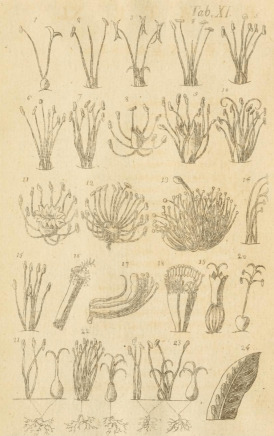
As Derby was too far away to meet regularly with his friends in the Lunar Society, Darwin took up a new project: the translation of the work of Carl Linnaeus from Latin into English. This was technically difficult because of long lists of plant characteristics, many of which had no obvious English equivalent and so he consulted Sir Joseph Banks, Dr Johnson, and William Curtis of Curtis’s Botanic Magazine, as well as many others to help him. Sometimes they had to coin new words and about 50 of these, mostly detailed botanical terms, entered the English language, .
The project took him no less than seven years and led to the publication of A System of Vegetables in 1785 and The Families of Plants in 1787. Again to avoid publicity potentially interfering with his medical practice the books appeared as the work of ‘A Botanical Society at Lichfield’.

While Darwin was a keen proponent of Linnaeus system his practical experience and garden experiments made him realise that it wasn’t perfect. He thought it necessary to also pay attention to other plant characteristics apart from just the number of stamens and pistils. To do so so he drew on his observations and reading to devise a ‘plan for disposing part of the vegetable system of Linnaeus into more natural classes and orders’ which he thought would be more useful, especially for medical plants.
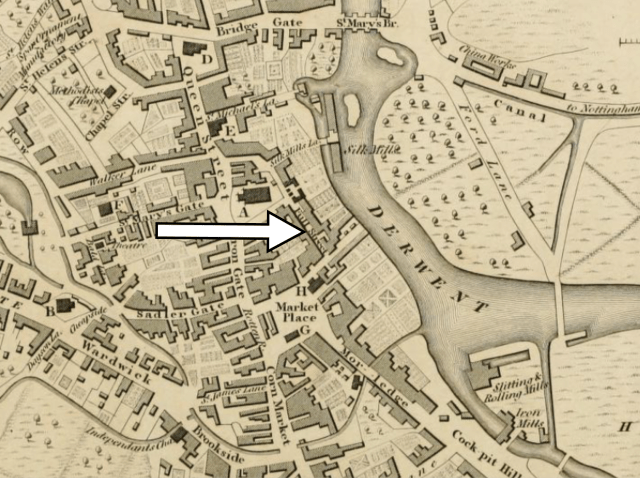
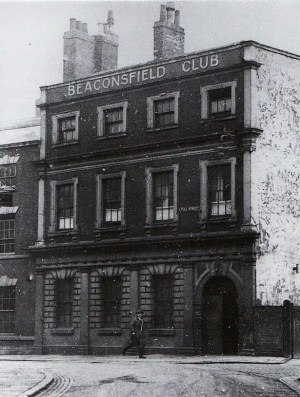
The Darwins left Radbourne in 1783 and moved into a large house on Full Street in the very centre of Derby itself with a walled garden running down to the banks of the Derwent.
One of the first things he did was to help found the Derby Philosophical Society, which held its augural meeting in his house. Its members included not only most of the local doctors but also industrialists, and landowners who wanted to use the ‘daring hand of experimental philosophy’ to increase the ‘common heap of knowledge’ and contribute to the ‘useful arts’ and sciences. They created a large library of medical, scientific agricultural and horticultural books and were obviously interested in the connections between these subjects. It seems that he also hoped the Derby Society would be able to hold joint meetings with the Lunar Society.
For more on the Derby Society see Paul Elliott’s article on the West Midlands History website.

Darwin began a new garden behind the house at Full Street but also acquired an orchard on the opposite side of the river which he used an experimental ground. .He was to use his findings for ideas about agricultural and horticultural improvements in his later books, notably Phytologia. Because the road route was circuitous, to reach the orchard from the garden he bought a boat and used a pulley system to take it across the river. Like the Lichfield botanic garden, his Derby gardens became well known locally and seem to have attracted a lot of visitors. He catalogued the plants he grew and papers in the Cambridge University library list over 200 trees in the orchard and garden. There was also a large range of hardy plants, although many were native species rather than conventional garden cultivars. That might explain why accounts of the garden describe it as an ‘extensive wilderness’, or even a collection of weeds.

A page from Charles Darwin’s pocket book, with Erasmus’s annotations on the left.
© Cambridge University Library
His sons inherited his interest in botany. One, Charles, who was training to be a doctor but died aged just 20, kept a pocket book of nature prints which his father later annotated with Linnaean classifications. Another,Robert, was sent as many as 300 plants by his father ‘with their names’ which, he explained, would ‘half set you up as a botanist’. Darwin may well have been involved in a plant exchange network with friends but others were probably obtained from local nurseryman Joseph Mason, who, according to Loudon kept a ‘good nursery and florist’s garden’ with a reputation for growing auriculas, polyanthuses, double primroses, carnations and other flowers.

Three of Darwin’s children in the garden at Full Street, from Pearson’s Life of Francis Galton, 1914
Darwin had a large heated greenhouse – 82ft long and 9ft wide – built in the garden. It had a roof made of small panes of glass about 8″ square and was divided into two sections so that ‘one half may be a month forwarder than the other’. Each had its own stove and circulated hot air through the flues set into the walls and pipes under under the floor, which resembled the way the famous local silk mills were heated. The greenhouse produced an ‘abundance of kidney beans, cucumbers, melons and grapes’, but not pineapples. Additionally the ‘young ladies’ had ‘filled the vine-house’ with plant pots, mostly ‘originally imported from Elston’, the Darwin family seat . It cost him £100, in large part because of the high tax on glass at the time.
At the same time Erasmus carried on inventing, including two garden-related gadgets. One was a mini-plough to dig potato trenches and the other a ‘melonometer or brazen gardener’ designed to control the ventilation in green houses according to the weather. [For a description of how it worked follow this link]. He also continued his scientific research, giving papers on artesian wells, and explaining the formation of clouds to the Royal Society but he also decided to rework his translations of Linnaeus from a dense and difficult botanical text into something lighter and more accessible with the idea of spreading acceptance of Linnaeus’s system of taxonomy to the general public. For that he drew on his own gardening experience and the result is going to be the subject of another post soon.


 The Garden History Blog
Brilliant! This was fascinating reading, well done. It’s hard to comprehend how a man could have packed so much into one life.
Thank you! I was amazed when I started researching his life how much he packed in – and it’s such a pity that’s achievements have gone almost unnoticed compared with his grandson. Please spread the word about him! David
Dear David
I had intended to write to you earlier to congratulate you on the blog’s 10th birthday. It’s a fantastic achievement and no doubt your 500+ contributions reflect many many hours of research (otherwise known as the internet rabbit-hole). I always look forward to reading them with my coffee on Saturdays and was particularly interested in yesterday’s subject, Erasmus Darwin. You may recall from the days of our face-to-face garden history courses at IHR (how long ago that seems now!) that I told you that I volunteer at Down House, Charles Darwin’s home. I still do, working in the glasshouse, leading garden tours and now also giving occasional talks at our volunteer coffee mornings. And guess who is the topic of my next talk – yes it’s Erasmus Darwin, a particular favourite of mine. What an amazing polymath and also what a naughty fellow! I have spent some time reading his botanical work and collecting stories, some of which you have covered, but I haven’t yet had time to visit the Lichfield museum. And I love Jenny Uglow’s book on the Lunar Men. I am especially interested in Erasmus’s thoughts on transmutation of species and the struggle for existence and how they inspired his grandson Charles. I mentioned Erasmus as part of a previous talk at Down but he will be the star of my next effort. I shall no doubt regale the Down House volunteers with some more verses from Erasmus’s somewhat erotic poem The Loves of Plants! In one of the course sections that Mark Spencer covered at IHR in 2019 we looked at Linnaeus and I prepared a short presentation for the participants then on Erasmus’s translations. It’s attached below – it’s probably full of mistakes as I haven’t checked it over properly and know a lot more now than I did then!
I do hope you are keeping well and that your French garden hasn’t been too affected by our now rather strange climate.
Best wishes and looking forward to the next part of your Erasmus story!
Sheila Poole

>