
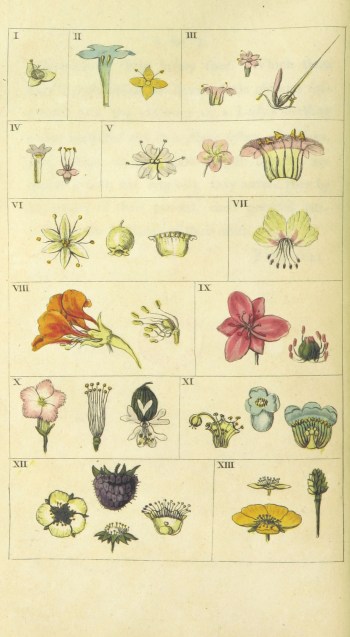
Towards the end of the 18thc botany had become a fashionable subject amongst the educated class in Britain, and in particular it was thought the study of plants was a suitably feminine pastime. So when Erasmus Darwin (who I wrote about last week] decided to try and popularise Linnaeus’s new system of plant classification he had a big problem. Linnaeus claimed that plants had sex, so how could Darwin explain that without shocking his readership? Believe it or not he decided to do it in verse.
What followed was a 4,000 line poem about the sex-life of plants with racy [for the time] language and imagery which made him the most famous poet of his day. Written in two parts The Loves of the Plants [1789] and The Economy of Vegetation it was then republished in 1791 as The Botanic Garden.
But there’s more to it than just plants ….
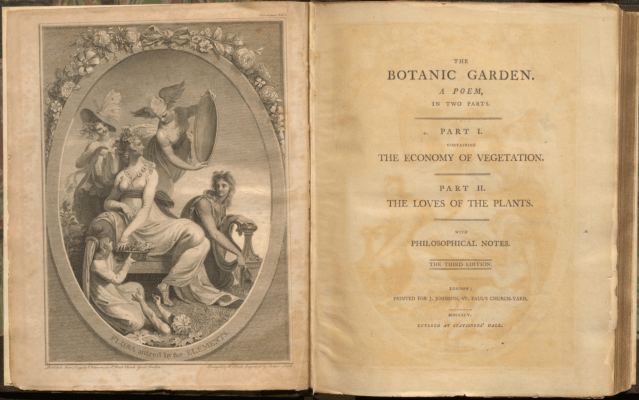

The easiest to read version of The Botanic Garden can be found on Project Gutenberg, The Economy of Vegetation and The Loves of the Plants, but if you want to see an original edition you’ll find it on archive.org
Let’s start by looking at how Linnaeus classified plants. He devised 24 classes grouped by the number of stigma – the male parts – each plant had, with further subdivisions for the number of pistils or female parts. That might seem straightforward enough but how to describe the way that plants in each class reproduced? His guiding principle was that there were analogies between the human and plant kingdoms, so he resorted to conventional terms for human relationships such as marriage. Unfortunately plants aren’t human and many orders of plants do not have conveniently equal numbers of stigma and pistils so don’t fit neatly into the “husband and wife” pattern. As a result such unorthodox arrangements were described by terms such as “concubine”or “clandestine marriage”. Linnaeus took this further with the calyx equated with the “nuptial bed” while other sexual analogies went much further – far too far for most respectable readers of this blog before breakfast!

Some of his early translators including Darwin’s friend William Withering could not bring themselves to use similarly overtly sexual language and resorted to euphemisms, much to Darwin’s annoyance. He wrote in his Commonplace Book that : “Linnaeus might certainly be translated into English without losing his sexual terms, or other metaphors, & yet avoiding any indecent idea.” Although he had none of the hang-ups that were to haunt Victorian England how was he to do it without shocking or offending his audience many of whom would be women?


Eros and Dione after Fuseli, illustration to ‘The Poetical Works of Erasmus Darwin’; 1807
© The Trustees of the British Museum
Darwin chose to build on something his readership already knew well: classical mythology. It was nothing unusual in Greek myths for people to turn into trees and flowers so Darwin stood this idea on its head and in The Loves of the Plants turned plants into humans. Now plants could smile, talk, move and have love affairs. He wrote of blushing virgins, handsome swains, and deceitful harlots giving his readers licence to imagine what happens when “Beaux and Beauties crowd the gaudy groves, And woo and win their vegetable Loves”. To the modern reader I’m afraid the whole concept is weird because we simply don’t share the mind-set and intellectual or linguistic worlds of the very late 18thc, where long didactic poems even about science, were not uncommon. Nevertheless let’s give it a go and “if thou art perfectly at leisure for such trivial amusement, walk in and view the wonders” of Darwin’s “Inchanted Garden.”

Unmounted fan-leaf, with various examples from Darwin’s “Botanic Garden”; 1792 © The Trustees of the British Museum
The Loves of the Plants is narrated by the Goddess of Botany, with each of Linnaeus’s classes and how they perform in the “nuptial bed” addressed in turn. Alongside each section are long prose footnotes giving the scientific background to the plants. It would be impossible to go through all 24 classes without being really repetitive and sending you to sleep so I’ve just picked out a few to give you a general impression of the language and imagery but check out one of the on-line versions if you want to read more.
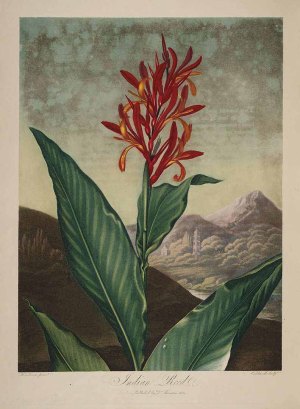
The goddess starts by describing the class of plants that have one stigma and one pistil. This includes the canna.
First the tall Canna lifts his curled brow
Erect to heaven, and plights his nuptial vow.
The virtuos pair, in milder regions born,
Dread the rude blast of Autumn’s icy morn;
Round the chill fair he folds his crimson vest,
And clasps the timorous beauty to his breast”
and then moves on through other classes such as…

Meadia’s soft chains five suppliant beaux confess
And hand in hand the laughing belle address
Alike to all, she bows to wanton air,
Rolls her dark eye and waves her golden hair…
while Lychnis is clearly polyamorous with ten male and five female parts
Each wanton beauty, trick’d in all her grace,
Shakes the bright dew-drops from her blushing face;
In gay undress displays her rival charms,
And calls her wondering lovers to her arms.

His notes on Lychnis add: “Ten males and five females. The flowers which contain the five females, and those which contain the ten males, are found on different plants; and often at a great distance from each other. Five of the ten males arrive at their maturity some days before the other five, as may be seen by opening the corol before it naturally expands itself. When the females arrive at their maturity, they rise above the petals, as if looking abroad for their distant husbands. ”

And just one more before we move on:
The anemone whose flower reputedly only opens when the wind blows becomes more a little erotic
So shines the Nymph in beauty’s blushing pride,
When Zephyr wafts her deep calash aside; [a calash is form of hood]
Tears with rude kiss her bosom’s gauzy veil,
And flings the fluttering kerchief to the gale.
This imagery gets picked up in the image above by Blake where you can see an athletic and naked Zephyr leaping out of one anemone flower attempting to seize the scantily clad young woman in the other.


Darwin then moves on to other equally mythological and scientific fantasies. The Carline thistle with its dome of lightweight seeds, for example, gets compared with a Montgolfier balloon. While this too might be a bit surreal [and not very believable] its worth remembering that Darwin had researched the properties of gases and was fascinated by the new-fangled balloon which had only made their maiden flight a few years before. He had even experimented with making smaller ones himself,
So on the shoreless air the intrepid Gaul
Launch’d the vast concave of his buoyant ball.
He flies on over towns and towers and temples while, far below:
Silent with upturn’d eyes unbreathing crowds
Pursue the floating wonder to the clouds….

and he was prescient about the potential;
Soon shall thy arm unconquered Steam afar
Drag the slow barge, or drive the rapid car;
Or on wide-waving wings expanded bear
The flying-chariot through the fields of air.”
He adds in his accompanying notes that “there seems no proper method of flying conveniently but by the power of steam or some other explosive material , which another half-century may probably discover.”
He then rambles on for another page or so involving a trip through the cosmos to see the planet Uranus – better known then as the Georgian Star – only discovered by William Herschel in 1781. [For more on why that was significant see this short video by the Royal Astronomical Society]


Because of his Lunar Society connections Darwin is also up to date with his knowledge of industry too, meaning that the section about cotton gets a contemporary gloss. Its “leathery pods” give up their “vegetable wool” before being spun and then woven in textile factories by new machinery.
With wiry teeth revolving cards release
The tangled knots, and smooth the ravel’d fleece;
Next moves the iron-hand with fingers fine
Combs the wide card, and forms the eternal line
Desmond King-Hele, his biographer, suggests that Darwin made himself “the laureate of the Industrial Revolution, celebrating in verse the marvels of the machinery, praising the enterprise of the industrialists, and glorying in the taming of energy in the mill or the steam engine.”

Henry Fuseli, The Nightmare, 1781 Detroit Institute of Art. An engraving of this was included in The Botanic Garden/.

The Power of Fancy in Dreams, illustration by Fuseli to ‘The Poetical Works of Erasmus Darwin’; 1807
© The Trustees of the British Museum
Of course as a doctor Darwin was well aware of the downsides of some plants – notably of course the poppy (in botanical Latin Papaver).
Sopha’d on silk, amid her charm-built towers
Her meads of asphodel, and amaranth bowers.
Where Sleep and Silence guard the soft abodes,
In sullen apathy Papaver nods.
Faint o’er her couch in scintillating streams
Pass the thin forms of Fancy and of Dreams;
Froze by enchantment on the velvet ground
Fair youths and beauteous ladies glitter round.
On crystal pedestals they seem to sigh,
Bend the meek knee, and lift the imploring eye…

The poem returns to sex again at the end where Darwin focuses on Adonis, a plant family in which ‘many males and many females live together in the same flower’:
A hundred virgins join a hundred swains,
And fond Adonis leads the sprightly trains
Pair after pair, along bis sacred groves…
…Licentious Hymen joins their mingled hands,
And loosely twines the meretricious bands.
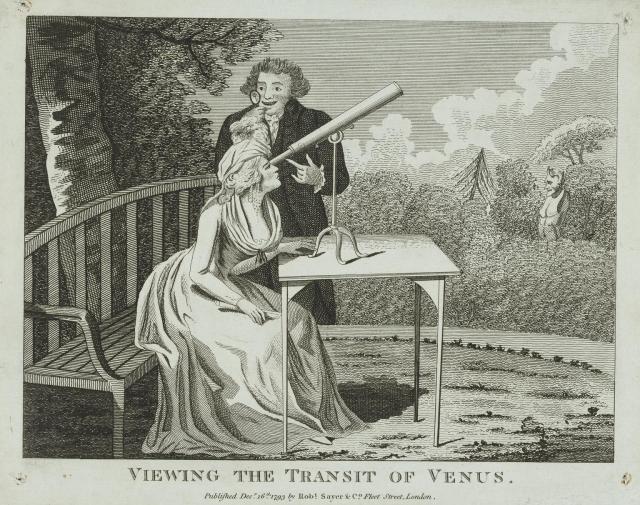
Viewing the Transit of Venus., 1793
A play on the sexual references of astronomy: a man looks through his glasses at a young woman as she leans forward showing her cleavage to use the telescope andlook at the leer on the satyr’s face.
He might have been influenced here by Joseph Banks because his notes add that in Tahiti where Banks had been with Captain Cook to witness the Transit of Venus ” the society of the Areoi… ‘consists of about 100 males and 100 females who form one promiscuous marriage’. The poem ends with Venus watching the proceedings as
Wide o’er the isle her silken net she draws,
And the Loves laugh at all but Nature’s laws
As Desmond King-Hele notes “Who would have thought that a didactic poem about botanical classification could end in a scene so unbotanical, so jovial and so subversive?”

Herbarium specimen of Cassia
Darwin’s politics also comes through strongly too. He was, like all the Lunar Society a strong supporter of the abolition of slavery. So writing about Cassia whose seeds were often washed east across the Atlantic just as African slaves had been carried west, hecompared them to Moses in his basket floating along the Nile and how Moses later freed the Israelites from captivity. He was also able to express his horror at colonial brutality.
“ Heavens ! on my sight what sanguine colours blaze!
Spain’s deathless shame ! the crimes of modern days !
When Avarice, shrouded in Religion’s robe,
Sailed to the west, and slaughtered half the globe…

…Hear, oh, Britannia! Potent Queen of Isles,

on whom fair Art, and meek religion smiles,
Now Afric’s coast thy craftier sons invade
with murder, rapine, theft, and call it trade!
The Slave in Chains on supplicating knee,
Spreads his wide arms, and lifts his eye to thee;
With hunger pale, with wounds and toil oppressed,
Are we not brethren? Sorrow chokes the rest…
and he makes an impassioned plea to Parliament to “right the injured” and “Hear this truth sublime. He who allows Oppression shares the crime.”
For more on Darwin and the abolition movement see The Politics of Erasmus Darwin’s The Botanic Garden

Darwin had to defend himself against those who saw the poem as immodest and unfit for the eyes of women. His friend Anna Seward said of this reaction: “I had heard it was not fit for the female eye. It can only be unfit for the perusal of such females as still believe the legend of their nursery that children are dug out of a parsley-bed; who have never been at church, or looked into a Bible, – and are totally ignorant that in the present state of the world, two sexes are necessary to the production of animals..“
As with his translation of Linnaeus Darwin invents new words as he writes. 147 have been identified, 65 of them are the earliest usages recorded in the Oxford English Dictionary and the other 82 even earlier than the earliest noted in the OED. They include gauzy, frenzied, scintillating, promiscuous [when used in the sexual sense] cannabis, blubbery, convoluted, geological, hydrogen and iridescent.
Not only was the poem popular but it was influential. Wordsworth who had been at Cambridge with Darwin’s stepson fell under his spell admitting to being ‘under an injurious influence from the dazzling manner of Darwin’ and accepted Darwin’s theory that that plants were capable of feeling. Coleridge called Darwin ‘the first literary character in Europe, saying he possessed “perhaps, a greater range of knowledge than any other man in Europe”. Later he coined the term darwinizing, meaning to speculate wildly, because of Darwin’s theories about the evolution of life. Another who was heavily influenced was Dr Robert Thornton who was in the process of publishing his own book The Temple of Flora [if you don’t know it read the blog about it] Thornton became a disciple and Darwin responded by saying The Temple of Flora had “no equal”. My biggest surprise was finding that it may well have influenced HG Wells in one of his macabre short stories. [For more on that see David Haden’s blog about Darwin.]


Unfortunately for Darwin the poem was published when the French Revolution was raging and It was easy to portray his work as politically revolutionary in the same way. There was a tremendous backlash against such ideas from both the authorities and much of the population. So whilst being lauded for the poem he was almost arrested for writing a pamphlet in support of parliamentary democracy, was attacked as a crank, denounced as an atheist, and his poetry parodied for arguing that mankind had risen from the “Cabbages of the field”.

That didn’t stop him writing equally revolutionary work beginning with Zoonomia or the Laws of Organic Life in 1794-96 . Again publication led to much criticism and scorn but it was very influential to his grandson Charles and his theories of evolution.
[For more on that see “From one Darwin to another” in Nature 4th April 2023 by Eva Guadalupe Hernández-Avilez & Rosaura Ruiz-Gutiérrez]
Erasmus suggested that “all animals undergo perpetual transformations…and many of these acquired forms or propensities are transmitted to their posterity. ” He even goes so far as to cite David Hume’s claim that “the world itself might have been generated, rather than created” which could imply the conclusion that “all organisms would then derive not only from earlier organisms or even ultimately from inorganic substances.”

Frontispiece to The Temple of Nature – drawing by Fuseli 1803
© The Trustees of the British Museum
He was to return to this theme in his last book , The Temple of Nature, another long poem, published just after he died in 1803. In it Urania, the Muse of Science, explains how life emerged from a primeval sea as microorganisms and became increasingly complex through “sensation” and “volition” and how after “millions of ages” humans developed.
Organic life beneath the shoreless waves
Was born and nurs’d in ocean’s pearly caves;
First forms minute, unseen by spheric glass,
Move on the mud, or pierce the watery mass;
These, as successive generations bloom,
New powers acquire and larger limbs assume;
Whence countless groups of vegetation spring,
And breathing realms of fin and feet and wing.
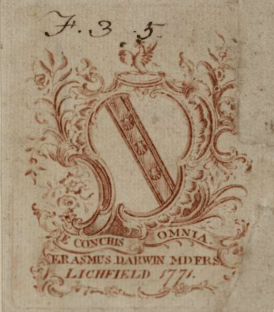
It helps explains the motto on his coat of arms: which translates as ‘everything from shells’.

Breadsall Priory, c1800 Historic England Archive
In 1802 Darwin sold the house in Full Street and moved to Breadsall Priory, the former home of his son Erasmus junior who had just died. It had ‘a fine situation with 3 fish-ponds descending down a valley’, with views of the river Derwent while the grounds offered Darwin the opportunity to create a new larger-scale garden. Sadly that opportunity was never fulfilled because he died a few months later.
Erasmus Darwin’s reputation survived long after his death in 1802. G. L. Craik’s popular History of English Literature in the 1860s gave Darwin twice as much
space as Shakespeare and six times more than Byron, but by the end of the 19th century he was definitely out of fashion and easily mocked.

If he is almost invisible to us now, it is partly because of his grandson’s fame and partly because his critics went to such lengths to portray him as a crank. Yet to a modern eye there’s no doubt that Erasmus Darwin was one of the outstanding intellectual figures of his, or indeed, any age.


 The Garden History Blog
.jpg)
.jpg)

You must be logged in to post a comment.