
One part of garden history as a discipline that sometimes gets overlooked is the history of landscape in its widest sense, so today I’m turning my attention to the way that Europeans saw and recorded new landscapes when they started exploring the rest of the world.
We know that early adventurers such as Columbus were fascinated by plants, animals, the natural resources and the people of the so-called New Worlds. They collected them & transported them home and distributed them widely but surprisingly they appear to have taken very little interest in the landscapes of the places they visited, or if they did, seem to have done very little to record or represent it pictorially.
Why ever not?
I suspect a major reason was the ancient and mediaeval dread of wilderness: it spelt disorder. The unknown and the very vastness of forests, mountains, swamps and so on was terrifying. It was only settlements and the modified land around them that attracted human interest. So why should the wilderness of the Americas hold any more appeal than that of Europe?

But of course at the time no-one really knew what they had discovered. Columbus wrote in his log book that he had been sent “to see those parts of India and the princes and peoples of those lands”. Perhaps there was an expectation of the exotic world of Asia as reported by Marco Polo, or the [mythical] worlds described by Sir John Mandeville but that certainly wasn’t what he found and he looked in vain for the elements that figured prominently in such accounts : no great cities, great riches or Great Khan. Instead he found first the islands of the Caribbean and then the mainland of central America, while other European explorers found the coast of North America and Brazil. It was a while before they discovered the great civilisations of the so-called New World and probably more than 50 years before anyone seriously started recording its topography.


Although Columbus does briefly describe Cuba where the ‘lands are lofty and in it there are many sierras and high mountains” most of his account of the island concerns the trees and the birds.
Our first illustrations which are said to be of the New World appear immediately after he returned to Spain in 1493. The announcement of the success of his voyage across the Atlantic Ocean was printed and quickly became one of the earliest ‘best sellers’ of European publishing.
No less than eleven editions were published in 1493 alone, right across western Europe, in Spain, Italy, France, Switzerland, and the Netherlands. Six more editions were published in 1494-97. Most of them had woodcut illustrations. Yet not one of the images even vaguely resembles the New World. Why not?
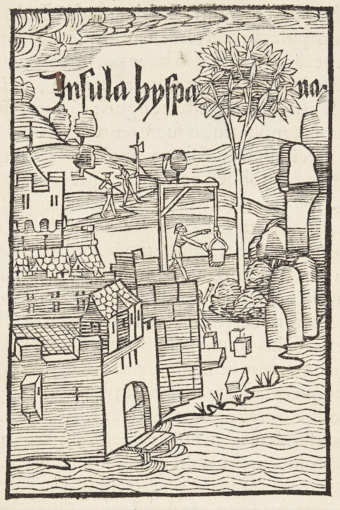
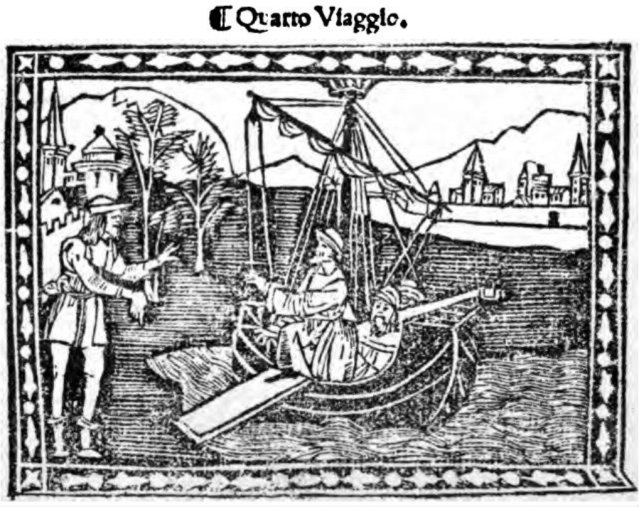
I suggest where the was for two reasons. One was expense. Woodblocks are expensive to produce and a printer would re-use them wherever possible. So the woodcut images that illustrate the early Columbus accounts are simply “borrowed” from other books.
The boat in the image of his landing is a Mediterranean galley and the people with strange hats are apparently found elsewhere masquerading as pilgrims to Jerusalem.
According to the woodcut on the left Hispaniola apparently had a fortified town and a thriving building industry although of course it didn’t, while the boat in the last image [below] is slightly more realistic even if the map of the crowded Caribbean islands with their towns isn’t.

But the second reason is I suspect the main underlying one. How do you describe the almost indescribable? No-one, Columbus included had any idea of the immensity, the strangeness and the difference of what we now call the Americas and no one, even Columbus and the other returnees knew how to get the printers and the artists and craftsmen who made printing blocks to represent this unknown world to an audience whose world was, for the most part, incredibly confined and limited. So they used what they did know to represent what they didn’t.
As a result we can already see that European ideas about the new world and what it looked like was being moulded by the ideas embedded in the imagery of the older known world.

This does not mean that there are no European representations of other aspects of the Americas. Notably we have marginalia and decorative panels on maps – which include representations of the land and some of the flora and fauna such as this map drawn up for the Portuguese crown to mark the Treaty of Tordesillas of 1494 and copied illicitly and smuggled to the ruler of the Italian city-state of Modena in 1502.


Here is an enlargement showing the coast of Brazil, recently explored by the Portuguese, together with accurate depictions of parrots, but fairly stylised trees and no real hint of topography. Parrots had been bought back to Europe and would have been available to the artist to use as models.
Similar mismatches of accuracy and invention can be see in the depiction of West Africa which was better known to the Portuguese. The coastline has been surveyed, and although stylised the people and huts, like the birds were almost certainly drawn by people who had either seen them first-hand in Africa, or in captivity in Portugal. But the fortified city in the middle can only have been imagined by the artist, based on their knowledge of European towns.

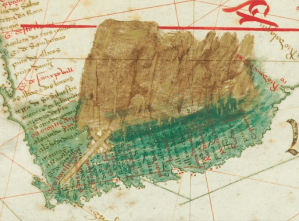
Similarly the image of the Cape of Good Hope bears some relationship to what might have been seen by a sailor on board a Portugueses ship, and is certainly more realistic than the fairy-tale depiction of Jerusalem. There were no attempts to shows the topography or inhabitants of Asia at all. 
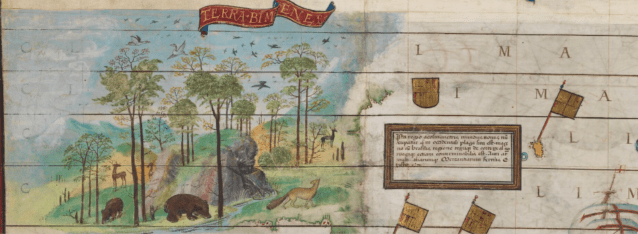
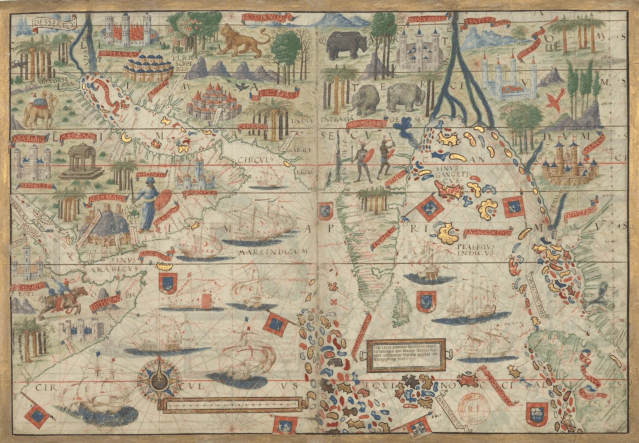
Almost a generation later, the Miller Atlas of 1519, given as a gift by the King of Portugal to his French counterpart has more images of later Portuguese discoveries during their explorations of Brazil and the Indian Ocean. Those of Brazil must have been based on first hand sketches and observations but they do not appear to be representations of particular places, merely evocations of the country as a whole. These maps were also kept highly secret because of their geo-political value. We have to wait about 50 years to begin getting a flow of images drawn from life.

While the animals and people look lifelike and well observed in the detail below from another plate in the atlas showing Brazil, there is little sense of the features of the country, other than forest, and the exotic nature of the country to Europeans has been heightened by the dragon – or is an iguana? – in the bottom left hand corner.

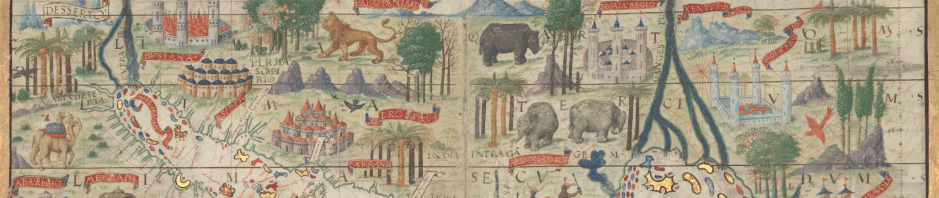
By comparison the representations of the lands around the Indian Ocean is sketchy to say the least, and shows how the Portuguese were mainly concerned about recording the coastline, merely ornamenting the rest of the map with largely imaginary items, with just elephants and a rhinoceros drawn from life. The King of Portugal managed to bring a rhinoceros to Europe in 1515, which he famously sent as a gift to the Pope.

The most important early source of our knowledge of the Americas doesn’t really come until the publication in 1547 of the Chronicle of America by the great Spanish naturalist and historian Fernandez de Oviedo. His book was, indeed still is to anyone who doesn’t know it, a real eye-opener. Oviedo was clearly a true Renaissance man: a pioneer of empirical observation and commentary. His manuscript contains the first proper drawings of America rendered by a European, including the first image of a pineapple.

The accompanying text contains reports of exotic creatures, ethnographic descriptions of indigenous groups, and their artefacts and customs and detailed reports about the conquest and colonisation process, but – and its a big but- it has very little to say of the topography.

His sketch of the approaches to a volcano
So what did Oviedo think about the new world land forms? He certainly drew simple maps and what might be described as topographical sketches, but it’s difficult to know if he saw the landform of the New World in the same light as he saw the “newness” of other things unknown to Europeans. He certainly didn’t draw them so perhaps rather like his forbears he had a blind spot for wilderness.
Which means that the first generally accepted European painting of the New World is this extraordinary piece…

It’s by Jan Mostaert the court painter to Margaret of Austria, the governor of the Netherlands and was done sometime between the mid-1520s and Mostaert’s death in c1552, just about the same time that Oviedo was publishing the Chronicle. The likely date is thought to be the mid-late 1530s. Its definitely worth looking at the picture in much greater detail which you can do on the website of Amsterdam’s Rijksmuseum..

A first reaction might be (rather like our likely thoughts on seeing the images in the 1493 Columbus letter) ….mmmm what the hell has that got to do with America?
By the time Mostaert was painting the new continent had been known about and visited by Europeans for several decades at least. His Spanish masters had conquered large chunks of it and were then in the throes of taking over the Inca empire too. So where did he got his information from? There were undoubtedly Spanish and Portuguese merchants in Antwerp, which was the largest port of the Western European seaboard. Was it one of their seamen bringing sketches? Perhaps it was based on eye-witness accounts or written reports which ended up at Margaret’s court? Whatever the answer it just doesn’t feel right as an accurate depiction of anywhere in America.

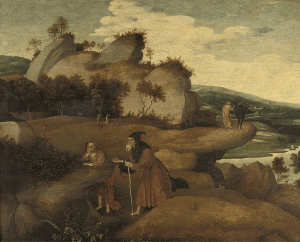
Instead it is hard to escape from the fact that what we have is much more akin to a standard Flemish religious painting of the time than anything else it might be. So even if Mostaert had access to first hand accounts, which I’m sure he did, or had met a returning conquistador which is also quite probable, I suspect he was unable to interpret the story in a way that was outside either his normal way of working as an artist or more importantly his [and his audiences] innate understanding of the way the world looked.
Mostaert knew how to do this sort of work thoroughly and so, the scenery in the picture was filtered through that knowledge down to the cows, sheep and rabbits inhabiting the fields. Only the monkeys, peacock and parrots could be considered exotic, but even they were already well-known in Europe.

The vegetation he depicts is completely stylised with nothing “exotic” or “American” in sight and even the “natives” fail the test of reality because they are like the barbarians in classical mythology – naked and athletic – as in drawings and etchings by Poluiouallo and his contemporaries.


So any exoticism and sense of newness is confined to the very limits of Mostaert picture. He could only represent what he knew and could understand , and thus his New World is just a distorted reflection of the old world that he knew.
Then I started wondering. Is this virtual visual ignoral of landform that we seem to find in the Spanish encounter with the Americas repeated by other “newcomers” and other “newly discovered lands” Did, for instance, all European explorers/travellers see things in the same way ? Did it matter if they went as explorers, as traders, as conquerors, as colonists or as later happened as “scientists”? Do all artists/publishers produce work that is “familiar” to themselves? Or are some illustrations a real reflection of what the author actually saw and intended his readers or viewers to see as well? Do they modify the exotic to fit in with prevailing tastes? Is it the same for objects/ specimens as well topography?Did early European images of Australia or Canada or India or Africa try to capture “the genius of the place”? Unsurprisingly there was the variety of responses, although fairly obviously these are partly dependent on when the first encounters happened. And it doesn’t really answer the question where does the idea of representing “landscape” for its own sake come from? When does what we might loosely call “landscape painting” get invented? I’ll come back to that in some more posts soon.


 The Garden History Blog
Fascinating account to wake up to this morning. Thank you
Thank you. I’m glad you enjoyed it. The next couple about how Europeans saw other “new worlds” is proving harder to research than I thought but I’ll get there eventually :-). David