

This was supposed to be a really easy post to write because there are lots of nice pictures and, I thought, a reasonably straightforward story to tell. But it’s been anything but! It follows on from last week’s post and looks at an artist whose early work was thought to contain some of the earliest images of the New World seen through European eyes.
French by birth Jacques Le Moyne fled to London in one of waves of Huguenot refugees escaping from religious persecution in Europe becoming a naturalised Englishman before dying in 1588.
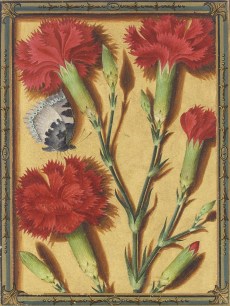
Although little is known of his life it’s clear he was also an extremely talented botanical artist and a pioneering figure in the history of florilegia. In the words of a recent British Museum exhibition he “created remarkable watercolours of plants, flowers, fruit and vegetables which captivate the eye with their extraordinary naturalism and the striking simplicity of their presentation.”
In the end, however, Le Moyne proved much more elusive than expected especially as earlier this week when I was finishing this post I discovered completely new research, published just a few weeks ago, which made me rewrite a large part of it!


Jacques Le Moyne de Morgues, to give him his full name, was born about 1533 in Morgues, a small village near Chateaudun, but later became a citizen of Dieppe. He probably trained in Rouen where illuminated manuscripts were still being decorated with floral borders until the mid-16th century. He may also have worked with or for a cartographer in his adopted town because Dieppe was then a well-known centre for map making and surveying.

Le Moyne first comes to notice when he is chosen to go on a transatlantic expedition to Florida in 1564. The area had been visited by an earlier French party who decided it had potential for a new colony and the mission of the new expedition was to set one up. A base was established at Fort Caroline, near present day Jacksonville and Le Moyne was instructed to “chart the sea-coast, observe the situation of the towns, the depth and course of the rivers, the harbours, and the houses.’”
The mission was ultimately a complete failure, with internal dissent and then an attack by the Spanish who were already well-established in Florida, wiping out most of the French leaving under 20 of them to take ship back to Europe. They were blown off course and finally half-starved reached Swansea in 1565 before returning to France in 1566.
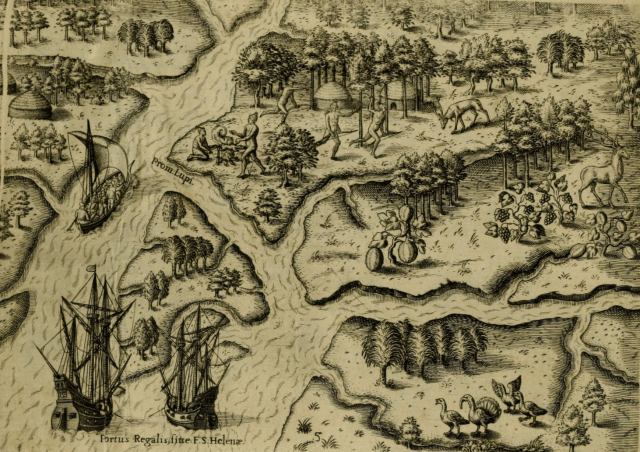
Unfortunately all but one of Le Moyne’s original drawings were reportedly destroyed in the Spanish attack on Fort Caroline so most of the Florida images attributed to him are actually engravings by Theodor de Bry, which are thought based on recreations that Le Moyne produced from memory when back in Europe. [All I can say is he must have had an almost photographic memory] Forty two of these images were used in the snappily named Brevis narratio eorum quae in Florida Americai provincia Gallis acciderunt, which was published in 1591 three years after Le Moyne’s death.
Le Moyne was a Protestant and sometime after the St. Bartholomew’s Day massacre of Huguenots in 1572, he joined the flood of refugees seeking asylum in England. He settled in the parish of St Anne’s Blackfriars, based around the old Blackfriars monastery which was one of the main areas of Huguenot settlement in London along with Spitalfields, the area around Lime Street and Soho.
His arrival was noted by Richard Hakluyt the compiler of books about voyages of exploration such as Divers Voyages Touching the Discoverie of America (1582) and The Principal Navigations, Voyages, Traffiques and Discoveries of the English Nation (1589–1600) who would have been interested in knowing Le Moyne because of his experience in Florida.

Le Moyne was granted denization rights in 1581. The official Return of Aliens on 28th April 1583 describes him as “James le Moyne alias Morgan, paynter, borne under the obezance of the Frenche King, and his wife, came for religion, and of the French Church, denison ii years. He hath one childe borne in England.”

Either through other well known and well-connected other Huguenots in the parish, or through Hakluyt he met another early artist of the Americas: John White who recorded the English attempts to establish a colony in Virginia and whose work was also later to be published by de Bry.
It was probably White who introduced Le Moyne to another fellow explorer of North America, the poet and courtier Sir Walter Raleigh. Raleigh supported Le Moyne financially while he redrew the Florida sketches, and also introduced him to other figures at the Elizabethan court, including Lady Mary Sidney who was probably the patron who inspired some of his botanical works. [Unfortunately its not absolutely clear whether this is Lady Mary Sidney (née Dudley) or her daughter, the poet and literary patron Mary Herbert, Countess of Pembroke, the sister of Sir Philip Sydney the poet]
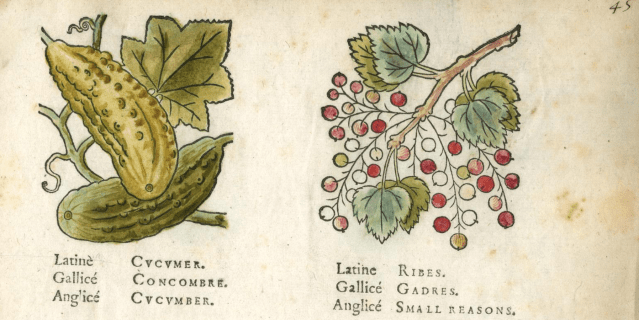

Whichever it was he dedicated his only printed book to “Ma-dame, Ma-dame de Sidney” in 1586. This was La Clef des Champs in which Le Moyne adapted 96 his paintings for woodcuts. The title translates as the key of the fields and in colloquial French taking the key of the fields means to make one’s escape. The editor of the Huguenot Society website wonders if Le Moyne was subtly referencing his flight from France.


Only three copies of the book survive and they are in part florilegium and in part bestiary, and probably intended as a pattern book for embroiderers and other craftspeople. In an interesting aside, in Painter in a Savage Land, his book about Le Moyne and the Florida expedition , Miles Harvey suggests that Jacques could have been be the son of Henry Le Moyne embroiderer to Mary Stuart both when she was Queen of France, and later in Scotland.
Le Moyne was to die in London in the year of the Armada 1588, and it seems de Bry bought some of his surviving artwork from his widow. He had them engraved and published alongside Le Moyne’s account of the Florida expedition as Brevis narratio, in 1591. It was the second in a series of 14 books about European voyages to the Americas put out by De Bry who had never set foot outside Europe himself.
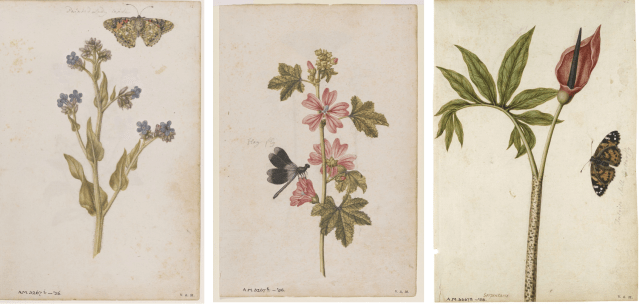
In recent years however the accuracy of the engravings in Brevis narratio have come under detailed scrutiny by scholars and it appears that de Bry was rather “creative” with some of the details. He may well have bought Le Moyne’s artwork from his widow but he definitely added bits from other sources to create a picture that Europeans would see as fitting in with their existing ideas of what the New World was like.
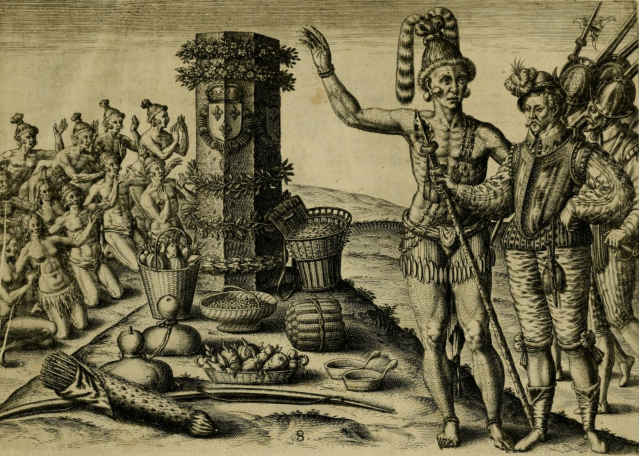
As an example take this image of an Indian chief, pointing out a stone column which had been set up by the earlier expedition to mark French sovereignty of the area. In the foreground there are baskets of fruit and vegetables, maize and some bottle gourds. However the fruit and vegetables, and indeed the baskets, are European while the climbers on the column are stylised European decorations rather than actual studies of real flowering plants. So it’s not surprising that recent scholarship has casts doubts on the accuracy of what was once taken as hard evidence of early encounters with the indigenous people of Florida. As an article by Jerald Milanich of the Florida Museum of Natural History asks “What are Brazilian war clubs and Pacific seashells doing in 400 year old engravings of Florida Indians?” The article goes on to suggest that “until someone finds an actual documented Le Moyne drawing or painting of Florida Indians I am going to assume we have been duped.”
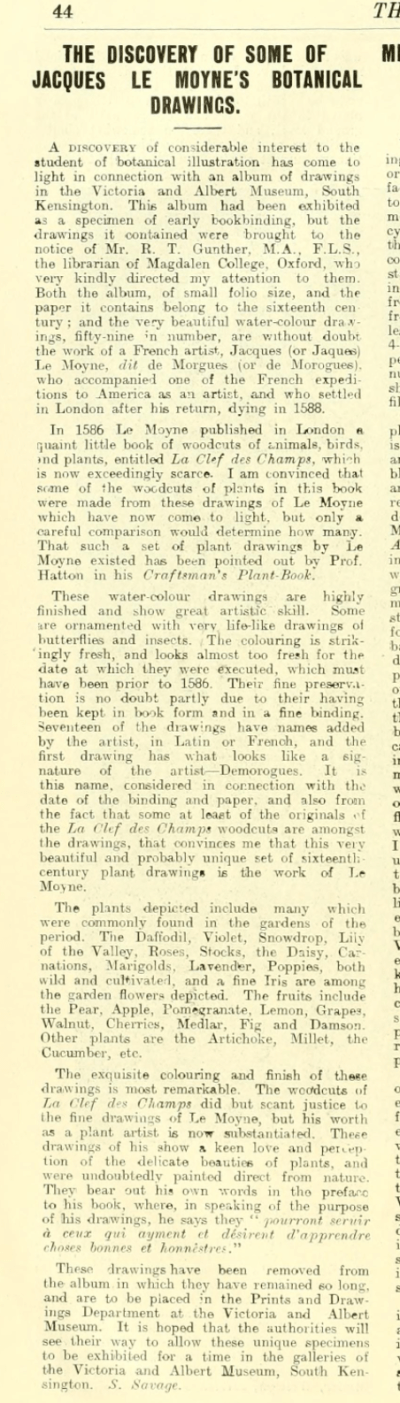
That debunking might have been the end of Le Moyne’s reputation as an artist but in 1922 there was a substantial and very different addition to his known work. It was then that R.T. Gunther, author of Early British Botanists and Their Gardens (1922) and Spencer Savage, the librarian of the Linnaean Society saw a volume of botanically themed watercolours in the Victoria and Albert Museum which had never been properly studied.
Savage reported this in Gardener’s Chronicle. The volume had been bought in 1856 because of its high quality binding but the 57 paintings of flowers and plants had largely been overlooked – indeed they had been taken out of the album.
Savage was able to date the paintings from the watermark in the paper, which is of French origin, to between 1556 and 1568.

He also noticed a single word inscription -demorogues -at the bottom of the first painting in the album – one of daffodils and a Red Admiral butterfly [see below] and thought it was more significant that had been thought earlier, and was actually the name of the artist Le Moyne who sometimes added ‘de Morgues’ to his name. So of course he ascribed the album’s paintings to Le Moyne
The album was digitized in 2020 to coincide with an exhibition of Renaissance watercolours at the museum.
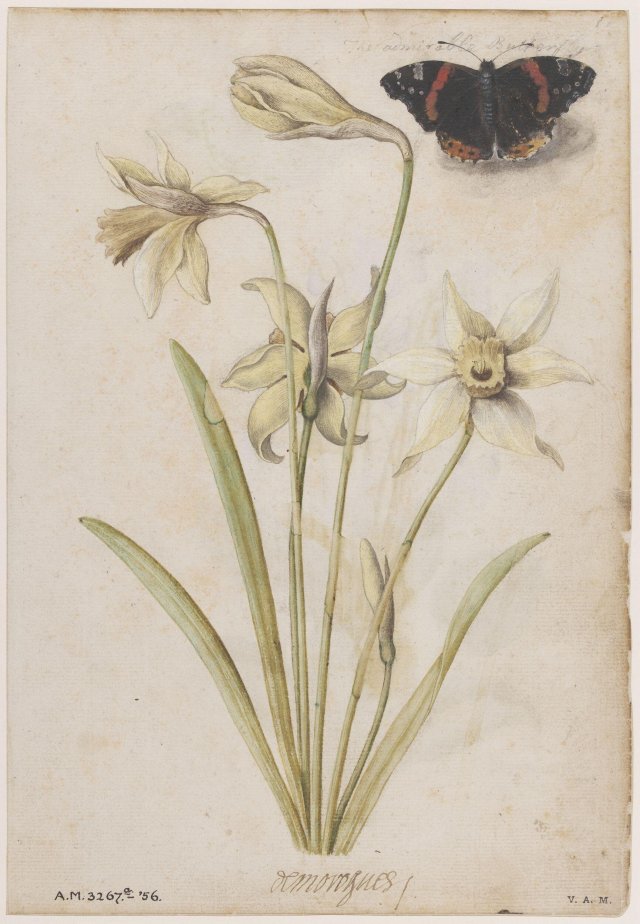
However Savage has been proved mistaken.
In an article published as recently as November 2023 Monique Kornell and Dániel Margócsy show that the inscription relates not to the painter but to the owner of the album, a French courtier and fellow Huguenot, Jacques de Morogues, Seigneur des Landes et de Sauvage, whose identical signature survives in three other sixteenth-century sources, and who is known to have collected illustrated books
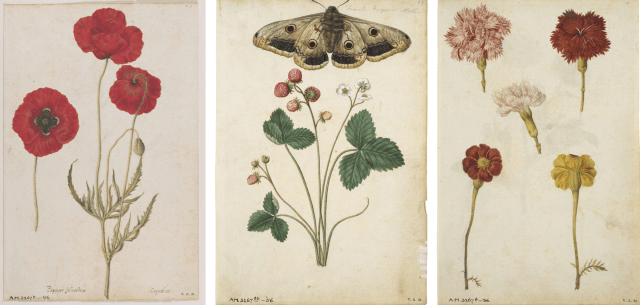
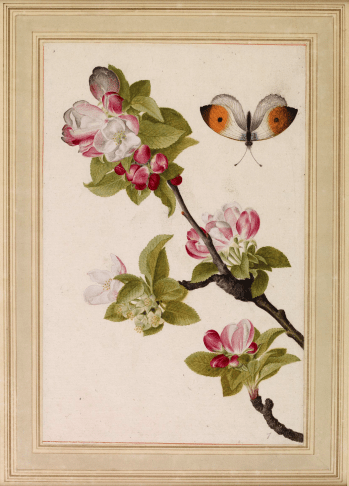
They further suggest that the paintings are probably not by Le Moyne after all. This is on stylistic grounds because although “at first glance, the plants and the insects of the V&A album give the impression of being … a careful study of nature, [with] attentive recording of damaged leaves and close observation of butterflies and moths… Frequently, it is not the living plant that is presented.” They are not drawn “from life but rather follow earlier artistic models, drawing on examples found in printed botanical illustration and in illuminated manuscripts.” They then give suggestions as to where these examples were taken and argue that the album should now be attributed to that well known artist “anonymous”.

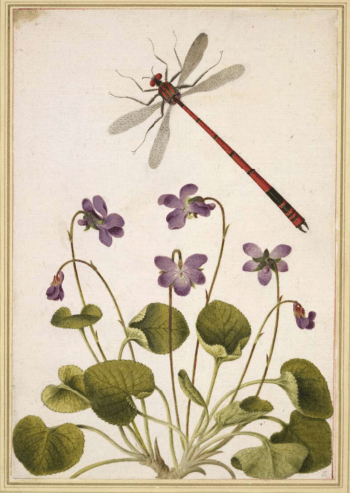
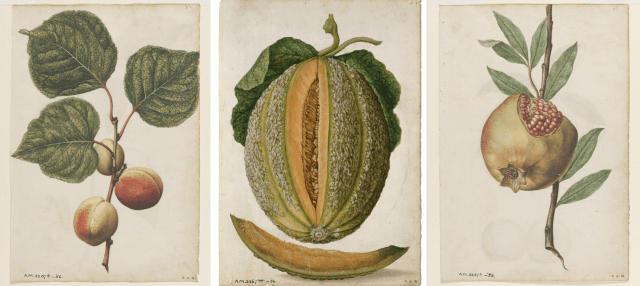
No more works were ascribed to Le Moyne until 1962 when another album, this time of 50 watercolours came up for auction and was bought by the British Museum because they were “probably superior to any botanical drawings that are known of the period.” These are thought to been part of an album created for Lady Mary Sidney.
Almost all the paintings are of common garden plants such as pinks, columbines, and roses, although there are also sprigs of fruit blossom, fruit including citrus and nuts as well as vegetables such as peas and pumpkins. Were they perhaps a record of the plants growing in Lady Mary’s garden?
“They are plant portraits which delight the eye and at the same time satisfy to a remarkable extent the scientific requirements of the botanist. The combination of these virtues is very rarely found to the same degree at this period.” Sometimes the plants are joined by snails or insects, and at least one resembles a butterfly in Thomas Moffet‘s ‘Insectorum sive minimorum animalium Theatrum‘. Moffet is usually acknowledged as the father of entomology although his daughter – Little Miss Muffet – is probably better known. It’s worth pointing out too that Moffet was under the patronage of the Earl of Pembroke and his wife, Mary Sidney and it’s almost certain that he and Le Moyne would have known each other.
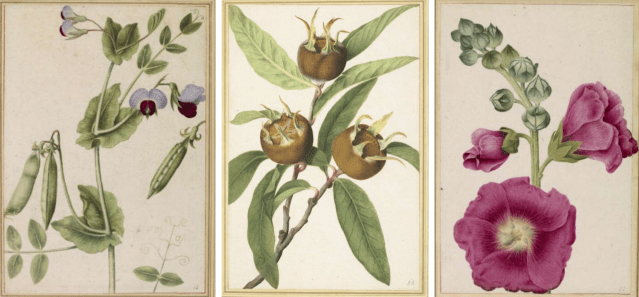

The album was the subject of a recent exhibition of Le Moyne’s work at the British Museum which said : “Isolated against blank backgrounds, they are not idealised or generic representations of plants, flowers and insects, but images that have the individuality of portraits. Complete with blemishes and imperfections, these almost tactile images were intended to be admired not only for their scientific accuracy but also for their aesthetic beauty.” Kornell and Margócsy argue that not only does The British Museum album have “a completely different aesthetic” to the one in the V&A , because it shows living “robust plants with verdant leaves and whole produce on the branch”, but that several woodcut illustrations in La clef des champs are smaller versions of those found in the album.
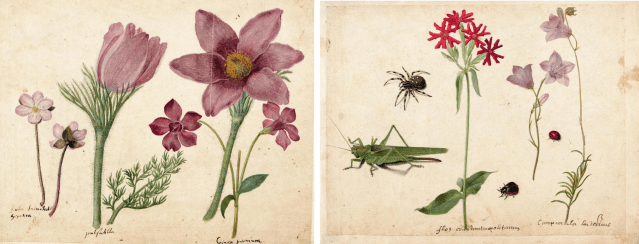
The 1962 “discovery” bought several other possible Le Moyne attributions out of the woodwork. The Oak Spring Garden Library has an album of sixty watercolours many of which are almost identical to some in the V&A album. Although Oak Spring has identified them with Le Moyne or his circle, Kornell and Margócsy argue it should be considered the work of the V&A artist or his workshop. Unfortunately only a couple of the paintings are available digitally in An Oak Spring Flora by Lucia Tongiorgi Tomasi.
Two more albums and several smaller groups of paintings have also passed through Sotheby’s hands. An album of 27 watercolours was sold in 2004 and another, the “Du Marry” album with 80 more paintings sold for $1,135,000 the following year . Both were close in style to the V&A album but subsequently broken up. They are definitely worth checking out on the Sotheby’s website.
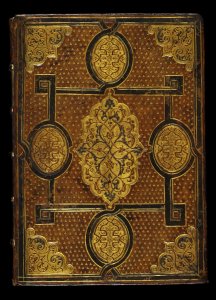
The Oak Spring, Sotheby’s and V&A albums share the same paper watermark so Kornell and Margócsy suggest that the V&A album was the equivalent of a master copy done in France in the 1560s, an idea which is supported by its lavish binding.
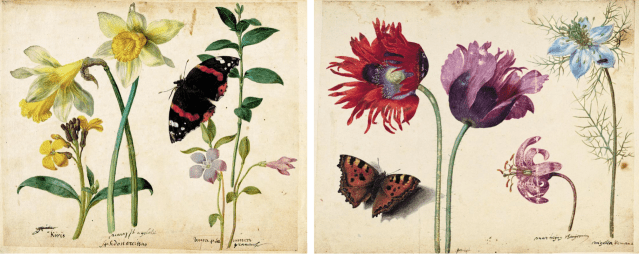
Yet another album, once owned by Elisabeth of Austria, Queen of France (1554–1592), can be found in the Fitzwilliam Museum in Cambridge. [ PD.217-1994] It has been dated to around 1570 when Elisabeth arrived in France to marry Charles X, and can also be attributed to the V&A artist’s workshop both because it includes several copies of flowers in that album but also on general stylistic grounds. The Fitzwilliam has a second album of 44 paintings which has copies of some of Elisabeth of Austria’s but also others of the V&A paintings. Unfortunately neither is available digitally.
There are more signs of networking connections because de Morogues was in Vienna probably helping arrange Elisabeth’s marriage so perhaps he arranged for the same artist who painted his album to produce another for the new queen. Later his nephew was the French ambassador to Vienna, where he met and became friends with Sir Philip Sidney, sister or son of Le Moyne’s patron. It was a small world!


The Houghton library at Harvard had another small volume of floral and insect studies previously associated with Thomas Moffet It was decided that in fact some of these could have been by Le Moyne.
Dumbarton Oaks also possess a series of eight highly complex miniatures which were probably not designed to be part of a florilegium while six more like these were sold by Sothebys in 1997.
I’m sure there are at least a few others out there somewhere! Let me know if you know of any.
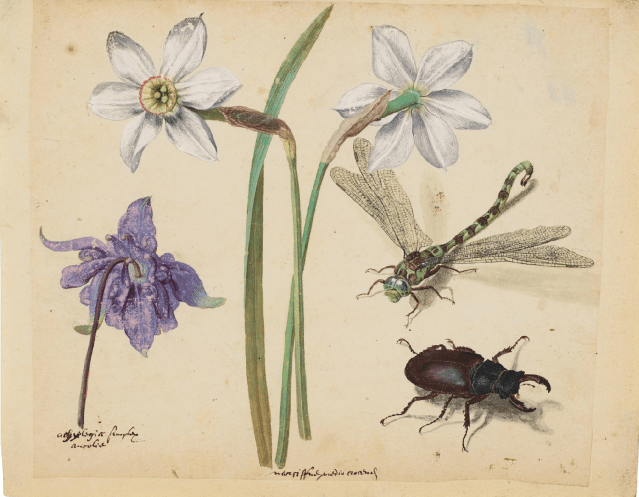

Despite these various discoveries Le Moyne remains a misty and largely unknown figure. A critical account of his work was published in 1977 by the British Museum but since then there has only been sporadic research until Kornell and Margócsy published “A Spring of Immortal Colours” in the Journal of the Warburg and Courtauld Institutes vol.86, 2023. Luckily they also published electronically on Academia.edu in November 2023.
Their detective work might mean there’s less authenticated Le Moyne artwork around but even so the quality of the “anonymous” volumes isn’t bad!
So…even if you don’t want to read the detail of their research and evidence you can just enjoy flicking through the albums!


 The Garden History Blog
You must be logged in to post a comment.