

This could be a fairy tale story. A dashing young American millionaire buys a Moorish castle in a breathtaking position, from an ancient aristocratic Spanish family promising to restore it.
Imagine the excitement when he announces he has found hidden treasures which will make it second only to the Alhambra Palace in historical importance. He engages 70 workmen to begin digging up under the floors and the courtyard garden and discovers vaults he says date back to Roman times, containing not only mosaics but Roman, Moorish and Gothic gold coins and other precious objects, and believes he has discovered the untouched tombs of Moorish kings.

So why haven’t you heard of it? What happened to this potential second Alhambra? Did something go wrong?
In part the story is enough to make you laugh – or maybe cry – but , despite that, I’m still writing about the house and garden he bought.
Read on to find out what happened and why its definitely worth visiting…
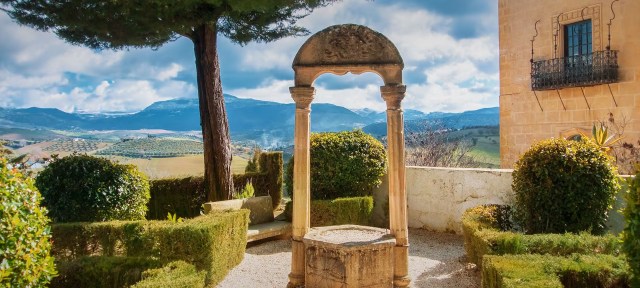
 As usual the photos are mine unless otherwise acknowledged. Apologies for the poor quality of some of them.
First the serious stuff then the garden. From the 7th century until 1492 large parts of Spain, particularly in the south were under the control of Arab Muslim rulers who created many beautiful palaces and gardens, in cities like Granada, Cordoba and Seville. One of these days I’ll risk writing about some of them too but today’s post is about a tiny garden attached to a building known as the Casa del Rey Moro or the House of the Moorish King in Ronda, a small town 700m up in the mountains in Andalusia.

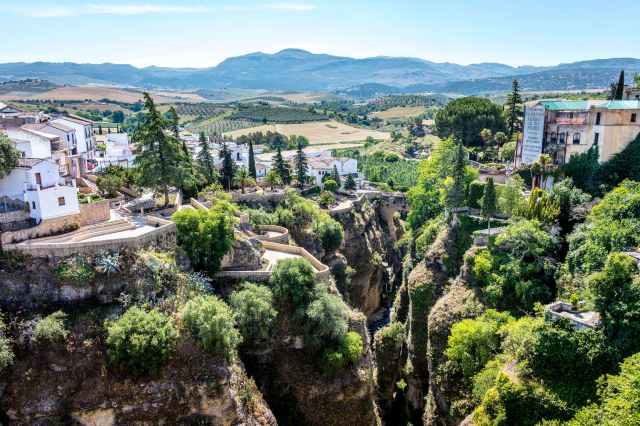
What makes the site so extraordinary is that it sits perched on the very edge of a sheer sided deep canyon over 100m deep, known as “El Tajo”, cut by the river Guadalevín. It also sits on top [literally] of a remarkable piece of early Islamic engineering, which was in the past the main water supply for the town

From The Birmingham Weekly Post, Sat 9th April 1910. Britsh Newspaper Archive.
Ronda was a strategically important town and as the Christian kingdoms of Castile and Aragon gradually pushed the Moors out of central and then southern Spain it was continually in the firing line between the Moors of Granada and the Christians of Seville. But once it fell to the Spanish in the late 15thc it gradually sank into genteel obscurity. It was only the opening up of the area for tourism with the arrival of the railways that put it back on the map.
One of the new wave of visitors was Lawrence Perin, the son of an extremely wealthy Baltimore stockbroker who had inherited a fortune on his father’s death in 1904 and was looking for things to spend it on. Perin’s young wife had recently committed suicide and he told the mayor of Ronda that he heard the municipality had some land for sale, and he wanted to buy it and build a chapel in her memory. The Mayor knew all about spendthrift Americans – or thought he did – and in his minds eye obviously saw a lavish park being donated to the town at no cost, so was very welcoming. Perin also negotiated the purchase from the Marquis de Salvatierra of a very large rambling house [or rather collection of houses] on the very edge of the gorge that cuts through the town.

All appeared to be going swimmingly well. Perin splashed money around with abandon, began work on the property and soon released news of his amazing discoveries. He travelled to Madrid to speak to the minister of culture and tell him that he had started on the restoration of the house and had discovered all sorts of Arabic architectural ornaments and objects of great value, as well as uncovering a palace worthy of a fairy tale. Underneath the house he claimed to have discovered huge rooms and extensive galleries which he thought contained royal tombs. He was so concerned to respect these graves and their contents that he had contacted the nearest Islamic ruler Sultan Muley Hafid in Tangier, who he thought was descended from the last Islamic rulers of Ronda to ask advice, about what should become of his ancestors’ resting place. He even asked that troops be sent to prevent looting.

The unassuming entrance to the Casa, and lower down the present entrance to the gardens.

from Guzman’s article 1910
Imagine the excitement in November 1909 when Perin announced all this to the press. It made the headlines in Spain and was picked up all round the world, including Britain, Canada and Australia. Everyone, or almost everyone was taken in. There was one exception an eminent historian Juan Pérez de Guzmán y Gallo, who happened to have been born locally. In 1910 he wrote a long article for the Bulletin of the Spanish Royal Historical Society doubting “such unlikely news” especially the discovery of anything of Arabic origin, because he had known the site since childhood and knew its history. The Mohammedan connection was he though mere fantasy and he felt the press were being gullible.
Of course Guzman was right. He knew that there had been very little on the site at the time of the capture of Ronda by the Spanish, and certainly nothing as grand as a palace. The main building was isolated right on the edge of the precipice and guarded a staircase that had been cut through behind the rock face and which went down to the river below. 
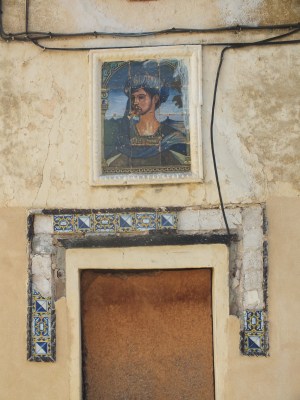
The present house which Perin had bought and claimed to be Moorish had according to the city archives only been built in 1709 and had been sold in 1767 to the Salvatierra family who added an ornate facade and their family arms, and later bought the adjoining properties and added them to the pile.
As Guzman said “It is not necessary to add that throughout the outside of Casa del Rey moro does not exist the smallest detail, neither architectural nor of ornament, which is reminiscent of Moorish art.”
This is now the point where you can choose to laugh or cry.
My Spanish is almost non-existent and so I was dependent on translation apps, without much success, so as I couldn’t find much about the Casa and its gardens I decided to look for information about the various owners. It turns out that the real restorer of the palace and the commissioner of the very pretty garden that exists bought the site in about 1911 or 1912 so Perin only owned it for a couple of years. I wondered why. Mr Google and his friends were eventually helpful in tracking down Lawrence Perin and then with a bit of assistance from the British Newspaper Archives the whole story began to fall into place.
Lawrence Perin was a charming young man about town but he was also a lady’s man and spent his father’s money like water. However his behaviour was often strange and erratic so eventually Perin’s father, just before he died, managed to have Lawrence committed to a private asylum. Lawrence escaped, married one of his lady friends and escaped to Europe with huge amounts of money to burn. After his wife committed suicide Lawrence embarked on the Ronda experiment. It ended when having made his announcement about what he had found “thousands journeyed to the site to look for treasures for themselves.” In vain for, as the Birmingham Weekly Post informs us, “Lawrence informed the assembled multitude that he had perpetrated a good old fashioned American April Fool’s joke , and leaping ito his waiting automobile dashed away.”

From The Birmingham Weekly Post, Sat 9th April 1910. Britsh Newspaper Archive.

from Manchester Evening News, 17th Dec 1910, British Newspaper Archive
Perin escaped to Cairo where he was apprehended, after the American consul in Ronda contacted Washington and his family. Declared insane he was freed by psychiatrists in Tangier in Devember 1909 but on his return to the United States taken before another lunacy hearing where another of his lady friends turned up with a baby claiming to be his wife, although that didn’t prevent him being committed to an asylum again. Again he got himself released, and quickly remarried, but he took his own life in a Baltimore hotel in 1917 virtually bankrupt leaving his widow and baby son virtually penniless.


The Casa del Rey Moro was then obviously put back on the market where it was spotted and quickly snapped up by the grand-sounding Trinidad von Scholtz Hermensdorff, a wealthy art collector and philanthropist. Her family had arrived from Prussia in the 18thc and established themselves in the wine trade so she was despite her name thoroughly Spanish. She was married first to a fabulously wealthy Mexican landowner and diplomat Manuel Yturbe, and then after his death to Fernando de la Cerda y Carvajal Gand y de Queralt , 9th Count of Parcent and 10th Count of Contamina. In 1914 the count was elevated to a dukedom and Trinidad became the Duchess of Parcent, adding even more grand houses and palaces to her collection including Paris and Madrid. For more on her collecting and houses see Eva Ramos Frendo’s article about them.
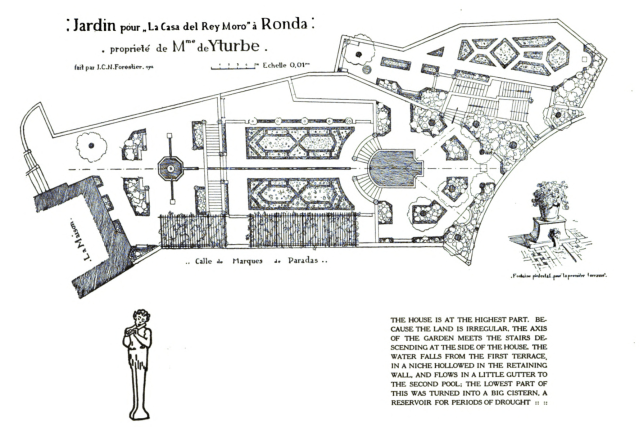
from Forestiier’s Gardens; a note-book of plans and sketches, [Engliush translation] 1924
 Unlike Perin she did restore the house but in the process demolished the buildings on the east side to make space for a garden, while those on the west side were rebuilt in the newly fashionable neo-Mudejar or Moorish revival style.
She then called in the French garden designer Jean Claude Forestier. He had been responsible for many of the major public spaces in Paris but also worked a lot internationally as well, particularly in Spain. [He deserves a post of his own one day].

from Forestier’s Gardens; a note-book of plans and sketches, [English translation] 1924
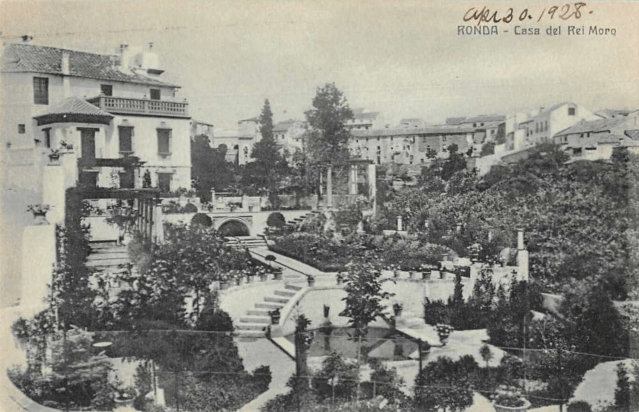
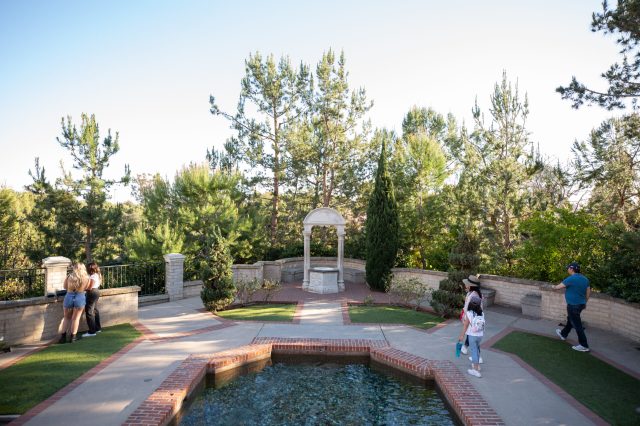
The site, “crowded between the street and the ravine” sloped quite sharply away from the house so the garden is arranged on three terraces, linked by short flights of red brick steps and united by a flow of water throughout its length. A large cistern was placed on top of the house which fed water to a wall fountain lined with colourful Andalucian tiles [azuljenos] on the top terrace, which is also largely decorated with neo-Mudejar tiling. The water then went through a long rill lined with bricks and more coloured tiles down to another basin [seen in the postcard below] on the lower level.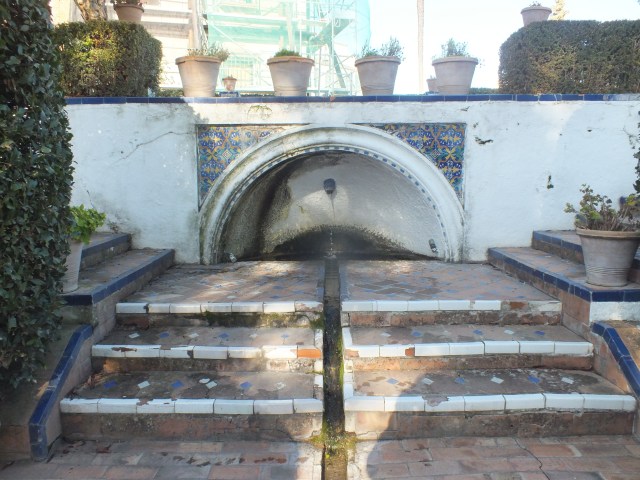
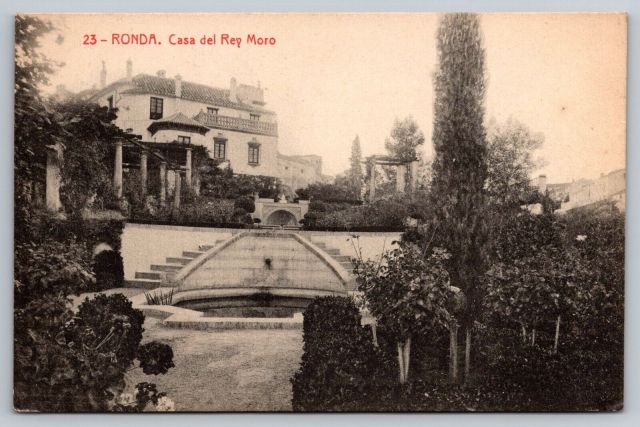
Undated postcard, but from the more mature planting perhaps mid- 1930s
The channel of water was originally lined with flower beds edged dwarf Evergreen euonymus and intersected with lines of box, and nowadays with clipped cypress, box and myrtle. Forestier originally used mainly aromatic plants and lots of roses with oranges, mimosas, cypresses, palms, oleanders, myrtles, and cestrum to give spots of dark green and bright colour. The background planting was Myopurum and different sorts of Pittosporum. Unfortuanately as can be seen from the modern photos, with the neglect that came later much of this planting, especially the roses has suffered greatly by being overshadowed by the trees which have been allowed to greatly outgrow Forestiers design.


from Forestier’s Gardens; a note-book of plans and sketches, [English translation] 1924
 On the southern side against the enclosing wall was a pergola painted black and supported by ancient columns of white marble. that runs along the entire length of the garden and which provides much needed shade in the summer.
Originally planted as a rose arbour it is now covered by a venerable wisteria. There are also several Hispano-Moorish tiled benches throughout the garden.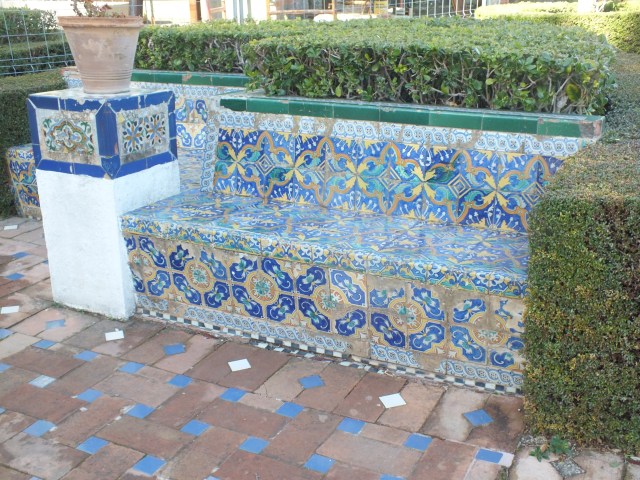
Along the edge of the gorge there are places where the gardens actually hang over breaks and gaps in the cliff face and at the lower end the gardens seem actually to project out over the gorge.
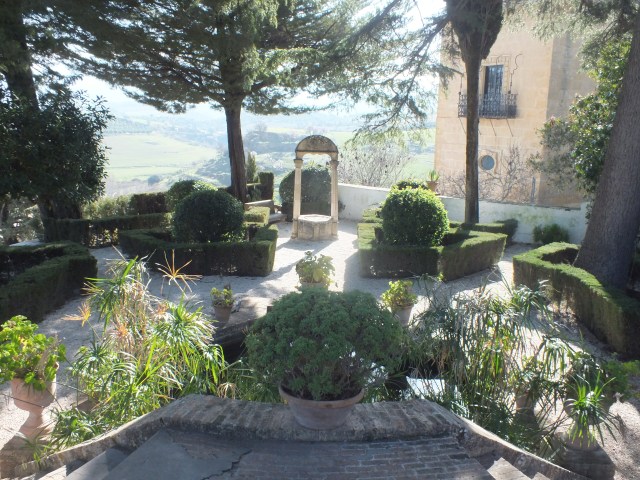

Amongst the early visitors was Ralph Cornell, who was to go on to be the supervising landscape architect at the University of California Los Angeles from 1937-72, and who was very interested in gardens [his archive has over 1000 photographs and is well worth looking at] . It includes 11 taken at the Casa on a visit in 1929.


The fountain in the last two photos was bought by the Duchess and originally installed inside the conservatory of her Paris home but when she bought the Casa she moved it into the garden there. Unfortunately it was later stolen.

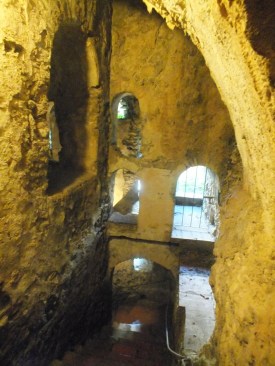 But the garden is not the only point of interest. Underneath the garden and house is what’s known as the water mill which was critically important to Ronda in Moorish times. Towards the end of Islamic rule the town was frequently besieged, and the first target of every besieging army was its water supply. To prevent the city’s supply being cut off Ronda’s then Moorish king, Abomelik, ordered the cutting of steps down inside the sheer rock walls of the gorge down to river level. This work was probably done using Christian captives as slave labour.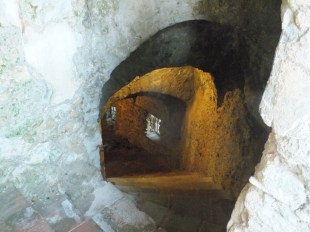
Originally there were 365 steps all cut from the solid rock by hand and they go through a number of chambers designed as passing places or for resting. One of these is known as the Sala de Secretos – Room of Secrets. While you might think that implies some arcane military or magical purpose it’s simply that the room had one bizarre characteristic.

 Like the famous Whispering Gallery at St Paul’s Cathedral or the Whispering Hedge in the Tuileries Garden in 17thc Paris two people standing close to the wall, but at opposite ends of the room, could speak perfectly well to each other although their words were completely inaudible to anyone standing in the middle of it. Sadly the only secrets most of those going through the room who were mainly christian slaves were liable to be able to pass on were the number of water containers they had managed to carry that day. Though intended as a secret, it must have been a pretty open one, since it was common knowledge among the Christians that “in Ronda you die carrying water skins”. The Duchess had the steps repaired, although with the house closed up visitors only have to manage about 300 steps down to reach the river – and then 300 back up to return to Forestier’s garden.

The funtainless oupper terrace before recent restoration work
 After the Duchess’s death in 1937 I presume the house passed to her only daughter but certainly by 1996 it was in the hands of the municipality and in a dilapidated state. They sold it to a German hotelier Jochen Knie. He opened the gardens the following year and promised to restore the Casa and open a 5 star hotel although it was not in a zone where this would normally be allowed under Spanish planning law. Indeed it transpires that the town council did not even have planning powers in such a case as these rested with the regional authority. A stalemate ensued followed by 14 years of legal disputes with claim and counterclaim, until in 2010 it was thought a solution had been reached. Since the hotel hadn’t opened when I was there in 2018 and doesn’t appear to have opened since I can only assume that the scheme hasn’t gone ahead although there are signs on the building saying renovation is underway. Apparently the dispute is still rumbling on although I’ve searched in vain in the English-language press for more definitive news. For more on the dispute see this 2010 article on Ronda Today.

One good thiong has happened recently. The stolen fountain was tracked down in 2019 and has been returned to the garden.
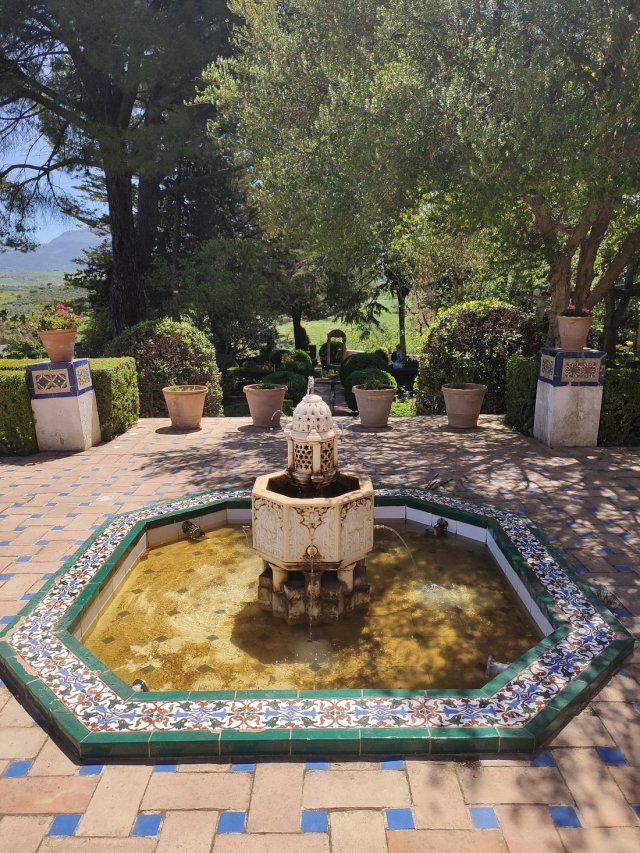
The fountn ain back on the upper terrace
As you’ll see the Casa is now “officially” a “palace” and “14thc Arab fortress” although I’ve not seen evidence that Guzman was wrong, but what’s sad is that, the building has now been empty and unused for at least 40 years and although work has been done there is no sign of re-opening. The one consolation is that the garden is well maintained and open to the public.
Finally as an interesting aside, the story of the house and garden reached California and in 1935 The Casa del Rey Moro Garden was designed by Richard Requa for the 1935 California Pacific International Exposition inspired by the Forestier gardens in Ronda, Spain. I wonder if he knew Ralph Cornell.


 The Garden History Blog

You must be logged in to post a comment.