
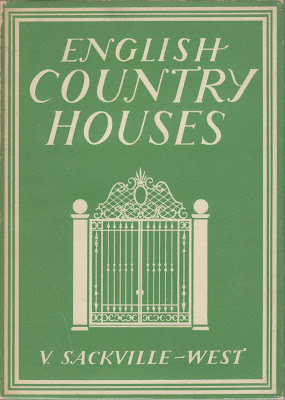
 The Gardens Trust is working towards publishing a book on Unforgettable Gardens and together with a few colleagues I’ve recently spent ages trying to decide which ones to include and why. Our debates reminded me of a similar dilemma which must have been faced by Vita Sackville-West when she was writing English Country Houses in the middle of the Second World War. Published in 1941 it had the aim of boosting national pride and morale and reads a little like a love letter to the stately, and even more, the not-so-stately homes of England.
Read on to see which houses and gardens she eventually included – or omitted – and why.

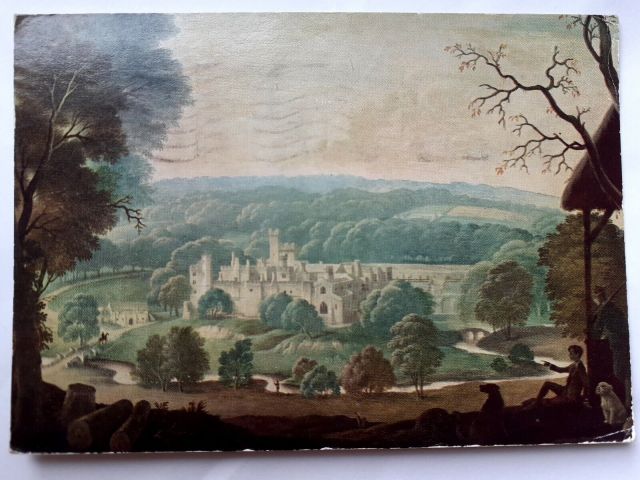
Newstead Abbey, by Varley, 1825

All the images come from English Country Houses, unless otherwise acknowledged, although where the quality of reproduction in the book was poor I have tried to find an alternative source for the same picture. However this has proved difficult because many of the paintings she chose were, and still are, in private hands, and undigitized.
“There is nothing quite like the English country house anywhere else in the world.” Perhaps that’s understandable given that she grew up at Knole, in one of the greatest of all, in every sense of the world. But of course she’s right. “France has her chateaux, Italy her historic villas, Spain her gardens like the Generalife hooked on to the hillside, Germany her robber castles, but the exact equivalent of what we mean by the English country house is not to be found elsewhere.”

A Country House by the river, Edward Daye [now known to be Gouldrings, near Hertford]

Her book is one of the 126 in the eclectic, not to say, eccentric, Britain in Pictures series published by Walter Turner, editor of the Spectator magazine between 1941 and 1949. The constraints of wartime are evident, although there are a lot of images nonetheless, including 12 not very high quality colour plates. She was not the only great writer of the day to get involved. Amongst many other well known names he had Lord David Cecil on English Poets, Edmund Blunden on English Villages, Elizabeth Bowen on English Novels, Edith Sitwell on English Women, John Betjeman on English Cities and David Low on British Cartoonists. There’s a full list which also includes a few unpublished volumes as well on the Books and Writers website., and more about them in a Guardian article by Nigel Beale from 2009.

Vita is nothing if not trenchant in her views. “Our cities, generally speaking, are deplorable” but our villages and rural domestic architecture is so much better. Even some country houses come in for a withering comment or two as she writes from what she admits is “the most personal point of view, prejudiced possibly but certainly offered with conviction”. It means that even some famous country houses are “excrescences which should never have defaced the countryside.” This was largely because they “were too often built all of a piece, to gratify the ostentation of some rich man in an age when display meant more than beauty.” Is this the snobbery that comes from her upbringing because she goes on: “they were not allowed to grow with the oaks and elms and beeches; they were not true country houses at all, but a deliberate attempt to reproduce in the country the wealth and fame which their owner enjoyed in town. They were his country residence rather than his home.” She sums this up as meaning that such houses “were false to the real tradition. They do not represent England at all, and, although they must be mentioned and even illustrated in the following pages, it must be understood that the sympathies of the author of this monograph are not with them.”
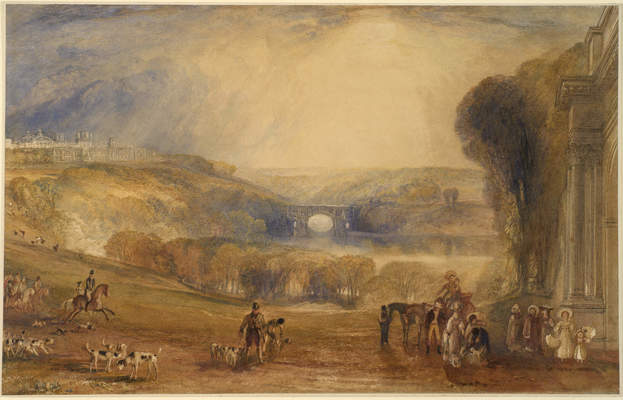
Amongst those estates condemned are some we would all probably consider amongst the greatest: Chatsworth, Stowe, Blenheim, Welbeck, Bowood, Castle Howard, and Wentworth Woodhouse. But her justification is clear: they might have “splendours: but they cannot be said to melt into England or to share the simple graciousness of her woods and fields.” Such houses “may have the advantage of architectural unity …[but] they lack the advantage of a natural development. And it must be added that the unity is frequently of a style not to be admired.”

Arundel Castle
Enough carping. How did she choose those houses and gardens to be included in such a short volume? Luckily she was not limited to a set number as we at the Gardens Trust are by our publishers, so she decides not to choose just a few but to comment on many, although not all with approval, “All things considered, it seemed best to do [this] by date. That meant beginning with the castles. But then, immediately, everything began to overlap. Castles cropped up in centuries where they had no business at all.” One of her basic criteria was that the property should be lived in, which ruled out Scotney for example even though it “still dreams amongst its flaming azaleas above its dark-green moat”. Bodiam too was a non-starter despite its “rounded towers rising out of a floor of water-lilies.” Arundel and Alnwick were “large and largely fakes”. Other castles had later been domesticated so she decided her classification must “very elastic…This realisation, inconvenient though it might be, did however confirm the theory that the charm and genius of our domestic architecture lay in its gradual and continuous development.”

So having discussed the merits of all sorts of castles she settles on Berkeley in Gloucestershire, which after recounting its history she calls “sullen, secretive… nothing but its colour and its beauty could save it from being wholly tragic and sinister [but] Not even the great yews on the terrace, cut into the shapes of elephants carrying howdahs on their backs, can sadden its beauty… Berkeley has a swagger of its own.” After that she contemplates turning to the “mirrored magic of Leeds and Broughton, floating swanlike above their moats” or with ” lawns which… almost take the place of water; it is merely that they are opaque instead of translucent; they are green as water though less quivering, less sensitive to clouds or sunlight.” A list of other potential contenders for selection follows: Herstmonceux, Sizergh, Maxstoke, Chilham, Hever and is joined by Ightham. All are quiet and green.
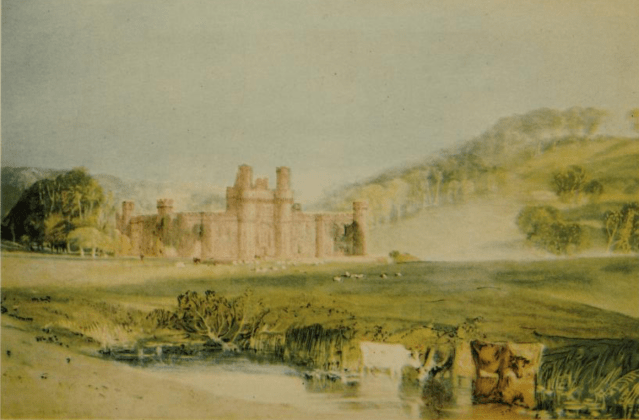
Herstmonceux
This subtle underlying love of country and countryside shines through as an antidote to war: “England is green throughout; her seas, her woods, her fields all island-green. Green, quiet England. Old, quiet England, disliking war, never having known war at home in the sense that European countries knew war. No devastation, no wrecking of villages and the homes of man, whether castle or cottage.”

Mells
Vita moves on slowly through the Tudors and manor houses, the result of how “English genius slowly evolved its own idiom” although ” the very slowness of its growth renders the result confusing, and it would be perfectly possible for an untrained eye to mistake, say, a seventeenth-century Cotswold manor-house for one of the same type built a hundred years earlier.” She was aware of the risk of “giving a mere list,” and stood “bewildered before the wealth I have to choose from …shall I include Barrington Court, in Somerset; Mapperton, in Dorset; Levens Hall, in Westmorland, that pale house with its topiary gardens; the Vyne, in Hampshire, of brick and stone” before succumbing to the risk and listing even more.

Sandford Orcas, by H.J. Medlycott
In particular she praises Mells in Somerset, “where the shadow of the high church tower veers slowly like a pointing finger across the lawns of the manor garden” and Sutton Courtney, in Berkshire, where “from the end of the village street you can look up at the house through wrought-iron gates, even if you have not the privilege of walking in the garden where a wilderness of roses overhangs the Thames and mossy walls crumble among the statues behind the borders filled with flowers.”
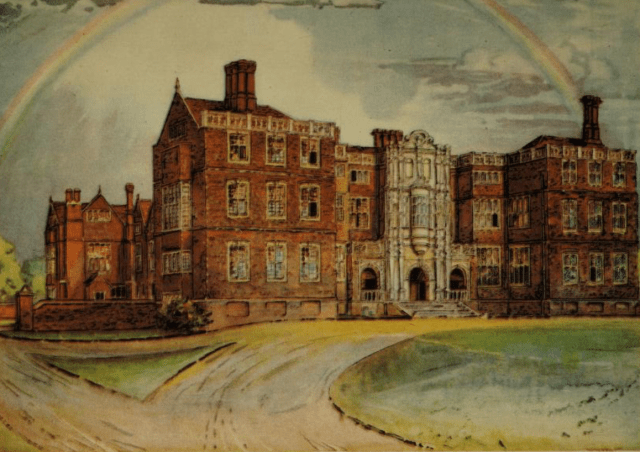
Bramshill
The list almost ends with Littlecote: “long and low and pink, with mullioned windows and forty gables of simple proportions; the garden behind the house is all that an English garden should be; lawns as perfect as those of an Oxford college, flower borders designed with a perfect regard for a most unusual combination of colours, a water-garden fed by that same Kennet which flows past Avebury.” Then she changes her mind and opts for Bramshill [although it’s hardly a moderate sized house!] “Lovely inside and out, Bramshill, standing among the fine trees and bracken of its park, offers as fair a picture as any house in England.”

Of the larger early houses she could hardly avoid a mention of her ancestral home, Knole, which, “although so vast in extent (being built round a system of seven courtyards and covering over five acres of ground), is yet perfectly subdued in its external parts. You could not isolate any separate section and say, “This was built for display.” The grey and green courtyards are quiet as a college; the garden paths suited to the pacings of scholars as well as of courtiers; its “stately and tempered mediaevalism” lacks all taint of the nouveau riche.” Her account, of course, does have the taint of other things instead.
She includes a section on the joys of regional architecture in brick or black and white timbering which have “their charm. [but] much of the charm is lost when we come to the over-enriched specimens such as Gawsworth and Moreton Old Hall, where the simple craft becomes self-conscious. It was not an art that ought ever to have been over-elaborated.” One could say the same about their gardens.
What I love about Vita’s writing is that it is never shy and often surprising. I didn’t imagine after all her waxing lyrical about the architecture and culture of the Elizabethan age that she’d conclude “Let us face it: Elizabethan and Jacobean taste could be atrocious, and frequently was. It was never safe, tidy and quiet as the taste of the succeeding century.”
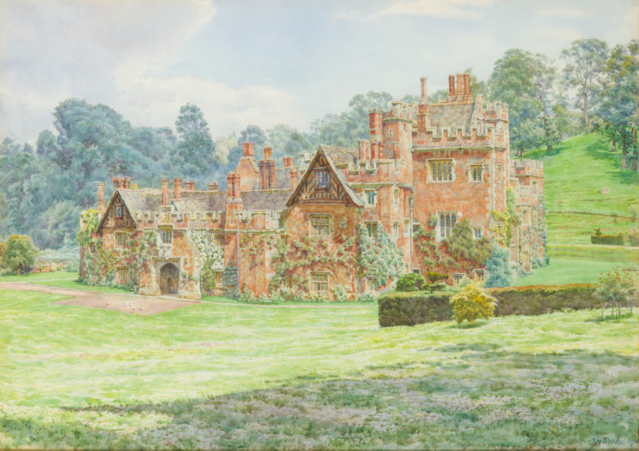
Seventeenth century English domestic architecture “became more sophisticated and less picturesque. It was getting itself tidied up. It became neater and more symmetrical. It straggled less. It became more deliberate and intentional, and less haphazard. We calmed down. We lost something; we gained something. We lost the rich extravagance of youth; we gained the sobriety of early middle age. We ceased to be twenty and passed into being thirty years old. Architecturally speaking, we ceased to be very young, but were not yet quite grown up.” This was she thought in large part due to Inigo Jones who “abruptly imposed the real innovations he had brought back from Italy. The idiom of one country always startles when it first appears in another.”

Squerries by Roland Pym
However, what she called these first “wildly adolescent experiments” of the new style were soon” replaced by deliberately planned constructions, satisfying to the eye, convenient to live in, classic rather than romantic” in estates like Tyttenhanger, Ramsbury and Squerries.

Cranborne Manor, by Rackett & Basire
I admit surprise reading how she scorned the “alarming genius” of Vanbrugh who “never catered for grace and charm” and “must only observe that it would be surprising were Mr. Noel Coward suddenly to take to architecture and begin erecting some of the most ambitious piles of masonry ever put together in this country.” Houses of this period showed “a pomposity different from the dashing Elizabethan spirit which built as it chose, and added and straggled and thought more of comfort than of impressiveness.”

The Tower at Sissinghurst, by Roland Pym
Eventually “The poetry of the sixteenth century was gone, and in the place of its gables and finials, its fantasy and its mistakes, its gaiety and its extravagance, stood the solid Hanoverian England of the Georges.” It was this period when “the most quietly charming, convenient, and decent houses ever” were built. “They are unassuming. They are as quiet as the country squire and the country existence where they belonged. They take their place, in the seventeenth and eighteenth centuries, as opposite numbers to the Gothic or early Tudor or Elizabethan or Jacobean muddles which preceded them. They belong to an England which, architecturally, was beginning to grow up.”

Owlpen Manor, by Lord Methuen.
The book is, like all the series, short at a mere 40 pages but she couldn’t really escape from commenting on the country houses of the preceding hundred or so years, much though I guess she would like to have avoided doing so. So she takes her revenge because as “this essay draws to an end, it is surely not necessary to give more than a passing mention to the freak architecture of the Gothic Revival. This remarkable style, however successful in Sir Charles Barry’s Houses of Parliament (1840), proved ludicrously unsuited to the English counties.” She assumed that “men were becoming bored by the staid houses which had succeeded the introduction of the classic tradition. They were safe, but they were dull”. Luckily “we may rejoice that the whimsical air of novelty was so soon blown away. Had the same fate attended the later purely Gothic craze, we should be spared much to-day: St. Pancras Station, the Albert Memorial, and streets of gabled villas with stained glass in the doors.”
They simply didn’t fit in to their surroundings. She went to “emphasise once more the peculiar genius of the minor English house” for doing just that, although there was a subtle admission that she might be wrong in the longer term, acknowledging that tastes change and “there is no Absolute in such matters. Our appreciation depends on the taste and fashion of our own immediate age. We may esteem one style and condemn another. The next generation may reverse all our ideas.” In that at least she was right!
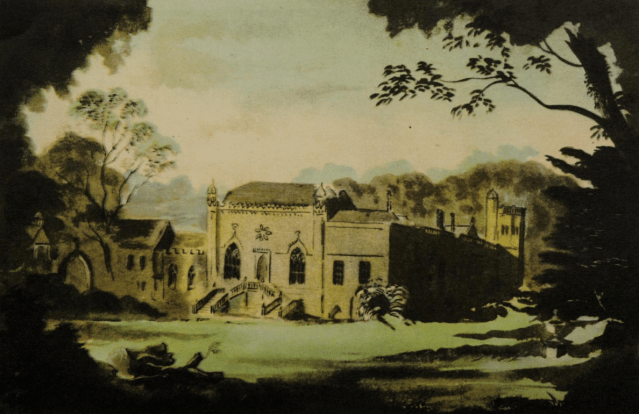
Laycock Abbey
Of course the the whole book is also a monstrous exercise in snobbery, but leaving aside her forthright views, or perhaps because of them, reading English Country Houses today, is an insight into an almost lost world, a mindset and a world before the rise of the National Trust’s empire. It’s summed up by the book’s cover which shows the shut gates of a great house and as Emily Rhodes wrote “Let’s not forget that if one ever did get through those steely gates, life was terribly elegant but, like the houses, perhaps a little ‘safe’ and ‘dull’…”, although I’d have to add that would only be the case if Vita wasn’t around!”
Read it for yourself on archive.org!

A Country Call, by George Stubbs


 The Garden History Blog
This was a fascinating read, to which I plan to give more time. Just a tiny observation that your system may have led you to mis-spell Herstmonceux.
Ray Hall
Thanks Ray. I’ll correct my spelling straightaway!
David