
 I’ve discovered I’m a snob. Not so much about people but about plants. I suppose I’d always known that I had that tendency but my trip last week to the Orchid Festival at Kew bought it home in no uncertain terms.
This was the 28th annual festival and this year it drew its inspiration from the unique flora and fauna of Madagascar, the world’s fourth largest island and home to Kew’s third research site. It was, their website promised, “an extravaganza of themed floral displays and living installations, created by Kew’s team of horticulturists to transform the Princess of Wales Conservatory into a colourful celebration which never fails to brighten up the winter months.”
That’s one way of putting it. Read on to find out why I was glad to get outside again, even though it was raining.

All the photos are mine unless otherwise acknowldged.

So the good stuff first. The Kew Orchid Festival has had a place on the annual horticultural calendar during February and March since 1996, each year celebrating a different country’s biodiversity. Over recent years, the countries featured have included Cameroon, Costa Rica, Thailand, Colombia and Indonesia.
Orchids live on every continent, except Antarctica, and grow in almost every type of habitat, from coastal tropics to alpine meadows. They are particularly important in the flora of Madagascar where various species make up about 10% of the different plant types found on the island. Madagascar is one of the most biologically valuable countries in the world and Kew has been working with Malagasy partners for nearly 40 years and has its only overseas Conservation Centre based there, cataloguing and describing the country’s flora, and conserving rare species. You can read more about the Kew links and the various projects they are supporting on the centre’s website , and more about the conservation of Madagascar’s orchids on this page of Kew’s own website.


More generally, orchids are one of the great evolutionary success stories. The earliest plants were pollinated by the wind but around 150 million years ago some plants, including orchids adapted and developed flowers with bright coloured petals to attract insects to do the work instead.
Not all seed-bearing plants evolved in that way – there are still about 1000 species of non-flowering plants including cycads and conifers, but there are over 370,000 which do have flowers including orchids which are the largest of all plant families with at least 29,000 species known.
For more information see “The number of known plants species in the world and its annual increase”. by Christenhusz & Byng in Phytotaxa, 2016 , and “A review of the trade in orchids and its implications for conservation” in Botanical Journal of the Linnean Society, 2018.

 Kew’s Marco Pelligrini says “Orchids have captivated humanity since the dawn of civilisation.” But why? He suggests it’s because they “exhibit some of the most exquisite morphological adaptations in the plant kingdom.” Certainly their flowers have taken shape, design and colour to extreme lengths, almost to the limits of what must be possible. Indeed some are so extraordinary that you can’t believe they’re real – and others which are so outlandish that you realise you probably couldn’t have imagined them yourself. Interestingly their pollinators have become equally unusual too. If it’s not orchid’s aesthetic qualities alone, is it perhaps because they have also long been known to have medicinal and cosmetic uses, or perhaps it’s because of their supposed aphrodisiac properties? “Who knows” is the short answer! Perhaps the answer lies in the various myths and legends that surround them and which I’m planning to cover in another post soon.
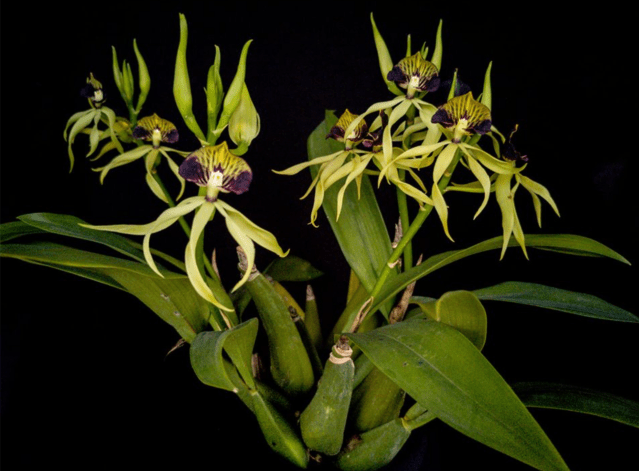
 But if orchids have been successful in the wild, they have been an equal success in “captivity”. Tropical species began to arrive in Europe just over 200 years ago and were immediately subject to attempts to hybridise them. These were soon successful and there are at least 100,000 known cultivars, surely more than any other plant species [I’m sure someone will correct me if I’m wrong!]
Kew’s own collection is potentially the oldest in the world because it was as early as 1787 that William Aiton, the then head gardener, managed to get a Central American clamshell orchid, Prosthechea cochlea, to flower for the first time in Britain.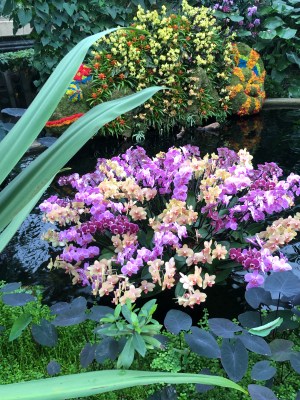
Now Kew’s greenhouses hold nearly 9,000 plants of 1,300 species and cultivars. Propagation techniques have also improved so rapidly that orchids have long ceased to be luxury rarities but the commonest sorts can be picked up in the supermarket, as impulse buys, for just a few £s. Orchids are now the second most economically important potted plant in global terms [only beaten by poinsettia] and in the top few worldwide as cut flowers. The total orchid market is estimated to have been over $5 billion in 2020 and is expected to rise to over $7 billion within the next 3 years.
Phalaenopsis or moth orchids outsell all the other sorts, probably because they are the easiest to keep alive. Now mainly micropropagated they have year-round availability, and have been bred to have longer vase life and diversity in flower colour and size. The Royal Horticultural Society maintains the international register of orchid cultivars and in 2018 they listed an almost unbelievable 34,112 hybrids of Phalaenopsis.
For more on orchid hybridisation see: “A review for the breeding of orchids: Current achievements and prospects” in Horticultural Plant Journal, Sept 2021
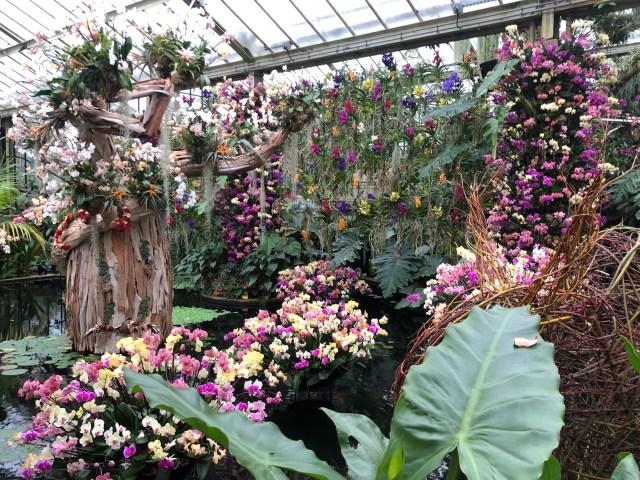
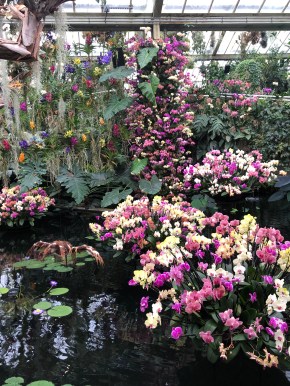
The wild and the cultivated come together every year at Kew in their orchid festival. There’s no doubt that it’s extremely popular, this year all the slots for the weekends and many weekdays were already sold out when I went to book my place. The queue to get into the Princess of Wales Conservatory to see it, even for those with timed tickets, could be half an hour long. The place was packed with everyone reduced to shuffling past keen amateur photographers snapping away at every bloom or display, that’s if they weren’t snapping away being an amateur photographer themselves.

My problem is that I didn’t learn much about orchids, other than I dislike seeing masses of them stacked up in colour-clashing displays big enough to induce eye-ache. The conservatory looked rather like the show home on a new executive estate tarted up for sale with blowsy curtains and flashy soft furnishings.
I don’t think Ive ever seen so many moth orchids – Phalaenopsis– in one place in life – not even the Orchid Garden in Singapore which is also an assault on the senses especially the eyes. Those at Kew have been bought in en masse from Dutch growers. 
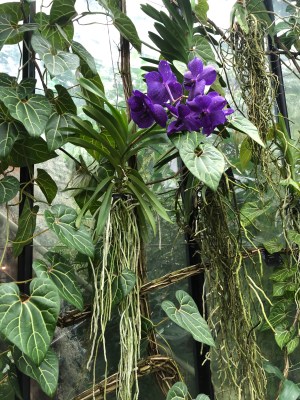
Vanda caerulea
They were virtually everywhere in the warmer sections of the conservatory, on arches over the paths, covering the building’s structure, on frameworks etc etc and cascading down not just the walls but the permanent planting. There were thousands of plants in every colour of the rainbow apart from pure blue – which I didn’t think existed in orchids, -the nearest to that being Vanda caertulea which was and still is highly prized for its brilliant colour

I was however wrong in thinking that what usually passes for blue orchids are simply white ones that have been dyed. Andre Schuiteman, one of Kew’s top orchid experts says there are actually a few Australian terrestrial orchids that are blue, and even a very few epiphytic ones. One of these was an otherwise “unremarkable” dried Dendrobium specimen from New Guinea, in the herbarium of London’s Natural History Museum.
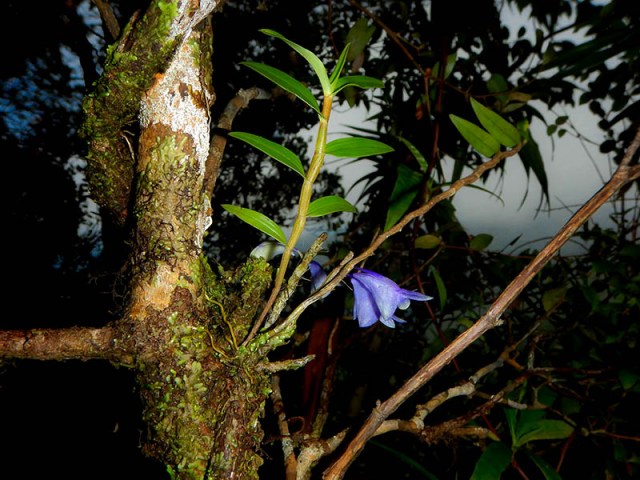
It had a typed label reading ‘Orchid growing on trees; flowers deep sky blue’. These specimens had been collected by someone named L.E. Cheesman on 17 June 1938 on the summit of Mt. Nok, an extinct volcano on the isolated jungle-clad island of Waigeo, off the western tip of New Guinea. It turns out this was Lucy Evelyn Cheesman who after becoming the first female curator at London Zoo, went on to become a freelance explorer, making several trips to New Guinea amongst other remote places, and by all accounts must have been an intrepid and remarkable woman. [another post soon perhaps?] That was the last time the plant, now named Dendrobium azureum was seen until 2017 when it was found again in the wild by a local conservationist.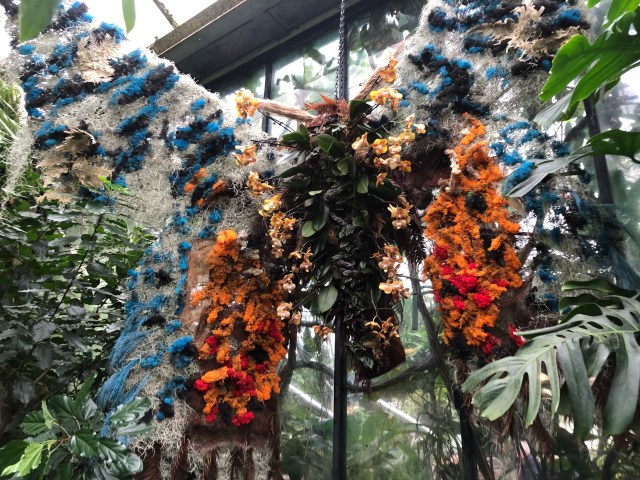
 Alongside all these “striking” [Kew’s word not mine] floral installations, “visitors will encounter floral sculptures recreating some of Madagascar’s most iconic wildlife, including ring-tailed lemurs, radiated tortoises and the enigmatic aye-aye, the world’s largest nocturnal primate”, and chameleons around the pond with a mobile of flies above waiting to be devoured by their long tongues. These varied from the inoffensive to the brash, and rather like attitudes to garden gnomes you can either love them or loathe them.
 To be fair to the organisers I think they must have known what was going to be the likely effect. They noted that “One can easily miss certain areas of this exhibition. When the initial flurry of the bigger displays and the riot of colour dies down be sure to continue down the paths to the greener areas.” There it was possible to spot individual specimens of orchids but sadly impossible to take the time to look at them properly because of the crowds.

One of the orchids that wasn’t really visible close-up but which was gaining a lot of attention only because there was an information panel explaining it, was Darwin’s orchid- Angraecum sesquipedale”. This has creamy white, fleshy and star-like flowers -hence its other common name the Malagasy star orchid. The sesquipedale part of its name means foot and a half in latin and refers to the extraordinary length of its nectar spur which lies behind the lower lip of the flower and which can be up to 45cm long. In their native environment, the flowers appear between June and September, although it normally flowers between December and January when grown in Europe.

The structure of an orchid flower from Darwin’s On the various contrivances etc
In January 1862, Darwin wrote in a letter to Joseph Hooker, the director of Kew, who had sent him some orchids: ‘I have just received such a Box full […] with the astounding Angraecum sesquipedalia [sic] with a nectary a foot long. Good Heavens what insect can suck it’. Later that year Darwin published what he called a “little book,” although that’s a stretch for a work with 365 densely-packed pages and 34 fine woodcuts. On the Various Contrivances by Which British and Foreign Orchids are Fertilised by Insects, and on the good effectsof intercrossing argued that “every trifling detail” of orchid structure was not necessarily the result of “the direct interposition of the Creator”. The book also acted as a rebuttal to critics of Origin of Species, and also served to move the debate away the origin of human beings and to the somewhat less controversial territory of botany.
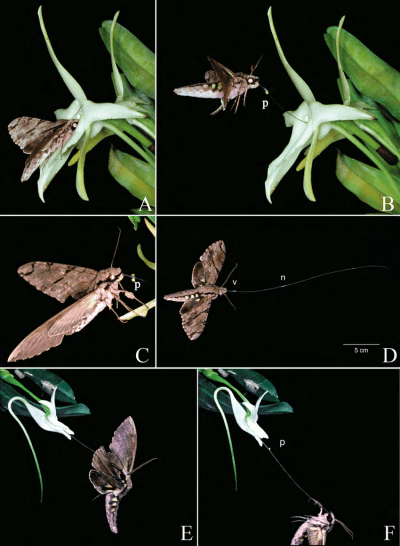
Darwin predicted that the long spur must have co-evolved with a pollinator moth with an equally long proboscis to be able to reach the last drops of nectar at the bottom of the tube.
However, it was not until after his death, and 41 years after writing his letter to Hooker, that the pollinator was eventually discovered – the Malagasy subspecies of the African hawkmoth – which was given the scientific name Xanthopan morganii praedicta in honour of Darwin’s prediction.
The moth finds the orchid because of its strong perfume which is only exuded at night.

 The invention of the Wardian Case a few years earlier transformed the British conservatory and led to a demand for new exotics to fill them. European nurseries sent plant hunters to satisfy the boom in demand, often with particular instructions to bring back new orchids. Great for British horticulture but devastation for the world’s jungles and other orchid habitats [More on that in another post soon.]

These days, fortunately, the vast majority of global orchid trade is as artificially propagated cut flowers and plants grown under controlled conditions. However, orchids are also widely subject to harvest from the wild for local, regional and international trade. There are growing concerns that this trade is threatening wild orchid populations and species in many places.
Kew is still hunting for new orchids species but in a much more sustainable and ethical way. Andre Schuiteman was asked the difference between such a trip now and one a century ago, and replied: “Apart from the mode of travel and the timescale involved – in the past it took months or years and now it’s maybe three or four weeks – the main difference is the bureaucracy involved. You need so many permits today, to even bring back one dried flower. In the past they just took shiploads full of plants, without anyone asking questions. To get all the permits to go to Cambodia took two years.” But is collecting now on a more ethical basis, perhaps? “As it should be,” he added.

 The ethical nature of Kew’s work is also shown at the end of the festival tour round the conservatory, where there is a mock up of a typical Field Research Camp, complete with jeep, tents and scientific equipment in the middle of the arid section of the house.
After which point I was able to escape.

I should start off by saying that like any gardener or plant-lover I love Kew. I’ve been visiting since there was a turnstile that took old pennies, and have been a Friend of Kew for years, I know people who work there and hold the science, plantsmanship and commitment of Kew in the highest regard, so nothing I say is anti-Kew. I started this post as a bit of rant – the last time I did that was also about Kew and other historic gardens – but modified it after some reflection because condemning everything as tacky, naff or even vulgar would be too easy – as well as snobbish. Clearly the festival’s o.t.t displays are what attracts the paying public and Kew desperately needs the money to support its work. It was possible to spot individual specimens of beautiful orchids but sadly impossible to take the time to look at them properly because of the crowds. So the thing to do is go back when it’s all over and take a look at the specimens that are still in place.

Thank goodness for the completely desretd alpine house
But it was a great relief to get out from the crowds and to see, less than 5 minutes walk away, wonderful drifts of spring bulbs, defiant against the rain, camellias and magnolias, the empty alpine house and and the almost empty temperate house….
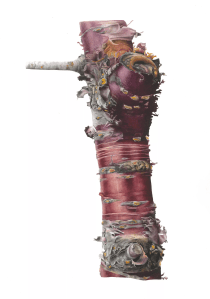
…and if you need an exuberant colourful and thought provoking show then head down to the Shirley Sherwood Gallery to see the results of the International Young Botanic Artists competition and the work of Matt Collishaw which also includes some unusual orchids.
Much more interesting and inspiring I’m afraid than an army of phalaenopsis!


 The Garden History Blog
You must be logged in to post a comment.