
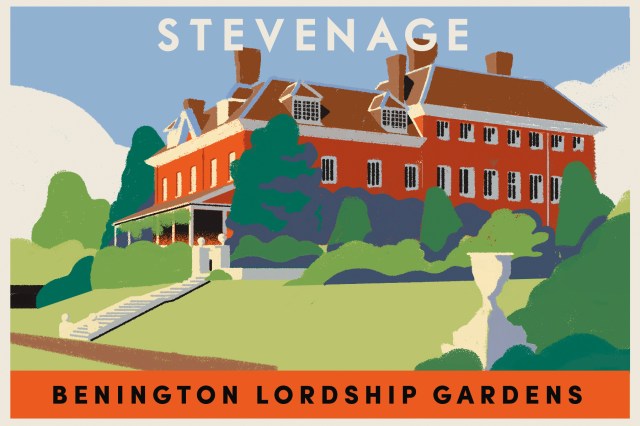
 Benington Lordship wears its long history with a welcoming smile. Lived in by the same family for well over a hundred years it has actually been inhabited since Saxon times. It still boasts the remains of a mediaeval castle as well large chunks of a mock one, a Queen Anne house with Edwardian extensions, extensive rural views, beautiful wildlife friendly gardens and what it’s particularly famous for, vast carpets of snowdrops.
Sadly this year the rain had battered most of them before I got there, but even so it was well worth visiting to see the other spring flowers and the changes that have taken place since my last visit pre-pandemic.
The photos are mine unless otherwise acknowledged

The ruins of the castle
The castle was built in the 1130s but didn’t last long because its owner was outlawed in 1212 and King John ordered its demolition. All that remains today are foundations of the walls of the keep and the moat. A farmhouse was later built next to the ruins and in 1614 the Lordship – not a title but the local Hertfordshire name for a manor house – was acquired by Sir Julius Caesar, Chancellor of the Exchequer for James I. His family did not live there but at nearby Benington Place and around 1700 they replaced the farmhouse with the elegant red-brick house that still stands today, probably for use as a dower house. Not much happened after that until the estate was acquired in 1826 by George Proctor, a solicitor from nearby Ware.
 Historical revivalism was then the order of the day, especially a nostalgia for the Middle Ages – think Walter Scott and Ivanhoe – and George was obviously caught up in this. He decided to celebrate the site’s mediaeval past and although there is no direct documentary evidence of the appointment, its almost certain he commissioned a local architect Thomas Smith to realise his dream. Smith is mainly known for designing churches and public buildings, and was to go on to become county surveyor in both Hertfordshire and neighbouring Bedfordshire, but, as you will see he must have had a less serious side as well.
In 1826 Smith was supervising a building project where a man named Obadiah Pulham was adding ornamental features in cement. Smith was so impressed with the workmanship that he offered Obadiah a job working for him, and then a couple of years later he also took on Obadiah’s brother James. Pulham is a name which will ring bells with most garden historians and this was the beginning of the Pulham brand. James and Obadiah had started out as plasterers working for a manufacturer of cement-based artificial stone but they were obviously talented and so were trained up to become “architectural modellers” to create decorative additions such as cornicing, architraves and features such as figure-head keystones over doorways.
I’ve written extensively about the history of artificial stone : about the very early history,Artificial Stone 1: the projector, the architect, the thief and the formula; then about the most famous manufacturer Artificial Stone 2: Eleanor’s enterprise; the collapse of her business under her successors,Artificial Stone 3: Coade broken and finally Artificial Stone 4: Post-Coade potteries

A sketch of Smith’s folly. image scanmed from Rock Landscapes: The Pulham Legacy by Claude Hitchings, 2012

Smith had recently acquired a house with 5 acres of grounds in Hertford, and laid them out to include a ‘pleasure’ garden where there were ornamental bridges over a river and a folly in the shape of a Norman tower and gateway. There’s no precise date for these features but Claude Hitchins in his history of the Pulham business suggests c1834 which is around the same time that Smith began work at Benington.
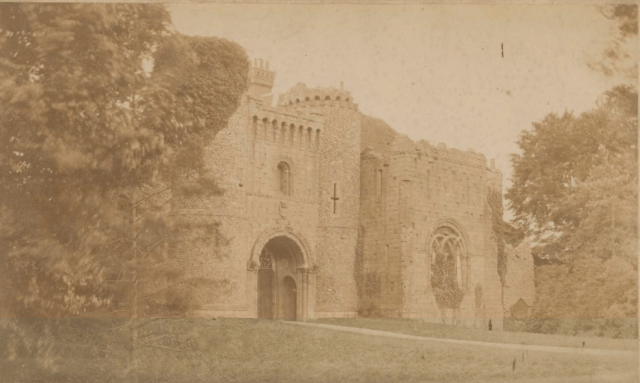
Proctor’s idea, realised by Smith, was to link the house to the mediaeval ruins with a grand neo-Norman entrance gateway, an additional room on the side of the house to hide the join in style and materials, and a summerhouse which together became known as The Folly. All this work was faced a mix of flint rubble and cement modelled in imitation of rough-hewn blocks of stone.
For more on the Folly I’d recommend a recent article by one of my favourite fellow bloggers, the Folly Flaneuse. Even better I’d recommend you sign up to get her weekly post on follies from all round the country.

The main entrance to the grounds is now through the neo-Norman archway in the two-storey gateway which is complete with crumbling battlements and machicolations and is flanked by two circular flint towers.
This is all ornamented with decorative features perhaps inspired by books like Essays on Gothic Architecture, first published in 1800. They include Proctor’s coat of arms and a series of masonic symbols celebrating his connections with freemasonry.

To the right of the archway is the additional room [which now serves as the tea-room – excellent home made cakes!] and has large ecclesastical-looking, arcaded and arched windows.

Going through the arch leads into a courtyard area and looking back, over the courtyard side of the arch, is a large relief panel in cement-work showing a king receiving homage from a group of monks.
 On the right hand side of the courtyard is a flint and stone wall of a corridor that connects the additional room to the house, with fragments of old stained glass in its leaded windows. On the left, another flint and stone wall stands high up on a grass bank and leads round to the summerhouse, which is reached by a flight of steps.

The interior is quite small and contains not only a Buddha [perhaps installed by the Edwardian owner who had lived in India] but an ancient marble plaque collected from the Field of Troy, commemorating a Greek slave, which was given to George Proctor in 1832.

The summerhouse and castle ruins seen ffrom the terrace in front of the hosue

The back of the summerhouse seen from the side of the moat
The bank on which it stands is part of the 12thc inner bailey of the original castle and it drops down sharply into the dry moat on the other side. All this work is designed to successfully give the impression that much more of the original castle survives than is actually the case.
The construction was overseen by James Pulham as Clerk of Works and so even though The Folly wasn’t built by the yet-to-be formed Pulham firm, it was claimed by them in their promotional book, Picturesque Ferneries and Rock-Garden Scenery, written by James’ son (also James) about 40 years later. Claude Hitchens describes it effectively as the first Pulham site.
James Pulham died suddenly in 1838 shortly after finishing the work and George didn’t enjoy his Folly for long either as he died in 1840. His son Leonard inherited the estate and employed Obadiah to ornament a new red brick stable block with some imitation stone decorative features, notably a series of winged horses. That marked the end of building and garden work at Benington until the estate was sold again in 1905.
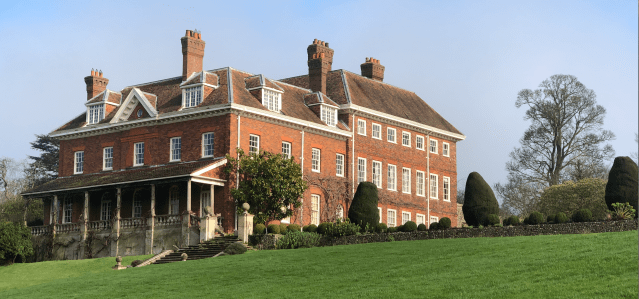
It was the new owners, keen gardeners Arthur and Lilian Bott, who really started the garden as it is seen today. They had just returned from India where Arthur had been working as a railway engineer. They commissioned alterations and a two-storey extension to the house, adding a Tuscan columned verandah which James Bentley suggested in a Country Life article in 2020 was “perhaps inspired by memories of India”. They also altered the driveway to the house, so that it led to the village, adding a pretty lodge at the entrance.
Lilian was probably the driving force behind the garden. She certainly left watercolours of various garden views, which show typical Edwardian garden features. A couple of these can be seen in the guidebook but have not been made available digitally, and there are a couple more on the watercolourworld website.

The entrance to the walled garden
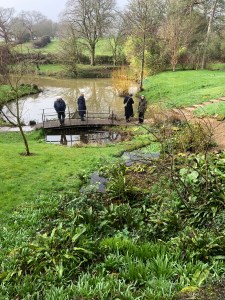 Turning their attention to the garden, they built a walled kitchen garden and took in a section of the parkland, including what were thought to be Norman fish ponds, adding it to the garden, and having a ha-ha dug as the new boundary.
They then laid out the structure of garden largely as seen today including a long double sided herbaceous border running down the slope past the walled garden…

…a rose garden, a rockery and much more. They also started the mass planting of snowdrops which have now naturalised on the banks of the moat, around the ruins, and the former inner bailey of the castle. As Kathryn Bradley-Hole said in an article in Country Life in 2020 “all wonderful things that indicate earlier days when labour was cheap and widely available.” When the National Gardens Scheme began in 1927 Benington was one of the original gardens to open.
As everywhere, the devastating effects of the Great War meant a decline in the garden, and “it was sleeping peacefully” by 1970 when Arthur and Lilian’s grandson Harry and his wife Sarah inherited, it was clear that a major rethink was necessary . Their success in reinvigorating the gardens can be seen when Benington was the subject of a Country Life article by Tony Venison in May 1982.
Calling it “a recently renewed country garden” created by the enthusiasm of Sarah Bott he stressed how the Edwardian nature of the design and planting had been kept wherever possible creating “an atmosphere of long-established permanence”. The garden even made the cover of that issue with a shot of its double herbaceous borders. The descriptions and photographs show the garden was still remarkably complex and densely planted, with the wider landscape of the parkland and farmland beyond described as seemingly “Reptonian”.

Mrs Bott’s success led her to be included in Rosemary Verey and Avilde Lees-Milne’s The New Englishwoman’s Garden published in 1987. There she confided that while she and her husband might have been full of enthusiasm for the task they were also ” luckily ignorant of the headaches it would give us, or we would probably have turned the cows out into the garden straight away.” Fortunately “the bones and roots were all there, which was lucky as I know I could not make a garden from a ploughed field.”

One of my favourite shrubs – Stachyurus praecox making up for the ssnowdrops being finished
I suspect that’s probably not quite true, but its clear from her interview it was hard work, even if they did use a goat to clear the moat, and get weekend visitors to “get busy and sweat off the London gin”. To make matters worse after the drought of 1976 “the place looked like a desert” and she was “in total despair.” Visits to other gardens, and turning to Russell Page’s Education of a Gardener and Vita Sackville-West’s Garden Book saw her through until she managed to recruit a gardener, Ian Billot, who was both enthusiastic and a skilled propagator. Under her guiding hand the gardens began to regain some of their lost Edwardian splendour so that Benington became “a garden of the golden afternoon”. To see what I mean it’s worth reading the full well-illustrated interview in The New Englishwoman’s Garden.

Since 2005 Benington has been the home of Arthur and Lilian Bott’s great-grandson, Richard and his wife, Susanna, although when they took over they were pressed for time to care for it as they had a young family. Interviewed for Country Life in 2020 the challenges facing them became clear. With rising costs and pressures on time and energy things became “necessarily simpler and, indeed, fashionably wilder in parts, than in Sarah’s day.” That has been turned into a virtue – with the aim of making the 7 acres a wildlife haven. This has included mass planting of spring bulbs especially on the many steep banks, areas of long grass, removing thuggish plants, turfing over older borders, new wildflower meadows and one of the ponds left fish-free to attract aquatic life.
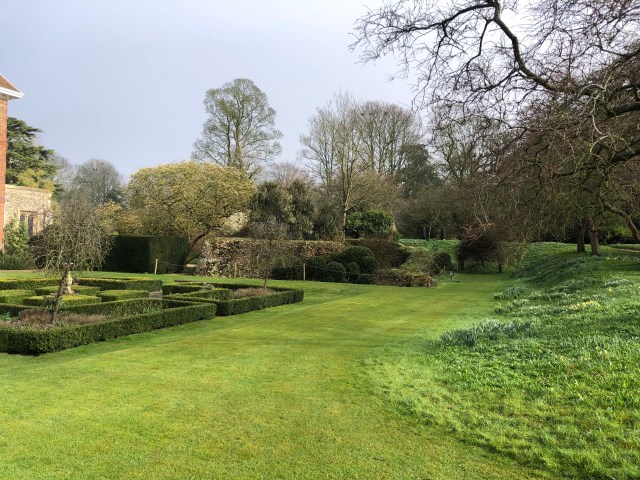
The rose garden on the left and castle ruins beyond
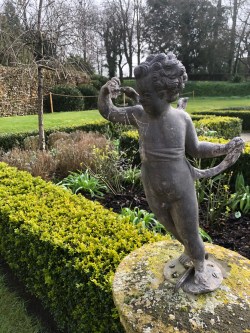
A cherub in one corner of the rose garden
The Edwardian formal rose garden was looking tired so was rethought by garden designer Julie Wise, in a very clever way, basically by turning the existing arrangement on its head. The previous hard landscaping became the new planting areas while the old rose beds were covered, and pathways widened using the former paving. The planting was then simplified with a box parterre, white groundcover roses and species tulips and four weeping pears in the corners to give some height.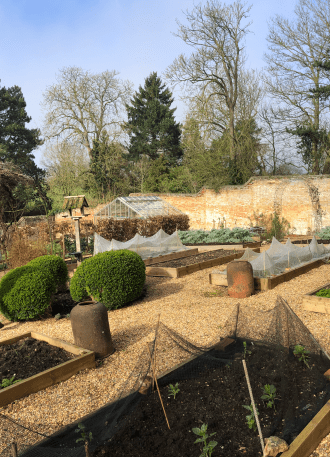
The walled kitchen garden too has been remodelled and made less labour intensive with half left as a productive garden with raised beds and and the rest redesigned largely as meadow planted with spring bulbs and wildflowers with some ornamental beds around the walls. Even the magnificent herbaceous borders have been recently rethought and while the upper part is still full of all the old favourites the lower section has been replanted in a more naturalistic way, to take account of climate change and be more resilient.

 Nor, because it was their family home, did they want the stress of becoming a fully commercial venture so instead of opening all year they concentrate on the snowdrop openings in February, and a popular chilli festival in August, each attended by around 8,000 people. There are also a short series of events when the gardens are also open: May bank holiday when the garden is at its peak; a plant fair in early June and a village open gardens weekend at the end of the month. Their website invites you to come in one these short periods and “discover its timeless charm” I’d definitely encourage you to do so too.
For more information take a look at the Benington Lordship website where there is a gallery of beautiful photographs and try reading the two most recent Country Life articles; “Benington Lordship: From medieval castle to comfortable home – and back again” by James Bettley, The magnificent gardens at Benington Lordship, a blueprint for spectacular gardening without blowing the budget”, by Kathryn Bradley-Hole, May 30 2020. There is also an article in Homes and Gardens with photos by Marianne Majerus published in Nov 2021, and another in The English Garden, in March 2021.


 The Garden History Blog
You must be logged in to post a comment.