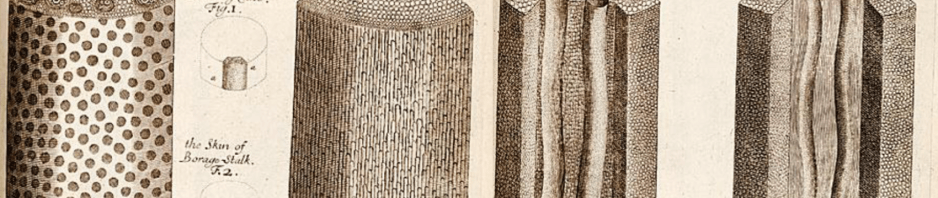
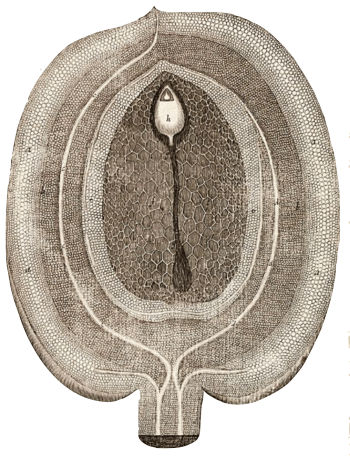
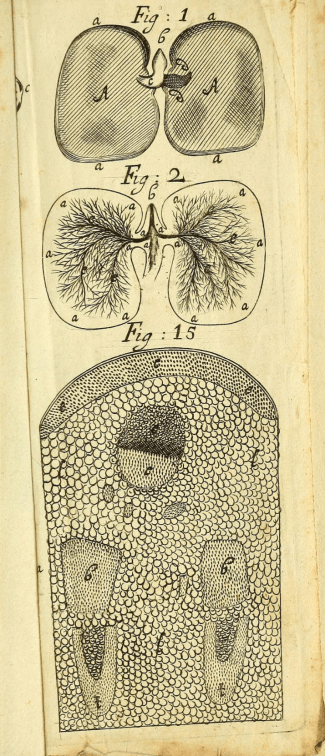
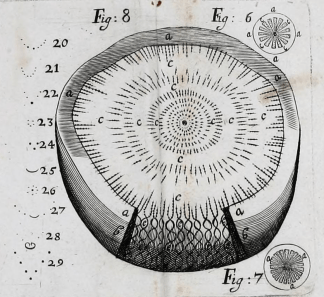
 Take a close look at these images. What are they? How, when and why were they drawn? Who thought of drawing them in the first place?

Read on to find out the answers to all those questions and, of course, find out why are they important enough to feature on the blog?

They’re among the 82 engravings included in a book by another one of those long-gone figures you’ve probably never heard of but ought to have done! His name is Nehemiah Grew and he was a pioneer in the scientific study of plants who died 312 years ago this week. Now known as the Father of Plant Anatomy he merited a paragraph or two in another post a few years back, but I think its about time he came into the limelight with an article all of his own, especially as it will follow on neatly from two recent ones about Erasmus Darwin and his work on plants.
All the images unless otherwise acknowledged come from Grew’s most important book The Anatomy of Plants published in 1682

Grew was born in 1641, the son of a Coventry clergyman. He went to Cambridge, and graduated in 1662 before returning to Coventry to practice as a doctor. At the same time he began developing a side interest in gardening and plants, particularly for their role in medicine. However botanical science was changing, and moving on from herbalism to take a wider view of the importance of plants. Meanwhile some of his contemporaries had been investigating the anatomy of animals and Grew became inspired by their findings to see if he could find similar structures in plants. This he reasoned was likely because both animals and plants “came at first out of the same Hand, and are therefore the Contrivances of the same Wisdom; I fully assured my self, that it could not be a vain Design, though possibly unsuccessful, to seek it in both.”
In 1670 the results of his initial findings eventually reached the eyes and ears of the bigwigs of the Royal Society, notably John Wilkins, its joint secretary, where it was greeted with considerable interest. As a result the 29 year old Nehemiah was asked to submit a paper which was then authorised for publication under the auspices of the Society.

The following year, 1671, was a busy one for Grew. He gained a doctorate from the prestigious university of Leiden, probably the leading European centre for medical studies at the time, he was elected a fellow of the Royal Society at the suggestion of Robert Hooke the society’s curator of experiments, and his The Anatomy of Vegetables Begun: with a General Account of Vegetation Founded Thereon was published. At the same meeting when the book was formally presented to the Royal Society for approval they also received a manuscript from Marcello Malpighi an Italian botanist, whom had been working completely independently on the same subject. He was elected a fellow and corresponded extensively with Grew about their findings and between them they established the observational basis for the new science of botany.
The book was dedicated to John Wilkins and when it appeared Grew was keen to ‘know the sense also of other Learned Men, whether the steps I have already taken, would warrant me to proceed any further’. The answer came from Wilkins himself when he wrote: “You was very happy in the choice of this Subject to write upon; one of the most Noble and the most Copious parts of Philosophy; and such an one, as hath lain uncultivated. And you have been very successful in your first Attempt in so many remarkable Observations and Discoveries, as you have made I could heartily wish, that you would still apply yourself to this kind of Enquiries. You will find that Additionals will come in more copiously and easily.”

In the 1660s when Nehemiah had started a garden he had become interested in seeds, and this seems to have dictated the structure of the book. It begins with an account of the form, structure and germination of different seeds which is followed by short sections on the various parts of a plant: root, stem, bud, flower, fruit and seed again, ‘claspers’, or tendrils, and ‘thorns hairs and globulets’. These are not simply bland descriptions but quite detailed observations, for example of the structure of buds and the ways in which they opened: ‘plain lap’, ‘plicature’, ‘muliplicature’, ‘rowls’ from the edges, both forward and back and the ‘tre-rowl’ as in ferns ‘which is twice rolled.’ As Jeanne Bolam commented “The fact that any curious child could have made these observations in any spring as the leaves unfolded simply underlines the fact that before Grew no one thought it important.”
But he was interested in more than just what he could see, offering speculative ideas about the function and purpose of each part. Inevitably, over succeeding centuries, his speculations have often been proved wrong but his observational skills remain exact and still hold up.
Under normal circumstances Grew might have expected to return to Coventry and his medical practice but the Royal Society thought differently.
Wealthier members subscribed to a fund to pay him £50 a year to continue his studies almost like a research fellowship. However, although the idea quickly fizzled out, another opportunity to stay in London cropped up when he was appointed deputy to the professor of physic at Gresham College, and then deputy to the professor of astronomy. It meant that he could continue his research into the structure and functions of plants, alongside his work for them.

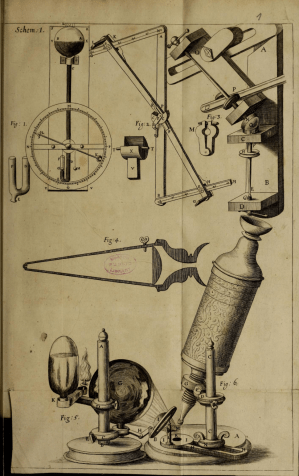
Initially he focussed on trying to clarify the way that plants were classified -this was of course well before Linnaeus set out what was to become the accepted system – and it was an immense task. But he quickly became, more interested in the way that plants were structured. At first his work was done from his observations just using the naked eye and a magnifying glass but from 1672 onwards he was able to capitalise on the huge technical improvements his colleague Robert Hooke had made to the microscope and which had led to the publishing of Micrographia.
Hooke was an excellent scientific artist and had been trained by court painter Peter Lely, but although Micrographia included many sophisticated and delicate engravings omade using the microscope it was Grew who first made full use of the instrument in botanical studies and his work would remain the most advanced in the field for about the next century.

Section of the trunk of a sumach first included in Anatomy of Trunks, 1673
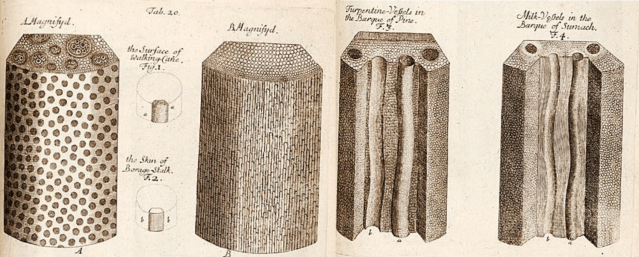
Using the power of the microscope he was able to study many features of plants that today we take for granted such as their cell-like structure and the growth rings in wood, but which were then groundbreaking discoveries. He began to present papers to the Royal Society initially about the roots, branches, and trunks of plants, and later about their leaves, flowers, fruit, and seeds. These were illustrated by extremely detailed engravings, using completely new techniques in the explanatory drawings such as transverse, radial, and tangential longitudinal sections to explain the structure of stems and roots.

Section of the trunk of a fig tree, first published in Anatomy of Trunks, 1673
His work clearly established that plants, like animals, had separate distinct parts which had specific functions. This effectively meant that he began to see plants as “living machines” and so he moved on to study the mechanics of how they functioned.
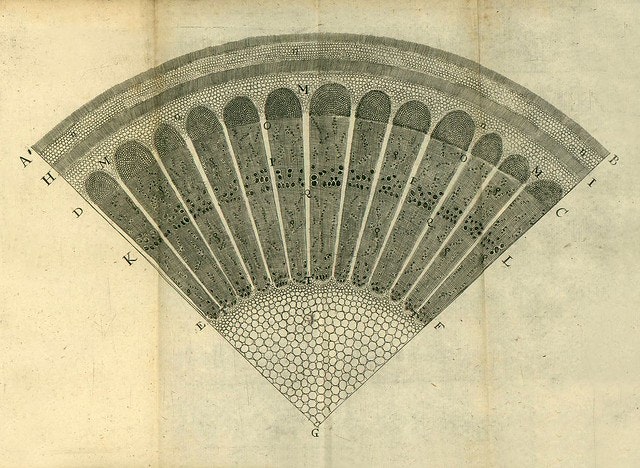
Section of the trunk of a Barberry first published in Anatomy of Trunks, 1673
His work led , in 1673, to the publication of his Idea of a Phytological History Propounded and then in 1675 A Comparative Anatomy of Trunks. This was dedicated to Charles II and because his use of the microscope open up previously unseen worlds he wrote ‘I may, without vanity, say .. it was my fortune, to be the first that ever gave a Map of the Country‘. In doing so he devised new words such as ‘radicle‘ for the embryonic root of a plant, ‘plume’ for what is now known as the plumule, or primary bud of a plant embryo and ‘parenchyma‘, a word adapted from its use in animal anatomy for unspecialised cells, just as we owe the word cell to Hooke’s analogy with the honeycomb.

Grew was also more than just a botanist. Science in the very late 17thc was on the verge of many breakthroughs and he was able to explore a whole range of other scientific projects. Running in parallel with his work on plants was his work investigating the therapeutic properties of what were generally known as the materia medica ie any substance used for healing. Three more papers followed: Discourse Concerning the Nature, Causes and Power of Mixture in 1675, his Experiments in concert of the luctation arising from the affusion of several menstruums upon all sorts of bodies in 1678, and much later a study of the spa at Epsom Tractatus de salis cathartici amari in aquis Ebeshamensibus, which led to the production of Epsom Salts. He also turned his attention to animals, particularly their intestines [!] and wrote the illustrated ‘Comparative anatomy of the stomach and guts‘. The Royal Society also published a number of other minor essays such as “The description of an . . .Hummingbird” and “Some observations touching the Nature of Snow.” and New Experiments and useful observations concerning sea water made Fresh.
All these early papers ensured he managed to get more permanent employment, because when Henry Oldenburg, the secretary of the Royal Society died in 1677, Grew was appointed joint secretary alongside Robert Hooke. He became responsible for correspondence and the editing of the society’s famous Philosophical Transactions. He was tasked too with cataloguing the society’s extensive collections of “natural and artificial rarities” and in 1681 published Musaeum Regalis Societatis. This was not a mere list of their holding but a reclassification accompanied by learned descriptions of the various items, together with high-quality illustrations paid for by subscription. 
 The following year 1682 most of Grew’s earlier papers were republished together in a single volume compendium The Anatomy of Plants which ensured his lasting reputation as a pioneer. In it he was now able to include 82 images, hand engraved on copper, many of them complex and detailed, and drawn using views from his use of the microscope, and printed on good quality paper. The sheer size and intricacy of the illustrations and depth of study by Grew remained unparalleled until the 19th century.
The first image in this post was a cross section of an apricot stone showing the seed [the white oval] in the early stages of development but it was preceded by another plate showing many more stages of the process, including several close-ups. No wonder he said in his dedication of the book to the king that “your Majesty will find that we are come ashore into a new world of whereof we see no end.”

 In addition to all the earlier investigations it tackled two areas of controversy in science at the time. The first was about the sap in plants. Did it move around? If so how? Did it circulate? What made it flow? Although he didn’t suggest it was exactly the same as the circulation of the blood as discovered by William Harvey half a century earlier, Grew was clear the movement of sap was “mechanical” and involved internal pressure which forced sap to ascend through the plant and helped the plant to grow. His work was to lead to others including Thomas Fairchild and Stephen Hale setting up experiments to prove that sap did indeed circulate like blood.
Unfortunately the language of 17thc science is difficult to follow, even with the explanatory diagrams Grew included so if you want to know more of the detail then there’s an excellent recent article Plants and laboratories: the ascent of sap between physics and vegetal physiology by Fabrizio Baldassarri, in Notes and Records: the Royal Society Journal of the History of Science, [December 2023] which will probably tell you more than you ever thought you needed to know!
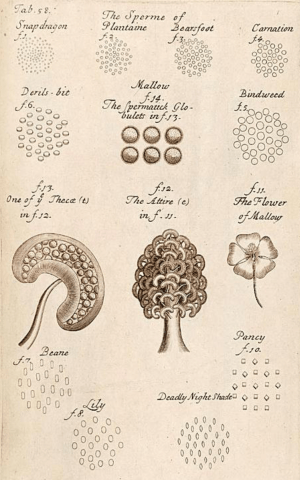 Another breakthrough came following Grew’s discussions with the royal physician Thomas Millington. Both men had begun to suspect that plants reproduced sexually. They then surmised that a plant’s stamens were male, producing pollen, which they then guessed was the fertilizing agent, and Grew went on to identify a flowers pistils as the female part.
He then became the first to seriously investigate pollen, discovering through using the microscope that while all pollen grains are roughly globular, the size and shape of the grains varies greatly between different families of plants, for any one species the grains are similar. Grew’s findings gave Thomas Fairchild, the knowledge to make the first known deliberate hybridisation of a plant.

Grew’s scientific works became well-known and so impressed Linnaeus that he named a genus of tropical and subtropical trees and shrubs Grewia in his honour, although of course Grew is unlikely ever to have seen any of them!

A few Grewia images from a Google search
Gradually Grew’s links with the Royal Society loosened a little and he showed his curiosity about a whole range of subjects other than botanical science. He wrote an ambitious theological text – Cosmologia Sacra (1701), – dedicated to proving the existence of God, and “the Truth and Excellency of the Bible” for which he taught himself Hebrew. It enabled him to reconcile his strong religious beliefs with his rigorous pursuit of scientific truth by seeing God as a divine engineer and nature the result of his industry.
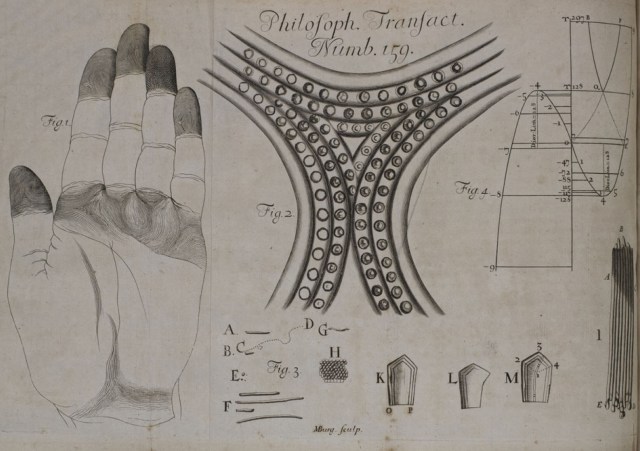
 He was also interested in what is technically called dactyloscopy – and was a pioneer in the study of the ridges, furrows, and pores on hands and feet, publishing the first accurate drawings of finger ridge patterns in 1684. Not quite fingerprints as we’d understand it but pretty close.
Sadly, until very recently, Nehemiah Grew has been largely overshadowed by his more famous scientific contemporaries like Robert Hooke, but as you can see from the references below there has been a recent resurgent interest in his ideas and significance in the history of botany and science more widely.
Long may that continue!


 The Garden History Blog
You must be logged in to post a comment.