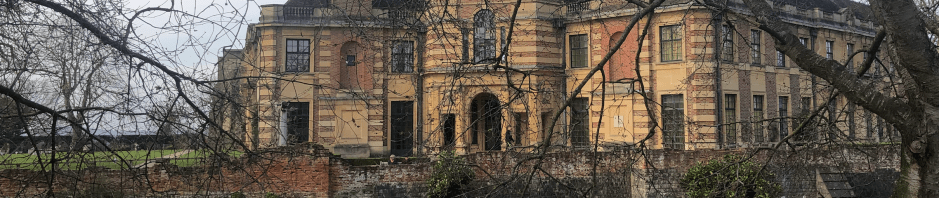

Easter is a difficult time for bloggers, especially if you’re not someone of faith, so having looked at Easter lilies, Easter eggs, even bunnies I was running out of obvious things to cover. Of course the central theme of the Christian festival is resurrection so I hope no-one will be offended if I take that for my theme in a more secular sense.
I took a party of my research students to Eltham Palace recently and at first I thought I’d do a piece about how, like so many other historic sites Eltham is always on the lookout for ways of making money and bringing in a new audience and how Easter is a good time to do that with Easter egg trails etc, even though it often impacts badly on the site.

Then I had a brainwave, and it wasn’t to do with these Easter events but instead it was about the resurrection of this former mediaeval royal palace and its gardens, not once but twice in less than a hundred years.

Postcard from a private collection, showing the approach to the palace c1900
Let’s start with a brief history of the site. Inhabited since before the Norman Conquest Eltham first really appears in the records when Anthony Bek “most elaborately built the manor of Eltham” and enclosed land for a hunting park. This was more than just another manor for just another 11thc bigwig. Eltham had extremely high status because Bek was not only Bishop of Durham but a leading advisor to Edward I and had travelled widely across Europe on diplomatic missions, as well as taking part in the Crusades and wars with Scotland. He was immensely wealthy, and was even named Patriarch of Jerusalem by the Pope, making him nominally at least the senior cleric in the country. His Eltham stood on a walled and moated site, and archaeology in the 1970s revealed the remains of some his buildings including the site of a tiled great hall. Even today there are tiny fragments of Bek’s work still visible.

Eltham as it may have looked in the early 14th century, when it belonged to Bishop Bek © Historic England (illustration by Peter Urmston)

John of Eltham, Earl of Cornwall (1316-1336) from the Genealogical roll of the kings of England – British Library Royal MS 14 B VI
On Bek’s death in 1311 Eltham passed to the crown and was given to Queen Isabella, wife of Edward II. The palace has since often mistakenly been known as King John’s Palace after Edward and Isabella’s second son who was born at Eltham in 1316. That was the start 0f a long association with the crown. Christopher Hussey, writing in Country Life in 1937 said no palace was more closely associated with the last Plantagenets, the Lancastrians and the Yorkists.” This may well have been because of its position on a rise high above the Thames with breathtaking views from the royal apartments towards London.
The accounts of the Kings Works [the records of royal building works etc] and the Exchequer show not only that their was continual maintenance and improvements but that garden was constantly tended, with a modest income received from the sale of surplus produce. They show too that in 1355 Edward III ordered the digging of a ditch in the grounds about 200m long with the spoil being used for a rampart walk, while in the 1360s they record payments for enclosing more land for hunting with ditches and newly planted hedge. Twenty years later Richard II had a new garden laid out which was turfed and had shady vine-covered walks, to the south of the moat. Amazingly we even have the names of the royal gardeners at this time: William Gascoigne, who was paid 3d. a day from 1384 to 1388 followed by the appropriately named John Gardyner.

Postcard of Edward IV’s Great Hall c1900 from a private collection
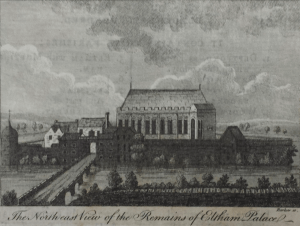
In 1450 Bek’s great hall was hit by lightening and partially destroyed and this was an opportunity to rebuild on an even grander scale. The royal accounts show that 51 masons and 48 carpenters were employed in the 1470s on constructing the present Great Hall for Edward IV, making it the third largest in the country, smaller only than Westminster Hall and Christ Church Oxford.
By this point Eltham had grown and grown and had become one of the larger royal residences, able to accommodate the entire royal court, which often extended to more than 800 people. The parkland too had been considerably extended and now enclosed some 540ha [1300 acres]

However, Henry VII rebuilt the palace at Greenwich between 1500 and 1505 and it quickly became a popular alternative to Eltham, leaving the older estate to become the childhood home of his younger children including Henry VIII.
When he became king in 1509 Henry VIII continued to use it as a favourite haunt. According to the Exchequer accounts he “commanded to make an Ally to walke in, of xvi fote wide from the end of our drawbridge on the Southsyde, along the South syde of our moat Eastwarde … unto our garden Gate there.” But it was not just a new walk. It was to be completely private “with banks on every syde of the same Aley set with quaky-sette of Thornes” and if that wasn’t enough it was to have “a substantial pale.. framyd and with sawen bored, and nailed, of such height that when wee goo oute of our lodgings that waye to our Gardeyn we may goo secretely.” There was another thickly hedged arbour south of the moat too, as well as a bowling green and archery butts, with shade provided by fruit trees.
Despite all this elaborate work and expense Eltham began to lose favour as a royal residence, partly because of the convenience of reaching Greenwich from London by river but also because of Henry’s acquisition of Hampton Court from Cardinal Wolsey. It was not much used by Mary or Elizabeth either as both also preferred Greenwich.

John Thorpe surveyed the palace for the crown in 1590 and again in 1604, and showed it was far bigger than Hampton Court – about 1000ft x 500ft [305m x 152m]. However the buildings were “farre in decay” and substantial repairs had to be undertaken, but from then on the royal family scarcely visited, and the Civil War finished its decline.

As with other royal parks and palaces Eltham was surveyed by Parliamentary commissioners who reported it “much out of repaire and soe not tenantable”. Valued at £2574 for its building materials, it was sold in 1651 to Colonel Nathaniel Rich who proceeded to demolish large sections and sell the trees in the park for naval timber, so that when John Evelyn visited in 22 April 1656: “both the palace and chapel [were] in miserable ruins, the noble wood and park destroyed by Rich the rebel“.
At the Restoration with no money to restore it and little interest anyway Charles II granted a lease to Sir John Shaw who had loaned him money during his exile. Shaw found the old palace largely derelict and abandoned it, commissioning Hugh May to build him a new house known as Eltham Lodge nearby on the estate.
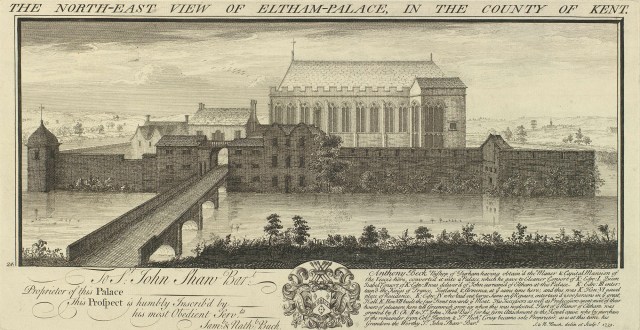
The North-East View of Eltham-Palace in the County of Kent after a drawing of 1735 by Samuel Buck
Royal Collection Trust / © His Majesty King Charles III 2024
By the late 18thc attitudes to mediaeval ruins were changing and Eltham became one of the archetypal romantic ruins. It began to be visited by tourists and the Great Hall can be seen with its windows blocked-up in paintings by Sandby, Turner and Girtin.


This was almost its complete undoing because when Sir Jeffrey Wyattville was commissioned carry out substantial remodelling of Windsor Castle in 1827 one suggestion was that the ornate timber roof of Eltham’s Great Hall be taken down and re-used as the roof of Windsor’s new St George’s Hall . This proved too expensive an operation so demolition was in prospect. However the farmer who used the hall as his barn was annoyed saying it would expose his grain and machinery to weather damage while also recording his appreciation of “this most beautiful specimen of Gothic Architecture.”
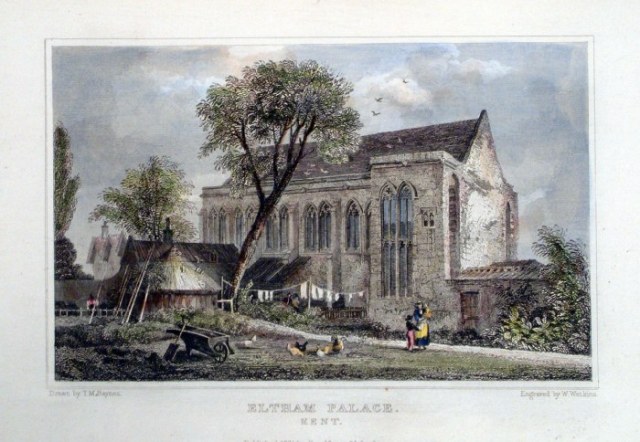
The proposal to demolish started a dramatic revival of interest in Eltham and its history and it became an early example of the heritage conservation movement. In 1828 it became the subject of a new book An Historical and Descriptive Account of the Royal Palace at Eltham, by J. C. Buckler, while a separate Collection of plates and plans of the Great Hall was also published that year.

In the House of Lords the Marquess of Lansdowne called for its restoration and despite the Prime Minister, the Duke of Wellington, asking what real use the hall could possibly have if restored, the decision was made to call in Robert Smirke to carry out repair work for the Office of Works at the extortionate cost of £6000. The Duke was right [at least initially] and after the repairs the hall returned to agricultural use although later it also served as a coach house, a drill hall, the site of flower shows and village fetes and even a tennis court.
The story of the campaign was recorded 150 years later in Country Life, May 26th 1977.

By this point the palace grounds were filling up. The Moat House had been built by the entrance bridge, and it was joined in 1859 by another house, Eltham Court, right next to the Great Hall with gardens and glasshouses around it, as well as in the moat.

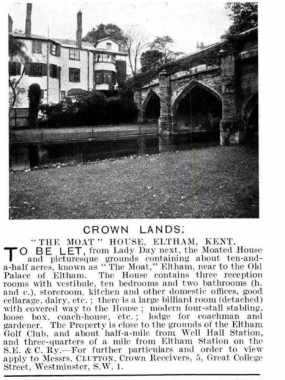
from Country Life, 8th Jan 1921
At the end of the 19thc century Shaw’s descendants surrendered the lease and both houses, together with the outbuildings and palace ruins reverted to the Crown, who tried unsuccessfully to let them on another long lease. That’s probably not surprising as essential repairs still needed to be regularly carried out.
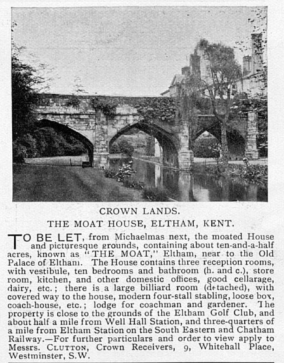
from Country Life, 24th June 1905
The Great Hall featured in Country Life in April 1906 after the latest repairs, and the house and estate were frequently advertised there too, but it wasn’t until 1933 that Stephen and Virginia Courtauld took a 99 year lease and the site’s first resurrection began. That led to another article announcing the news in Country Life in November 1933.

The Moat House, postcard from a private collection c.1900
Stephen Courtauld was a scion of the textile dynasty which controlled the world’s leading man-made fibre company. He had a distinguished war record, was a keen mountaineer and explorer and also one of the founders of Ealing Film Studios. He had married Countess Virginia Spinola (née Peirano) in 1923 and they were looking to move from their home in Grosvenor Square. He told a friend “I want to be within easy reach of the London theatres and concert halls, and at the same time have enough space to make an outstanding garden.” When he and Virginia saw Eltham they realised its potential.
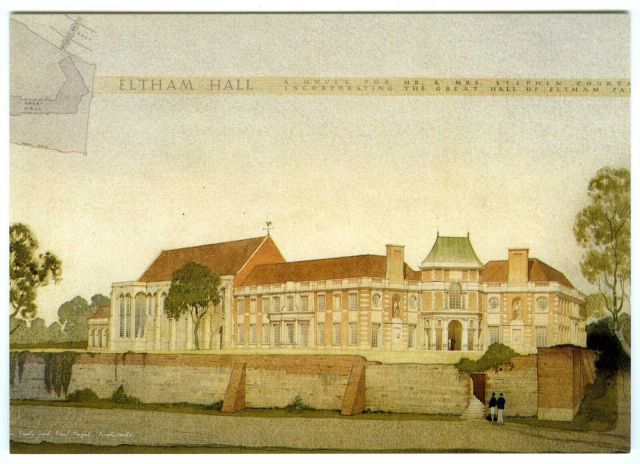
English Heritage postcard of Seely & Paget’s design, private collection

The Times 24th Feb 1934
They were introduced to John Seely (later Lord Mottistone] and his partner Paul Paget, who ran a fairly new but high-end architectural practice, and quickly commissioned them to demolish most of the the rag-tag collection of buildings and design a modern home which would incorporate and complement the surviving Great Hall.
Today it’s almost impossible to imagine they’d be allowed to do anything like it, and even then there was controversy about adding something so utterly contemporary to such an ancient site.
However, Seely and Page were extremely careful to choose sympathetic materials and a quietly conservative style and eventually their plans for a large house with a then fashionable ‘butterfly’ plan were approved.

As part of the process they worked the former Inspector of Ancient Monuments to carefully restore and enhance the Great Hall carefully linking it to the new house. They also incorporated three Tudor gables with their oriel windows, adding new stained glass by George Kruger Gray. The gables can still be seen from the entrance court and from inside.
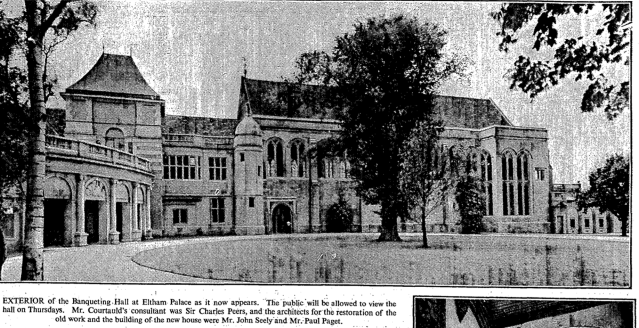
From the Times article announcing the completion of the restoration work 21st July 1936
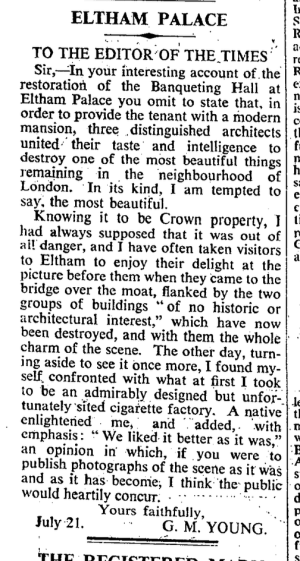
The Times 23rd July 1936
When the house was completed in 1936 it was greeted with dismay by some, notably the historian George Young who complained in a letter to The Times that the architects had “united their talents and intelligence to destroy one of the most beautiful things remaining in the neighbourhood of London” and that when he first saw it he found himself “confronted with what at first I took to be an admirably designed but unfortunately sited cigarette factory.” Others including the eminent architect Herbert Baker backed him.
I think few today, even the strictest of conservationists, would agree, with Eltham now being regarded as an outstanding example of the best of 1930s design both inside and out.
However maybe we should leave the last word on this with John Seerly himself who wittily responded …
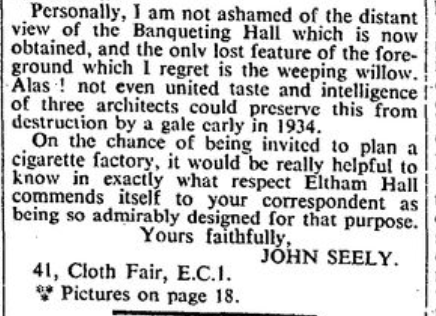
from The Times 25th July 1936
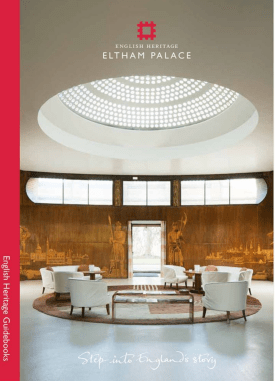
The light-filled entrance on the cover of the English Heritage guidebook
The interiors are largely by Seely and Page too, although a couple of rooms were done in a streamlined art deco style by the Marchese Peter Malacrida an Italian socialite/designer friend of Virginia, and a couple of others were simply transferred from their house in Grosvenor Square. Gillian Mawrey in her account of it thinks the whole ensemble has a “Hollywood atmosphere” perhaps because of Stephen’s association with Ealing film studios.

from The Sphere July 1933, courtesy of British Newspaper Archives
Yet while the interiors were bold and contemporary the outside of the house and the gardens were anything but. When they bought Eltham there were several small gardens, often running “romantically” wild, with greenhouses and other outbuildings in the moat and it must have been difficult to decide what to do.
The Courtaulds began by asking Thomas Mawson’s son and successor, Andrew, to come up with some ideas, but although his plans went on display at the 1935 Chelsea Flower Show they were not convinced. Next Seely and Paget suggested alterations, but then they asked garden-owning friends for their ideas. These probably included Christopher Hussey who was to write three articles on Eltham for Country Life in 1937, John Gilmour who was Assistant Director at Kew, and Ruth Hanbury, whose family owned La Mortola in Italy and had links with Wisley and the RHS.

In the end the decision was almost total clearance although some mature trees and shrubs survived the cull. The resurrection had begun but as Hussey admitted it wasn’t a popular decision as Eltham lost its picturesque romantic quality overnight. But sometimes, as the late great John Sales was always reminding me, hard things sometimes have to be done.
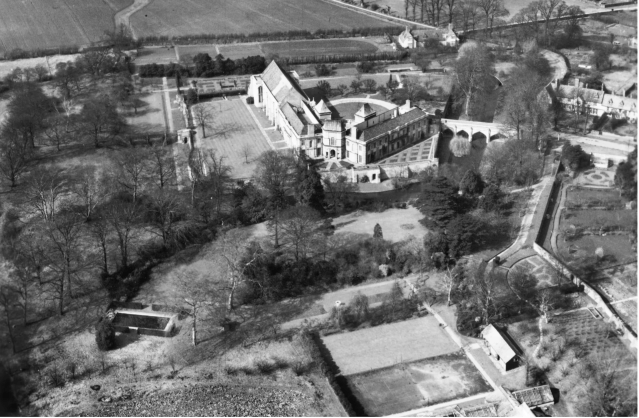
The new gardens were finally laid out by nurserymen JAE Blackman of Plumpton, assisted by the Courtaulds’ gardener, John Meads, in what Gillian Mawrey called “a charming if rather conventional formal style, which in no way reflected the extraordinary interior.” She’s right but they do complement the house and add up to more than the sum of their parts.

After all their devotion and hard work the Courtaulds only stayed at Eltham a few years. When war broke out the most valuable items were moved elsewhere, and the staff was reduced from 15 to 2. The palace was hit by incendiary bombs in 1940 and the Great Hall damaged but the Courtaulds stayed on until 1944 when they moved first to Sunningdale and then to Scotland and, in 1951 giving up on the idea of returning to Eltham, to what was then Rhodesia. Stephen died there in 1967 and Virginia remained for a few more years before moving to Jersey where she died in 1972.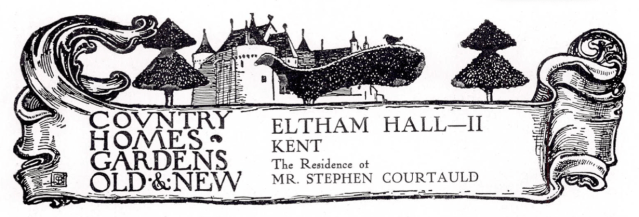
Next week I’ll look at the Courtauld-designed gardens and Eltham’s second resurrection
There will be a full list of other Eltham-related references next week but for more information on the mediaeval period see History of the King’s Works. v. 1 & 2, The Middle Ages (1977); John Charlton, ‘Eltham Palace’, Transactions of the Ancient Monuments Society, 31, (1987); A. Emery, ‘Eltham Palace’, Archaeol Cantiana, 74. Vol 74, (1960); Humphry Woods, ‘Excavations at Eltham Palace, 1975-9’, London and Middlesex Archaeological Society, 33, (1982)
You might also like to know that there is shortly to be a conference about the work of John Seely and Paul Paget, the architects of the Courtauld mansion:
Seely and Paget in the 21st Century: Restoration and Reputation
One day conference, 1st May, 10-4.30, The Charterhouse, London. For more information and to book a place visit: https://www.sahgb.org.uk/whatson/1may2024seelyandpagettconference


 The Garden History Blog

You must be logged in to post a comment.