
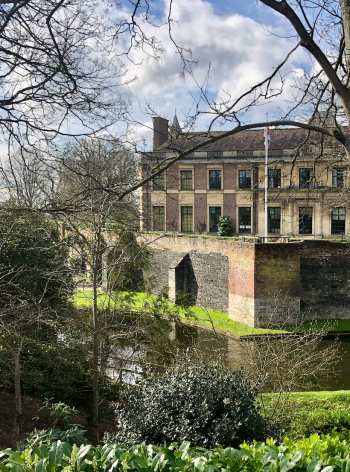
 Last week I explored the history of the former royal palace of Eltham, one of the favourite residences of medieval monarchs which was later almost abandoned and fell into decline before being rediscovered, redesigned and revitalised in the 1930s by Stephen and Virginia Courtauld.
Today’s post is going to look at its history after the Courtaulds left in 1944, and in particular how the gardens have been given a new lease of life – dare I say – a second resurrection – over the last 30 years under the guardianship of English Heritage.

As usual the photos are mine unless otherwise acknowledged

The Sphere – Saturday 11 October 1947
Image © Illustrated London News Group. courtesy of THE BRITISH LIBRARY BOARD.
At the end of the Second World War Stephen and Virginia Courtauld decided not to return to Eltham and instead handed the lease back to the crown. Their only request was that the site be used for educational purposes.
The result was that the Army moved their various educational units here. These eventually became the Royal Army Educational Corps and they took charge of the palace and its grounds, using it as their HQ.

Illustrated London News – Saturday 06 July 1946
Initially, staff worked in the palace, but in the 1960s a new office block was built on the south side of the gardens. The palace itself was used for conferences and entertaining – continuing something of the party spirit that had prevailed when the Courtaulds were in residence.
For more on the army at Eltham see this English Heritage webpage.

The Sphere – Saturday 22 March 1952
Image © Illustrated London News Group. Image courtesy of THE BRITISH LIBRARY BOARD

The Sphere – Saturday 23 July 1955
Image © Illustrated London News Group. Image courtesy of THE BRITISH LIBRARY BOARD
Although many places have suffered badly when left in military hands Eltham was reasonably well looked after until the Army moved out in 1992. Perhaps the main reason for that is that in 1978 the officer in charge Colonel Colin Kirby, persuaded the Royal Parks to place their training school for apprentice gardeners at Eltham, which meant the gardens were always well cared for. Even so there was still a lot of work to be done by English Heritage when they assumed responsibility for the entire site in 1995.
In the past, indeed right up until 1970s much greater emphasis was placed on researching and presenting the earliest phases of a site’s development. In deciding to concentrate on restoring both the Great Hall and the 1930s mansion and grounds to their Courtauld heyday English Heritage marked a shift in public attitudes to conservation generally and towards this period of design in particular, especially as even then there was a limited budget to carry out the extensive work required.
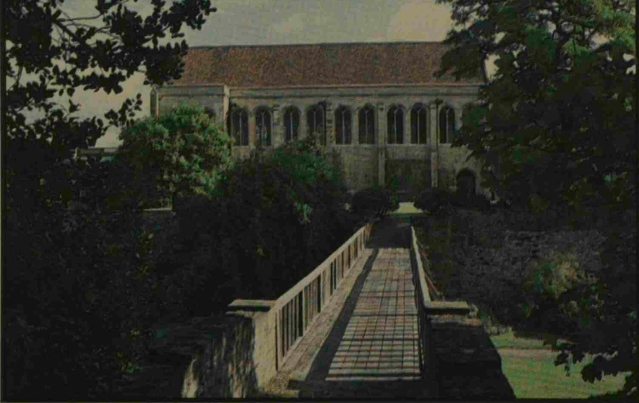
Illustrated London News – Monday 01 October 1979
Image © Illustrated London News Group. Image courtesy of THE BRITISH LIBRARY BOARD
It was a challenge but they had several major sources of information – the three articles from 1937 in Country Life, an inventory taken in 1939, Courtauld family papers and the archive of the architects Seely and Paget. In the end the work including copies of furniture and furnishings cost just over £2million and its success was celebrated by an article in Country Life by Alan Powers, with another by Jeremy Musson following once the palace opened to the public. As Musson said: “it seems unthinkable that any organisation would have embarked on anything so unusual 20 years ago. It is surely the result of the confidence of the 1990s: the great post-fire constructions of Uppark, Sussex, and Hampton Court have shown what modern craftsmen can do.”

my photo March 2024
Since then there has been a lot of coverage of the interiors of the house but the gardens are hardly mentioned anywhere. Yet they are following suit, equally successfully, albeit at a slower pace and were a gold medal winner in the London in Bloom Awards in 2017.
Most of the interior restoration is now complete, with copies of furniture and furnishings in place and looking as if the Courtaulds had just gone out for a swim or to stroll around the moat! 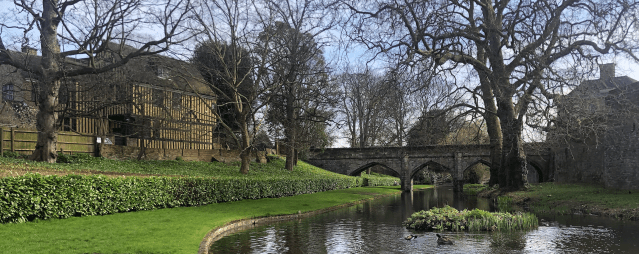
 Lets a take a tour, the outer or green courtyard of the palace complex is now almost all gone, with just the half-timbered Lord Chancellors Lodgings left while a road and housing has taken over the rest. However the entry from the former green court to the palace itself remains the same: a stone bridge rebuilt for Edward IV at the same time as the Great Hall. Looking over the side of the the bridge there are two arches, one blind and one open which are all that remain of the palace’s inner gatehouse.
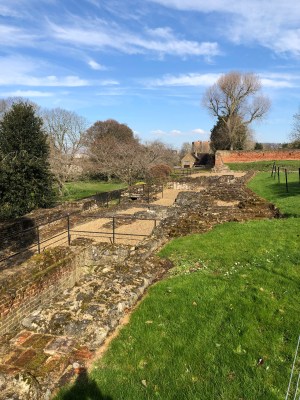
Part of the foundations of the royal apartments
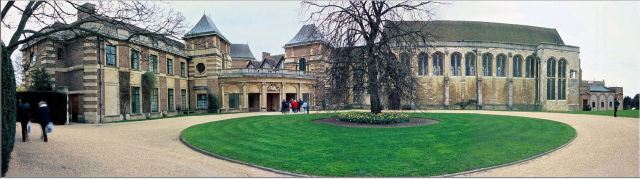
Reaching the end of the bridge the visitors arrives in a spacious open courtyard, with a turning circle and circular lawn dominated by a large lime tree. Underneath this are the remains of parts of the mediaeval palace, which was excavated in the late 1970s and then reburied. On the left is the entrance to the new house, directly in front the Great Hall with the Courtauld’s squash court tacked onto the far end.
To the right, and not in the image above, are the ground level remains of more medieval and Tudor buildings, notably the royal apartments which had extensive views westwards towards London. Beyond them were the palace’s kitchen gardens.

The view of London over the remains of the royal apartments and the rose garden – the Shard can be seen centre right, with the city on the far right.
The view is now somewhat more problematic from a conservation standpoint since a huge new development of high-rise flats in nearby Kidbrooke rather spoiling the otherwise rural aspect. Boundary hedges would have to be quite high, and probably be out of scale, in order to conceal them.

Further round the perimeter of the palace site the view towards changes. The orangery with its large windows is on the right.
 The foundations of the royal apartments continue almost the whole way along the western side of the site, but in the 1930s they had not been excavated, and on the site was the Linear Garden, which had to be removed when the archaeology took place. Luckily the Courtaualds took photos.
On the opposite side of the path is the squash court designed by Seely and Paget which they added to the blank end wall of the Great Hall. On its outside wall is a large bronze statue of St George by Alfred Harden made in about 1930 and bought from the Courtaulds’ previous London home. 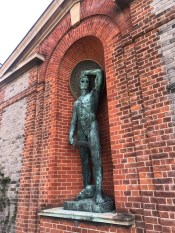
Going round past the squash court and the adjacent orangery where Stephen Courtauld kept his orchid collection, the visitor arrives at the South Lawn which has several large specimen trees. Now very open in aspect this was the site of more mediaeval buildings the remains of which are just under the surface. This means that management of the area, such as removing a dead tree or extending borders is complicated because of the archaeological potential.


Walking along the South Lawn one can see how sympathetically Seely and Paget joined the old and new. There is no strident changes of materials, or scale, with the new set back slightly to allow precedence to the mediaeval hall.
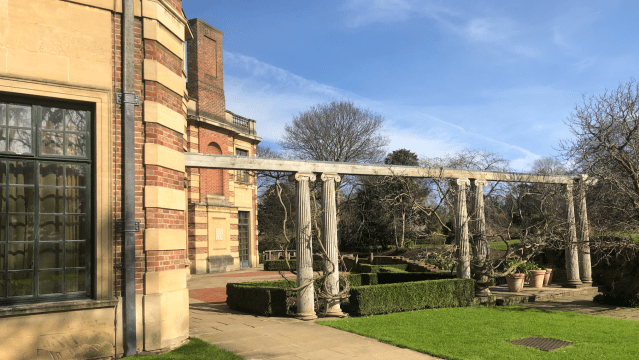
At the far end of the South lawn and at the corner of the new house is an unusually shaped area, between the building and the step drop into the moated area. It was deftly handled by Seely and Paget who added a pergola largely made up of some salvaged columns from John Soane’s Bank of England building which was being demolished by Herbert Baker. [That’s somewhat ironic given that, as I explained last week Baker was a strong critic of the demolition by the Courtaulds of Eltham’s 19thc buildings when they built their new house.]
 From here there are views over the moat to the rock garden on the other side and the extensive grounds beyond. A small geometrically designed triangle of garden fills the space beyond, while a set of steps has been cut into the supporting wall and leads down directly to the lower level of the garden.
Although Eltham sits on quite a high rise, 200 feet above the Thames, the palace was moated. The Courtaulds restored the water to the north and east but left the south and west sides dry. In 1937 Christopher Hussey described the gardens in the south and west moats as “a delightful feature… old trees and wall shrubs have been carefully preserved and the new section planted with taste and skill. The result as a whole is one of the most remarkable instances of the rehabilitation of an ancient site in a decade that includes those of Herstmonceux, Dartington and Leeds Castle.”
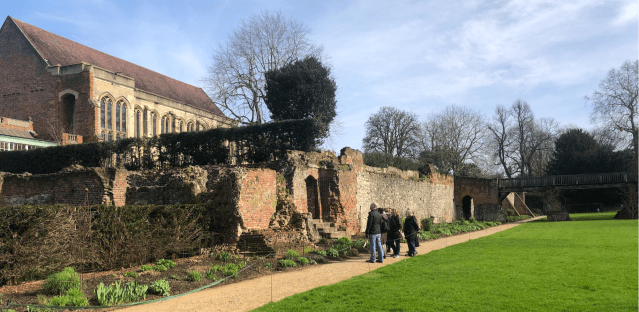
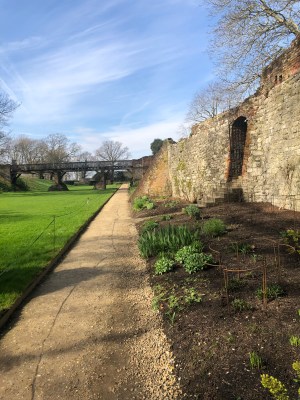
In the south moat now, and running at the foot of the largely mediaeval wall that supports the South Lawn is a 100m long herbaceous border designed, following a competition, by Isabelle van Groeningen in 2000 as one of a series of new millennium gardens sponsored by English Heritage at several of their sites.
Amongst many other things it contains 21 different kinds of peonies, 20 sorts of clematis and 18 different varieties of oriental poppies. It runs under the restored wooden footbridge with its 16thc brick piers, from the south lawn to the meadow on the other side of the moat that was the main entry to the mediaeval and Tudor gardens.

Turning the corner into the western moat the visitor reaches the sunken rose garden laid out for the Courtaulds. Its current design is a little less complex than the original but adheres to the same principles. It is centred around a rectangular lily pond with geometric beds containing historic rose varieties including many hybrid musk and hybrid tea roses. This obviously causes some problems since the many of original varieties are difficult to obtain these days and often suffer from all sorts of diseases. However rather than switch to modern “David Austin” varieties English Heritage have chosen to keep as close as possible to the original sorts even if they sometimes have had to use more resistant modern varieties.

One side of one of the garden rooms with a display of Stachyurus, one of the finest early spring flowering small trees/large shrubs
Beyond the rose garden are a series of smaller garden “rooms” heavily planted with trees and shrubs, which have needed some drastic treatment to bring back into order but which were looking good in early March. Trees where might once have been kept clipped and within boundaries have obviously grown out of their allotted space, and while beautiful in their own right make restoration to the Courtauld’s design more difficult to achieve. 
They end with another pool and beyond that the water-filled moat begins. This is a difficult area to manage because the surrounding ground is constantly damp and the grass worn away by the constant tread of visitors.

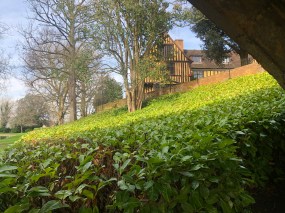 On the bank leading up to the former outer court there is extremely densely planting of laurel leading to the security fencing around the boundary. This was seen as a partial solution to prevent intruders, after a spate of vandalism and an IRA bomb in 1990.

After strolling under the entrance bridge and the willow tree on its artificial island in the moat, the path goes up the steep slope via irregular steps to look down at the eastern moat. This was lined with concrete by the Courtaulds so they could have it water filled again, and on the steep bank they constructed a rock garden. These were extremely fashionable in the 1930s and this one is large and well constructed with water worn limestone. Surprisingly a couple of their original trees survive and English Heritage are carefully replanting to match what is known of the rest of the plants, although they have not yet been able to restore the cascade, or replace the black and white swans Mrs Courtauld introduced.
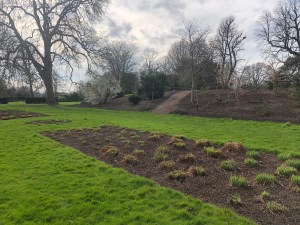
The Japanese iris garden, with the site of the swimming pool on the far left inside the yew hedge.
Equally interesting although though not so well defined are the areas outside the moat on the eastern and southern sides.
A garden featuring nothing but Japanese iris has been replanted, while the site of the swimming pool is being thought about. Unfortunately the pool was filled in by the army, and probably had the base broken up so there’s no chance of it being restored even if it were to be acceptable on health and safety grounds.
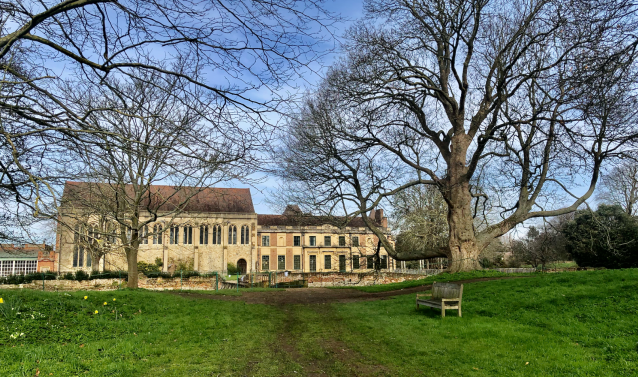
Looking back over the moat from the southern meadow
 There are plantings of cherries and then further round on the south side many mature trees and meadowland, beyond which are fields also part of the estate but currently let.
Finally some of the former productive areas of the estate, glasshouses, gardeners bothies etc have been successfully repurposed as the new main entrance cafe and children’s playground. Often these are intrusions but luckily Eltham is big enough for them to be incorporated without impacting much on the historic core of the site, so all in all English Heritage should be warmly congratulated on giving Eltham a second and one hopes more permanent resurrection.

For more information: the best place to start is the English Heritage webpages for Eltham, which include an extensive list of sources and further reading.
You might also like to know that there is shortly to be a conference about the work of John Seely and Paul Paget, the architects of the Courtauld mansion:
Seely and Paget in the 21st Century: Restoration and Reputation
One day conference, 1st May, 10-4.30, The Charterhouse, London. For more information and to book a place visit: https://www.sahgb.org.uk/whatson/1may2024seelyandpagettconference


 The Garden History Blog

You must be logged in to post a comment.