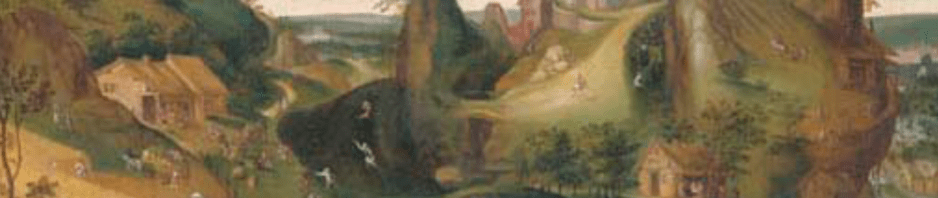
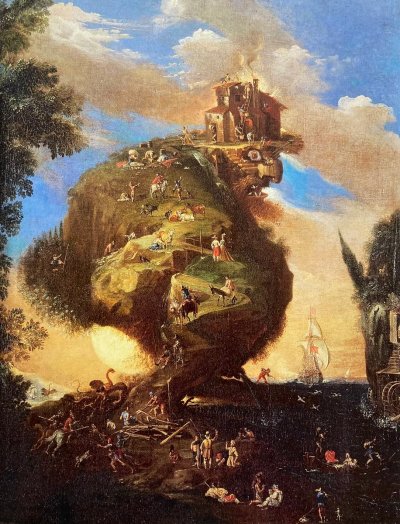
Last week’s Funny Faces were not the only hybrid art form that evolved in the late 16th and early 17th centuries. Landscape painting was developing too, especially in the Netherlands and artists, such as Arcimboldo whose work I looked at last week didn’t just do “composite heads” they also played around with landscape and architecture literally giving them human faces and sometimes bodies too [even if the one on the right looks a bit more like a chicken].
If that sounds a bit crazy it probably is, but it was great fun and the blame for the whole idea may well lie with an architect who wanted to flatter Alexander the Great…

The great Roman architect Vitruvius is famous for his Ten Books of Architecture which was rediscovered and republished during the Renaissance and had a huge influence on not just building design and gardens but for bringing to life many other aspects of the classical world. In Book 2, he tells the story of Alexander the Great meeting Dinocrates, a Macedonian architect. Dinocrates flatters Alexander telling him he has “ideas and designs worthy of thy renown” and that he had “made a design for the shaping of Mount Athos. into the statue of a man” meaning, of course, Alexander himself. In “his left hand I have represented a very spacious fortified city, and in his right a bowl to receive the water of all the streams which are in that mountain, so that it may pour from the bowl into the sea.” Unfortunately he gave no clue as to how this was to be done!

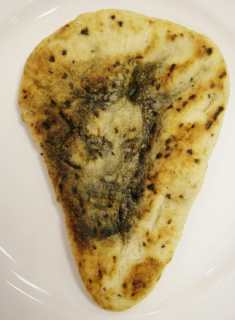
You might imagine the result would have been a massive piece of land art, like Northumberlandia where the land really has been sculpted to create a human form. Certainly we know ancient civilisations were capable of such large scale engineering but it’s also possible that the whole idea was meant to be illusory – a feat of the imagination, because humans have always been able and willing to trick their own senses and to see shapes in natural forms like clouds, rocks and even plants or food – think of the images like these, so perhaps we shouldn’t be too surprised that this idea really took hold in the Renaissance. The technical term for this is anthropomorphic

In 1464 the Italian architect and mathematician Leon Battista Alberti begins his book on sculpture, De Statua, with the thought that artists “occasionally observed in a tree-trunk or clod of earth and other similar inanimate objects certain outlines … something very similar to the real faces of Nature” which “by correcting and refining the lines and surfaces” they turned into likenesses.
Not much later Leonardo wrote in his journals about where he looked for inspiration: “If you have to invent some scenes you will be able to see in them a resemblance to various landscapes adorned with mountains, rivers, rocks, trees, plains, wide valleys and hills. You will also be able to see …an infinite number of things which you can then reduce into separate, well-conceived forms.”
And invent them Renaissance artists certainly did.

One early example, is Dürer’s sketch of the castle at Arco from 1495. Some see the whole hill as a giant head, but even if that isn’t obvious [and it isn’t to me] there’s a definite human profile on the left hand rock face.
But perhaps the artist who took this furthest in the early Renaissance was Herri met de Bles [c1500- c. 1555]. Not a name that was familiar to me but once I started researching I discovered that he seemed to insert human faces or even figures into landscape forms quite regularly. One art historian reckons at least twenty of his surviving paintings include anthropomorphic elements.

Not all show human features. In The Calling of St Peter the scene is dominated by an eagle’s head protruding from the rock face- did de Bles paint what he saw or is this an invented meant to capture the viewer’s attention? Or is it perhaps entirely symbolic because the story of St Peter is told in St John’s gospel, and St John’s emblem is an eagle?

Another religious link can be seen in The Way to Calvary. Erasmus, the humanist theologian, wrote about the similarities between Christ and Silenus one of the satyrs and a companion of Dionysus, the Greek god of wine. Not a very likely analogy you might think but Silenus was usually the subject of mocking laughter for his grotesque snub-nosed exterior. However, like Christ, he was capable of seeing the true nature of those he met, regardless of their status or wealth. Erasmus’s work helped Silenus to a prominent position in literature and art for the next century. In the painting Christ is almost invisibly small but the giant rock, shaped like Silenus, looms over the whole scene, with the procession going around his neck almost like a ruff.
If you’re interested in knowing more about art historical/religious background to these last two paintings, see Michel Weemans, “Herri met de Bles’s Sleeping Peddler: An Exegetical and Anthropomorphic Landscape” in Art Bulletin, 2014, 88 (3)
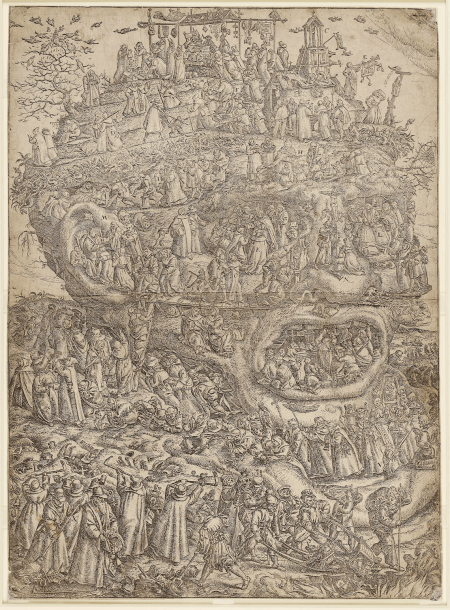
A more satirical take on religion can be seen in the giant rock/head devised by Marcus Gheeraerts the Elder, a Flemish artist from Bruges.
He was a Calvinist and the composite head is that of a monk transformed into a craggy outcrop with a tonsure of hedges , and covered with a myriad of little figures all of whom are engaged in various scenes of iconoclasm.
The print is a condemnation of Catholic idolatry in all its forms and shows the Calvinists as cleansing the world of this perceived evil.
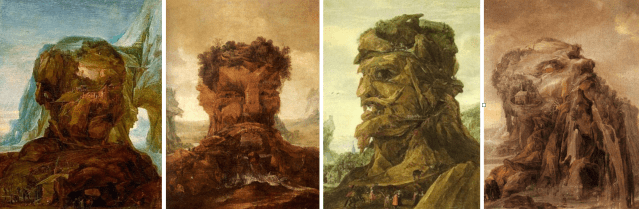
It’s difficult to determine the exact chronology, or sometimes even authorship, of the next few examples. Not all artists signed their work and very few dated them so I may well be showing them out of sequential time, although I don’t think that matters unduly as they are all roughly contemporaneous in the first part of the 17thc. Herri’s monstrous rocky Silenus is matched by a series of four bizarre paintings representing the Four Seasons by his compatriot Joos de Momper who died in 1635.

 Around the same time the Frankfurt-based cartographer, engraver and publisher Matthias Merian tried a slightly different approach. He painted several versions of this much more obvious human faced landscape.
In the detail of the topography there are lots of minuscule humans working the land seemingly ignorant they are cultivating on a giant! These figures are a feature which can be seen in many other later versions of this humanised landscape such as this one by Merian’s apprentice, Wenceslaus Hollar.
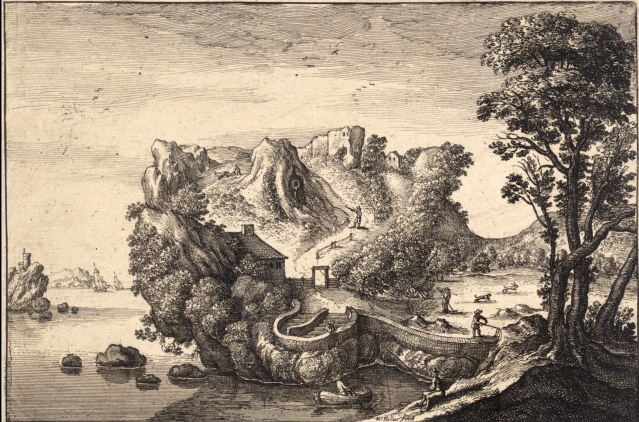
Hollar was Bohemian but who spent much of his life working in London, and his engraving [thus reversed from the original painting] is a much more sophisticated and better groomed version of Merian’s landscape. The head is literally a head of land jutting into the sea, with trees for hair, a beard and moustache and an ear made of a staircase! [There are two noticeably different states of this print which you can find in Toronto University Hollar Collection]
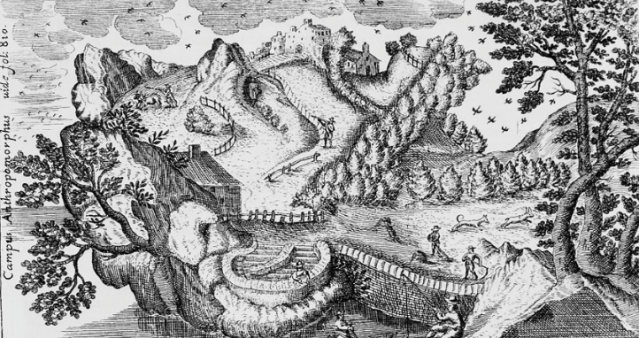
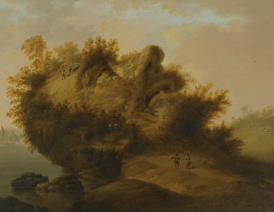
But Merian’s example was also the inspiration for an illustration that appeared in Ars magna lucis et umbrae (1645/6) a book by the Jesuit polymath Athanasius Kircher who long-standing readers of the blog might remember from an earlier equally quirky post.

Others joined in the game too as the amusement value of these grotesque landscape faces, which like Arcimboldo’s funny faces that we saw last week, seemed to have struck a chord.

It’s no wonder this kind of painting which takes reality – and illusion – to extremes appealed to early surrealists.
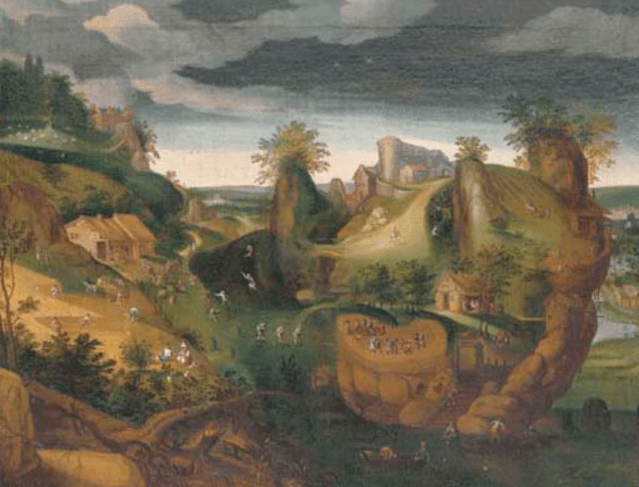
Once I started looking, these anthropomorphic landscapes seem too pop up everywhere. There are an interesting pair in the Musee Royale de Beaux Arts in Brussels by an unknown 17thc Dutch or Flemish Artist. The “male” landscape is in the same tradition as the ones we have already seen but it has a female counterpart. That’s quite rare with almost all the images I’ve found being based on older bearded male figures.


Tower thought to be by Arcimboldo xxx
At roughly the same time all this was happening Arcimboldo is also supposed to have humanised a building. His sketch, now known as an “Allegory of Death”, turns the tower’s windows into eyes and its door into a mouth.
Once again others rapidly followed suit. [There was no copyright law – or perhaps it was just that imitation is the highest form of flattery.]

from left to right: illustrations from Johann Wolfii’s Lectionum memorabilium et reconditarum centenarii, 1601; the Jesuit emblem book Veridicus Christianus (1601) ; and Icones mortis Sexaginta, [1648 edition]

Such anthropomorphic landscapes seem to become less popular in the 18th century, although examples can still be found. One proponent was the Augsburg-based artist and publisher Johann Martin Will about whom I have been unable to find much background information. These three prints, two anthropomorphic landscapes and an allegorical depiction of Asia is clearly in the same mould as many of the earlier images.
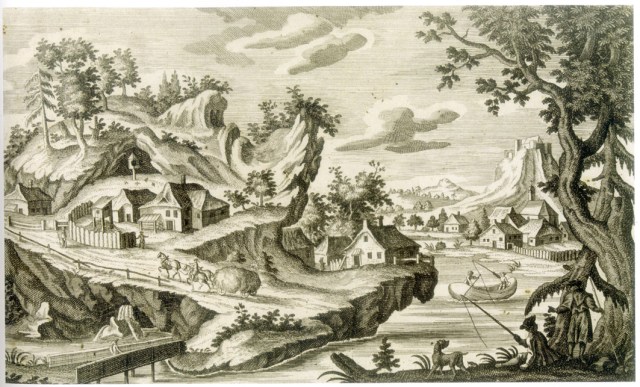

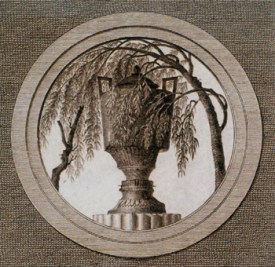
The 19thc saw a revival of interest in such puzzle pictures and optical illusions, notably in Germany, many of which include landscapes in various forms.
Some invent new forms such as this image of the garden urn published after the French Revolution which contained a seditious message. Can you spot what it might be? [Answer at the end]
A similar technique is used in the images below…


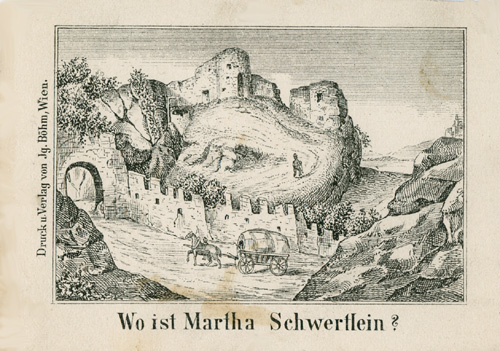
But in the end the old favourite always re-appears! As I said earlier it’s no wonder artists in the Surrealist and Dada movements used such prints as inspiration, but that’s a story for another day.
[Answer to the urn puzzle : the gaps between the urn and the willow tree contain the outline profiles of Louis XVI and Marie Antoinette]


 The Garden History Blog


You must be logged in to post a comment.