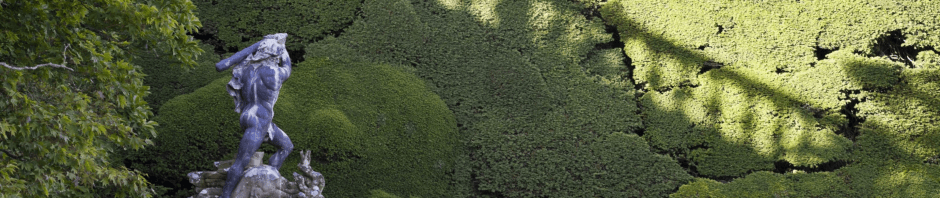

Following on from last week’s post ….the increasing popularity among the British elite for the Grand Tour from the later 17th century onwards introduced them then to classical statuary and contemporary sculpture in Italy and France.
On their return they wanted similar ornaments for their own gardens. However statues made of carved stone or cast bronze were expensive to produce and instead sculptors began experimenting with using lead. It was easily worked and highly durable and it was possible to produce multiple copies from the same mould, making it much more profitable.
The result was that money was no longer the deciding factor and soon it wasn’t just royal and the grandest aristocratic gardens that had their array of classical and rustic figures to ornament their walks and parterres.
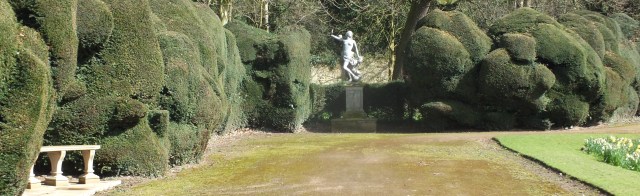
Andromeda in the gardens of Melbourne Hall, Derbyshire
As usual the photos are mine unless otherwise acknowledged

Many of the earliest artisans working in lead were Flemish, who came across to join the sizeable colony of their compatriot artists and craftsmen of all kinds working in Britain. The first was probably Artus Quellin (1653-1686), a member of a family of sculptors who came to England from Antwerp as a young man sometime before 1678.
He worked in partnership with the wood carver Grinling Gibbons on a series of royal projects and a large number of monuments in traditional materials but it’s clear he was already also working in lead. That’s probably because making lead figures were more profitable and less time consuming than stone carving.


In December 1685 the Earl of Strathmore ordered four statues of Stuart monarchs from him for the gardens at Glamis Castle, cast in ‘hardened’ lead and painted to resemble ‘brass’. James I and Charles I can still be seen at Glamis. It’s thought these were probably stock figures for which Quellin already had moulds and that other garden figures were also in production perhaps under the supervision of his assistant Jan Van Nost (1687-1710), who was originally from Mechelin.
After Quellin’s early death in 1686 Van Nost not only married his master’s widow but took over the business which had been left to her. He opened up new premises on Haymarket, an affluent area of the West End of London, anglicising himself as John Nost. He took on assistants including his own cousin [or nephew], John van Nost II and a young Frenchman Andries Carpentière [later Andrew Carpenter], both of whom became successful sculptors in their own right. In 1698 he took another property near Hyde Park Corner, which was close to the fashionable new streets around Grosvenor Square, and had the advantage that it could be easily seen by travellers on one of the main roads out of London. It began the area’s connection with sculpture which lasted for another century.

The Blackamoor bought by Lord Strafford for Wentworth Castle garden and now sited in the Victorian conservatory there
Although Nost carved monuments, fountains, and fireplaces in stone his principal activity from the 1690s was the design, manufacture and supply of lead garden statues and ornaments.
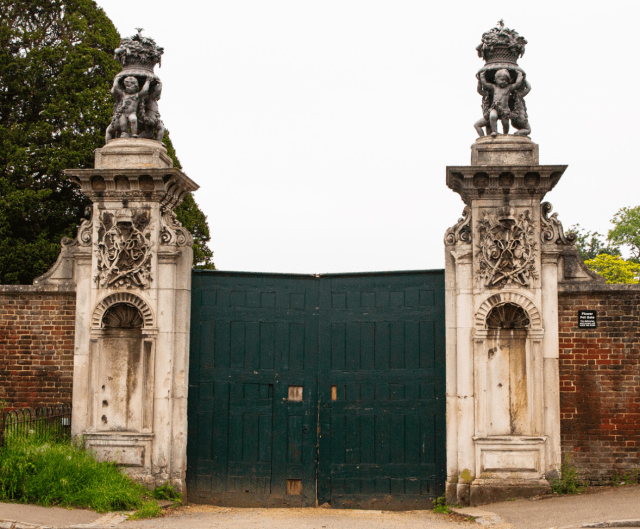
One of the earliest known references to them is his account for work at Hampton Court where, alongside carving in marble, there were also lead panels, and statues of basket-bearing putti for the Flower Pot gate which are still in place.
There was also a sum “for modelling a figure of a Blackamore kneeling being 5 ft high holding up a sundial” and then for “casting the said Balackamore in hard metal and repainting”. The Blackamoor design was still being made at the end of the 18thc and was to become the most popular garden sculpture of the period.
For more on Blackamoor figures and their context see this earlier post and this article “Learning from the Blackamoor” by Patrick Eyre in the Gardens Trust’s GT News.
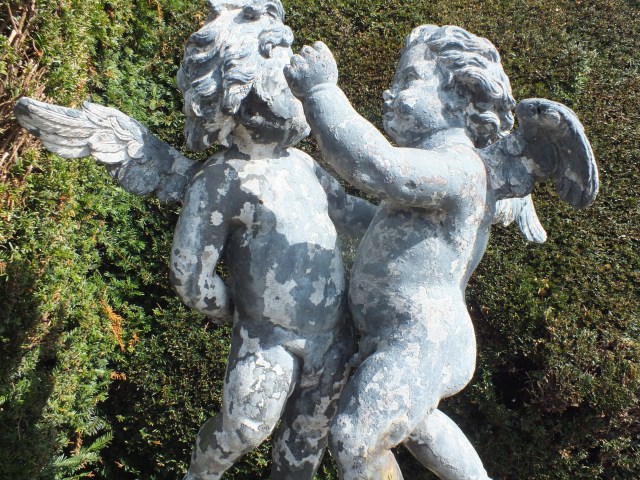
A pair of amorini or cherubs at Melbourne
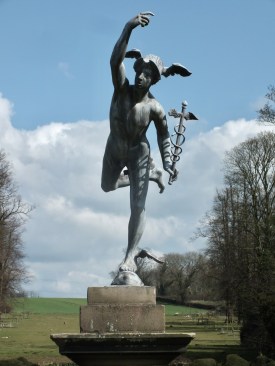
Mercury by Van Nost at Melbourne
Nost’s work at Hampton Court was obviously noticed by members of the Court, amongst them Thomas Coke of Melbourne Hall, vice-chamberlain to Queen Anne.
Coke was to become one of Nost’s most discerning patrons, commissioning a series of marble fireplaces and basins at both his London home and Melbourne. But more importantly he bought a large number of lead figures for his garden.
The first was a pair of amorini or cupids in 1699 which were “modelled apurpose and cast in hard metal” for 10 guineas. The following year he bought Perseus for £25, Andromeda for £20 and Mercury and Psyche for £50 the pair.


A fountain was ornamented with a “young Triton with a brass pipe in the middle” together with “a boy and swan for a fountain, the swan in proportion to the boy, no bigger than the young Triton” and a “duck and swan as big as ye life”. Two less pleasant figures still stand on the lawn in front of the house are kneeling figures of slaves: “an Indian and a blackamoor” as they were described in the invoice which came to £30.
The grandest piece at Melbourne isn’t a statue but it must rank amongst Nost’s finest work so I didn’t feel I could leave it out as it shows the high standard of craftsmship that was possible in lead.

The Four Seasons Vase
 Known as The ‘Vause’ it is a large urn depicting the Four Seasons, which cost £100 in 1705 and was reputedly a gift from Queen Anne. The vase has several sections, with monkeys supporting a group of cherubs playing, and on top of them a band with four heads depicting the seasons and finally a huge pile of fruit and flowers.
Coke was obviously intending to buy even more pieces until he saw the prices. Nost quoted for lead figures of ‘The Sabine Rape, £90’, ‘Hercules and Centoure, £70,’ and ‘Hercules and Anteus, £80’, claiming he had ‘made as nice a calculation as can be and find it cannot be done under the prises that is rated above’. Even without these Melbourne remains a treasure house for those interested lead figures, although all have lost any decoration they might once have had.
For more on the gardens at Melbourne see this earlier post.


Perseus at Melbourne
Perhaps Nost learned a lesson from that – or perhaps he’d discovered the economies of scale because his ‘prices of Statues and Flowerpotes proposed for the Earl of Hoptone’ submitted in 1709 seem cheaper. They included a six foot high “Hercules and his Mistress”, a Venus and Adonis and a Bacchus and Ceres, all at £30, as well as two figures of Hope, a Flying Horse & Fame, “Four statues about the fountain”, and four six foot high urns at £25 each.
Historic England’s listings include 56 mentions of sites where work by Van Nost survives, while a search on any major auction house site will show you how collectible [and expensive] his work has become.


When Nost died, in 1710, he “left behind him a good fortune” while the business passed into the hands of his widow and was run by John Nost II. By this point the business was focussing on lead garden figures, but had also developed a sideline in large-scale lead equestrian statues of George I often presenting the king in armour and crowned with laurels. The first of these was commissioned in 1717 from the corporation of Dublin at a cost of £1500.
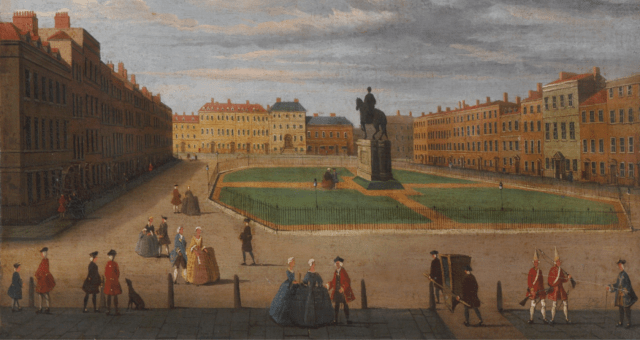
Nost cast the figure of the horse from moulds made from Le Sueur’s statue of King Charles I at Charing Cross, and he went on to use the same cast to produce several more lead versions for other patrons. That for the Duke of Chandos was gilded and stood on a pedestal carved with the trophies of war in the gardens at Canons. After the sale and demolition of Canons in 1747 the statue was bought by the residents of Leicester Square, and installed at the centre of the Square. For the rest of its tragi-comic story see this earlier post.
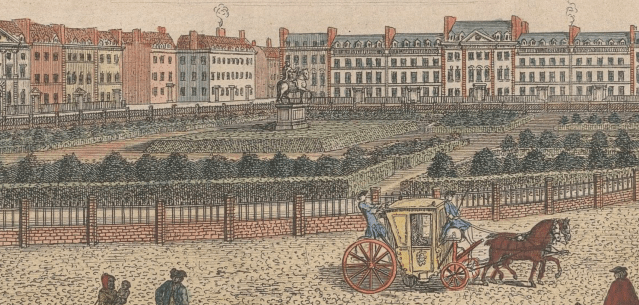

Several other Whig landowners, including Lord Cobham at Stowe and the Duke of Bolton at Hackwood followed the Duke’s example using the statue of George to show their political allegiance. Another formed the centrepiece of the new gardens of Grosvenor Square.
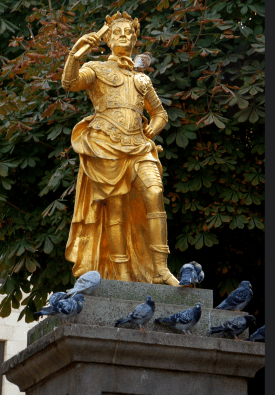
The Duke of Chandos also ordered several other lead figures for Canons, including a series to line the parapets of the house, and more for the pleasure grounds, together with a large number of urns and vases. They were joined in 1727, when George II ascended the throne, by a statue of the new king too. After the Canons sale it was moved to Golden Square. Another statue of George II “in Armour richly gilt” dating from 1751 can be seen in Royal Square, St Helier on Jersey, and a third of the king on a column is at Hartwell House in Bucks accompanied by an equestrian statue of his son, Frederick Prince of Wales. The last three were much later and by John Cheere who as we will see in another post soon took over the Nost sculpture yard together with the stock and the moulds.


Other clients of Nost included General Dormer at Rousham where several pieces remain…
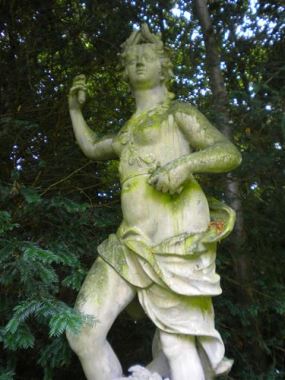
and Sir John Germaine of Drayton House in Northants who, in 1710, spent £60 on twelve vases which can be seen on the colonnades in the courtyard. In 1718 Nost also supplied him “‘two leading Statues Six footh hey from the plint” including “a backus … and also to make three Leadin Vasis upwards of four footh high of two Severall Sorts… ‘the Sayd figurs and Vasis Shal be painted twice over with a White Stone colour’. All for £40.

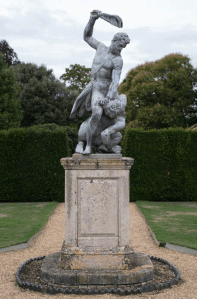
The same year 1718 Nost sold four statues, “Cain and Abel, Diana, a Gladiator and Hercules with a club”, at a cost of £86 to the Earl of Hopetoun for his gardens at Hopetoun House, near Edinburgh. This was quickly followed by another order worth £56 for four more: “an Adonis with a greyhound, Venus with Cupid, Venus coming out of the bath, and Phaon playing on a pipe”. The first set were clearly in stock as they were to be delivered just a few weeks later, the others were probably made to order with delivery fixed for the four months later. In fact the “fave larg’ casses of Leaden status” didn’t arrive until early the following year with Nost adding an extra guinea charge to help defray the transport costs. None of these works remain at Hopetoun.

One final client worth mentioning simply to show the potential fate of these statues is Sir Nicholas Shireburn of Stonyhurst who bought several garden figures in 1714 and 1716. These were later melted down so the lead could be used to repair the roof!
John Nost II died in April 1729, and his wife Catherine took over the business. Their son, John Nost III was at that time apprenticed to the sculptor Henry Scheemakers and was to go on and make a successful career for himself in Dublin.

John Nost I’s other assistant was Andries Carpentiere – Andrew Carpenter – according to George Vertue ‘a Man in his time esteemd for his Skill’. By 1703 he was working independently in premises very close to his erstwhile boss on Piccadilly near what is now Hyde Park Corner, and also near the ironsmith Jean Tijou. Carpenter worked in traditional materials like marble but also began to specialise in lead, building up a substantial repertoire of lead figures including classical, biblical and rustic designs.


Like Nost he provided an “abundance of works” for the Duke of Chandos, while other clients included the 1st Earl of Bristol and the architect James Gibbs for garden ornaments for Wimpole Hall, as well as groups of figures for Powis Castle. It was also possible, as one potential client put it, to ‘get something done a-purpose after a good design.’
His price list submitted to Lord Carlisle at Castle Howard in 1723 gives some indication of the range he was able to provide. It was £20 for a six foot Cain and Abel or Diana and Stag. A six foot Venus de Medici was yours for £15 but the Duke of Marlborough the same size would set you back £28. Smaller pieces were much cheaper: a five foot bagpiper was £10 while a five foot Cleopatra was just £7, a four foot high “french paisant & paisanne [two figures]” £10, and “Love & disdain [two figures]” three and half feet high were just £8.

Packing and freight for lead pieces required as much care as those in marble. Lord Carlisle’s order cost £84 but the packing cases cost an extra £9 7s 9d, and it took a workman nine and a half days, twenty-one pounds of ‘spike’ and a thousand ‘double-tenns’ nails to prepare the works for the journey from London to Yorkshire. More than a dozen of Carpenter’s pieces can still be seen at Castle Howard.

However there was a lot of competition for lead work and prices paid for work at this less prestigious end of the market were diminishing so that in January 1736 Carpenter announced in the Daily Journal that he intended to “leave off entirely the casting of lead figures’ and intended to sell ‘his entire stock of Statues of Figures in Hard Lead, Vases, Pots and Pedestals” and to “apply himself solely to his other business, viz the Statuary and Carving Part in Marble and Stone”.
When he died the following year his wife Anne took over the business but in 1744 advertised a sale at the sculpture yard to sell her late husband’s “Metal Statues or Figures in Hard Lead … together with his Moulds, Models and casts in Plaister”.

The death of Andrew Carpenter and the end of the Van Nost dynasty might have marked the end of the great golden age of lead statuary – but it didn’t and in fact the best was yet to come, as we’ll see in another post soon.
I must acknowledge the extensive use I’ve made of A Biographical Dictionary of Sculptors in Britain 1660-1851 for the fine detail of this post. It is an excellent database and freely available via the Henry Moore Foundation website.


 The Garden History Blog

_3_(geograph_6154322).jpg)

You must be logged in to post a comment.