

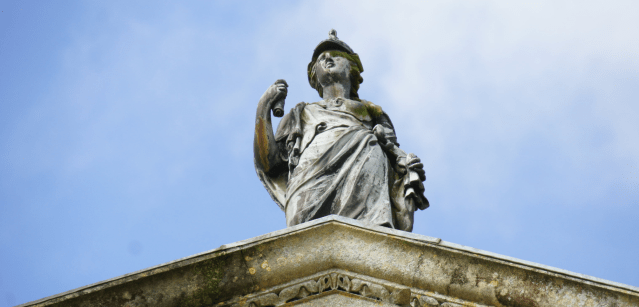
Minerva at Queluz Palace, Portugal
In this my third and final post about 17th and 18thc garden statues I’m turning my attention to John Cheere who was probably the most prolific and arguably the greatest sculptor in lead in Georgian Britain. His work can be seen in many historic gardens around the country, and still commands high prices today if it ever comes to auction.
He trained, alongside his older brother Henry, in the workshops of John Nost II whose story was covered last week. After Nost’s death Henry set up business on his own but in 1739 he and John took the lease on their former boss’s old yard on Piccadilly near Hyde Park Corner which John was to run for the next 50 years.
Hogarth’s engraving of his yard captures its almost haphazard state, with copies of classical pieces, mixed up with tomb monuments, anatomical drawings and a statue being lifted on a block and tackle ready for transport to a client.
Henry soon moved away to establish his own workshops and develop an extremely successful career as sculptor in marble and other stone for major public projects and funerary monuments. He became wealthy and was even given a knighthood by George III. John was equally successful but in the more mundane fields of lead and plaster. He capitalised on the fashion for internal “parade” rooms creating plaster statues, statuettes and busts to decorate grand interiors. But because plaster is fragile and doesn’t have the same look or feel as more expensive materials he pioneered a way painting these pieces so they resembled bronze. But it’s his work with lead for which he is mainly remembered today as he dominated the market for high quality lead figures especially between the 1740s and 1760s.
For more on Cheere’s interior work a good place to start is “Eighteenth-Century Interiors. Redesigning the Georgian” by Hannah Greig and Giorgio Riello in Journal of Design History, Vol. 20, (Winter, 2007).


He began by buying up some of the remaining stock and moulds of Andrew Carpenter, a colleague of John Nost and whose work I looked at in the last post, and continued to use them, slowly adding new subjects of his own. Varying in size so as to suit a range of consumers, including nouveau riche city merchants who were the subject of much mockery in contemporary satires for aping the taste of their social betters, there were some classical pieces, some adapted from the statues in the gardens at Versailles and others which were copies of more contemporary sculptors works in traditional materials.
Although it’s true that the figures were moulded in sections that could be assembled in different configurations the standard figures largely remain the same which makes dating and identification of the maker difficult. Thus figures ascribed to Nost, Cheere, Carpenter or indeed some of their smaller-scale rivals could perhaps be the product of one of the others, and its often only documentary evidence that might allow the dating of a piece, or occasionally the stamping of the maker’s initials on an out-of-the-way part of the figure that identifies the author.

William III in Petersfield
Photo © Copyright Colin Smith and licensed for reuse under this Creative Commons Licence.
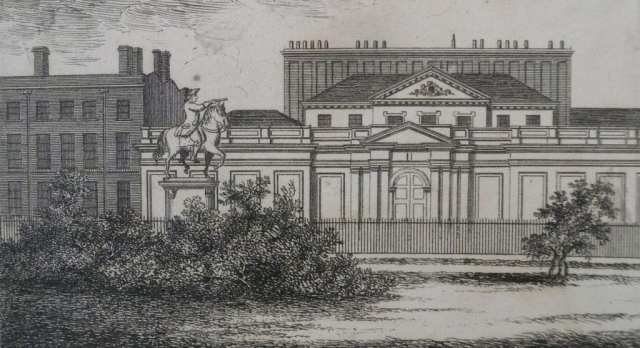
His first known new commission must have made John Cheere wonder if he was actually going to make a financial success of the business because it did not go quite according to plan. It was for a lead equestrian figure of William III in the classical “Roman” style, which was ordered as a centrepiece for St James Square by the wealthy residents of this upmarket development. Unfortunately the money – a reported 300 guineas – didn’t materialise and the statue remained ‘standing at his Yard’. Luckily he did recoup the considerable outlay and it’s probably the statue that now stands in the centre of Petersfield in Hampshire, given as a bequest by William Joliffe, the local MP, when he died in 1750. [Follow this link for more information on the Petersfield statue ] [There is, in fact, an equestrian statue of William III in St James Square today but it is in bronze and dates from 1807.]
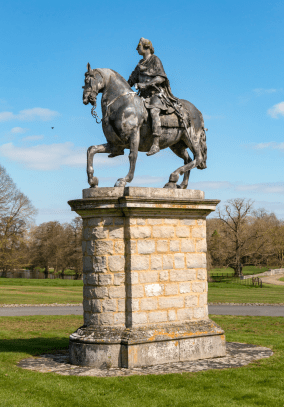
Other equestrian statues followed. Hartwell House near Aylesbury has one erected in 1757 in memory of Frederick, Prince of Wales who had died earlier that year, while another of William Augustus, Duke of Cumberland was set up in Dublin 1746 to celebrate his victory at the Battle of Culloden in 1745.
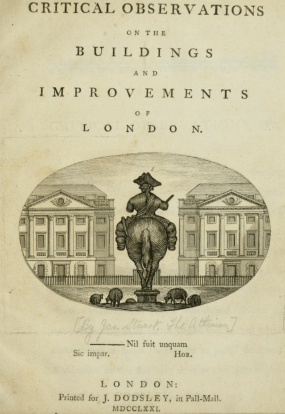
A gilded copy of that was erected in the centre of Cavendish Square in the west end of London in 1770 which was widely mocked, most obviously by John Stewart’s Critical Observations of 1771. It was taken down ostensibly for repair in the late 19thc but never returned probably because of the Duke’s reputation as the Butcher of Culloden and was almost certainly melted down instead. There’s more about that statue and its context on the UCL Survey of London website.

A parody copy in soap [yes soap!] by Korean artist Meekyoung Shin stood in its place between 2012 and 2016.

Luckily Cheere had also caught the attention of other powerful patrons who were looking to furnish their gardens. One was the Duke of Kent who had an avenue planted at Wrest Park to commemorate the Glorious Revolution and needed a statue of William III dressed as a Roman general to complete the scene. Listed at Grade II* it can still be seen looking down the canal in front of the Archer Pavilion at Wrest.

William III at Wrest Park
© Copyright M J Richardson and licensed for reuse under this Creative Commons Licence.

Amongst other early patrons was the Earl. of Carlisle, builder of Castle Howard, who bought a copy of the Apollo Belvedere, as well as a copy of the Borghese Gladiator and a Dancing Faun, ‘cast’ from a moddle made on purpose’.
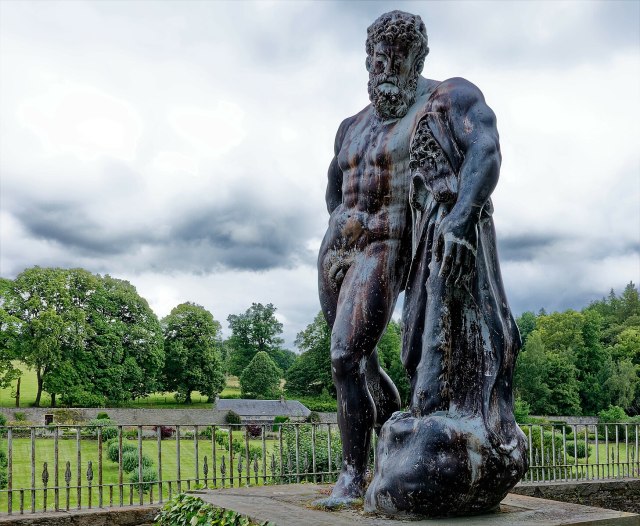
Hercules at Blair Castle, 1743 photo by Holger Uwe Schmitt, Creative Commons Attribution-Share Alike 4.0 International license.

Another was the Duke of Atholl who landscaped the grounds at Blair Castle between the 1730s and 1760s, including laying out a series of walks radiating away from his front door. One of these led to a figure of Diana [destroyed in a storm in 1893 and replaced with a copy] and another to a figure of Hercules. His Grace followed up with an order for seventeen plaster busts, largely of classical and modern “Men of Letters”, for his library, as well as ten plaster statues and groups.
Another seven large orders for lead figures followed including a “Gamekeeper made in the best manner and painted in proper Coulers”, which was sent with instructions that it should be washed and oiled every two years. Another was a figure of “Time with a dial” which was largely reconfigured, rather bizarrely, from the same sections that also made up of the Indian slave at Melbourne Hall.
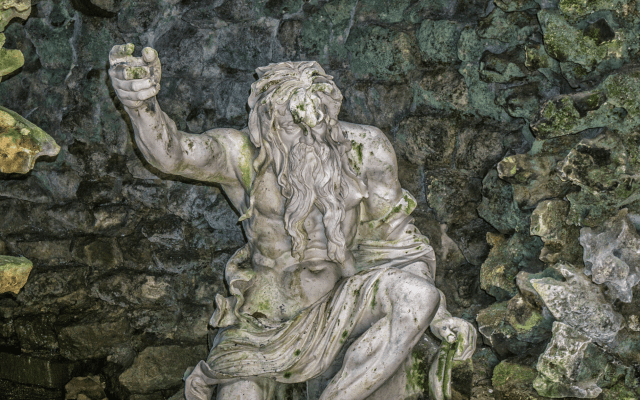
The River God in the grotto at Stourhead. Photo by Graeme Churchard, from Flickr CC BY 2.0 DEED
Attribution 2.0 Generic
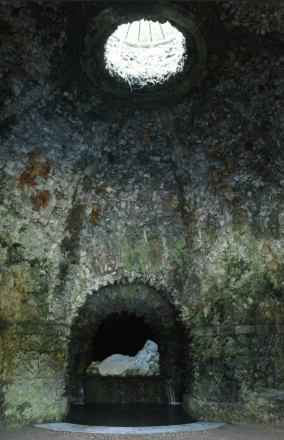
Ariadne, photo by Alwyn Ladell
CC BY-NC-ND 2.0 DEED
Perhaps Cheere’s single most famous piece is the large bespoke painted lead figure of the River God in the grotto at Stourhead installed around 1750. It cost £98 and was never duplicated.
In 1756 he also supplied a statue of Ariadne, “the nymph of the grot” as part of what Stourhead’s owner, Henry Hoare, was probably attempting to recreate: the scene from Virgil’s Aeneid in which Aeneas meets the nymphs and Father Tiber.
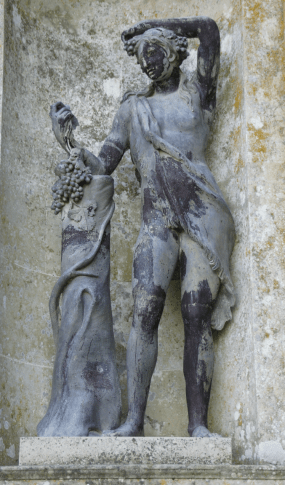
Bacchus, on the Pantheon at Stourhead. photo by Alwyn Ladell
CC BY-NC-ND 2.0 DEED
Ten years later Cheere sold Hoare a series of classical deities and muses to ornament the Temple of Apollo and the Pantheon. Some are still on display but sadly others have disappeared.
For lots of images of these and more background information see John Harrison’s article “Classical statuary in the Eighteenth century English country garden: Icon or ornament?”

Cheere had a fine line in Sphinx too. They can be seen on the image of the yard in Hogarth’s Analysis of Beauty. He provided a pair for Chiswick in 1748, and two pairs for Castle Hill in North Devon [perhaps with a pair of lions too]. The design remained popular and William Chambers ordered more for his rebuilding of Somerset House in 1778.
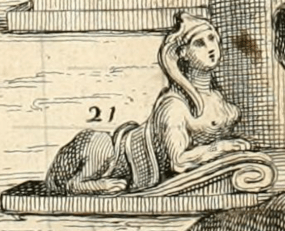
Sphinx, from Hogarth’s Analysis of Beauty

A pair of wyverns, the family crest of the Trevors, were commissioned to top the carriage entry gateposts at their Glynde Place estate in Sussex.
Another group of lead figures can be seen on the parapets at Hampton Court. Painted to resemble stone most of them are earlier, probably by Nost, but Cheere was paid £38 in 1752 for either the repair or more likely a replacement figure of Mars. His initials are stamped onto the rear of one of Mars’ legs.
There’s an interesting article about these[and other statues at Hampton Court] by Susanne Roome in the London Gardener.

Like any successful practitioner in the luxury trades, Cheere kept abreast of stylistic trends and he responded to the growing taste for naturalism in the garden and landscape by later extending his range to include commedia dell’arte and other rustic figures.

The Shepherd, photo by Holger Uwe Schmitt, Creative Commons Attribution-Share Alike 4.0 International license.
The Duke of Atholl was a client for both sorts and in 1755 ten bucolic subjects and six commedia figures were bought for Blair Castle including a Shepherd and Shepherdess.

One other naturalistic order in particular caught my eye. It was for a pair of lead pineapples set on Portland stone plinths made for Kedleston in 1758, the bill for which included “the expense of buying the fruit and making the pattern and moulds.”

The National Trust, who now own Kedleston, suggest that getting the fresh pineapples cost exactly half as much as making the final sculptures themselves. They were amongst a whole series ordered by the owner, Nathaniel Curzon, and documented in his handwritten ‘List of Statues I have’ (c. 1760) and then his published ‘Catalogue of the pictures, statues, &c. at Kedleston’ of 1769.
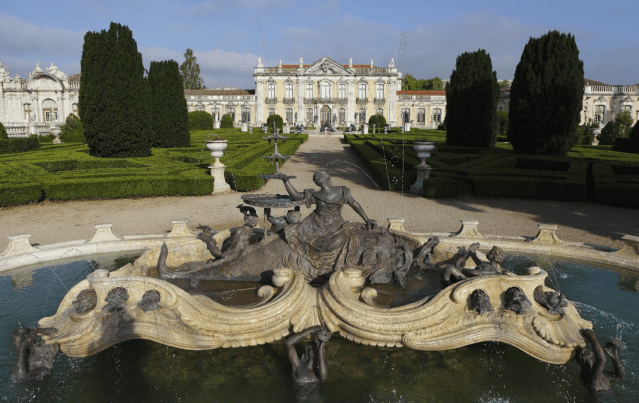
Cheere’s fame spread overseas too. When the Portuguese ambassador to London Sebastião José de Carvalho e Melo, returned to Lisbon he was given charge of the landscaping of the gardens of the summer residence of the country’s monarch Pedro III. Remembering Cheere’s work he asked his successor to choose and send over more than 60 pieces, some of which were modified to order. In the summer of 1755 thirty-six crates were sent together along with a complete list of what else might be available. The salesmanship worked and that autumn another 58 crates were despatched, together with careful instructions on installation and maintenance. The gardens at Queluz represented almost a full display of Cheere’s catalogue with 9 sculptural groups, 57 individual figures, and 72 lead vases still there, making it by far the largest extant collection of his work.
The World Monument Fund recently completed restoration of the Cheere sculptures and I think that’s worth a post of its own when I’ve finished investigating a bit further.
Cheere’s response to market trends made him the most successful of the lead sculptors and at the height of his fame his yards became something of a tourist attraction. I’m extremely grateful to Moira Fulton who has done extensive research on Cheere for this account by an anonymous Irish clergyman of his visit there in 1761. He had set out from Windsor at 6 in the morning and four hours later arrived at Hyde Park Corner where “we desired ye coachman to set us down at Mr Chare’s ye Famous Sculptor. Who was complaisant enough to shew us His fine Busts and Figures in plaister of Paris….After this we took a view of his statues in Metall & were Introduced into an Assembly of Gods and Goddesses, Juno, Minerva, Venus de Medici, Jupiter, Mars, Neptune and many Rural Deities Pan & Frisking Satyrs, with an Infinite Multitude of Mer Dancers, Haymakers, Gladiators, wrestlers, Huntsman & Fowlers, also Eagles, Vulturs, Hawks, Kites, Ostrich, peacocks, Lions, Leopards, tygers.”


A Statuary’s Yard by Rowlandson undated late 18thc drawing. Image courtesy of The Huntingdon Library
The writer was reminded of the story of Deucalion, the classical world’s answer to Noah, and his wife Pyrrha. Zeus flooded the world so mankind drowned but when the waters subsided Deucalion and Pyrrha were told to throw stones – the bones of Mother Earth – over their shoulders which would turn into humans to repopulate the earth. The author claims that had they seen Cheere’s yard they could have save themselves the bother of throwing stones and instead “animated those Leaden & Stone figures Readymade … [and] command ym to step down from their pedestals & walk.” (Journals of Visits to England in 1761 and 1762, BL Add MSS 27951, 16 inset).
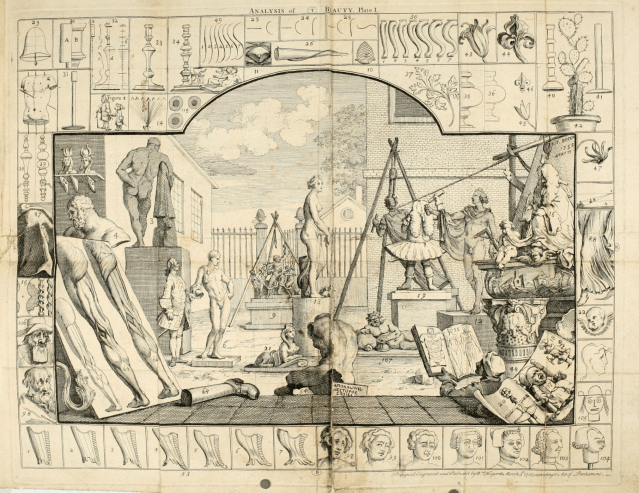
The Sculpture Yard in Hogarth’s Analysis of Beauty
The inclusion of Cheere’s yard in Hogarth’s Analysis of Beauty was a mark of how famous it had become. So famous indeed that it was mentioned in George Colman and David Garrick’s play A Clandestine Marriage when Lord Ogle visiting the city merchant Mr Sterling’s garden remarks: “Great improvements indeed, Mr. Sterling – wonderful improvements! The four seasons in lead, the flying Mercury, and the basin with Neptune in the middle, are all in the very extreme of fine taste. You have as many rich figures as the man at Hyde-Park Corner.”
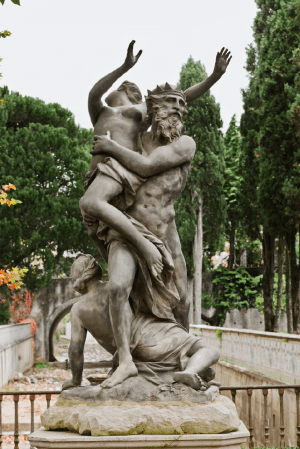
The abduction of Persephone at Queluz
Cheere died a wealthy man in 1787 leaving ‘the leases of the Houses and Ground in Piccadilly‘ and ‘all the statues with the Models Moulds Patterns and Utensils … in the said houses Yards Shops and Shows in Piccadilly‘ to his nephew Charles Cheere, Henry’s son, who promptly auctioned everything off in 1788.
Doing that helped bring an end to the era of lead statues although it didn’t help that tastes in garden design were changing. While we might admire the weathered appearance of surviving lead pieces it’s worth remembering that’s not how they were intended to be seen. Contemporary accounts make it clear they were painted to resemble more expensive materials like bronze or marble, or else painted in real-life colours. Such ornately painted statues were beginning to be thought too artificial as ornaments in a purely natural landscape.
Yet despite the rapid decline in new manufacture, the interest in lead sculpture remained high in many quarters and its very clear that when estates and their contents were sold or any reason disposed of, Cheere’s work like that of the Nost’s Carpenter and their rivals were readily snapped up.


In 1812 for example the brewer, Samuel Whitbread, bought 20 statues for £975, 15 of which went to his gardens at Southill, Bedfordshire. The Shepherd and Shepherdess at Fenton House were originally made for Coldbath Abbey in Worcester while at least four groups of figures -Aeneas & Anchises, the Abduction of Helen of Troy, Venus & Adonis and Meleager & Atalanta – at Wrest Park passed through the hands of dealers or collectors before being acquired in the 1830s by Earl de Grey. Another garden with a large collection of Cheere pieces assembled long afterwards is at Anglesey Abbey where Lord Fairhaven acquired Apollo, Diana & Actaeon and a pair of gardeners from Copped Hall, as well as four of the original statues from the roof of the Temple of Concord and Victory at Stowe.
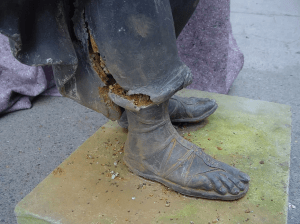
There was however one other reason that lead passed out of fashion, as the new owners of old statues eventually discovered: the casting methods used meant inherent long-term structural problems with repair being difficult. As a result many historic examples have been lost and those that do survive need careful protection, with early detection of problems critical. That’s an interesting subject in itself and I’ll come back to it in another post soon, but I think after 3 posts in a row on the same subject I need to think about something completely different for next week!


 The Garden History Blog


You must be logged in to post a comment.