

detail of St. Fiacre from the Book of hours of Simon de Varie National Library of the Netherlands
Happy St Fiacre’s Day!
You’ve just got time to organise a party for the patron saint of gardening, whose “official” feast day in most places is today – 31st August. But don’t worry if you can’t celebrate today, because in some places he’s honoured tomorrow, September 1st.
Nor should you worry if you don’t get an immediate response from Fiacre himself because he was/is a very busy man. Not only is he the spiritual guardian of gardeners but for different reasons, believe it or not, he also takes care of taxi-drivers and sufferers from haemorrhoids.
So how did an obscure monk from Ireland end up having so much heavenly clout?


Of course the mediaeval world was besotted by saints – I was going to say bedevilled by but that somehow doesn’t seem quite right. One or other of them was believed to watch over after every minute aspect of daily life. Legends grew up around them and although many are obscure like Fiacre [perhaps a polite way of saying they are either imaginary or have lives which have been ’embroidered’] nevertheless they became well-known, if only locally, with shrines, chapels, wells, springs and statues dedicated to them.
The story of Fiacre is pretty thin and like most early saints, it depends more on folklore than hard evidence. In some versions he’s a Scottish prince who becomes a monk in Ireland. In others he’s Irish and probably really called Fiachra. He is not mentioned in the very early Irish calendars of saints, but the ‘accepted’ version of his life [ie that given in The Catholic Encyclopedia] is that he was born in Ireland around the close of the 6thc, and then educated in a monastery before becoming a monk himself. He then went one stage further and became a hermit near present day Kilfiachra, or Kilfera in County Kilkenny.

A modern Irish St Fiachra’s garden
https://x.com/lorraineelizab6/status/898463203046432768/photo/2

The site of his hermitage and holy well still exists, and in 1936 there was a revival of the annual pilgrimage in his honour. There are even the remains of “his” church although that’s a slight exaggeration since it probably only dates to the early 18thc, but, as the blogger on Irish Holy Wells says optimistically “it is difficult to be sure”.
Click here for more photos and legends of the Kilkenny site and the story again in the Old Kilkenny Review published by the Kilkenny Archaeological Society.

St Fiacre’s Well
But everyone loves a saint so that claim is not the only one and as you might expect there are other St Fiacre sites, one at Clontubrid, now long vanished, and another being the 12thc church at Ullard which is locally named after him.

Unfortunately for Fiacre he became a very popular hermit, – a sort of contradiction in terms – and was soon swamped with visitors. This made him yearn for solitude so he fled to France where legend has it, he ended up at Meaux a small town to the north-east of Paris. The local bishop, Faro, himself to become another little-known saint, had Irish connections and is supposed to have offered Fiacre all the land he could turn over in a day.

In some versions of the story Fiacre is helped by an angel, but in most because, after all, he was a saint in waiting, Fiacre didn’t need help or to use a spade or a plough. Instead he pointed his hermit’s staff at the ground and it miraculously turned the soil, and in the process clearing the ground of all the weeds and scrub.
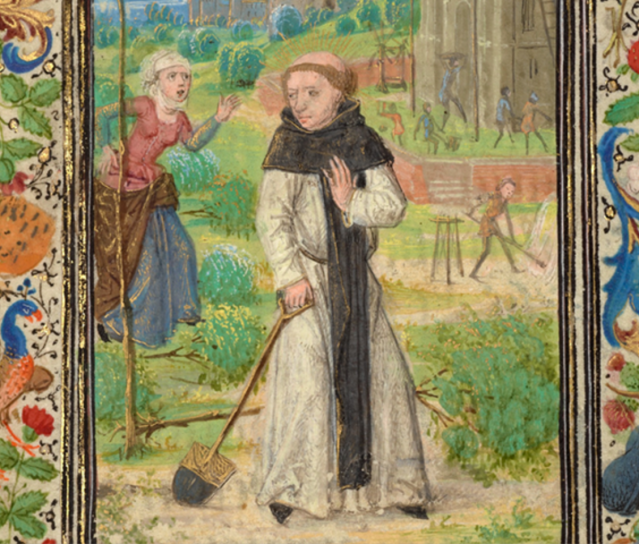
detail from Saint Fiacre and Houpdée, by Lieven van Lathem, 1469, Getty Museum, Los Angeles
Perhaps unsurprisingly this raised a few local eyebrows, and one disbelieving woman, Houpdee, rushed to the bishop telling him what Fiacre was doing, proclaiming it must be the devil’s work. Faro immediately set off to see for himself but equally immediately saw that Fiacre’s wonder-working was divinely not diabolically inspired. Fiacre seems rather harshly to have taken exception to the interference and is said to have excluded all women from the precincts of his monastery, on pain of severe bodily infirmity. Of course since women were commonly excluded from many monastic foundations at this time the saint’s apparent vehemence loses some of its sting.

St Fiacre, in his garden, plate 18 from Oraculum Anachoreticum; c.1595-1600, British Museum
Having built a hut and created a garden to grow his own food Fiacre lived a life of manual labour, combined with mortification, prayer, vigil and fasting. Once again his fame spread and, just as in Ireland, he was soon swamped with visitors and even a group of disciples. This time however Fiacre did not run away from the crowds but instead built a hospice for travellers, and a shrine to the Virgin where they could worship. Gradually this developed into the little village of St Fiacre-sur-Marne.

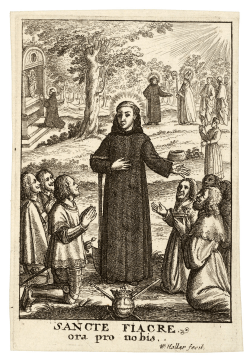
St Fiacre, by Hollar, Thomas Fisher Library, Toronto
More basically and saint-like Fiacre fed the poor and cured the sick by laying on his hands. Stories are told of how he cured blindness, polyps and fevers, but somehow he gained a reputation for dealing with haemorrhoids, which acquired the tasteful euphemism “Saint Fiacre’s figs”. Apparently this association derives from a story in which Fiacre is said to have sat on a millstone which miraculously became soft when touched by his saintly backside. What can one say!
Fiacre’s miracles apparently continued long after his death in 670 and he became one of the most popular saints in France, Flanders and Brittany during the late Middle Ages with at least twelve priories dedicated to him, and crowds visiting his shrine for centuries. His reputation grew, partly of course because having a local saint associated with your monastery or town was a profitable business. They could also benefit from sending his bones on a tour as happened in 1094 when a priest named Guillaume was paid the annual sum of 120 livres for taking the relics of St Fiacre around the diocese of Reims for nine years for the benefit of Saint Faro de Meaux.
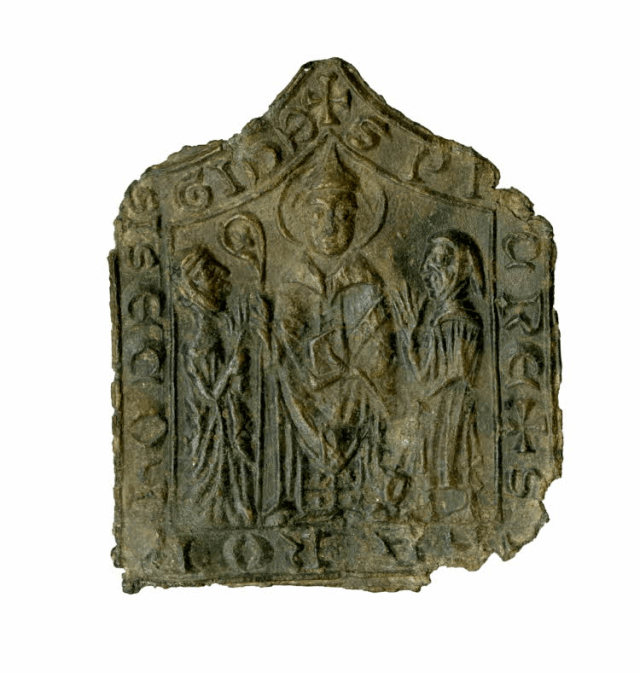
Pilgrim-badge embossed with figure of St Faro Bishop of Meaux, St Fiacre & his sister St Syra. British Museum
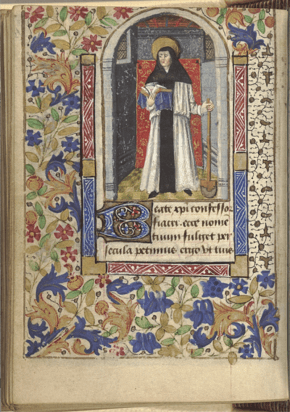
From Belleville Hours, c1425-50, Harry Ransom Humanities Research Center, University of Texas
So by 870 Fiacre gets his first mention in a documentary source when another Bishop of Meaux, Hildegaire, included him in his biography of Bishop Faro [two local saints obviously being even better than one]. This account provided the basis for the story of his arrival and the foundation of the settlement. A couple of other manuscripts from the 10th and 11thc add some extra details, until finally Fiacre got a “life” of his own written in the 12thc by a monk in the priory he founded. Of course these “biographies” all tell us more about the mediaeval mind and context that they do about the “real” Fiacre.
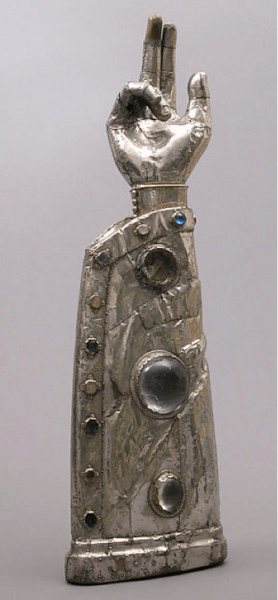
Reliquary Arm of Saint Fiacre. Metropolitan Museum of Art
In 1234 Fiacre’s bones were transferred from his tomb to a new shrine by the then bishop, with one of his arms for some reason being placed in as separate reliquary. This was ‘upgraded’ in 1479 to a silver shrine and that in turn was transferred from his own church to the cathedral in Meaux, ostensibly to save them from the iconoclastic Calvinists during the French Wars of Religion. Around the same time the next account of Fiacre’s life was written. [Acta Sanctorum, MS 8552 Bibliothèque Royale de Bruxelles] which includes such news as the English king Henry V deciding to take Fiacre’s body back to Britain but being thwarted when the horses refused to take the coffin outside the monastery precincts.

St Fiacre from the Breviary of Charles V of France c.1364-70
Biblioteque Nationale de France
But it’s in the 17thc that Fiacre really assumes much higher status as a saint, although quite why is anybody’s guess. His shrine was opened in 1617 and part of his body [although I can’t discover which bit] was given by the bishop to the Grand Duke of Tuscany, and in 1637 it was again opened and at least one of Fiacre’s vertebrae given to Cardinal Richelieu. The prelate may have effectively ruled France but he still suffered from haemorrhoids and presumably hoped that placing the saint’s bones on them would be a cure, although we have no report of the efficacy of the treatment!
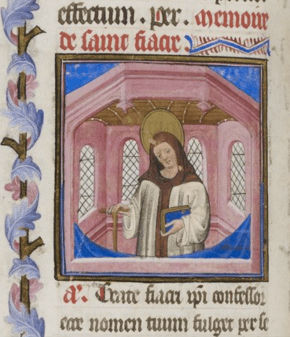
St Fiacre from ‘The Hours of René d’Anjou’, c 1410, MS Egerton 1070,British Library
In 1641 Anne of Austria, wife of Louis XIII, gave thanks for her husband’s recovery from serious illness because of the intervention of St Fiacre, and made a pilgrimage to the shrine. Even she obeyed his injunction about women entering his enclosure and prayed outside the door, amongst the other female pilgrims. The queen is also known to have sent a token to the shrine for the saint’s intervention in the birth of her son, later Louis XIV, when she was 37 and had been childless for more than 20 years.
Louis’s confessor and adviser, Jacques-Bénigne Bossuet, was Bishop of Meaux and both he and the king are also recorded as invoking Fiacre’s prayers and support.
Unfortunately the shrine was destroyed during the Revolution and he now has to share a chapel with two other saints.

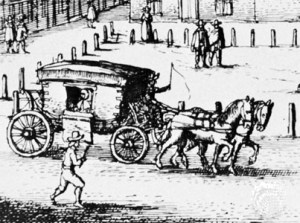
carriage, detail of an engraving by Hollar, 1646; British Museum
It’s from this period too that Fiacre acquired his influence over cab-drivers. In around 1645 Nicholas Sauvage rented a large house – the Hotel St Fiacre – in the Rue St Martin in the centre of Paris, [near the present day Pompidou Centre] and began hiring out boxlike 4-wheeled horse-drawn carriages rather like an early taxi service. Over time the coaches came to be called ‘fiacres’ and the saint was adopted by taxi-drivers.
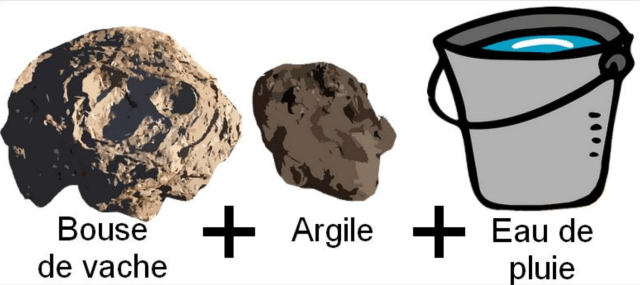
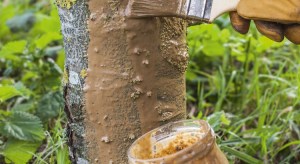
Onguent de Saint-Fiacre – now often made up of clay, sieved compost and water
John Claudius Loudon also notes that Fiacre had his name given to the “grafting clay” used by French and Dutch nurserymen. The Onguent du St Fiacre was comprised of 5o% cow manure and 50% good loam, and was used for excluding air from all sorts of plant wounds as well as to surround and protect grafts. It’s still in use today although often with a different recipe, and is widely recommended by organic gardeners.

Maybe that’s the reason why the gardens at Versailles are so impressive. Certainly Jean de la Quintinye who was in charge of the gardens is supposed to have founded the Confereres de St Fiacre, a semi-secret professional lodge, amongst the gardeners there [Loudon 1829]. I can’t find any specific evidence for that but it is quite plausible given that there were other societies dedicated to the saint from around that time including one first established in Rouen in 1644 [refounded 1700] and another in Nevers founded in 1708, both still going strong.
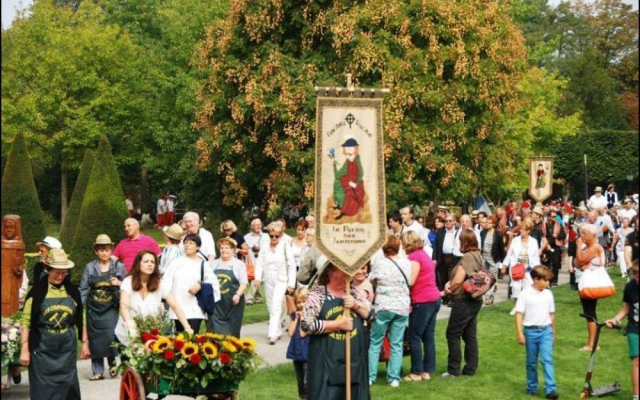

Today in addition to the Rouen and Nevers Confereres de St Fiacre, [brotherhoods] there are at least seven others, notably those at Orleans whose festival is attended by more than 15,000 every year, and Sens. Lots of other groups across France and Belgium in particular also use his feast day as an excuse to hold their annual gardening jamborees.

A part of the display for the festival of St Fiacre at the church of St Marceau, Orleans
There are lots of other photos on the Orleans group’s website, especially in their archives section.
 There are also still many oratories, chapels and churches dedicated to him, as well as statues, mainly in northern and western France, as well as Ireland, Belgium and the Netherlands. His shrine at St Fiacre-sur-Marne near Meaux is still a resort for pilgrims with all sorts of bodily ailments seeking a miraculous cure.
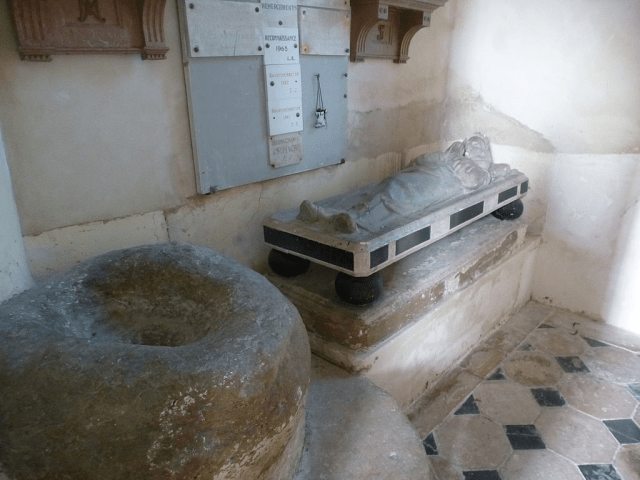
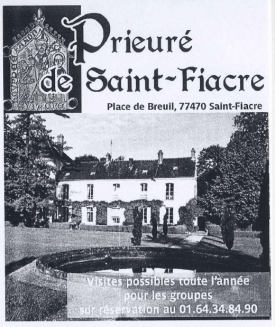
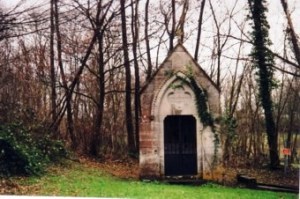
Of course the priory built later on his hermitage site, was sold off like all church property during the French Revolution. However, his tombstone and the millstone he softened [ now sadly once again as hard as millstones usually are] are still there in the village church. There is also a 19thc oratory built on the site of what was thought to be his hermitage.
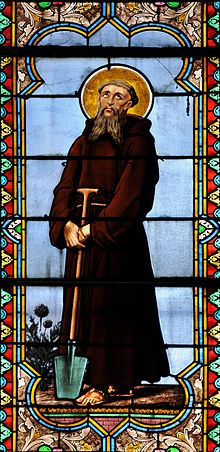
So…. when you next have to deal with a with an overgrown weedy patch remember to pray to St Fiacre and ask him to bring his miraculous spade and help clear it with you, and even if he doesn’t actually help with the digging and lifting, maybe he will grant you patience and not-quite-such a painful back!
Although judging by his expression he’s heard that prayer before…


 The Garden History Blog

You must be logged in to post a comment.