
After two recent posts about Piercefield, the picturesque landscape near Chepstow, I thought it might be a good idea to explore the idea of the Picturesque a bit more. It’s one of those terms tossed about in garden history and art history books, often without much by way of explanation of the terminology. After all we all know what picturesque means in gardens and paintings don’t we?
Actually I’m not sure we do.
So I thought I’d turn to the experts so checked the website of the Tate Gallery for an authoritative answer. It tells us that “the word picturesque refers to an ideal type of landscape that has an artistic appeal, in that it is beautiful but also with some elements of wildness” See if you think that’s inclusive enough when you’ve read the rest of the post, although I suspect that like me, you’ll still be confused!

The idea of the picturesque first emerges as an idea in late Renaissance in Italy where the term pittoresco began to be used in writing about art and meaning the manner of depicting a subject “like a traditional picture”. A similar idea was emerging too in Holland in the early 17thc where a completely new genre of landscape painting was often referred to as “painter-like” (schilder-achtig).

It was the Dutch who literally invented landscape painting – the very word landscape derives from the Dutch- landskip – meaning literally remodelling the land. as they reclaimed it from the sea. It was also then applied to the way they painted scene in their local countryside.

Such paintings depict “natural” scenes usually quite accurate topographically, and like the one above reveal local pride, in what was in the fields, how the land was divided, what the houses looked like, etc. There’s a whole culture of pride in ownership of lad and possessions.

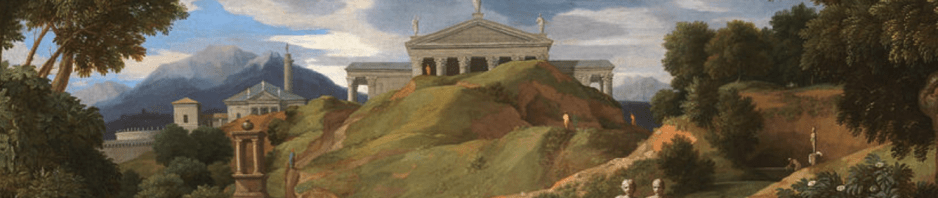
At roughly the same time French artists like Claude Lorraine and Nicholas Poussin, who were often working in Italy ,were also painting landscapes but their’s were classically inspired, and dare I say it, rather artificial and stylised in form, with ruined temples and mythological figures. They often have a narrative element, to illustrate a Greek myth or something similar and they perfected what one might describe as Arcadian settings. These, rather than the Dutch natural scenes, were the kind of images and impressions that English landowners bought back from their Grand Tour – and then re-interpreted in their grand 18thc landscape gardens such as Stourhead or Stowe.

Despite knowing about this more classically inspired vision of the landscape, most Northern European landscape painters seem to have stuck to more realistic depictions which do not show conventional “beautiful” perfection but a much wilder reality. The first pure landscape painting known in Britain, seems to fit more into this category. Painted by Sir Nathaniel Bacon, a Suffolk gentleman, [see previous post for more about him] and perhaps theoretically telling the story of the “Flight into Egypt”, arguably this is also the first English picturesque landscape.


The first reference that I found to the concept of the picturesque being used in association with depictions of landscape is in a book about painting published in 1685 where the author picks up on the Italian term – saying it means Boldly…. and Genius but this requires a strong judgement or else it will appear … meer drawing. [sadly none of this early texts have images to demonstrate more precisely]. 
But according to the Oxford English Dictionary the word “picturesque” itself doesn’t get used in England until 1705 when it relates to “in the manner of a picture” then by 1719 it had gradually widened its meaning to include such things as “especially original or striking”, worthy of being painted by 1738, and “attracting attention because of its originality” in 1749. However, it doesn’t really get applied to landscapes until 1768 as part of an emerging new set of theories about aesthetics.

 The main protagonsit for this was Edmund Burke in his Philosophical Enquiry into the Origin of Our ideas of the Sublime and Beautiful first published in 1757. It was the first complete attempt to explain ideas about what is beautiful in art and poetry etc. Burke doesn’t actually use the word picturesque itself but what he does talk about are “the Beautiful” and “the Sublime” and he sets out ways of distinguishing them and defining their characteristics.
As a starting point it’s very clear. According to Burke, the Beautiful is that which is well-formed, smooth and aesthetically pleasing, whereas “the passion caused by the great and sublime in nature… is astonishment… in which all its motions are suspended, with some degree of horror.”
So what we see developing during the later part of the 18th century is a battle between the beautiful and the sublime at opposite ends of an aesthetic spectrum. By way of example, the Rowlandson watercolour above is at the beautiful end of the spectrum, because it aims to please the eye by emphasising the smooth, the curved, and the harmonious. This fits a more contemporary view of the word picturesque.


Moving along the spectrum we come to images like these watercolours by William Payne which are much closer to the Sublime end. Here, there are potentially overpowering natural elements which invoke terror and were clearly fear-inducing and even dangerous to the people depicted.
At the “extreme” end of the spectrum we reach the sublime landscape proper. In these scenes, such as those below, nature is completely dominant. Sometimes that’s because of smallness of the figures in relation to the grandeur of surrounding landscape, at others because of the way the weather is on the same scale as the scenery making it difficult to tell where the weather stops and the mountains begin.


Simplistically, therefore, what we see during the later part of the 18th century is a battle between the beautiful and the sublime with the debate leading to what is in the middle ground being called the picturesque. Pinning a definition down further seems to flummox even the experts. So I turned to my mentor for 18thc garden history, Michael Symes, the man who probably knows more about the picturesque than anyone else. In his 2013 book “The whole subject is fraught with difficulties: it is a glacier on which one struggles to maintain a grip or foothold. There are no neat definitions, nor are there clear distinctions between the categories.”
What does seem clear is that these terms were generally used very loosely indeed, and there’s potential mix of topography, allusion, exaggeration, romance as well as even elements of fantasy.

The old palace of Woodstock.
Courtesy of Historic England, NMR: CC50/00455
Nevertheless its worth pointing out that the idea of the picturesque and landscape has a long ancestry, perhaps going back to the building of Blenheim Palace at the beginning of the 18thc, and the destruction of the medieval ruins of the old Woodstock Palace with architect Sir John Vanbrugh arguing “it would make one of the most agreeable objects that the best of landskip painters can invent.”

The North Prospect of Hampton Court, Herefordshire, by Leonard Knyff, c1699
Yale Centre for British Art
It’s closely followed by Jospeh Addison’s 1712 comments that “fields of corn make a pleasant Prospect, and if the walks ere a little taken care of that lie between them, if the natural embroidery of the meadows were helped and improved by the additions of Art, and the several rows of hedges set off by trees and flowers… a man might make a pretty landskip of his own possessions” Such a landskip can be seen in views like that of Hampton Court above.

These early hints by Vanbrugh and Addison are followed by those of William Kent. Kent had spent about 10 years in Italy where we know he collected paintings and prints of landscape by painters like Claude Lorraine and Salvator Rosa, whose works show signs of both ends of the beautiful/sublime spectrum. They, but particularly Rosa, had a great influence on his work as both a painter and garden designer.


So perhaps it’s not surprising that Joseph Spence the Oxford professor and commentator on gardens claimed in the 1750s just after Kent’s death that he was “the first that practiced painting in the garden”. Kent is also retrospectively credited by William Shenstone, the poet and garden-maker, for practising “picturesque gardening”, which is thought to be the first use of the term in connection with gardens and landscapes.

The Redcross Knight over ruled by Dispair but timely saved by Una,

Kent’s drawings and prints of landscapes with their combination of broken trees, uneven ground and rocks show many similarities to those earlier Italian paintings by Rosa and others.
Its also worth noting that Kent likes to show the landscape being used by humans, interacting with nature, or just busy engaging with every day life and that becomes a big feature in the later “high ” picturesque period:

Even in very traditional looking scenes of a classical semi-formal garden like this at Carlton House in central London, although Kent included architectural elements he expended as much effort on their natural surroundings. Here for example he used real rough rock rather than cut stone in the pool that he created. He used dead as well as living trees “to give a greater truth to the scene” according to Horace Walpole.
That comment by Walpole is interesting [or perhaps confusing!] because he had also described Lancelot “Capability’ Brown as “setting up on a few ideas of Kent”. Does that mean that Brown’s landscapes can be described in any way as picturesque? Certainly not according to the later theorists of the picturesque like Uvedale Price and Richard Payne Knight who had very a different take on what Brown was doing, and not always a very polite one.

Brown himself clearly appreciated the pictorial possibilities of a site. On one occasion he discussed ideas which were “exactly fit for the painter” and of course his work was the subject of paintings like this one by Richard Wilson of Croome, or by Turner of Harewood.

So is it just prejudice from later theorists who have excluded Brown from the picturesque story?

Brown’s critics like William Chambers, say his work such as the great expanses of Blenheim is boring and bland and made “Our gardens differ very little from common fields.” It maybe that this encouraged the real enthusiasts for the wilder, more savage and sublime landscapes to intensify their efforts to make the contrast greater still.

Horace Walpole also comment that “every journey is made through a succession of pictures” and of course it was Brown who produced hundreds of these English “landscape pictures”, transforming our idea of the English landscape to the point where it has become the yardstick against which all other gardens styles are measured. They were captured on canvas by Wilson and Turner in an equally English style and a far cry from landscapes by Lorraine, Poussin or Salvator Rosa. Yet the most of the stately homes of England were stuffed with such wilder landscape paintings collected on the Grand Tour…so perhaps the two ends of the spectrum are reconcilable after all [at least at this point in time] and we could just say that Brown was at the “very Beautiful” end of it…
I’ll return to the picturesque next week and look at later developments, especially the Sublime.


 The Garden History Blog
You must be logged in to post a comment.