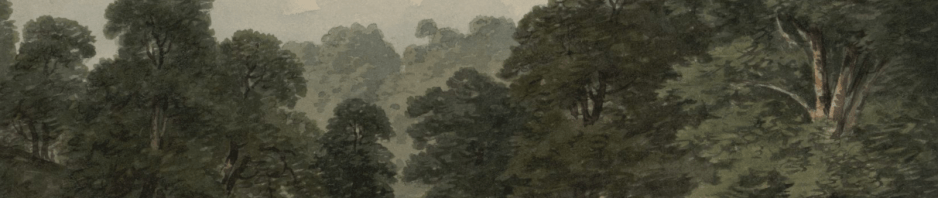

Last week’s post looked the origins of the picturesque movement and today’s is going to look at its flourishing at the end of the 18th and beginning of the 19thc centuries. That’s when the pendulum swung away from the Beautiful towards the Sublime encouraged by a group of theorists, critics and garden-makers. But it wasn’t a coherent or unanimous move…
Lets start by introducing the new theorists of the picturesque who rejected Capability Brown and all his works, and who were more interested in that wilder end of the landscape and garden spectrum.


First up is William Gilpin, a clergyman and schoolmaster and later artist, author and travel writer.
He first comes to public notice when he published in 1748 an anonymous “A dialogue upon the gardens of the right honourable the Lord Viscount Cobham at Stow in Buckinghamshire” which explored the differences between ‘moral beauties’ and ‘picturesque’ qualities. Why, for instance, are ruins particularly attractive features when they denote only ruin and decay? Then he mocked Dido’s cave because, being made of hewn stone, it was untruthful to the eye.

In 1768 he went on to publish his “Essay on Prints where he defined the picturesque as “that kind of beauty which is agreeable in a picture”. Around the same time he began to travel extensively round Britain in the school holidays, making notes and sketches and working on developing these aesthetic principles. He circulated his work in manuscript form to his friends and they in turn passed them on to acquaintances until Gilpin’s work had reached all the major critics and poets of the day and even George III himself. However they are not immediately published and so not available to the general public. We’ll come back to Gilpin shortly


Of course Gilpin wasn’t the first to record his views on the wonders of the wilder parts of Britain. The long series of wars with France during the 18thc made continental travel, including the Grand Tour more difficult. Domestic tourism flourished, made easier by rapid improvements in the road and transport system. Mountains, moorlands and wilderness were no longer something to be avoided but rather to be embraced and attention was turning to lesser known parts of Britain such much of Wales, Scotland and the Lake District.

Llanberis Lake and Dolbadarn Castle by George Barret the elder, c1777 Nottingham City Museums and Galleries

You can see that change reflected in travel writing – I’m just going to share one example, that of Thomas Herring, the Bishop of Bangor in north Wales. As you can see from the earlier post about early picturesque tourism in Wales travellers like Herring felt almost overwhelmed by the scenery: “The face of it is grand and bespeaks the magnificence of nature, and enlarged my mind so much, in the same manner as the stupendousness of the ocean.” He compared it to the fashionable landscapes of the day such as Stowe saying: “their beauties were all of the littlest; and , I am afraid, if I had seen Stowe in my way home, I should have thrown some unmannerly reflections upon it.” We also see the beginnings of the vocabulary of the sublime because Herring says he would have “smiled at all the little niceties of art, and beheld with contempt an artificial ruin, after I had been agreeably terrified with something like the rubbish of creation…”


I love that phrase “the rubbish of creation” to describe the scenery. It’s certainly an image picked up and visibly magnified by several early professional landscape painters with rough rock-strewn scenes, tumbling water and towering crags. Some of this is just fashion, because artist like Richard Wilson and his contemporaries were still also painting classical landscapes – what he called “good breeders” – but there’s definitely a move to the wilder side

 There are signs of an interest in “terrifying” and sublime landscape from another, probably unexpected source too. Responsible for buildings as diverse as Somerset House and the Pagoda at Kew, the royal architect, William Chambers, was in his own way also one of the theorists of the pictureseque. Almost all his work is in the classical Palladain tradition but his views on gardening were anything but. He was a very vocal critic of Capability Brown whose style he said “made our gardens look like common fields”. Instead he proposed ideas derived from his interest in China and its gardens which he had seen when he had visited briefly while working for the Swedish East India Company.
His Dissertation on Oriental Gardening was published in 1772 only four years after Gilpin’s Essay on Prints. In it he says that Chinese gardens have many sorts, and describes those of “the pleasing kind” and ” two other kinds which they they distinguish by the names of “the terrible and the surprising.” Unfortunately his book is unillustrated apart, rather oddly, from the ornate classical scene on its title page. However there are a couple of engravings in an earlier German architectural book which includes a lot of examples of non-European architecture, including the plates below which make good alternatives.
Chambers goes on to explain that “their scenes of terror are composed of gloomy woods, deep valleys inaccessible to the sun, impending barren rocks, dark caverns, and impetuous cataracts rushing down the mountain from all parts.… “ Elsewhere “the trees are ill formed, forced out of their natural directions, and seemingly torn to pieces by the violence of tempests, some are thrown down and intercept the course of torrents; others look as if blasted and shattered by the power of lightning: the buildings are in ruins, or half consumed by fire or swept away by the fury of waters, nothing remaining entire …”

Such descriptions might equally be applied to many landscape pictures of the period. But did Chambers book or these paintings have any effect on Gilpin ? I suspect not really.

Gilpin published a whole series of travelogues, or “Observations” as he called them, starting with Observations on the river Wye notes in 1782. It was followed by others including on Cumberland, and Westmoreland in 1786, the High-lands of Scotland 1789, the New Forest in Hampshire in 1791, the Western parts of England and, the coasts of Hampshire, Sussex, and Kent, 1798 and finally Observations on several parts of the counties of Cambridge, Norfolk, Suffolk, and Essex. in 1809. They were all subtitled “relative chiefly to picturesque beauty.” Now you’d think that for someone who travelled so extensively and who had such clear aesthetic judgement would be very happy with what he saw in nature, even if was somewhat wilder than he might have liked. In fact, Gilpin thought “nature for all her beauties, was unequal in composition and had to be corrected by someone of taste.” By that, of course he meant himself.


When writing he was quite happy to ignore sites [even famous ones] if he didn’t like them and when painting he would often “correct nature’s imperfections” or “rearrange” the scenery to suit his own ideal version of the picturesque, and of course he thought others should do the same too.
The most famous example of this are his comments delivered seemingly without any feeling of humour about the ruins of Tintern Abbey which was already an attraction for romantic artists such as JMW Turner. Gilpin was having none of this realism and wanted to redesign the ruins commenting that “a mallet, judiciously used, might render the insufficiently ruinous gable more picturesque.”

Other sites were treated equally brusquely. The Studley Royal estate developed by John and William Aislabie which incorporated the ruins of medieval Fountains Abbey was lambasted as ” a vain ostentation of expense…debauched in its conception and puerile in its execution.” Even the new classical temples were described as “ridiculous specimens of absurd taste”while he carried on insulting both the landscape and its designers for a further couple of pages.

Gilpin then proceeded to visit Hackfall, another estate owned by the Aislabies not that far away in the hills and you can imagine him getting his invective ready to lash out in the same way. BUT he got a shock and had to admit ” a great happiness that the improver of these scenes has less in his power” and whereas at Studley everything “was within reach of his spade and axe”, at Hackfall “he could only contemplate at a distance”. The result was the landscape could “continued sacred and untouched.”
Gilpin’s pursuit of his own version of the picturesque, even at the expense of common sense, made it a ripe target for satirists. The most famous of these was William Combe’s poem The Tour of Doctor Syntax published in 1812. Together with the accompanying aquatints by Thomas Rowlandson, it lampooned the aesthetic ideals lying behind the picturesque and its frequently pompous followers like Gilpin.

 In the end Gilpin’s theories got rather tied up with their own internal contradictions. I wrote about a good example of this in the post about Piercefield in South Wales. If only he stuck to what he originally said ie that the picturesque is the term expressive of that peculiar kind of beauty which is agreeable in the picture, things would have been quite simple.
Unfortunately he didn’t and made up his own rules. For example no regular building could be picturesque, only an uneven ruin. If you were displaying cattle in sketches they had to be in odd numbers, preferably three, because an even number could not be picturesque it was too smooth.
As far as gardens were concerned, like landscapes generally, they should be as natural as possible but not in the smooth serpentine Brownian sense— but rough and asymmetrical. Owners should “turn the lawn into a piece of broken ground: plant rugged oaks instead of flowering shrubs: break the edges of walks: give it the rudeness of a road: mark it with wheel tracks, and scatter round a few stones and brushwood; in a word,.,.,make it rough; and you also make it picturesque.” This is Gilpin heading perhaps towards what Burke might have classified as sublime, but bought down to garden level.


At the same time that Gilpin was publishing his later essays two Herefordshire landowners, Sir Uvedale Price of Foxley, and Richard Payne Knight of Downton Castle were also thinking hard about picturesque beauty but from slightly different approaches – Payne Knight from an intellectual stance and Price from a more emotional standpoint. The differences are too complicated and nit-picking to go into here, but if you want to know investigate the references at the end.


Both argued that Art should be employed as little as possible in the garden or landscape which should look totally natural and untouched. Where Art was found to be necessary, as surprise surprise it was on both their estates, the results should look “natural”. They both employed “the art that conceals the art.”
What of course is so bizarre about that statement is that could equally well be applied to the work of Capability Brown whose work was so subtly contrived that it looked entirely natural. You have to wonder if Price and Knight could see the similarity between Brown’s approach and theirs even if the end results were very different. Somehow I doubt it.

 Payne Knight’s contributions were a long poem The Landscape : a didactic poem in 3 books published in 1794, and An Analytical Inquiry into the Principles of Taste, 1805
The poem is turgid but it reveals how much Payne Knight hated what he saw as the insipidity of improvers’ work especially around the house. He argued that Nature should be allowed a much freer rein that had been the current practice by people like Capability Brown. He preferred controlled wildness, broken ground and ancient trees, and a liked quarries, boulders, clapper bridges, and seats made of stumps. He would even accept a classical ruin, provided that it was covered in ivy, honeysuckle, woodbine, moss and weeds, and set amongst thorns and trees. The ‘nice embellishments of art’ should be confined to terraces next to the house. as should any planting of exotic species. That last bit might even sound as if he was foreshadowing Humphry Repton who at this stage regarded himself as Brown’s successor, although I don’t think he was.


Uvedale Price had visited Italy in 1768 and while there bought series of drawings by Salvator Rosa which perhaps influenced his approach. He wrote an An Essay on the picturesque, as compared with the sublime and beautiful in 1794 outlining his theories on “The Picturesque”, using it as a term for landscapes which fell between the Beautiful and the Sublime rather in the way that I’ve suggested it could still be seen today.
“What most delights us is the intricacy of varied ground, of swelling knolls, and of vallies between them, retiring from the sight in various directions amidst the trees or thickets… it leads the eye on a kind of wanton chace…” You can definitely get that sense in this view of Foxley which was included by Payne Knight in his poem which was dedicated to Uvedale Price

His main complaint against “improvers” was “their exclusive attention to high polish and flowing lines”, which make “them overlook two of the most fruitful sources of human pleasure; variety, whose power is independent of beauty, but without which even beauty itself soon ceases to please; and intricacy, a quality which, though distinct from variety, is so connected and blended with it, that the one can hardly exist without the other.” As a result Price was particularly scathing of Brown’s smooth-banked lakes and rivers, and ridiculed the sameness and predictability of his designs. Brown he said ” was bred a gardener, and having nothing of the mind, or the eye of a painter, … formed his style upon the model of a parterre; and transferred its minute beauties… to the great scale of nature.”

And let’s finish with what is to my mind the most memorable quote from Price : a wonderful truism which sums up the whole picturesque debate: “There are few words whose meaning has been less accurately determined than that of the word Picturesque.” Never a truer word spoken in jest!


Now of course we could be spending hours looking at the semantics of these aesthetic theories but to be honest it can be quite dull, although I think there’s probably enough for one more post about the sublime itself which will follow soon. However if you’re interested you can follow the whole debate up quite easily because all the main texts are available on the internet.
The picturesque has attracted huge academic interest too, amongst them a group including my friend Professor Laurent Chatel who are argue we should be very sparing and careful with using the word “picturesque” at all , so you’ll be spoiled for choice if you want to investigate further. here are a small selection of places to start you off. Almost all have lengthy bibliographies which will take you down more rabbit holes than you thought possible. Enjoy the view!
In no particular order: ‘Nature too wild’?: Picturesque Landscaping and Uvedale Price, Charles Watkins, 2014; The Muddle of the Picturesque, Laurent Châtel, 2000; “The Garden as a Laboratory of Landscape- A Plea Against the Label “Picturesque Garden”, Laurent Chatel 2021; The Picturesque and the Later Georgian Garden, Michael Symes, [which has a very extensive bibliography] 2012; “The Revd William Gilpin and the ~Picturesque”, Francesca Orestano, Garden History, Winter 2004; Gardens and the Picturesque, John Dixon Hunt, 1992; Georgian Gardens: The Reign of Nature, David Jacques, 1983

From the Tour of Dr Syntax by William Combe 1812


 The Garden History Blog
You must be logged in to post a comment.