

Any guesses as to where this little house was? You might think somewhere quiet, leafy and rural but even in 1755 when the painting was done I suspect that wasn’t really true and there’d have been more people around than just one woman with her umbrella and basket.
You’ll also probably be surprised to know that hidden away behind the house was once a collection of classical antique statues [mostly broken] and later a large number of wine barrels [mostly full]! You might have a better idea of where it was, especially if you’re a Londoner, if I tell you it was within sight of both St Paul’s Cathedral and Somerset House…


Thomas Howard, 14th Earl of Arundel
by Daniel Mytens c1618. NPG
The painting actually shows the entrance to Cuper’s Gardens which was one of the very first commercial pleasure gardens in the city and stood roughly where the National Theatre and southern end of Waterloo Bridge stand today. Unfortunately there are virtually no images, or even descriptions of the gardens until after their demise so there aren’t quite so many pretty pictures in this week’s post.
The site was described in 1559 as “three acres of medowe” in “the bishopp of Canterburyes marshe.” After several changes in ownership it was sold in 1589 “as a great garden”, and after several more changes it was bought in 1634 by Thomas Howard, Earl of Arundel, who already owned lots of land in the area, as well as Arundel House on the Strand on the opposite side of the river. He soon leased this plot to his gardener, Abraham Boydell Cuper.

We don’t know what Cuper originally planned to do with the land but it’s worth pointing out that the south bank of the river had long been a place of recreation and resort, but also had a slightly disreputable reputation. It was the site of bull and bear baiting rings [which can be seen on the right of the map] as well as theatres, taverns and brothels. Part of the reason for this was that it was outside the regulatory control of the Corporation of London.

There is still no sign of anything in this detail from Faithorne and Newcourt’s Exact Delineation of London, surveyed in the 1640s although not published until 1658. Arundel House can be seen at the top centre with the site of the gardens almost exactly opposite on the south bank.
Perhaps as he gazed across the river from Arundel House Cuper aimed to raise the tone of the area and create something slightly less risqué and more salubrious as well as profitable. Unfortunately As far as I’m aware there are no descriptions of the gardens but some remnant of that earlier “great garden” may have survived and he may well have decided to use the land for growing vegetables and fruit for the market. However it’s equally likely that he was looking to maximise his income from the site.

In other market gardening areas around London such as the Neat Houses, we know that the gardeners used their land for recreational purposes too, having fish ponds or perhaps a space for bowling, and often serving refreshments, sometimes even from their own breweries. This practice was satirised on the stage in plays like The Asparagus Garden by Richard Brome – and there was, in fact, a real Sparagus Garden on the South Bank not far from Cuper’s.
Brome’s play centres around the other ways that gardeners could make money from their garden grounds. As the gardener’s wife says pointedly:it’s not “your durty sparagus, your artichoaks, your carpes, your tulips, your strawberries, that can bring you in five hundred pound a year” before going on to ask “What did the rich old Merchant spend upon the poore young gentlemans wife in the yellow bed-chamber?” I say no more!

So my guess is that in these early days that Cuper ran it as a basic market garden where visitors were allowed the garden to stroll, relax and probably enjoy some refreshments even if not the all other forms of entertainment. Since first writing this post I discovered that the Museum of London has a token that cost a halfpenny, issued by Abraham Cuper for admission to the gardens dated 1666 BUT to my surprise it was for entry to “Arundel Gardens”. There seem to be two possibilities. Either Arundel House was not permanently occupied by the Howard family at this point so he may have exploited their absence OR I suspect more likely he initially named the gardens on the other side of the river after his patron and that the name was changed later. It’s worth noting the “logo” of Cupid with his bow and arrow.
For more on supplementary sources of income see The Neat House Gardens by Malcolm Thick,1998
The idea that it was at least partly a market garden is supported by the fact that although I can’t find Abraham’s name in the membership records for the Worshipful Company of Gardeners, his son Bodwyn was a member by 1650 and served as master in 1661/62. By this time the Company was largely comprised of commercial market gardeners.
There is, however, another possibility, also noticeable across other market garden sites, and that is instead of growing carrots and beans gardeners would grow bricks and mortar. Cuper may well have had that idea for part of the land as he done exactly that elsewhere. During the Civil War several sections of the south bank were developed illegally with an official report of 1660 listing a number of people who had constructed houses and wharves along the riverside. The Cuper family had by then acquired another 7 acres on lease and had built 13 small tenements.

A market garden in Lambeth , detail from Hollar’s Prospect of London 1647
What we don’t know is when the gardens actually “formally” opened or assumed any official status. Some accounts suggest the early 1640s after Cuper acquired the lease from Thomas Howard, others put the date as late as 1691 when his son and other members of the family were running it. My guess is that the gardens were opened before the Civil War but only on a small scale and then evolved gradually but really only taking off after the Restoration.

The Folly, anon 1710 in the river opposite the site where Blackfriars Bridge now stands. Image scanned from The Pleasures of London [full ref below]
Very little is known about its origins but it was certainly a commercial lure since it probably acted as a floating brothel too. It was visited by Pepys in 1668 and maybe that Cuper thought that his garden could attract customers who might otherwise have gone straight to the boat.

Now we need to backtrack a bit and for reasons which will soon become apparent I hope, return to the 1620s and the story of Thomas Howard, Abraham Cuper’s employer and landlord.


Marmora Arundelliana
Howard, often known as the Collector Earl, had travelled to Italy and collected a large number of classical statues and other antiquities, also buying others through English merchants, diplomats and agents across Greece and the eastern Mediterranean world. These were used to decorate Arundel House and its grounds creating what is thought to be the first sculpture garden in England. A catalogue of the collection –Marmora Arundelliana – was drawn up and published by John Selden in 1628. Howard continued collecting until his death allowing Henry Peacham to comment that the earl “hath ever since continued to transplant old Greece into England.” In all it included “thirty-seven statues, one hundred and twenty-eight busts, and two hundred and fifty inscribed stones, exclusive of sarcophagi, altars and fragments”.[Some of the story of how these got to London can be found by following this link].

Detail from a portrait of the Earl of Arundel by Daniel Mytens c1627. Image scanned from Roy Strong’s The Artist and the Garden

After the Restoration the house was returned to the family and passed into the hands of Henry Howard, Duke of Norfolk who had no great interest in the marbles, so when John Evelyn visited in 1667 he saw what was left of these “precious monuments, miserably neglected and scattered up and down the garden…exceedingly impaired by the corrosive air of London.” Evelyn persuaded the duke to give some to the University of Oxford where they can still be seen in the Ashmolean Museum.
The Duke decided to demolish old Arundel house and redevelop the site, with a smaller smarter house for himself overlooking the river, and new streets of houses on the rest, as was the fate of almost all the aristocratic houses along the Strand in the later 17thc.

Some of the remaining Arundel marbles were sold but the rest left to their fate either in the garden or under a colonnade on the site of the new ducal house. This was not a good idea because “the emptying of the house was carried on with such remissness, that broken statues and sarcophagi, remnants of the Arundel collection, were found ten years later in the cellars of the newly-built houses in Norfolk Street.” Rather than remove the debris the workmen clearing up simply threw everything over the garden wall where it landed on the colonnade which collapsed under weight breaking more of the statues underneath! Even after that the best of the remains were sold to Sir William Fermor, who took them to his country seat, at Easton Neston, near Towcester. Then to return to the main part of our story most of what was left was given by the Duke to Abraham Cuper’s son Bodwyn who had probably taken his father’s place as gardener, and taken to the pleasure gardens across the river.

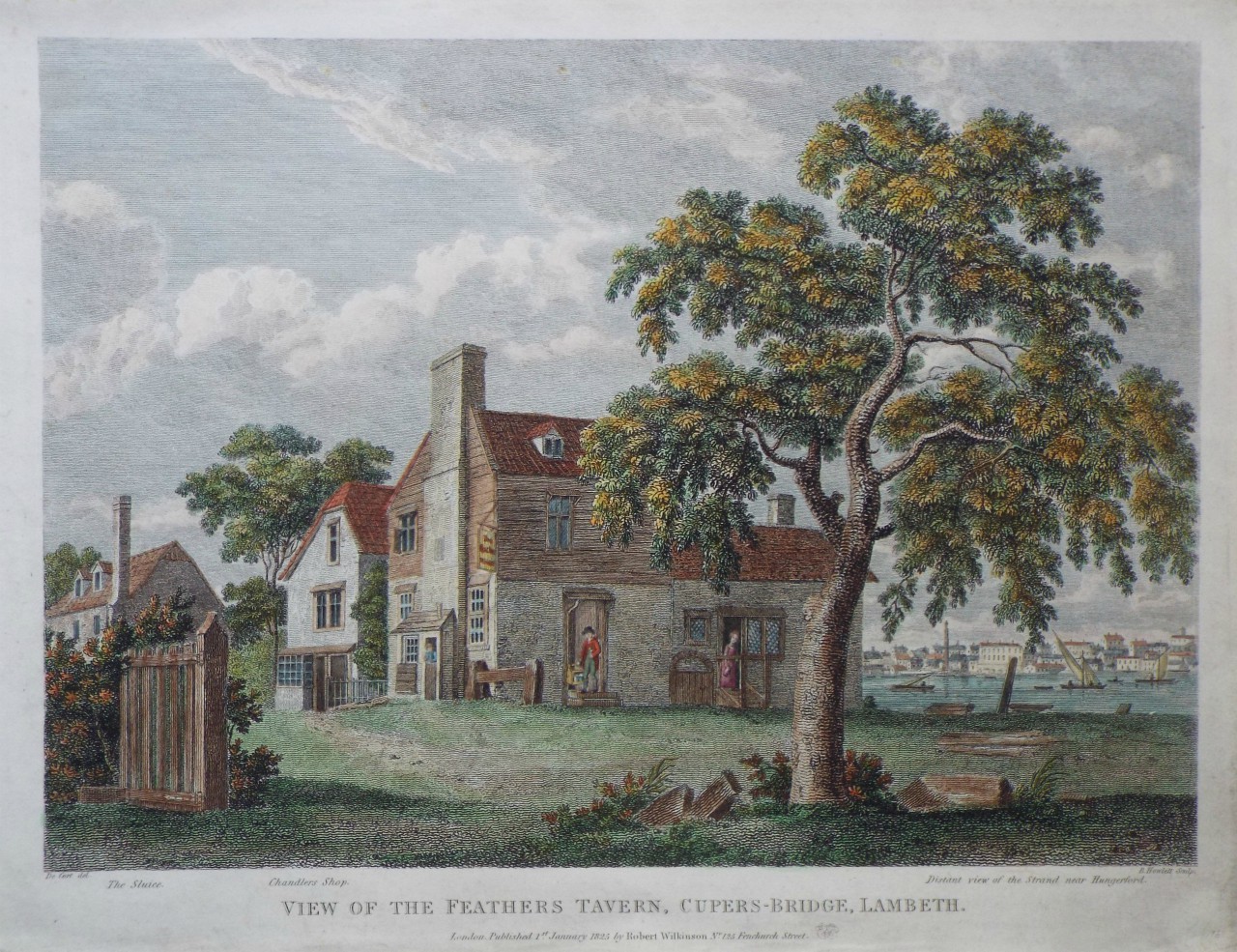
Cuper’s Bridge landing stage and the Feathers Inn [on the right] xxx
The gardens had stayed relatively small until this point but in 1686 Bodwyn and his family took a lease on another 7 acres of ground from the Archbishop of Canterbury and incorporated most of them into the garden. By this point too there are several other members of the family involved in the Gardeners’ Company. A landing stage, soon known as Cuper’s Bridge, was built to serve as the riverside approach to the gardens and a partnership seems to have been formed with a tavern known as The Feathers on the riverside.

It was clearly a profitable business. Bodwyn Cooper died in 1689. He had been admitted to the Gardener’s Company in 1650 and was made master in 1661/2, but was also a member of the Vintners Company. He left 4 children and his will suggests he was at least comfortably off. His eldest son Isaac took over the running of the gardens which were described in 1708 by Edward, Hatton as “pleasant Gardens and walks with Bowling Green… where a many of the Westerley part of the town resort for diversion in the summer season.”

from John Rocque’s 1746 Survey of London
As can be seen on Rocque’s survey of 1746 the garden plan was long and narrow. A tree-lined path led from the river and the Feathers Tavern to a central walkway with serpentine pathways on either side, lined the fragments of the Arundel Marbles. There was a bowling green and an oblong pond. Although the banks of Thames were lined with timber yards and wharves the rest of the surrounding area was still largely market gardens.

Much though one might like to think, like Hatton, that Cuper’s gardens were respectable places, like most commercial pleasure grounds they suffered from a disreputable reputation and were often referred to as Cupid’s rather than Cuper’s. Perhaps that was part of their appeal, although I suspect that’s merely a reflection of the Cupid logo on their admission token.
The marble fragments may have been a bit of a mess but in 1717 they attracted the attention of two art-lovers John Freeman Cook, of Fawley Court at Henley and Edmond Waller of Beaconsfield. It would seem that the Cupers did not have a sense of history – or maybe just preferred the money so a lot of the marbles were sold for just £75 and taken away. They were “rediscovered” in the 1960s and a couple of them found their way to join the others in the Ashmolean while others found different homes including one piece of a column taken to be used as a garden roller. [Don’t be too shocked – that was a common fate for such things in the 17th and 18th centuries]

Shortly afterwards in 1719 the then head of the family Isaac Cuper died, but it’s clear he had enhanced the family fortunes even further. Describing himself as a gentleman his will bequeathed several leases, including the ones on the gardens and at least ten houses to his widow. His son John was left more land and houses as well as “free access to the bowling greens and the gardens I left to my wife” with his friends and servants “to bowl, walke or work upon the same” and to be able to take away stuff through the back gate, and liberty of cartway leading from the wharf.” Isaac also left him a boat, the “Richard and Anne”, while His daughter Elizabeth received yet more leases on lands.


Soon after Isaac’s death the Cupers seem to have taken a back seat although they retained ownership of the lease, and management passed to Ephraim Evans. He improved the gardens adding a skittle ground, and building an orchestra where a band played from six until ten o’clock. Watchmen were appointed protect the clientele on their way to and from the gardens and to keep bad company out. In 1740 Evans died, but his widow, known universally as “The Widow” carried on the business. She advertised regular concerts and elaborate firework displays which as earlier posts show were very popular at the time.
They were however potentially hazardous events to stage.

Kentish Weekly Post 2 June 1750.
Handel’s “Fire-Musick” from his opera Atalanta was performed with “Fire-Wheels, Fountains, large Sky-Rockets… played off the top of the Orchestra. and attracted a fashionable Clientele, including the Prince and Princess of Wales, and many “nobleman and their ladies. ”

Ipswich Journal – Saturday 21 May 1743. British newspaper Archive
In the latter year the gardens, which had always attracted pickpockets and other undesirable clientele in spite of the shilling admission charge, became what Thomas Pennant called “the great resort of the profligate` of both sexes.” fell under the ban of a new Act “for the better preventing thefts and robberies, and for regulating places of publick entertainment and punishing Persons keeping Disorderly Houses”. It required premises for public entertainment to be licensed and the magistrates refused to grant one to Mrs Evans. For a few years she continued to run the place as an unlicensed tea garden in connection with the Feathers Tavern, with occasional private evening concerts and firework entertainments open only to subscribers, but it finally closed in 1760. It’s unclear what happened next but the gardens regularly mentioned in the press, and it seems a timber yard was constructed as well as pumping machinery to supply water to Lambeth.

In 1761 the lease of the gardens was bought byJesus College who sold the lead from the roof of the “Great House” and felled some of the trees, while the house near the entrance and other outbuildings were let out as tenements. The following year the college granted a 20 year lease to Mark Beaufoy who cleared the site and built a a distillery for the manufacture of vinegar and “British Wines” using imported dried grapes from Spain and Portugal which “admirably mimicked” foreign wines such as Madeira and Frontignac in vast quantities.” Thomas Pennant estimated there were vats for 58,000 gallons.

In 1813 Jesus College sold the original 3 acres to the Strand Bridge Company which had been set up to construct the new Waterloo Bridge and associated roads. The Feathers was demolished and rebuilt nearby but demolished again in 1951. By then whatever remained of the gardens had disappeared, although the name lingered on for a while longer and is recalled almost with nostalgia.

Morning Herald (London) – Friday 28 June 1822


 The Garden History Blog
You must be logged in to post a comment.