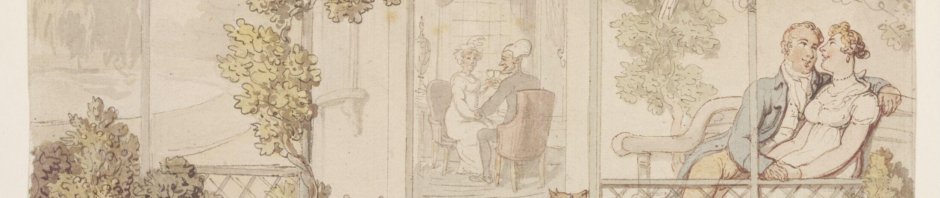

I wrote a few months ago about William Gilpin who was in the words of the Monthly Review in April 1799, “the venerable founder and master of the picturesque school.” The problem was that while his travel writings and books about aesthetic theories helped define “picturesque beauty” there’s little doubt that he was more than a bit pompous and self-opinionated, and so very easy to satirise.
There was no better deflater of the self-important than the cartoonist Thomas Rowlandson. He apparently told a group of friends that he had decided on a tour of his own to the West Country and he felt “in a humour to sketch a series, where the object may be made ridiculous without much thinking.” Gilpin was an easy target and by 1809 Rowlandson had invented the character of Dr Syntax.
Like Gilpin, Syntax is a clergyman, artist and schoolmaster who travelled to out-of-the way places, drawing and describing them for publication. The result was humour that parodied Gilpin not cruelly but comically, in ways that can still make us laugh today.

The Images come from the 1903 reprint unless otherwise acknowledged
Interest in the Picturesque had grown rapidly during the second half of the eighteenth century, and led to a spate of books about tours around Britain, like those of Gilpin. These were often illustrated using new techniques such as aquatinting that allowed the easy reproduction of sketches and water-colour drawings. Having got the idea Rowlandson produced a series of drawings which he offered to Rudolph Ackerman, a prominent print-seller and publisher for possible publication. [Many of these, including those not used, are now in the V&A] Ackerman, now best remembered for his monthly journal the Repository of Arts, saw the commercial potential and in a reversal of the usual business model of the day, where illustrations were commissioned after the acceptance of the text, he approached William Combe, a prolific writer for hire to produce the words to accompany some of Rowlandson’s sketches.

The first appearance of the Reverend Dr Syntax was in The Schoolmaster’s Tour published as a serial in another of Ackerman’s ventures, The Poetical Magazine, in 1810. He was identified as someone who fitted Gilpin’s definition of a “man of taste” because he could distinguish between “good” and “bad” picturesque compositions [ie he agreed with Gilpin].

Ackerman’s commercial judgement was right. Coming at a time when England was caught up in war, and domestic tourism was back in fashion, his appeal was enormous. The Schoolmaster’s Tour was republished in book form as The Tour of Dr. Syntax in search of the Picturesque in 1812. Over the next ten years three more books followed. As you’d expect from the title it recounts the reverend gentleman’s adventures around the countryside in search of perfect picturesque scenery. The book is divided into 26 Cantos, the first opening with Syntax contemplating the drudgery of his work as a schoolmaster and curate, his low pay for both, and his lack of chances for preferment in either…

And told the way to wealth and fame;

…“Oh! tell me,” cried the smiling dame,
” Tell me this golden road to fame.
So the good Doctor begins to explain…
You charm my heart, you quite delight it.”
“I’ll make a Tour—and then I’ll WRITE IT…
I’ll ride and write, and sketch and print,
And thus create a real mint ;
I’ll prose it here, I’ll verse it there,
And picturesque it everywhere.
I’ll do what all have done before ;
I think I shall—and somewhat more.
At Doctor Pompous [ie Gilpin] give a look ;
He made his fortune by a book :
And if my volume does not beat it,
When I return, I’ll fry and eat it.

Having convinced his wife Syntax sets off on his mare Grizzle. Everything that he does on his journey, the choices of where he goes, the way he tries to amend and improve the scenery he sees, and of course his intention to publish an account of his journey all echo Gilpin. Rowlandson’s sketches and Combe’s verse both parody and mock picturesque aesthetics, and instead of Syntax objectively describing what he sees on the tour they make him become the centre of attention instead.
 Of course that may in part be because he himself is picturesque, at least according to Gilpin’s rules. Gilpin wrote that if you wanted to see “the human face in its highest form of picturesque beauty, examine that patriarchal head…What is it, but the forehead furrowed with wrinkles? the prominent cheek-bone, catching the light? Just one glance at Rowlandson’s almost caricature-like figure is enough to prove the point, but Combe makes it quite explicit having Syntax say:
I am myself, without a flaw
The very picturesque I draw

So what happens on Dr Syntax’s tour? No sooner has he left home than he goes into a reverie about the fame that is going to come his way and gets lost. He comes to, and finds himself in a plain and dull landscape, with just some donkeys and a broken and illegible signpost in view…
Oh what a wide expanse I see,
Without a wood, without a tree…
…How could I come, misguided wretch,
To where I cannot make a sketch”…
But of course this does not stop him inventing a picturesque scene.
…But, as my time shall not be lost,
Ill make a drawing of the post ;
And tho’ a flimsy taste may flout it,
There’s something picturesque about it:
“Tis rude and rough, without a gloss,
And is well cov’red o’er with moss ;
But still the sketch is disappointing so he decides to add a group of cows to his drawing, although there are none in sight, and turns the pond where Grizzle is drinking into a stream, and the flat horizon into a “flat a shaggy ridge, And o’er the water throw a bridge” because…

_ I’ll do as other sketchers do—
Put anything into the view ;
And any object recollect,
To add a grace, and give effect.
Thus, though from truth I haply err,
The scene preserves its character. |
What man of taste my right will doubt, _
To put things in, or leave them out ? *
Tis more than right, it is a duty,
If we consider landscape beauty :
He ne’er will as an artist shine, |
Who copies Nature line by line: |
Whoe’er from Nature takes a view, |
Must copy and improve it too.

His journey is full of incidents which must have been real to travellers at the time but which also allow Rowlandson takes full advantage of the comic possibilities. One is a reflection of a rather bizarre comment by Gilpin in his Observations on some parts of England where he explains how a particular Lakeland view could be improved by the inclusion of some figures, in fact “nothing could suit it better than a group of banditti…the imagination can hardly avoid conceiving a band of robbers lurking under the shelter of some projecting rock; and expecting the traveller, as he approaches the valley below”. Combe and Rowlandson take this literally and have Syntax so busy sketching the landscape that robbers can creep up on him and then steal his money and horse and leave him tied to a tree. The good doctor thus experiences real terror and dread as opposed to Gilpin’s depiction of them as picturesque or sublime. Luckily he is rescued by two charming ladies so it ends well.

But still Syntax isn’t disheartened and eventually arrives at Oxford, his alma mater. There he meets with a former fellow student, now the Provost of the university, enthusiastically telling him of his plans
‘‘T’m going further, on a scheme,
Which you may think an idle dream ;
At the fam’d Lakes to take a look,
And of my Journey make a Book.”
Could Doctor G—— in chariot ride,
And take each day his wine beside,
If he did not contrive to cook,
Each year, his Tour into a book;
A flippant, flashy, flow’ry style,
A lazy morning to beguile .

Thereafter something happens to Dr Syntax in every canto of the book, almost all either related to his search for scenes that have picturesque qualities or to his complicated relationship with his good lady wife. When leaving Oxford he dismounts to sketch the city from a nearby hilltop but doesn’t check for livestock in the field so ends up being chased by a bull and forced to take refuge in a tree. Next he hears of a ruined castle and goes to inspect it and, of course, sketch it. When he reaches it he is disappointed that there no trees or bushes.

The palace of the feudal victor
Now serves for nought but for a picture….
…Plenty of water here I see,
But what’s a view without a tree ?
There’s something grand in yonder tower,
But not a shrub to make a bower;
Howe’er I’ll try to take the view,
As well as my best art can do.”
His thoughts come straight from Gilpin’s Three Essays: “We must ever reflect that nature is most defective in composition; and must be a little assisted…I take up a tree here, and plant it there. I pare a knoll, or make an addition to it”. Unfortunately for him Syntax’s attempts to use his “best art” lead to disaster…
An heap of stones the Doctor found,
Which loosely lay upon the ground,
To form a seat, where he might trace
The antique beauty of the place:
But, while his eye observ’d the line
That was to bound the mark’d design,
The stones gave way, and, sad to tell,
Down from the bank he headlong fell.
The comic nature of these mishaps is clear enough in Rowlandson’s pictures, but its neatly reinforced by Combe’s satirical verse: Once again the traveller in search of the picturesque becomes the centre of attention rather than the picturesque view he was trying to capture.

Later, invited to go hunting his continued obsession takes precedence and he replies
“‘Your sport, my Lord, I cannot take
For I must go and hunt a lake ;
And while you chace the flying deer,
I must fly off to Windermere,
Stead of hallooing to a fox,
I must catch echoes from the rocks;
With curious eye and active scent,
I on the picturesque am bent ;
This is my game, I must pursue it,
And make it where I cannot view it,

The sheep all baa’d, the asses bray’d,
The moo-cows low’d, and Grizzle neigh’d !
‘Stop, brutes,” he cried, “your noisy glee
I do not want to hear—but see ;
Though by the picturesquish laws,
You’re better too with open jaws.”

And it wouldn’t be a commentary on the Picturesque movement if there wasn’t a sly attack on the then fashionable garden style and its classical architecture:
T’ ascend the hill, and trace the plain,
Where lavish Nature’s proud to reign!
Unlike those pictures that impart
The windows of Palladian art,
From whence no other object’s seen
But gravel-walk, or shaven green ;
Plann’d by the artist on his desk ;
Pictures that are not picturesque…

…Nature, dear Nature, is my goddess,
Whether arrayed in rustic bodice,
Or when the nicest touch of Art
Doth to her charms new charms impart:
But still I, somehow, love her best
When she’s in ruder mantle drest:
I do not mean in shape grotesque,
But when she’s truly picturesque.

En route along the way Syntax meets, befriends and stays with a range of people including Squire Worthy in Cumberland, and a peer of the realm referred to as The Lord.
Syntax is also thinking of his publishing ambitions, he solicits subscriptions from people he met, and visits a bookseller to try to sell his manuscript for publication only to be told
“A Tour, indeed!––I’ve had enough
Of Tours, and such-like flimsy stuff”
and describes Dr. Syntax’s tour as a “fool’s errand” to travel throughout the country “and write what has been writ before!”
Fortunately the Lord has written a letter of support for his publishing proposal and the bookseller is persuaded to change his mind, proving that a man of taste and learning will be worth reading. The whole story ends on a happy note because not only is his Tour to be published but after he has returned home to the arms of his loving wife he receives a letter from Squire Worthy saying that the vicar of his parish has died and offering the living of his parish – in the picturesque Lake District – to Syntax for a stipend of £300
Thus the good Parson, Horse, and Wife,
Led a most comfortable life.


Three more books followed — The Second Tour of Dr Syntax in Search of Consolation (1820) and The Third Tour of Dr Syntax in Search of a Wife (1821) These have less about the picturesque in them but they find humour in other aspects of Georgian life and were equally popular. They inspired Syntax memorabilia and other writers to produce books about him.

Rowlandson and Combe’s story is not the only critique of the picturesque and the picturesque tour in particular. Its satire on both the “pursuit” of picturesque and the accompanying consumer craze of guide books was echoed by others. Indeed other writers claimed that some of these travel books were written at least in part without leaving home, or simply plagiarised from existing texts. Such comments show how widely the picturesque aesthetic was understood and appealed to, at least by the educated.

Combe and Rowlandson make a perfect coupling. The doggerel verse and the almost caricature-like images are a running joke ridiculing the picturesque tour and the picturesque tourist’s misadventures. Although time has dulled the pointed satire there is enough humour in the story to bring a smile on every page. I recommend it as a cure next time you succumb to picturesque mania!


 The Garden History Blog
You must be logged in to post a comment.