
 As usual I’ve been wracking my brains for the last few weeks trying to think of something original and garden-related to say about Christmas.
Over the last ten years I’ve tackled all sorts of things Christmasy from Hellebores to Brussels Sprouts and Amaryllis to Ivy. I’ve even looked at artificial Christmas flowers whilst studiously avoiding the obvious things such as Christmas trees . Sadly I thought this year I might have to give in, and for want of anything better finally give in and look at firs, spruces and pines but in starting my research I discovered another seasonal subject which allows me to avoid them for at least another year!
So if you don’t know much about Moodjar or Pōhutukawa then read on…

and see if you can work out what might they have in common with Bursaria, Blandfordia, Prostanthera, Ceratopetalum, or Calanthe?
The answer is probably obvious if you’re a botanist, especially if you’re a botanist from the other side of the globe, as they’re all plant families that have species that flower around Christmas time and have Christmas as part of their everyday non-Latin names. The first three families all contain trees and so theoretically at least capable of standing in for the Norway spruce or its equivalent in your sitting room right now. Most of these plants were introduced to Britain about 200 years ago and went into cultivation, and even commercial production, in hothouses soon after their arrival but they are all relatively unknown here today.

Nuytsia floribunda
Image credit: enjosmith/Wikimedia (CC BY-SA 2.0)
So let’s take a look at some of them starting with moodjar, which in botanical Latin is Nuytsia floribunda and which comes from south western Australia. This is a very unusual tree on several counts. First of all, it’s the largest parasitic plant in the world (or rather hemiparasite ie it gets its water and nutrients from other plants but also photosynthesises at the same time) Despite the fact that it can grow up to 10 metres tall one of its closest relations is mistletoe.

Next, according to Australian Geographic magazine, when one of its roots meets the roots of another plant it forms a collar of tissue around it, like a swollen wedding ring, and a sharp edge or blade forms inside that slices into the other root to gain nutrition and water from it. The edge is so sharp it can also cut through underground cables or human skin. Unlike many other parasitic plants Nuytsia is indiscriminate about host plants and will batten onto the roots of any green living things with each tree drawing on large numbers of victims up to 100 metres away.


Of course, the reason that it’s included in today’s blog is because of its extraordinary clusters of flowers which form huge inflorescences, up to a metre long between late October and January. Early European colonists called it the Fire Tree or the Flame Tree but it soon became the West Australian Christmas Tree,
The Noongar and Wadandi people who are the traditional inhabitants of the area where it grows consider it sacred, with each flower representing the spirit of a person that has passed on, while its vibrant sunset colours remind people that “our spirits travel across the country, through the caves and over the ocean where the sun sets for our final resting place.”
For more on the traditional significance of Nuytsia Floribunda see this post from Anthropology from the Shed.

Nuytsia was first recorded on the coast of Esperance Bay in south west Australia, by Jacques Labillardière a naturalist on the 1790s expedition to the antipodes led by Bruni d’Entrecasteaux. This was early in the wars between Britain and revolutionary France and on their return journey home all Labillardière’s work was captured by a British fleet. Luckily he was a friend of Joseph Banks who, when he found out, persuaded the British Government to return them “in order that he may be able to publish his Observations on Natural History in a complete manner. By this her Majesty will lose an acquisition to her herbarium, which I very much wish’d to see deposited there, but the national character of Great Britain will certainly gain much credit for holding a conduct towards Science and Scientific men liberal in the highest degree.” Labillardiere then published a popular account of his journey in 1800 and followed it up with the first account of Australian plants Novae Hollandiae plantarum specimen between 1804 and 1806. Nuytsia was named in honour of a 17thc Dutch explorer Pieter Nuyts, and the first scientific description was published in 1834 by George Don [more on him in this earlier post]

Study of the West Australian Flame-Tree or Fire-Tree by Marianne North, Image credit: The Board of Trustees of the Royal Botanic Gardens, Kew

Flowers of the Flame-Tree and Yellow and Black Twiner, West Australia, Marianne North
Image credit: The Board of Trustees of the Royal Botanic Gardens, Kew
Of course most early colonists were not interested in Nuytsia’s botany but in any economic value it might have. They were quite disappointed because the wood is commercially useless and the gum ,while sweet and used by the indigenous people, has little value.
However Marianne North was enthusiastic about it saying: “I shall never forget one plain we came to, entirely surrounded by the nuytsia or mistletoe trees, in a full blaze of bloom. It looked like a bush-fire without smoke.”
So what are the chances of it being a replacement Christmas tree here in the west? Unfortunately pretty slim I think because although Nuytsia will grow readily from seed, it is difficult to transplant and it’s rare for it to survive for more than a year or two outside of its natural range.


More traditional Christmasy in colour is the New Zealand tree pōhutukawa or ‘splashed by the sea’ in Maori. In botanic Latin it is the almost as equally difficult to pronounce Metrosideros excelsa. I was lucky enough years ago to see it in flower in its home country, and WOW was it impressive, so no wonder it is commonly referred to outside New Zealand as the New Zealand Christmas tree.
It’s an evergreen in the myrtle family, usually growing by the coast of North Island, and often in difficult rocky positions. They produce an amazing show of red stamens, although there is great variation in form and colour with small numbers of naturally occurring pink, yellow and white versions, whilst hybridisation has increased the colour range even further.


Pōhutukawa is an important tree to Maori as it is believed that spirits depart to the next world via the sacred tree growing at Cape Reinga on the northernmost tip of North Island country.
Unfortunately, there are several reasons why pōhutukawa probably wouldn’t make good replacements for Christmas trees here. Firstly they’re very susceptible to frost. That means the only parts of Britain where they stand a chance are the mildest and most sheltered parts of Cornwall, and the Scilly Isles and to prove that point there are a group growing at Tresco Abbey. However there is hope that new hybrids are proving more resistant and there are even some now being offered by nurseries in Cornwall.
There’s lots more information about this with descriptions of cultivars and crosses between M.excelsa and other species in the New Zealand Garden Journal, 2010,

Rowan, Ellis, Flower and bird paintings
Flower & Bird paintings
Pōhutukawa also usually grow as multi-trunked spreading trees, however, since they can grow to 25m often with incredibly gnarled trunks and branches that can be festooned with bunches of hanging aerial roots. they’d take up too much house-room , so could only possibly be a replacement for the one in Trafalgar Square ,

So if it’s not terrible practical to think of hanging your baubles on Nuytsia or Metrosideros maybe you could consider some smaller alternatives. Perhaps Blandfordia would fit the bill? Known as Christmas Bells in its native Australia there are four species, although they hybridise quite easily and there are several naturally occurring crosses.

The name Blandfordia was chosen in 1804 by Sir James Edward Smith, the founder of the Linnaean Society, in honour of George Spencer Churchill, then the Marquis of Blandford who was a great collector, gardener and spendthrift at his estate at Whiteknights near Reading. Smith had been sent dried specimens collected around Sydney and named them B. nobilis. Seeds were also being sent over to London nurseries around about the same time, although the first flowers didn’t appear until 1818 at Whiteley and Brames’ nursery.
There was initially a lot of confusion because ,as European exploration of Australia proceeded, three more species of were discovered. The first was distinct: Blandfordia punicea which is endemic to Tasmania where it is widespread. It was first named in 1805 but it wasn’t until 1842 that a plant flowered in England, at the Fulham nursery of Messrs. Osborne and Co.

Next came a larger flowered kind which grows along the coast and tablelands of New South Wales and southern Queensland.
Slow-growing with grass-like leaves and flower spikes having some ten to twenty bell-like flowers that vary from yellow to red with yellow tips, it was collected and named B. grandiflora by Robert Brown in 1810.
Our drawing of this superb liliaceous plant was made at Mr. Colvill’s Nursery, in August. The plant was growing in the open border of a new conservatory, where it flowered in great beauty and profusion. We are informed that it had been raised from seeds collected. in some part of New Holland by Mr. John Richardson; but Mr. Sweet tells us that he cultivated it several years ago, at Stockwell.

The last species, B.cunninghamii, came from the Blue Mountains , west of Sydney and is equally showy. It was thought originally to be a variant of grandiflora before it was recognised as a new species and named by John Lindley in 1845.
While none of these could replace a Christmas Tree they could replace any potted plants or cut flowers you might choose to have around the house at this time of year because peak flowering occurs around Christmas, hence the common name of Christmas bells. Their large, distinctive flowers and long vase life have good commercial potential for the cut flower trade and a small group of producers are already providing them to the Australian domestic market and investigating export markets.
For more info see Blandfordia in History by Tony Cavanagh


If you’re not impressed by Christmas Bells then how about Christmas Bushes? There are three competing Australian plant families given this name. From Victoria [and elsewhere on the eastern side of the continent ] comes Prostanthera lasianthos, commonly known as the Victorian Christmas Bush or coranderrk. It too was recorded by French naturalist Jacques Labillardière and described in his 1806 Australian Flora Novae Hollandiae Plantarum Specimen.
It’s a member of the mint family and capable of growing as a tree although normally it’s a large fragrant-leaved shrub that has adapted to long periods of drought and heat. Long sprays of white or pale mauve flowers appear around the Christmas season.


Further north is another large shrub/ small tree which is a rival for the Christmas Bush name. This is Ceratopetalum gummiferum, which is known as the New South Wales Christmas Bush, which has become a popular garden plant because its sepals turn bright red-pink at around Christmas time.

A third Christmas Bush comes from Tasmania and elsewhere on the eastern and southern coasts. Formally known as Bursaria spinosa it was first recorded by Antonio José Cavanilles in 1797 in his book, Icones et Descriptiones Plantarum. It too flowers around Christmas time but is probably a bit confused because not only is it the Tasmanian Christmas Bush but its also called Australian blackthorn, mock orange, prickly box, prickly pine, spiny box, thorn box and whitethorn amongst many others.

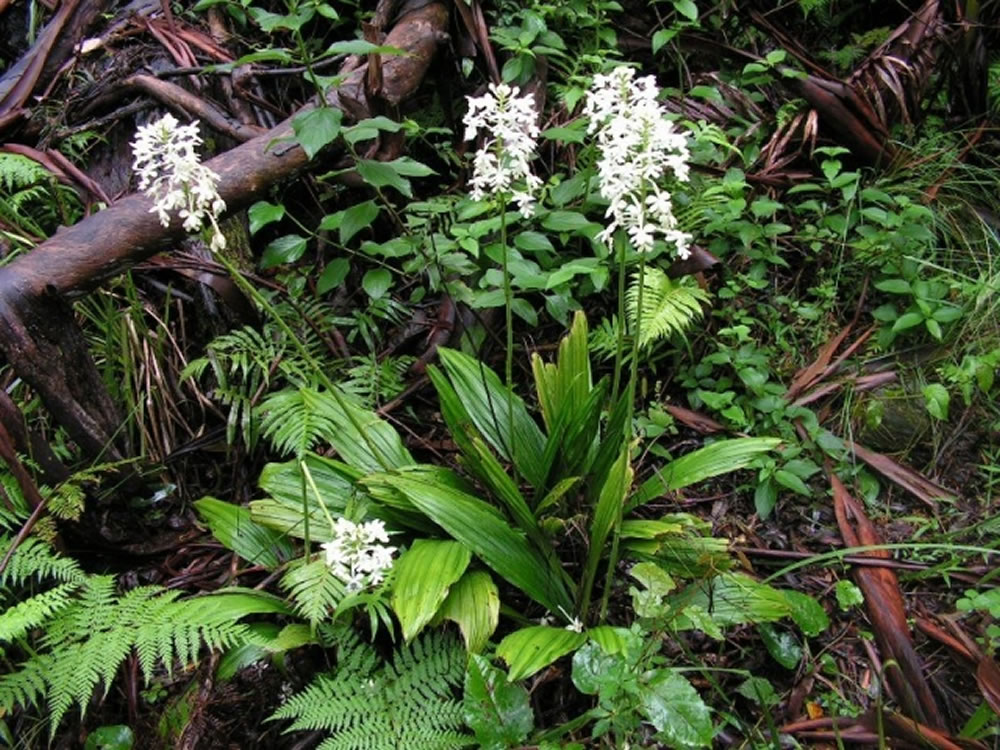
And finally if you really don’t want a large shrub cluttering up your living space how about a house plant that you can cover with tinsel? Two immediately spring to mind. There’s the Christmas Orchid Calanthe triplicata, first described in 1796, which is a terrestrial orchid widespread across Oceania, Asia, and the islands of eastern Africa. It forms clumps and has dark green corrugated leaves and up to forty white flowers on a stem.

And, finally, there’s Christmas Cactus or Schlumbergera which is probably the most well-known and commercially available of all these Christmas-related plants. In their native Brazil Schlumbergera are very uncactus-like growing not in arid deserts but on trees or rocks in habitats that are generally shady with high humidity. There are several species which are easy to hybridise, with the first known cross by William Buckley in 1852 and known as S.x buckleyi. This is the one thought to be the original Christmas Cactus.


By the 1860s, a substantial number of cultivars had been bred in a range of colours and habits, which were used as ornamental plants in hot houses, where they were popular for their autumn and winter flowering. However fashions change and by the early 20th century, many of these early cultivars had been lost. Commercial interest grew again from the 1950s and led to a new wave of breeding programmes aimed this time at producing plants capable of surviving as houseplants without the need for hothouse conditions.
Although they are often seen as rather sad-looking specimens on bathroom windows [well that’s where I first saw them in my grandparents house] there is now a much wider range of flower colour and shape including the first true yellow. There is even a group of gardeners dedicated to growing and promoting them – their photos are almost enough to convert someone to loving them, especially as they are the easiest to grow of all the Christmas named plants I’ve found. What they’d look like covered with tinsel and glitter I’m not sure …
but surely anything’s better than another Christmas tree!


 The Garden History Blog

You must be logged in to post a comment.