
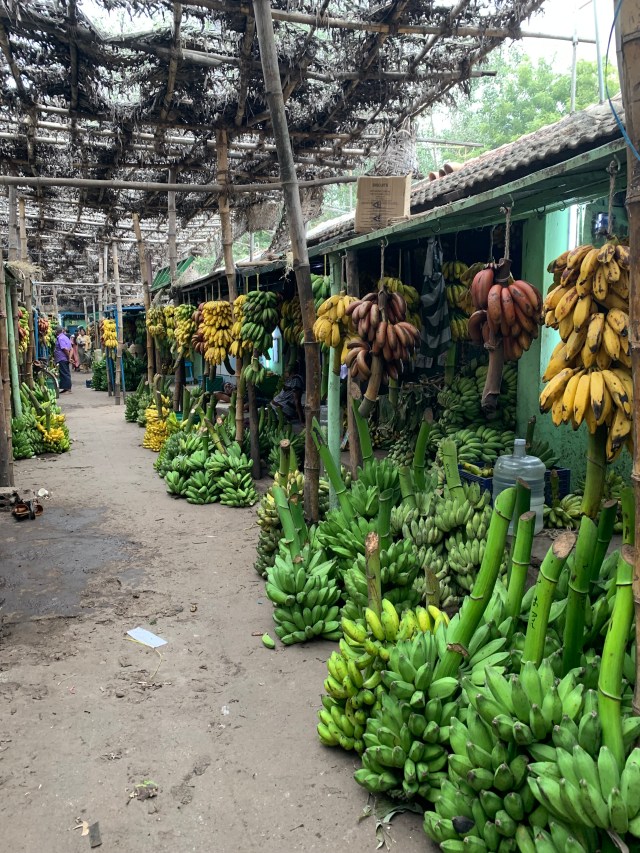
 I’ve just returned from a trip to southern India where one of the most amusing incidents was being taken to Banana Street, a narrow alleyway that led off the main fruit and vegetable market in Madurai.
The 40 or so stalls that lined both sides of this little thoroughfare only sold bananas and the guide said very proudly, there were 16 varieties on sale all grown locally.
I love bananas but I’d have been hard-pressed too distinguish more than 3 or 4 different sorts on display and none of them were that much like the ones we in Britain see on our supermarket or greengrocers shelves.
So of course I had to find out more about bananas and their history if not in our gardens then at least in our conservatories and supermarket shelves…


Let’s start with a question: when were banana first known about in Britain?
I thought I knew the answer to that. Surely it’s the bunch that was hung up at the shop of Thomas Johnson a herbalist, near St Paul’s Cathedral in 1633.
Johnson was responsible for the second edition of Gerald’s Herbal in which he says “The fruit which I received was not ripe, but greene. This stalke with the fruit thereon I hanged up in my shop, where it became ripe about the beginning of May, and lasted until June.” But I was wrong…

…because in 1999 archaeologists excavating a mid-16th rubbish pit in Southwark uncovered a blackened banana skin. At first they thought its must be a practical joke, but its authenticity was confirmed by conservation experts including Taryn Nixon, then head of the Museum of London’s archaeology services who said it has been found “in a sealed context” next to “dateable objects”. That makes it about 80 years older than Johnson’s.

Nowadays bananas grow almost anywhere that’s hot and wet enough and they are non-seasonal ie they fruit continuously. Those factors helped make them one of the world’s most important economic plants with production over 134 million tons in 2022 But they originate from a wild species that was taken into domestic cultivation in New Guinea about 7000 years ago. [For more on that see this article in the Smithsonian Magazine]
From there bananas were slowly dispersed across south east Asia, to India, before being carried along major trade routes to East Africa and the Middle East. The spread of Islam took them to Spain and North Africa. The Portuguese had encountered them in West Africa in the 15thc hence the likely source of their name from the Wolof word banaana, while the Spanish took them to the New World soon after their conquest and it’s thought that Johnson’s bunch may have come from Bermuda.
Bananas make an appearance in many of the great Renaissance books on natural history. Matthioli including those of Monardes and Oviedo which cover plants of the new world and Clusius’s translation of Orta which is an account of plants on the Indian subcontinent.


In Britain they are illustrated in the first edition of Gerard’s Herbal in 1597 where they’re called Adam’s Apple and said to grown in Egypt, Cyprus and Syria where they are known as Musa [which is now their botanic name], as well as the Malabar coast of eastern India [not far from Banana Street] and in Malaya. It doesn’t mean that Gerard had actually seen a banana plant or even a banana as the woodblocks for these images were borrowed from an Antwerp printer and were used in other books. As an earlier post showed Adam’s Apple trees also make an appearance on the title page of John Parkinson’s Paradsisi published in 1629.
Thomas Fairchild grew a banana in his Hoxton nursery in the early years of the 18thc and his successor, John Cowell illustrated it in is own book The curious and profitable gardener of 1730, where he appealed to “those Gentlemen who have Dealings in Jamaica, and other Parts of the American warm Countries” saying he would “be grateful to any who will furnish me with that Curiosity, as the House I have built for my Aloe is of a suffficient Height to bring the Banana or Plantain to perfection.”

However, regular sightings of bananas in Britain only came with faster steam ships in the 19th century, and then the development of refrigeration in the early 20th century. This turned an exotic novelty into what according to Kantar, the market research company is the nation’s favourite supermarket purchase. Bananas became Britain’s No 1 fruit for the first time thirty years ago, and by 2023 the average consumer was buying about 25 kilos a year – or about one banana every 2 days. There’s no doubt that supermarkets helped the process along too, because with the arrival of discount stores the main grocery chains responded with aggressive price cuts on key products and alongside sliced white loaves and baked beans bananas became a loss leader. And of course you may just be old enough enough to remember the catchy advertising jingle …


So perhaps it’s unsurprising that Lakeland has become famous for the banana guard, a yellow plastic case which protects the fruit from bruising, for fruit being taken for packed lunches!
It was a bit of collective shock when at one point in 2023 we almost did have to forgo the pleasure of unzipping a banana when temporary Brexit-related food shortages caused gaps to appear on Britain’s supermarket shelves. After shortages of tomatoes, lettuce and citrus fruit an award-winning Times article by Harry Wallop asked if the banana would be next.


Given that Britain depends on imports for 85% of its fruit and 100% of its bananas the threat of banana shortages was worrying and unpopular. It famously led Therese Coffey then Secretary of State to suggest we should “cherish the specialisms that we have in this country” such as “turnips”. Even though she was right in the fundamental point, she was ridiculed and one of the main reasons for the mockery was, I suspect, the British love of bananas. They can’t be replaced by turnips! While consumption of bananas continues to grow, Coffey’s turnips have almost dropped off the scale, the average consumer bought just 12 grams a week – maybe just one large turnip a year!
A new book by Louise Gray, Avocado Anxiety, points out the main reasons for the popularity of bananas “They are delicious and easy to eat. They are often the first thing you eat when you are being weaned and the last thing you can eat when you’ve lost your teeth… they are quick and nutritious. And they are joyful.” They are also cheap, and much cheaper today in real terms than they were in the 1990s when they started their rise to prominence in the fruit bowl. In terms of nutrition, few foods beat the banana for value for money.

Another key factor is certainty. You know what you’ll get when you buy a banana. There’s very little of what market analysts called “added value” ie it’s very difficult to innovate so supermarkets can’t change the colour /shape /etc and charge more. What we get in western supermarket bananas is uniformity and reliability. So the obvious question is why?

The answer is surprisingly simple. First of all bananas are not like many other fruits. Despite appearances they don’t grown on trees but on the planet’s largest herbaceous plant, with giant species able to grow to 7m [23ft tall] and even the dwarf forms reaching 3m [10ft]. They grow from a corm [which is an underground stem] and what appears to be the trunk is actually a pseudostem, each of which forms a single flower spike. Crucially they are propagated by cuttings not seeds. In other words new banana plants are clones of the parent plant and almost all the commercially grown bananas that we in the west eat are clones of a single plant of a variety known as the Cavendish, now almost 200 years old, whose origins are given away by its name.


As you may have guessed that single plant was grown at the home of the Cavendish family: Chatsworth House in Derbyshire, then as now the seat of the Dukes of Devonshire. In the mid-19th century it was also the home and workplace of the Duke’s gardener, Joseph Paxton. Paxton had built the duke what was then the world’s largest greenhouse and then worked with his patron to fill it with the rarest plants they could obtain. One in particular arrived by a roundabout route.
In 1829 two dwarf banana plants were shipped to Robert Barclay of the Bury Hill estate in Surrey by Mr Telfair of the botanic gardens in Mauritius. Telfair “had collected a great number of both species and varieties of Musa to ascertain those most worthy of culture.” He thought these two plants, which he name Musa chinensis, “to be the most desirable, for that purpose, out of all his collection; and, from its also fruiting when only 3 ft. high, he had very sanguine hopes of its being found to prove a valuable addition to the English stoves, where he expected it would fruit abundantly.”

Barclay died before the plants had matured and produced fruit. His plant collections were sold at auction and the bananas bought by Charles Young a nurseryman in Epsom [who has figured in an earlier post]. Young then sold one to an overseas buyer and the other to Paxton for £10. His finally flowered in late 1835, and fruited the following May. Taste is a very difficult sense to translate into words but Paxton said “when in perfection, it combines the pineapple, the melon and pear”. He named it Musa cavendishii, in honour of the duke’s family. Although it had been sold as Musa chinensis because Paxton’s was the first scientific description published, under international taxonomic rules, Musa cavendishii it has been ever since. For his work, Paxton won the Knighton Silver Medal at the 1835 Royal Horticultural Society show.


As we’ve seen Paxton was not the first to grow and fruit bananas in Britain by any means. But the early examples were all in botanic gardens, commercial nurseries or the exceptional aristocratic hothouse. For example, Loudon tells us that “In the year 1789, a very fine plant of the Musa paradisiaca fruited in great perfection in the pine stove of Tynningham, the seat of the Earl of Haddington, in East Lothian…. and yielded in the autumn four “hands” of well ripened fruit; the first, perhaps, that were ever seen in a dessert in that part of the world.”
By the 1820s hothouse cultivation of various members of the Musa family seems to have become much more widespread. 1826 Loudon’s Gardeners Magazine reports Musa coccinea growing in the conservatory at The Grange; and by 1828 a banana plants was exhibited by a Mr Jessop of Gloucester by Mr Smith of Hungate in the centre of York at local horticultural shows.

A description and history of vegetable substances, used in the arts, and in domestic economy published in 1829 by the Society for the Diffusion of Useful Knowledge cites a paper by John Lindley, “On the Tropical Fruits likely to be worth cultivating in England*,’which includes mention of banana saying that there are so many varieties , that’they would be as difficult to describe as the sorts of ‘apples and pears of Europe.” It adds that “The banana has frequently produced its bunches of yellow fruit in hothouses in this kingdom; particularly at Wynnstay, the seat of Sir W. W. Wynn; and at Messrs. Loddiges’, at Hackney: and, according to Mr. Lindley, “‘ it appears probable that there will be as little difficulty in ripening the fruit, as that of any tropical tree whatever.”

But Paxton’s good fortune was because Musa cavendishii was not only very productive but crucially a dwarf variety. The plant he nurtured at Chatsworth was just under 5ft and with a first crop of about 100 fruit. As was reported in the Horticultural Register for April 1836 “The other species of Musa which have been long in our collections, and frequently fruited, are such majestic plants, that very few stoves are lofty enough to allow of their rising to their full and fruiting height. But this new acquisition yields its fruit when only a few feet high, so that any common-sized stove may contain as many plants as will yield a supply of fruit for the table for several months.”

Paxton then began taking cuttings and sending them to other collectors in Britain, but also overseas, as well as introducing them to the commercial nursery trade. That same issue of The Horticultural Register notes that “Plants of this species are in Rollisson’s nursery at Tooting, and are 5 guineas each.”

It was however about another century before the Cavendish variety began to dominate the market. Around the same time Paxton was trialling it, corms of another variety originally from south east Asia were taken to Martinique and Jamaica where, for reasons unknown, it became “Gros Michel” or Big Mike. This was also highly productive and became popular soon spreading round banana growing regions of the Americas where it played a big part in the long-running Banana Wars between major fruit growing companies.

Gros Michel would still be the dominant variety if it were not for one thing. To maximise production and keep prices low, most commercial bananas are grown on huge monoculture plantations using lots of pesticides. There is little or no genetic diversity which almost inevitably leads to problems with diseases, so if and when a pathogen or disease comes along there’s no natural variation to help resist it. Big Mike fell victim to one of them in the 1950s when a nasty pathogen known as Panama disease devastated commercial production. In the search for a cure or a resistant variety it was discovered that Cavendish was even better suited to exportation than Gros Michel. Fruit could be picked green, packed into refrigerated ships and be in perfect condition for ripening on arrival in the destination country.
For more on Gros Michel a good palce to start is this post on Atlas Obscura

Cavendish quickly replaced Gros Michel as the banana of large scale production and supermarket supply but in the last few years it too has been running into similar problems. This time it’s not Panama disease but a soil-borne fungus, known as Tropical Race 4 (TR4), which has taken hold in plantations, particularly in the Philippines, but more recently in Latin America. This causes leaves to wilt and fruit to rot. Unfortunately TR4 has reached bananas growing in Britain – including the Eden Project. Chatsworth is worried and the original Cavendish offspring which still grow there are no longer on display to visitors but kept behind closed doors.

xxxhttps://www.dailymail.co.uk/sciencetech/article-12662231/Scientists-warn-Cavendish-bananas-EXTINCT-catastrophic-fungal-disease-wipe-worlds-popular-type-fruit.html
The TR4 fungus thrives in poor soil — one of the few things that has been shown to slow down the spread is heavy use of organic compost and planting in small plantations, with the plants interspersed with other crops, notably onions. That’s not feasible for supermarket-scale production. Another possibility is to use gene editing/modification, although there is another option, less popular with the large corporations who control the trade, and that is variety. The 16 sorts sold in Banana Street are just the tip of the iceberg, there are actually abut 70 members of the wider banana family with about 1000 known varieties worldwide so why don’t we eat them?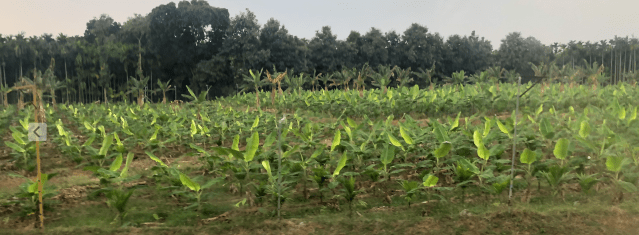

The problem with that is because bananas are so cheap there’s no incentive to diversify or invest in research and trialling to find something that is as transportable, standardised and acceptable to the consumer as the Cavendish. Profit margins are low with Fyffe’s the big banana importer having an operating profit of just around 1%. Yet without that research and variety we may see the end of the cheap all-year-round banana as we know it. As Paxton’s “baby” comes close to it’s 200th birthday having been the star of the fruit bowl for decades, I wonder what he’d suggest if he were still around? I suspect he’d agree with Harry Wallop who asks “why can’t our fruit bowls contain the small Monzana, the Blue Java or the Pisang Raja from Indonesia, described as having a sweet custard flavour? Why do we have to eat only the Cavendish?”
For more information especially about the commercial and disease aspects of bananas a good place to start is Wallop’s article “Unpeeled” If yo0u want something more in depth I’d recommend Lorna Piatti-Farnell’s Banana: A Global History ; Dan Keppel’s Banana: The Fate of the Fruit That Changed the World and Peter Chapman’s Bananas: How the United Fruit Company Shaped the World and finally try this short video by National Geographic: The Surprising History of Bananas in Under 2 Minutes
xr:d:DAF8ONV8bn0:192,j:4410571685340105941,t:24031512


 The Garden History Blog
You must be logged in to post a comment.