

As regular readers will know I’m very fond of the work of garden writer Beverley Nichols, but until recently I hadn’t really taken much notice of his interest and involvement in flower arranging. True the subject crops up in several of his semi-fictionalised accounts of his gardens but in 1967 he also published an entire book on the subject which he described as “an art — a minor art perhaps but a fascinating one nevertheless – and one with some similarities to music and painting.”
But a book, a whole book on flower arranging and its history, surely isn’t really possible. Well, its not only Nichols but several others who’ve proved that it is!


Nichols traces the development of this art from its first beginnings in ancient Egypt and Rome, through what he called the ‘spring song’ of the Middle Ages, then the discovery of the tulip, the auricula theatres of the eighteenth century and the floral arches of the Victorians, to the enthusiasm and care devoted to the subject in his own lifetime by flower specialists such as Constance Spry.
It’s interesting to speculate what he would have thought of the cult of celebrity florists which seems to be on the rise today as witnessed by the prominence of floristry in the events programme at the Garden Museum.
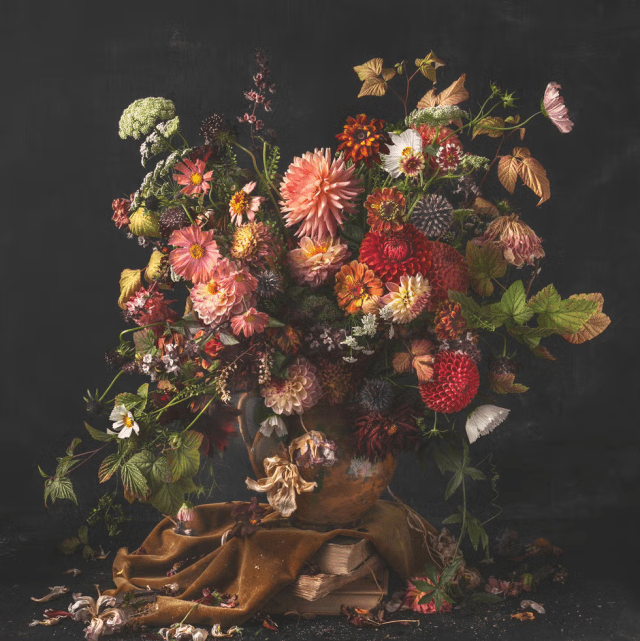
Dahlia’s Theatrical Finale by Kreetta Järvenpää
This artist loves fading flowers so in this image has dahlias in full bloom,but others flowers wilting or dead
Where do we start? If, said Nichols, “music in the mind of the architect is frozen into stone”; and “the emotion in the heart of the poet, … is set down in words which may… outlive the gilded monuments of princes. the ‘art’ of the flower arranger must always have something of the quality of an improvisation.” After all [and note his assumption about the gender of flower arrangers which of course is exactly the opposite of stereotypes,] “Only a few hours after he has set his flowers into place, and given his blessing to the leaves that twine around them, the pattern starts to change. Subtly but inevitably, the design degenerates. The stem of the wild rose that has raised its petals to the mirror, in a gesture of such exquisite abandon, begins, ever so faintly, to flag, like the arm of a model who has held a pose too long. Little by little the colours lose their freshness, and soon, all too soon, the petals will be falling….If we are of a morbid nature we may feel that in this process there is a disturbing reminder of The Picture of Dorian Gray…” Is it ever a ‘tragedy’ to have created a moment of beauty, even if it is a fleeting moment?

With writing like that it was quite tempting simply to take a couple of thousand of his words and forget adding any of my own but that would be a bit of a cop-out and it would also overlook other authors on the subject. Having said that, while of course there’s plenty of evidence that flowers and plants in themselves are a never-failing source of inspiration for architecture, ornamentation and the decoration of homes, there is actually very little written evidence for how flowers were arranged and not as much visual material as you might at first think.
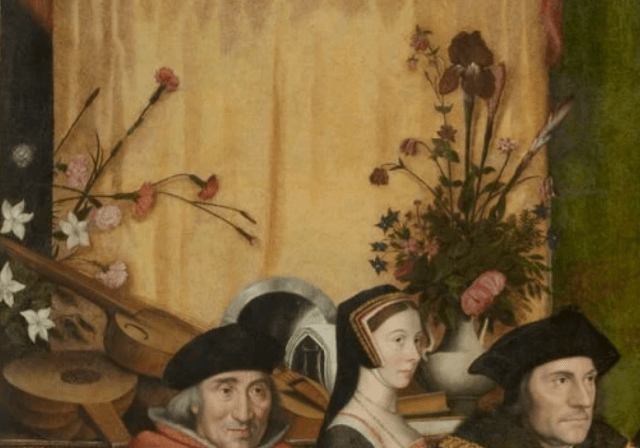
detail from Sir Thomas More, his father, his household and his descendants by Rowland Lockey, after Hans Holbein the Younger, 1593, NPG. The flowers in this painting may well have symbolic associations rather than being actual arrangements

detail from The Archdukes Albert and Isabella Visiting the Collection of Pierre Roose by Hieronymus Francken &
Jan Brueghel the Elder, c.1621-1623
While the occasional image, like the one to the left which shows the first known painting of a sunflower in western art, can be a useful contribution to historical knowldge, perhaps its not surprising that “the historian of flower arrangement is at a peculiar disadvantage”, as Nichols says “for the simple reason that all the evidence on which his findings must primarily be based — the flowers themselves — have long since disappeared.” He then lapses into several paragaphs of poetic prose. “The dust of ages covers the petals that may once have glimmered in the caves of Neanderthal man. (There is evidence in the cave drawings that flowers were objects of wonder, if not of love, even in the Neolithic era.) The roses of Pompeii are lost in the lava and trampled in the mud.”…and so on and so on.
Nevertheless it seems clear that flower arranging has been going on a long time and has developed differently around the world with strong and easily identifiable traditions in East Asia as well as Western Europe. : I’m not sure I know enough to write with confidence about the Japanese, Chinese, or other non-western arts of floristry so I’m going to stick firmly to the west.

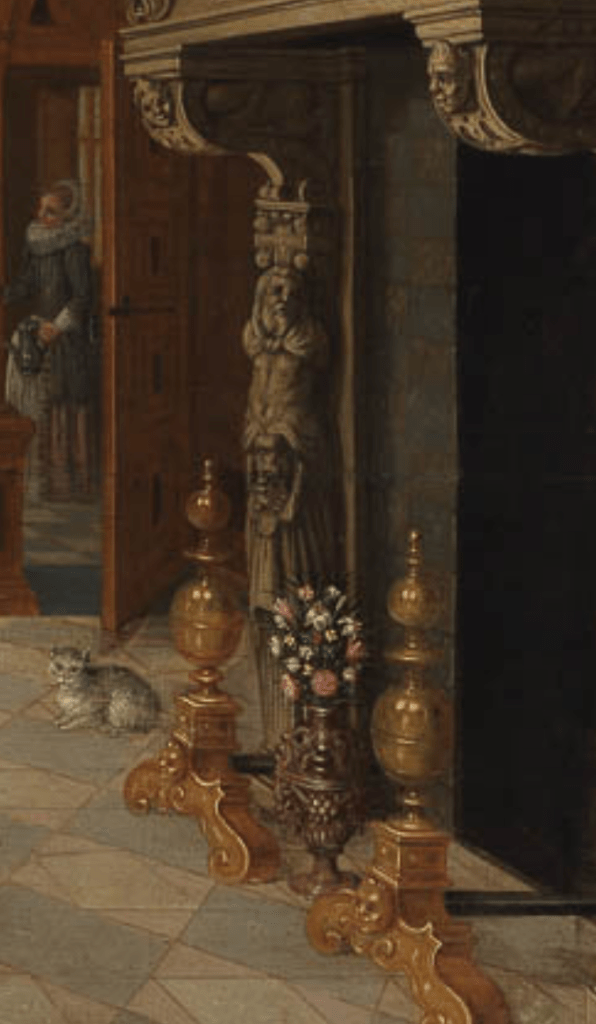
Of course Nichols is quite right, most of the obvious evidence for the ways that flowers were treated when cut faded into dust within days of them being picked. That explains why all accounts of the history of flower arranging are very vague on early periods, relying on the liittle surviving visual imagery, either of the flowers themselves or the vases and interiors where they were displayed.
That may explain why Nichols makes vases the subject of his opening chapter, at least theoretically but, as always, he allows himself a lot of leeway in what he writes about. It also gave him an excuse to tell one of his lengthy anecdotes or as he rather coyly put it “interpose a fragment of autobiography”. At first glance it was absolutely nothing to do with the subject but he returned to it partway through the story and then ended it with a surprise very much connected.

 “In the far-off days of the twenties, in one of the most enchanting London houses that the Adam brothers ever designed, there lived a lady with the most beautiful voice in the world, whose name was Nellie Melba. One Christmas night she gave a party — the first ‘grand’ party which I ever attended, for I was only lately down from Oxford and was struggling to make a living in Grub Street. In spite of my humble status I was bold enough, as the party was coming to its glittering conclusion, to approach her with a strange request.” He asked her to sing a scale and when asked “why young man” he replied “because when you sing a scale it is sheer music.” Melba then went to the top of the grand staircase and sang as she descended. Nichols was gripped by her poise and flawless singing but then
 “I noticed for the first time that at the top, and the centre, and the bottom of the staircase, standing like sentinels, were six of the most striking ‘arrangements’ that I had ever seen. Until this moment they had been almost hidden by the press of the crowd. But now they revealed themselves as tall conical spires of eucalyptus foliage, about four feet high, set in urns of great antiquity, and clipped into the shape of Byzantine spires. The leaves were so closely set that they might have been carved from stone, and in the centre of each spire, rising like a decoration of marble on a background of jade, was a single Bermuda lily. With these lovely creations in attendance Melba sang her way down the staircase, while the last of the guests turned and stared and listened, in total silence.” [I’ve looked long and hard for any images of such a grand staircase/arrangement but without success – however I have written about Bermuda lilies]

The rest of the Melba story covered another page but ended with “I forgot to mention one very important point in our story — the identity of the young lady who had decorated the staircase. It was her first important assignment in a career that was to influence the art of flower decoration for all time. Her name was Constance Spry.”
He now skilfully uses the flowers on the stairs as a reminds of the paucity of evidence because “even if her Byzantine arrangements had been dictated by the mosaics of Ravenna, or by some of those shabby little churches in the back streets of Naples where the Byzantine influence lingers on, in frescoes of blue and rose and faded gold, it is fairly safe to say that from the first thirteen hundred centuries of the Christian era she could have gained few other inspirations.” And that’s where he jumps to next saying “so let us turn at last to the Renaissance of Europe. At this point our book really begins.”

Other writers start their histories of floristry with comments about flowers in ancient Egypt where many wall paintings and bas-reliefs in tombs show how flowers, particularly lotus, albeit stylized, were displayed in vases. But there’s not really much more to say and these writers also soon end up in roughly the same place, with a look at the flowers shown in late medieval paintings, particularly those of the Annunciation. [See this earlier post for more on that]

There are symbolic overtones to virtually all flowers in images from this period. Even vases of flowers are placed in positions where they can be read as religious commetary, as in this detail from The Portinari Triptych. The flowers themselves are arranged and drawn naturalistically but despite that they carry meaning. The vase on the left is an apothecary’s jar and contains white and blue irises and a lily, symbolising the Virgin’s chastity, Christ’s kingliness and the Passion. The glass vase on the right contains seven blue columbines, alluding to the Virgin Mary’s pain, and three red carnations, references to the Trinity. Even the glass jar is symbolic of Mary’s chastity, taken from a quote by St Bernard ‘Just as the rays of the sun penetrate glass without damaging it but taking on the colour of glass… so the Son of God entered the Virgin’s intact womb and came out pure.’ Finally Behind the flowers there is a bundle of wheat which suggest the future bread of the Eucharist.
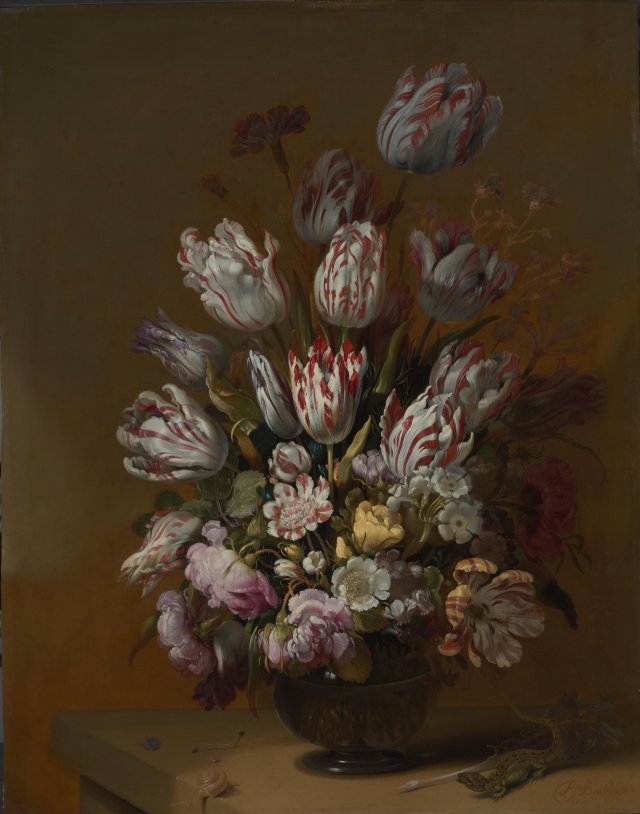

By the time we reach the later 16th century much of the symbolism has disappeared, perhaps because of the Reformation, and displays are becoming more and more exuberant, culminating in the floral still lifes portrayed in paintings of the 17thc Netherlands . Nichols describes that happened in suitably flowery language: “The sixteenth century, may be compared with the entrance of the premiére danseuse in a ballet, towards the end of the first act. Until now, although the entertainment has been charming and melodious there have been no star performers. Modest groups of irises, in dresses of various shades of blue, have grouped themselves in the corners, an occasional columbine has pirouetted across the stage, to discreet applause; and there has been a delicate twining and intertwining of roses.” Now enter the tulip!
“The theatrical metaphor, I hope, is pardonable, for in the whole history of floral arrangement the entrance of the tulip is by far the most dramatic single event, and assuredly the most creative.”


These Flemish and Dutch painters with their emphasis on bouquets of assorted exotic blooms seem to have led to a greater awareness [or at least acknowledgement] of the value of arranged flowers, and perhaps it was that led to more sophisticated containers in which to display them.
Gian Baptista Ferrari in his De Florum Cultura, published in Italy in 1633 includes the comments that “The most beautiful flowers should crown the vase like a beautiful head of hair crowns a beautiful body.’ What Ferrari also shows is the way that many vases of the period were designed with perforated covers or small holes around the sides of the upper part to carry separate stems of flowers rather than have a loosely assembled bunch put into an open top.

Ferrari also shows a series of more complex vases with water reservoirs concealed within the structure.
Such vases were clearly popular ways of displaying blooms, and the idea was developed particularly in Holland later in the century with elaborate ceramic vases, often in unusual forms such a pyramids or candelabra shapes designed to show off tulips in particular. Known as tulipières they became extremely fashionable and were popularised by Queen Mary II, wife of William III in the very late 17thc.

There is a good display of them at Chatsworth where they were collected by William Cavendish 4th Earl of Devonshire (later 1stDuke) during William and Mary’s reign.
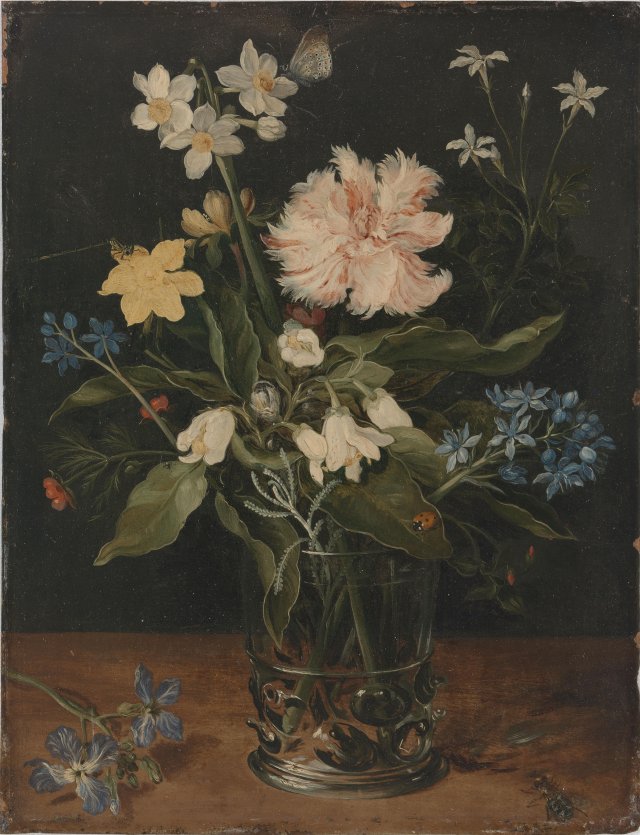
This careful spacing of single flowers mirrors the planting style in the garden with lots of space around plants so that each one could be viewed and appreciated on its own. [For a good example of this see an earlier post on the Stoke Edith hangings]
There is of course one major difference between real flowers arrangements, dramatic and contrived as they were in these wonderful containers and the equally dramatic but even more contrived way that Dutch/Flemish painters portrayed such arrangements. While the vases could only display what was in season the paintings rarely do that. Instead the paintings were an assemblage of blossoms put together flower by flower as and when they were in season.
I’m going to return to to the history of flower arranging and how it changed in the 18tsh and 19th centuries in another post shortly.
 For more information or further reading apart from Nicholl’s own book, try Julia Berrall, A History of Flower Arrangement, 1978 which thanks for an on-going dispute between archive.org and a group of American publishers is no longer available digitally , but secondhand copies are available at a reasonable price; Flora Domestica


 The Garden History Blog
As always loved your artic