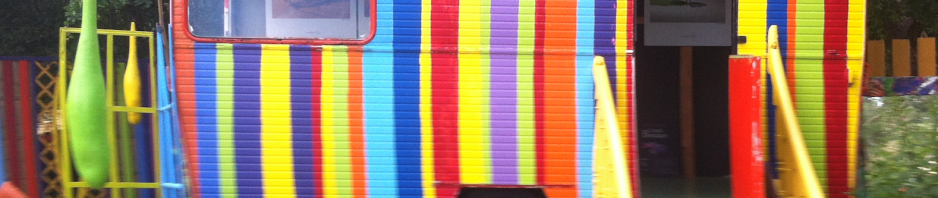
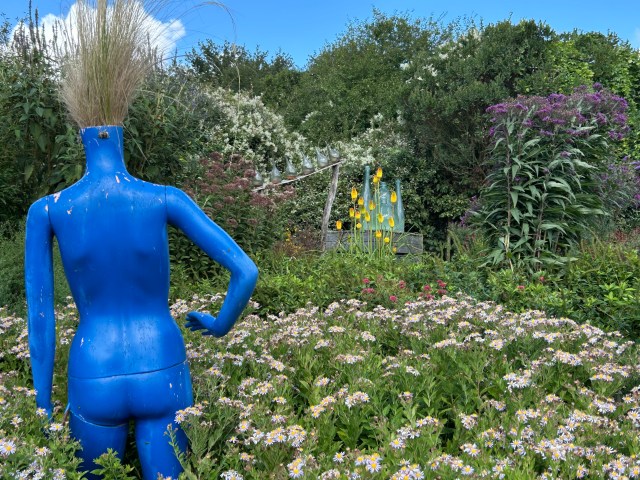
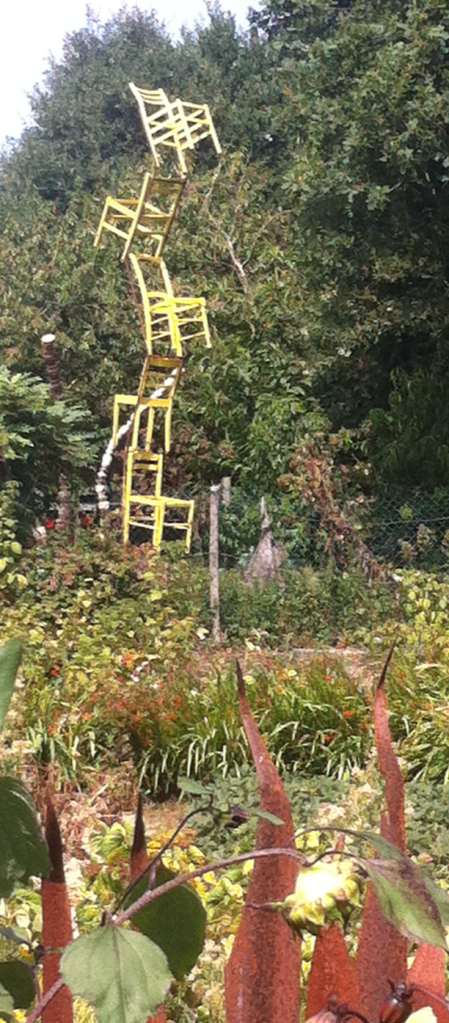
 Art has always had a place in gardens. Historically statues, columns, obelisks, urns, murals and even gnomes have all been very popular additions but more recently there’s been a trend to create sculpture gardens of a different kind, exhibition spaces where the garden provides a setting for contemporary work often on a temporary basis.
Sometimes such gardens can be rather quirky and today’s post is about a garden where nothing is quite as expected. It started life as a commercial market garden producing fruit and vegetables for the local markets, but has evolved over the past 20 years into a garden where although edibles still play a major role the lead is now taken by art, but not of the conventional sort, and it’s even got its own cartoon book to explain its origins and purpose
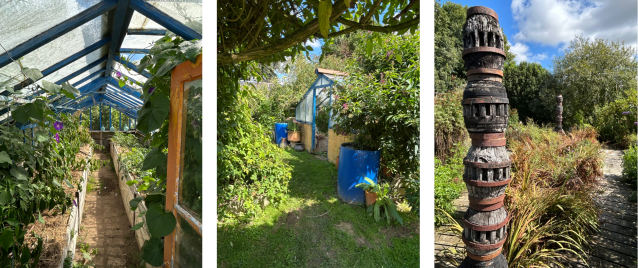
For once I’m going to let images rather than words do most of the work this week because the history of this garden is short and simple but it typifies a growing trend of mixing horticulture with education and even entertainment, with the garden as a destination for more than seeing some nice flowers and colourful vegetable beds.
Even its name makes a statement of intent..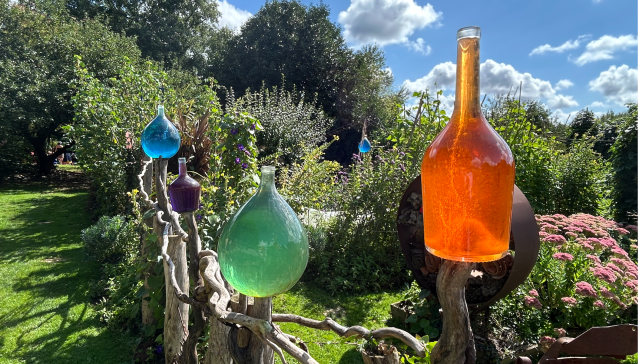
As usual all the images are may own unless otherwise acknowledged
 The garden is Rocambole and it’s deep in the countryside but just a few miles from Rennes, the capital of Brittany. You might know the name because Rocambole is a member of the allium family – although I’ve seen the name attached to both a sort of perpetual onion and a perpetual garlic.
When I first visited thats what I assumed the garden was named after but I’ve since discovered that Rocambole has another and much more appropriate meaning.

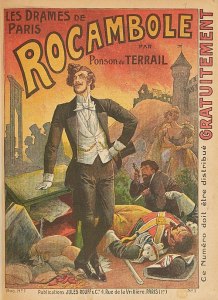 In the 19thc a French writer Pierre Alexis Ponson du Terrail [1829-71] began a series of novels based around a highly resourceful orphan who leads a life of crime and wild adventure, before eventually reforming and becoming a fearless hero fighting a variety of dastardly villains. He’s in the same vein as Raffles , Arsene Lupin and The Saint, and like them has found a place in the cinema and on the TV as well as having his story continued by many other authors. As a result rocambole has now become a byword for implausible and extravagant fantasies with extraordinary twists and turns. I can now see why the creators of the garden chose the name.

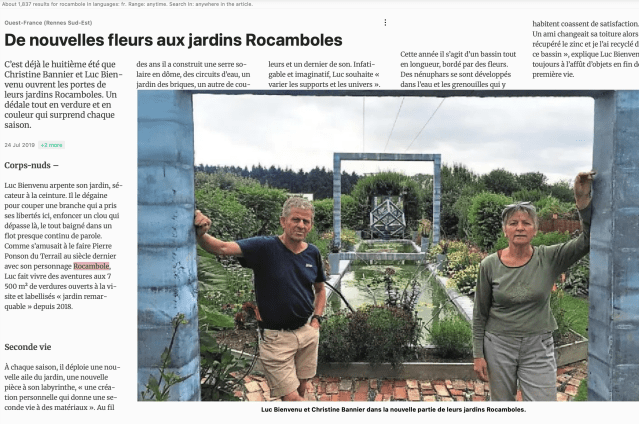
Christine Bannier and Luc Bienvenu, photo from Ouest-France 20th December 2019
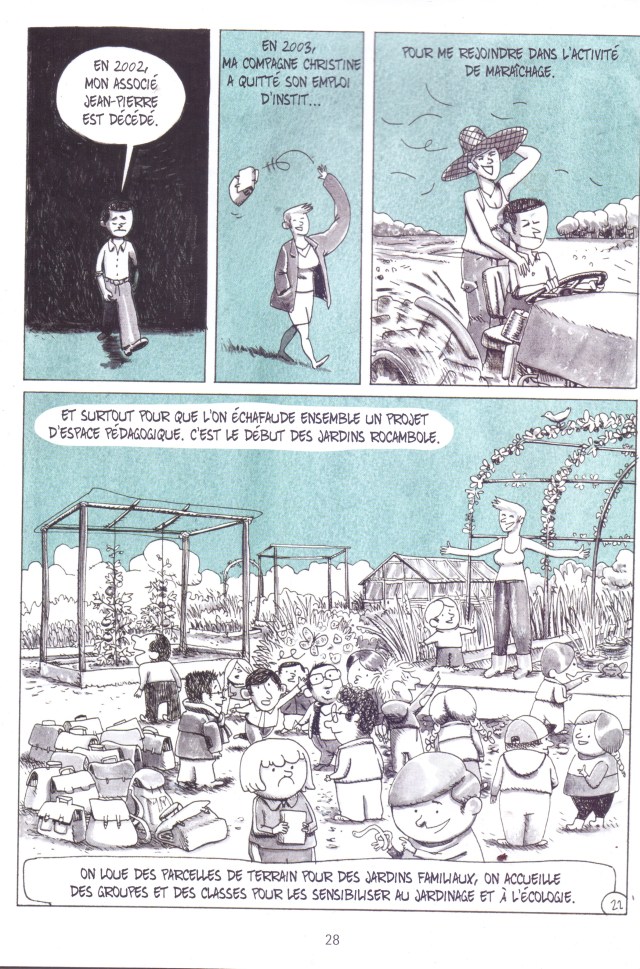
 Luc Bienvenu, the brains behind the garden has always been a passionate gardener. At school he did work experience with organic growers before studying botany at university, and then going to work at several different organic producers. In 1988 he set up his own business running an organic market garden and smallholding, but in 2003 decided on a change of direction.
His wife, Christine Bannier, quit her teaching job and together they decided to create an organic kitchen garden and orchard on part of the land, which they could use as a base for teaching sustainable horticulture but also as a space for artworks of all kinds. Some commercial growing continued but gradually wound down finally stopping in 2008 when more of the land was set aside for a series of allotments.
from Le Potager Rocambole

The original kitchen garden of about 1000 m2 – enough to feed two families – is still there. It’s very organised in terms of crop rotation within 4 main blocks: one specially for spring crops, another for summer growing, while a third as more permanent vegetable planting lasting about five-years and the final one has an even longer rotation. It now boasts about 80 different vegetables often with many different varieties, including I noticed unusual sorts such as yacon, perilla, American groundnuts, tiger nuts, and oca.

from Le Potager Rocambole
“The underlying idea is to create a sustainable ‘garden ecosystem’ that is as autonomous as possible.” Although Bienvenue is very clear that “We are far from the utopia we are sometimes described as.” However I loved the fact that he is also very clear that this all has to be done “without exhausting oneself and without spending all one’s time on it.”

Alongside that and drawing on their own experience, they have developed a comprehensive range of courses and events aimed at everyone from school groups to gardeners of all kinds from the beginner to specialists. He’s also gone on to run courses at the historic Ecole de Breuil, the leading landscape and horticulture school in Paris.

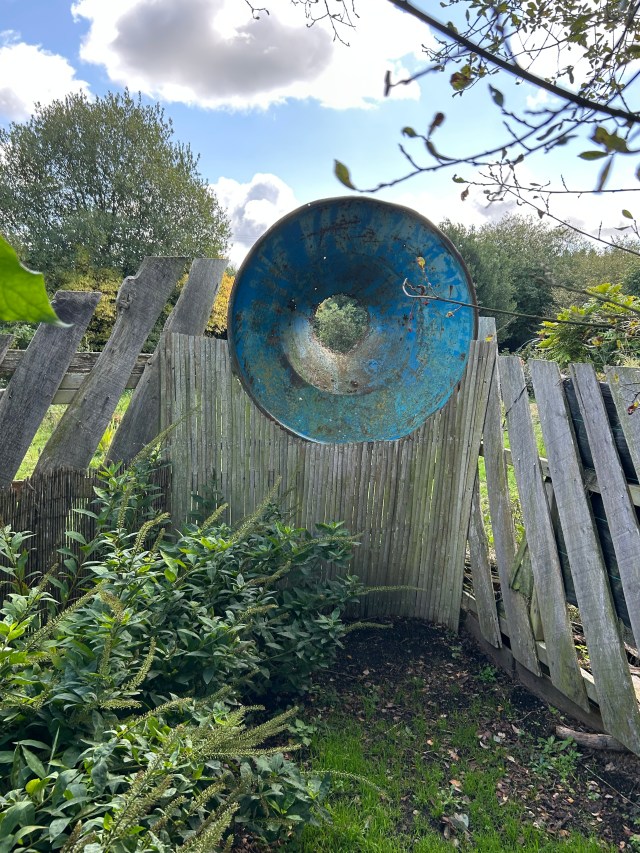
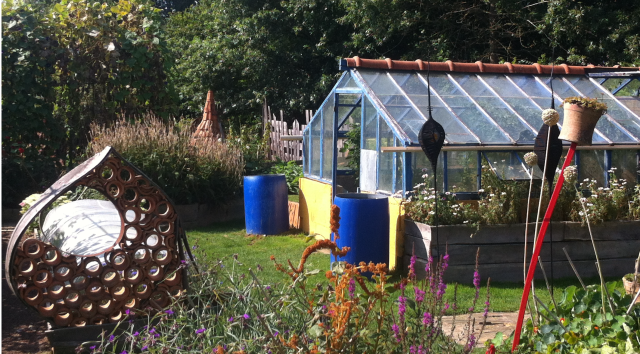
 But it’s about more than growing vegetables and fruit and gradually the garden has expanded and flowering plants occupying much of the original smallholding and just the allotments remaining outside. Interviews with Luc Bienvenue report him saying “I have always done theatre and painting, but I needed to combine my passions by adding another more sensitive, more creative dimension to the garden.” So now running through the entire site using the plants as a setting are contemporary pieces of artwork, and unusual versions of garden features. The image above, for example, shows path edging made of slices of old corrugated iron sheets, otherwise destined for the scrapheap.

I found this rather strange English translation of another interview with him where the interviewer commented that he “plays here with everything he has on hand. From season to season, this indefatigable magician of small nothings sows flavours and colours, diverts, transforms, invents, builds and sculpts all materials while juggling with all the senses.” While the language might be a bit odd I hope you’ll gather from the photos that’s a pretty good summary.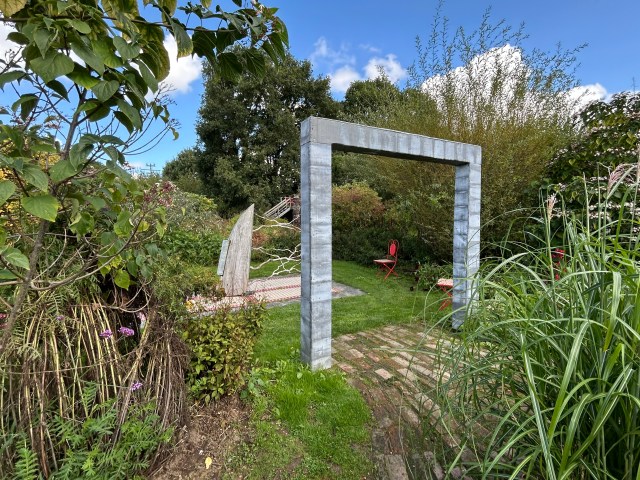
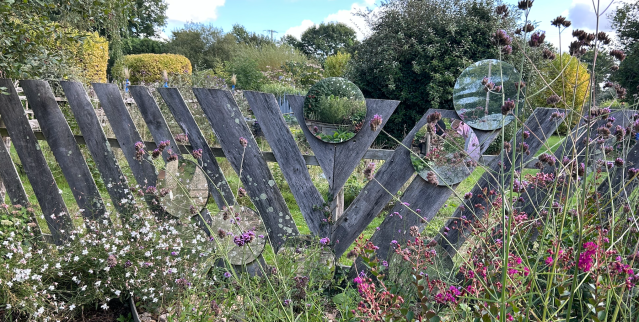

 What’s particularly interesting is that while the garden is comparatively small – until a recent expansion – only 6000 m2 it seems immense, described by one visitor as “a playful maze of a thousand colours.” That may partly be because there are over 20o species of flowers and other plants, or because as another visitor suggested because it’s designed to take you from surprise to surprise.
There is a suggested route round to make sure the visitor doesn’t miss any of the many hidden corners and which leads them past – or sometimes through – a whole range of installations, most of which are created from recycled materials of all kinds, mainly by Luc but also by other sculptors and craftspeople they have invited to contribute. But as he says “Nothing is fixed.” Things I saw on my first visit years ago have rotted away or simply been replaced by something he thought better.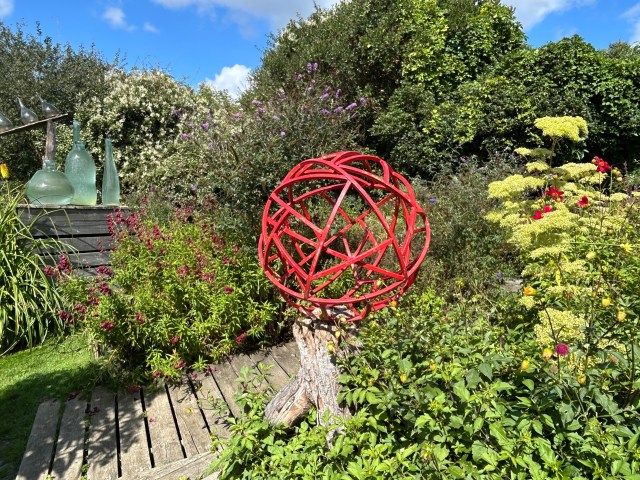
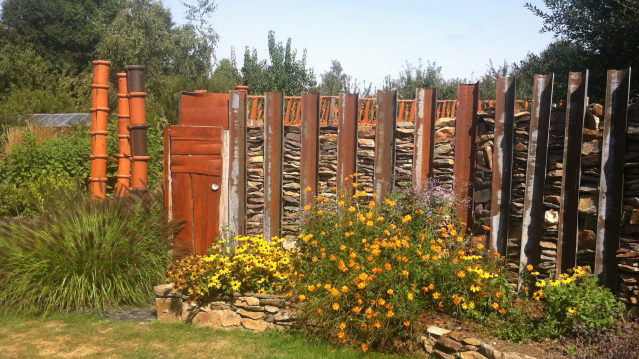
“Every year, I evolve the layouts and circulation because the garden is a moving narrative. A story full of surprises and twists: I have always loved to salvage items dumped in skips or at the recycling centre.”
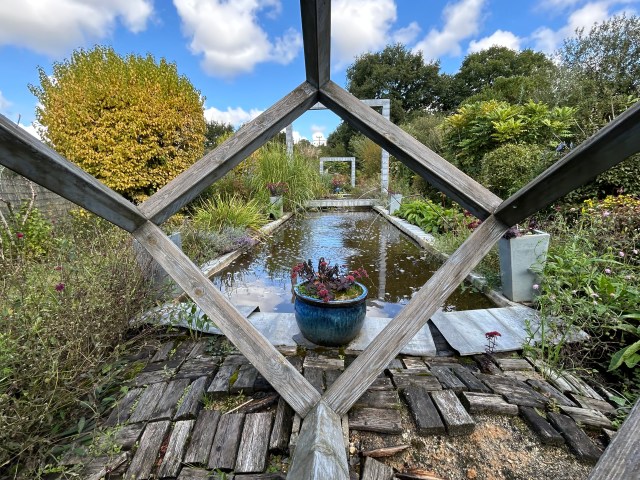
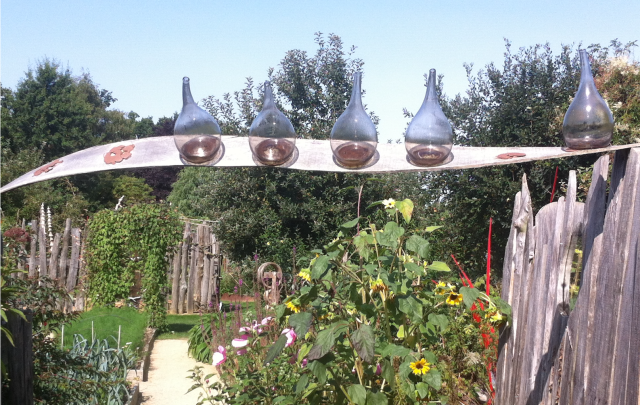
From 2012 the garden has been open all summer and autumn rather than just on special occasions and by 2016 they won the regional tourism trophy.
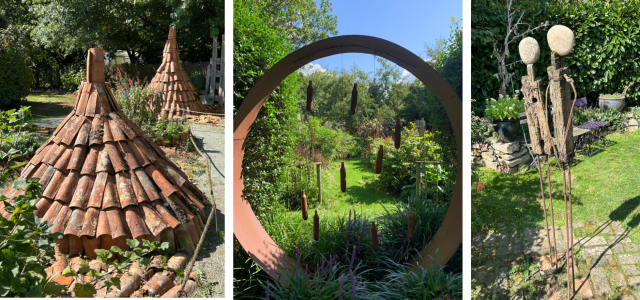

The latest extension to the garden ends with these snazzy umbrellas
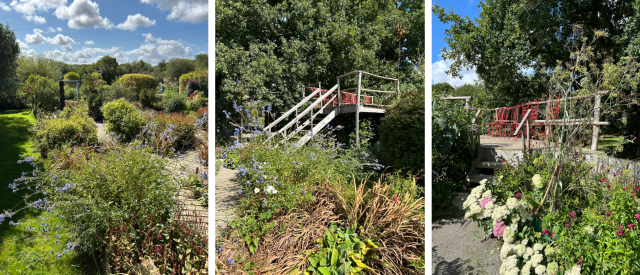
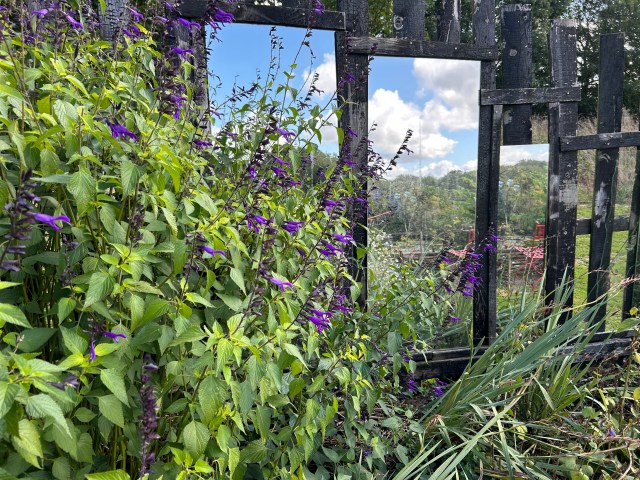
and is overlooked by this belvedere, which also looks over a new flower filled garden with decking paths, completely unlike the older parts of the garden
In 2018 they joined the ranks of gardens regarded by the Ministry of Culture as Jardin Remarquable and the following year went on to win first prize in the Kitchen Garden category of the awards run by the Société nationale d’horticulture de France.


It will be interesting to see if and how the garden grows. Like many other gardens it’s the work of highly motivated and inspiring individuals – and so when they retire will that sense of excitement disappear. Or will it, as I hope, continue to develop and become a historic garden typifying the 20th century move to sustainable growing?
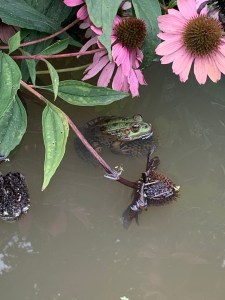 It reminds me in some ways of the eccentricity seen at the garden festival at Chaumont-sur-Loire: inventive, ingenious, and invigorating. As another visitor commented “It is a garden that does you a lot of good, which gives us a great desire to garden and above all … is a fantasy in motion, and to revisit with anticipation . A delight.” I couldn’t agree more.

 I’ve scoured the French press for more information, but can’t find anything particularly useful other than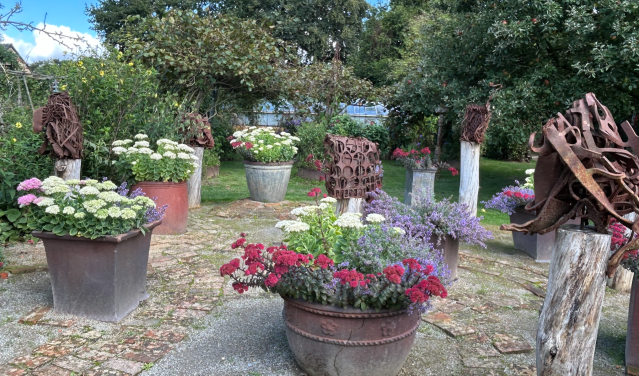


 The Garden History Blog
You must be logged in to post a comment.