Last week’s post looked at Queen Charlotte’s garden making at Buckingham House, Kew and Windsor but in 1790 she was given another house, Little Frogmore on the royal estate at Windsor. Two years later she also acquired its neighbour Great Frogmore. Only a mile or so away from the castle itself together they contained some 35 acres and although the natural flat setting did not immediately commend itself for the creation of a garden, this did not deter Charlotte. In the last years of her life she was to create a new picturesque landscape that remains largely intact to this day.
Most of the images in this post come from the Royal Collection Trust and are © His Majesty King Charles III, 2022. Links are provided to the relevant webpage for more information.
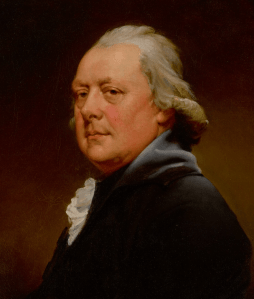
Charlotte renamed Little Frogmore calling it Amelia Lodge after her youngest child and asked Rev. William Mason, the poet and author of The English Garden, whose work she had admired at Nuneham Courtney [see last week for more info] to take charge of the garden side of the project. He was unable to do so and instead recommended his friend the Rev Christopher Alderson, rector of Eckington in Derbyshire. Major William Price, one of the King’s Equerries and younger brother of Uvedale Price, the pioneer of the picturesque theory of landscaping, was also consulted later that year.
Unfortunately there don’t appear to be any images of Little Frogmore before, or even after Charlotte acquired it.
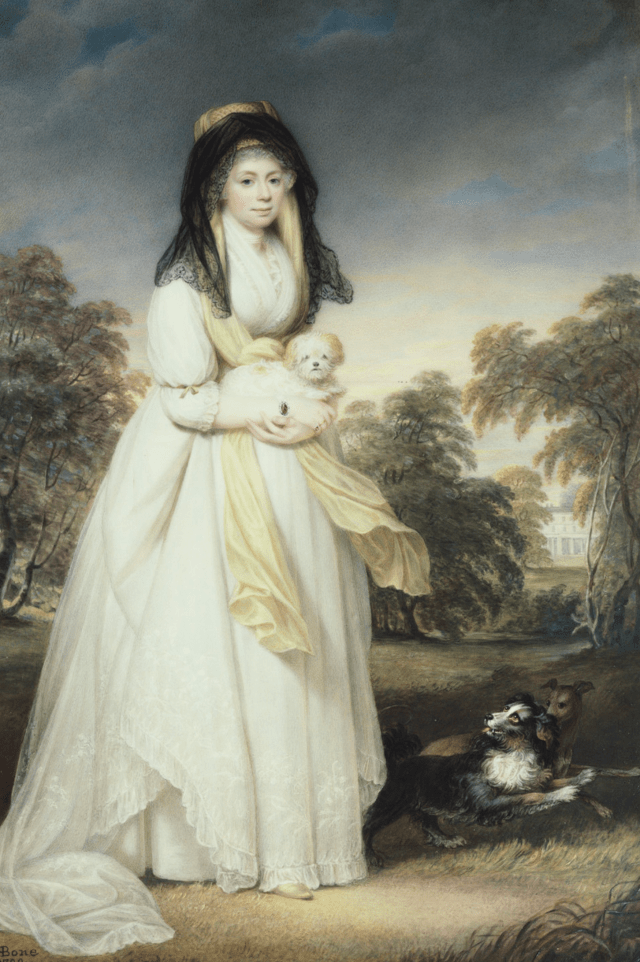
Work on redecorating the house and laying out new gardens in place of the existing formal enclosures began immediately. Around £2500 was spent laying out paths and covered walks and planting around 4,000 new trees and shrubs as Alderson tried to “render this unpritty thing pritty.” At the same time Charlotte had William Aiton of Kew supervise the building of a greenhouse in the former kitchen garden,
The Royal Archive holds her letters to her son Prince Augustus who was in Italy, telling him how the mild winter of 1790/91 had brought abundance of early blossom, that the greenhouse was finished in March 1791 and ‘by all connoisseurs allowed to be very fine’, that plants sent over from from Kew already ‘beginning to cut a figour’ although the rest of gardens were still not particularly attractive. Nevertheless the Queen added that she was looking forward to enjoying her “little Paradise’ and sweet retirement”.

Charlotte had formed a clear idea of what she wanted her garden to be. ‘My chief plants,’ she told Augustus, ‘are to be natives of England & all such foreign ones as will thrive in our soil.’ She drew on the extensive library she was collecting telling Augustus that botanical books were her regular study at Amelia Lodge, and that she found further pleasure in ‘the drying of plants both foreign & native’. Of the former, ‘I make a collection & have hitherto gone on with great success’. Her botanical library, received a big boost when George gave her the herbarium of John Lightfoot, the chaplain to the Duchess of Portland, when it came up for sale after his death and for which the king paid 100 guineas. [See this earlier post for more on Lightfoot]
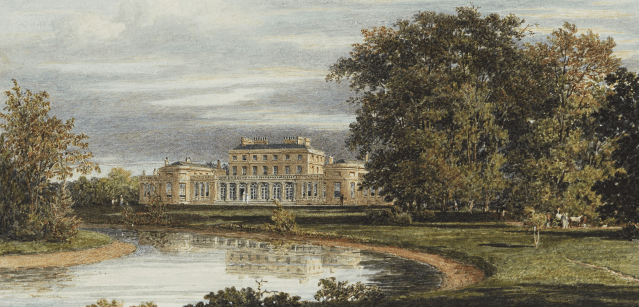
Things changed rapidly when in 1792 she bought the lease of the much larger neighbouring Great Frogmore, which had been built in 1680-4 by Charles II’s architect Hugh May. After her enthusiasm for Amelia Lodge you might be surprised to learn that now she abandoned it completely, and eventually had it demolished. The grounds and gardens of the two properties were amalgamated and she set about rethinking her project. Alderson is not mentioned in any reports or letters after 1792 and that maybe because Charlotte apparently thought him “a man of great natural taste but not of this world.” As a result the supervision of the works seems to have been the responsibility of William Price alone and he was appointed Vice-Chamberlain to the Queen in November 1792.
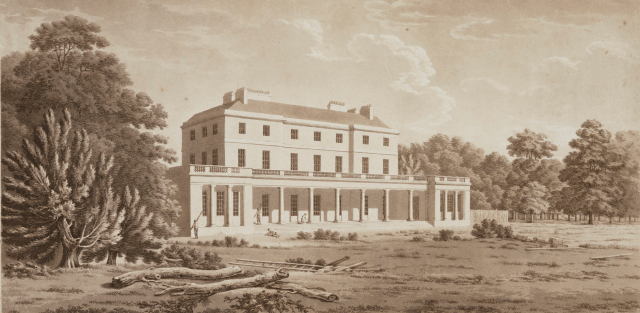

James Wyatt was commissioned to remodel Great Frogmore, with Charlotte asking him to add a ‘Colonnade . . . which will make a Sweet retirement in the Summer all Dressed out with Flowers’. Wyatt obliged, and it runs along the length of the garden front, facing south-west and linking the new wings he added at either end of the house. One of the rooms was designed and decorated by Mary Moser, one of the two female founding members of the Royal Academy. It was hung with her paintings and the walls and ceiling painted with garlands of flowers to resemble an arbour open to the skies and apparently cost £900. The Queen was so fond of it that she ordered the room be named after Moser – which it still is. Princess Elizabeth painted the decorations in the Cross Gallery, while the “Charlotte Closet,” is filled with drawings by Charlotte, the Princess Royal.
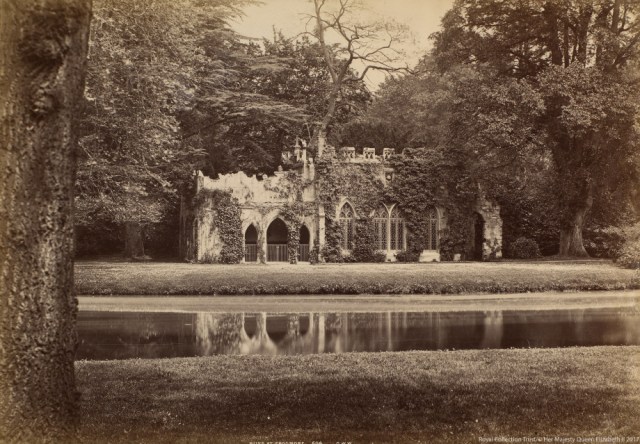
In 1792 and 1793 Price organised a substantial amount of earth shifting to create “a pleasing diversity of mounts, glades, serpentine walks, and canals; with bridges, and other erections” out of the former flat landscape. In particular the formal canal to the south-west of the house was widened and turned into a lake. The spoil from the excavation was used to created banks and mounds and small buildings were added at strategic points. These new garden features included a Gothic Ruin overlooking the lake which was designed by Wyatt working with Princess Elizabeth and used as a breakfast parlour in the summer.
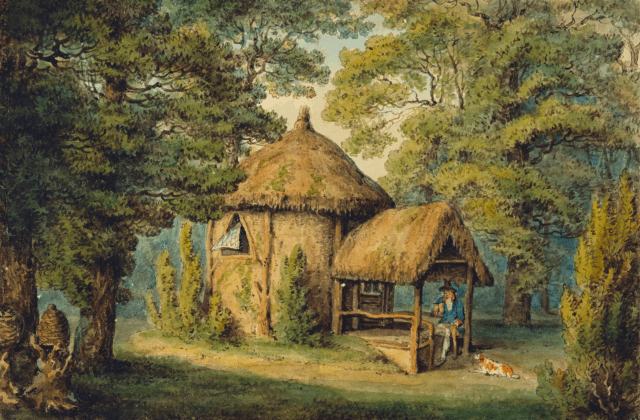
The princess also designed three other buildings. There was an octagonal Temple of Solitude which was later replaced by the mausoleum of Queen Victoria’s mother the Duchess of Kent in the 1850s, a thatched Hermitage and a “barn”. This doubled as a ballroom and theatre for amateur performances where the queen entertained not only courtiers but townspeople from Windsor to performances, wine and cake as well. [see Watkins Memoirs for an example]
Of course it was all well planted with the latest introductions, although as Jospeh Banks noted “the queen’s garden at Frogmore will be elegant in the extreme and would rival Kew if Her Majesty did not forbid all thoughts of introducing anything there till it had been at Kew.”
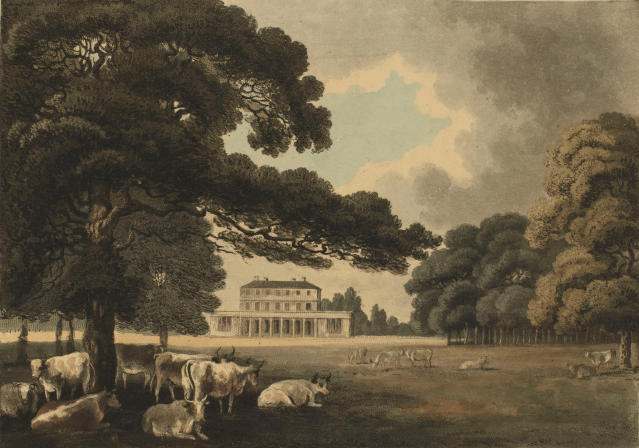
Unfortunately the late 1780s and early 1790s were marred by George’s increasing bouts of illness and this had a profound effect on Charlotte and would seem that Frogmore proved a good antidote to her anxiety about him. It now became her favourite retreat and she noted: “I mean this place to furnish me with fresh amusements every day”. The diarist Fanny Burney recorded, the Queen spent most mornings at Frogmore, delighting in its quiet and ease and rarely returning to the Castle before dinner.
The newly landscaped gardens were an ideal setting for receptions and fêtes away from the formal and restricted setting of the castle. Charlotte planned to hold the first on 25 October, 1793 the anniversary of the King’s accession and it was to be organised by Princess Elizabeth, with Wyatt designing the structures with her. Court ladies made ‘one thousand yards of Garland’ of artificial flowers including ‘Scarlet jeraniams ,Guernsey Lilies, also some Passions Flowers’ and even strelitzia. The fete was postponed by two weeks when news arrived of the execution in Paris of Marie Antoinette, but eventuality proved to be ‘the very prittiest Scene’.
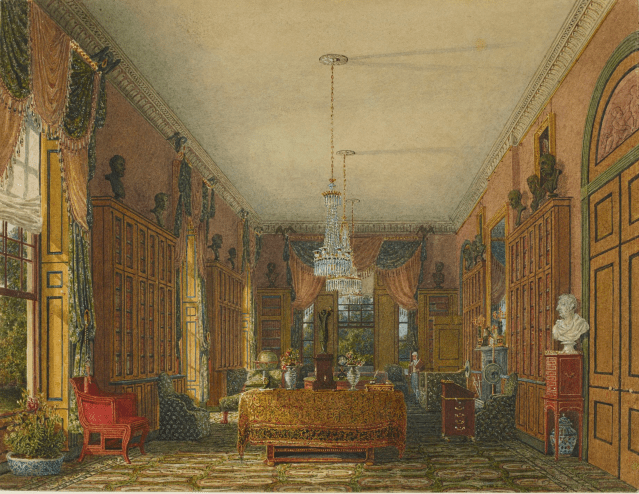
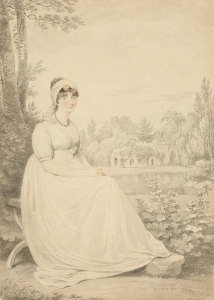
While Frogmore has sometimes been compared to Marie Antoinette’s Petit Trianon it was more studious than frivolous. Lightfoot’s herbarium [now at Kew] was arranged in ‘twenty-four fine mahogany cabinets’ at Frogmore by Sir James Edward Smith, who often went there to ‘converse’ with the Queen and the Princesses Augusta and Elizabeth ‘on botany and zoology’, and she continued making her own herbarium. Augustus sent her specimens from Naples while John Fraser, the nurseryman with strong American links did the same. [see previous post]. She had her own librarian and even her own printing press
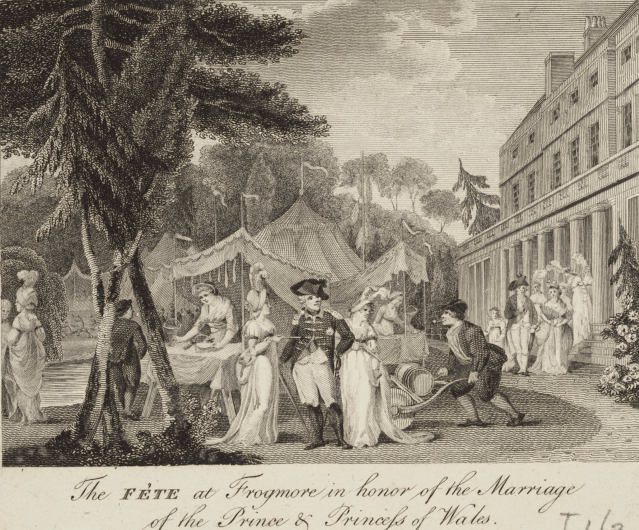
Another grand fete was held for the ill-fated wedding of the future George IV to Caroline of Brunswick in 1795 but the grandest of these Frogmore fetes must surely have been the celebrations for George III’s Jubilee in 1809 when the grounds were transformed for a water pageant. An eye witness noted that “the queen gave a most superb fête at Frogmore, which in point of taste, splendour, and brilliancy has on no occasion been excelled.” As many as 1200 people were invited including many of the local tradespeople of Windsor, and “at half past nine the gates were thrown open for the nobility, gentry, and others having tickets of admission. On the entrance into the gardens, the spectator was struck with astonishment and delight at the charming and fanciful scene of variegated lamps of different figures and colours. The avenues and walks were hung with brilliant coloured lamps in the shape of watchmen’s lanterns. The lawns adjoining to the house afforded a rich display of the choicest shrubs and plants, taken from the green-house.”
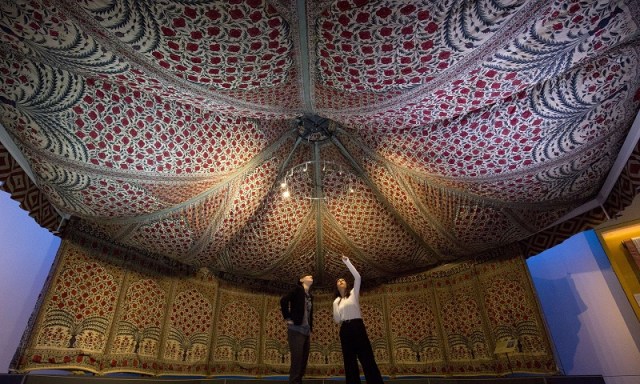
On the lawns stood “twelve beautiful marquees where the company partook of tea and coffee during the fire-works.” These “sumptuous tents” were “of considerable dimensions” and “formerly belonged to Tippoo Saib“. They had been captured during the Anglo-Mysore Wars in southern India and presented to Charlotte.
“In other parts of the ground were groups of theatrical and vocal performers, equestrians, tumblers, and various assumed characters, to add to the general amusement. The scene was further enlivened by the novelty of a Dutch wake, composed of booths, containing the usual articles that furnish a village fair, as toys, trinkets, &c. These were disposed of for suras at the option of the purchasers, to raise a fund for charitable purposes: hence the innocent gaieties of the fete were made subservient to the cause of benevolence.”
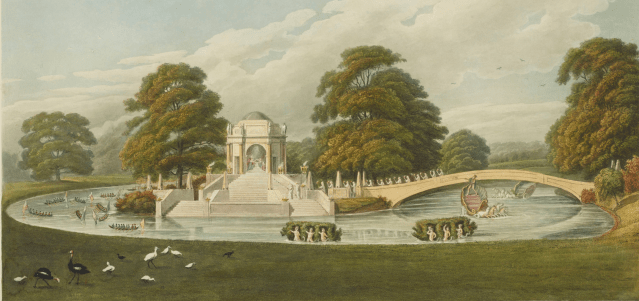
When the pyrotechnics finished “there appeared of a sudden, and as it were by magic, on the beautiful piece of water opposite the garden front of the house, two triumphal cars, drawn by two sea-horses each, one occupied by Neptune, and preceded by the other with a band of music.”
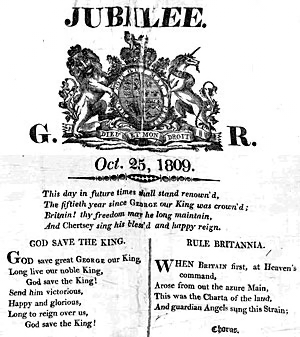
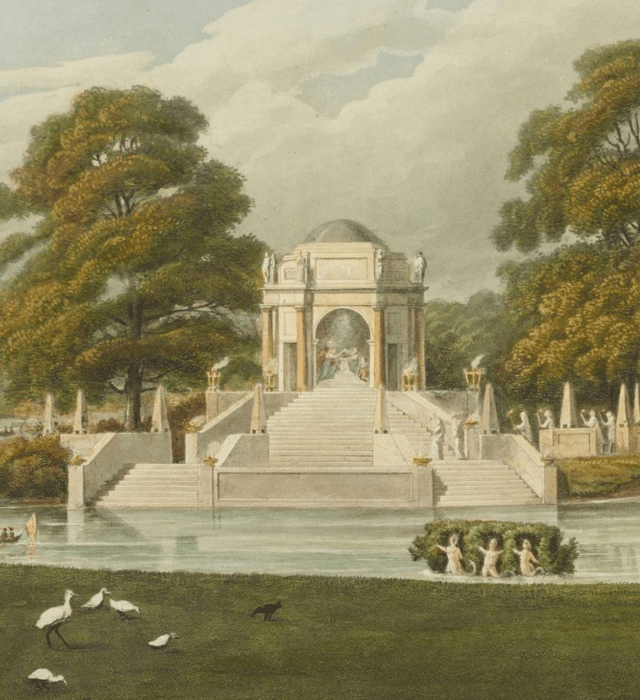
“On coming to the temporary bridge erected over the canal opposite the garden front, transparencies were displayed in an equally sudden and unexpected manner on the battlements, with the words “Rule, Britannia! Britannia, rule the waves!” inscribed on them. At the same moment the band struck up the tune….Opposite the bridge, an elegant Grecian temple was erected on a mount, surrounded by eight beautiful marble pillars. The interior of the temple was lined with purple; and in the centre was a large transparency of the Eye of Providence, fixed, as it were, upon, a beautiful portrait of his majesty, surmounted by stars of lamps.”
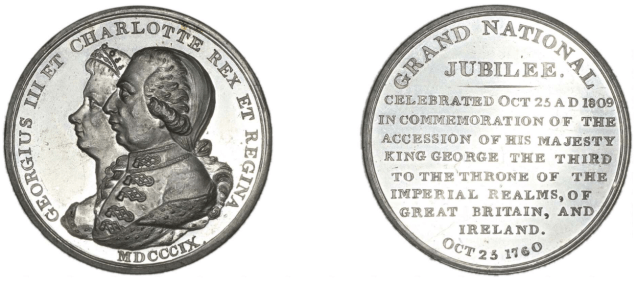
Unfortunately the King missed all this. He had been there earlier but was unwell and had gone to bed. The celebration was the last of its kind.
[For more on transparencies see last week’s post] More on the other celebrations for George’s Golden Jubilee in this earlier post
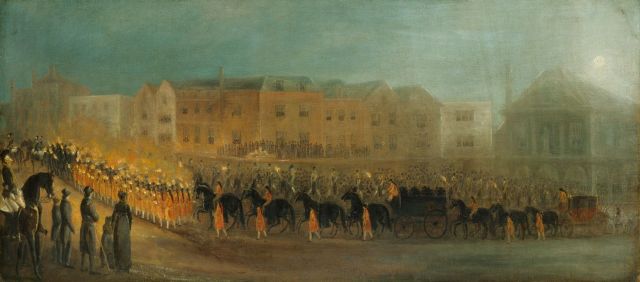
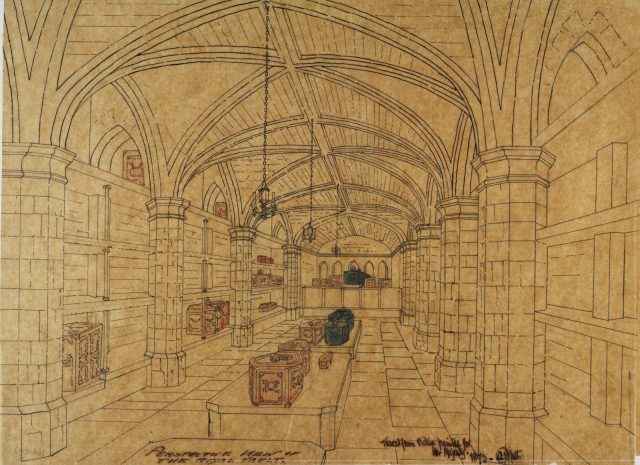
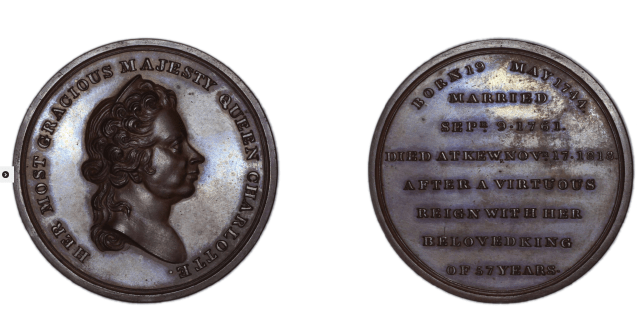
On her death in 1818 she was buried in the new Royal Vault in St George’s Chapel at Windsor, which had been commissioned in 1804 by her husband, King George III. Just a fe3w days later a lengthy obituary appeared in the November Gentleman’s Magazine, which spoke of her “innate good sense and steady principles”, her good humour and “sprightly conversation” but sadly nothing of her learning.
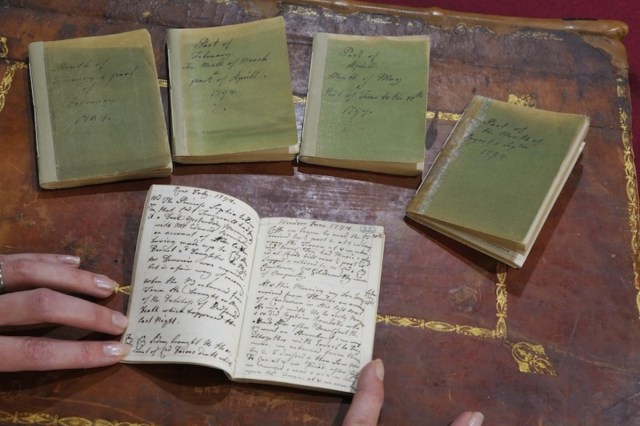
All her Windsor estates passed to her eldest unmarried daughter, Princess Augusta (1768-1840), although in a rather ruthless way most of her possessions including the contents of Frogmore House were sold for the benefit of all her daughters in a series of 33 auctions at Christies in May 1819. Unfortunately although the prince Regent directed that a few books be bought for the King’s Library at “a reasonable valuation” the rest of her immense library was sold in over 5000 lots in June and July for just under £4000. However, her diaries and a considerable amount of her correspondence survives in the Royal Archives at Windsor, with the catalogue and some commentary available on-line.
Perhaps Charlotte’s most public legacy is the Christmas Tree. Had I known about that before starting this post in the gap between Xmas and New Year I’d have used it for my Xmas piece. Although its’s often thought to have been Prince Albert who introduced the custom, in fact it was Charlotte who decorated a yew branch, a tradition from her Mecklenburg-Strelitz, with the assistance of her ladies-in-waiting and then had the court gather to sing carols and distribute gifts. John Watkins, who wrote Memoirs of Her most excellent Majesty Sophia-Charlotte, queen of Great Britain, the year after she died recorded that in 1800 “Her Majesty kept the Christmas-day following in a very pleasing manner. Sixty poor families had a substantial dinner given them; and in the evening the children of the principal families in the neighbourhood were invited to an entertainment at the Lodge. Here among other amusing objects for the gratification of the juvenile visitors, in the middle of the room stood an immense tub with a yew-tree placed in it, from the branches of which hung bunches of sweetmeats, almonds, and raisins in papers fruits and toys, most tastefully arranged, and the whole illuminated by small wax candles. After the company had walked round and admired the tree, each child obtained a portion of the sweets which it bore, together with a toy, and then all returned home quite delighted.
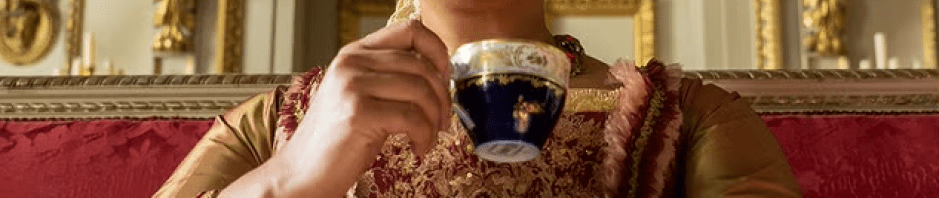
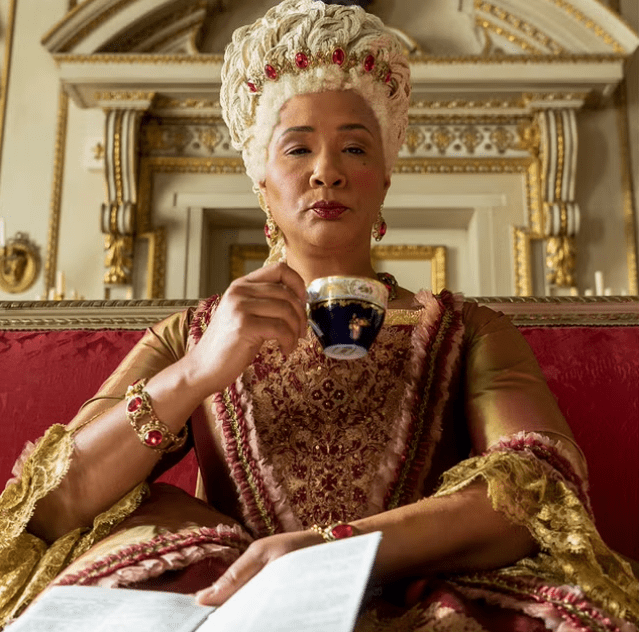
For more information on Frogmore itself a good place to start is the Royal Collection Trust’s webpage about it, while the best long read about Charlotte is Olwen Hedley’s biography, available on-line. There are plenty of on-line articles about Charlotte but be careful not to get confused with her grand-daughter Princess Charlotte who had died the previous year. [See this earlier post for more on her]…and of course don’t get her confused with Golda Rosheuvel.


 The Garden History Blog

You must be logged in to post a comment.