
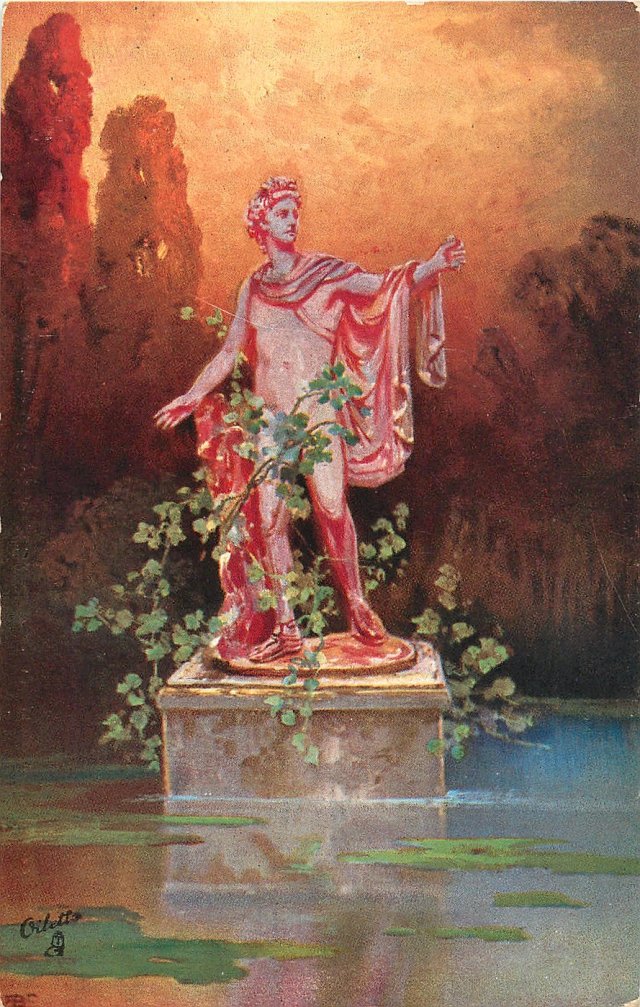
After a recent post about Chocolate Box Ladies – a nickname for those women artists who painted images for postcards but that could equally well be used for jigsaws or chocolate boxes – this week I’m turning my attention to their males equivalents – Chocolate Box Gentlemen.
The growth in postcard publishing provided work for a wide range of competent [and sometimes maybe not quite so competent] artists, because on average two million cards were posted every day between 1900 and 1910 and so unsurprisingly there was continual pressure for suitable new pictures .
While I suspect there were more women doing this work, there were certainly quite a few men who made a good living out of it as well, while others added postcards as a sideline to their more mainstream work. Can you spot any major differences in style with their female counterparts?
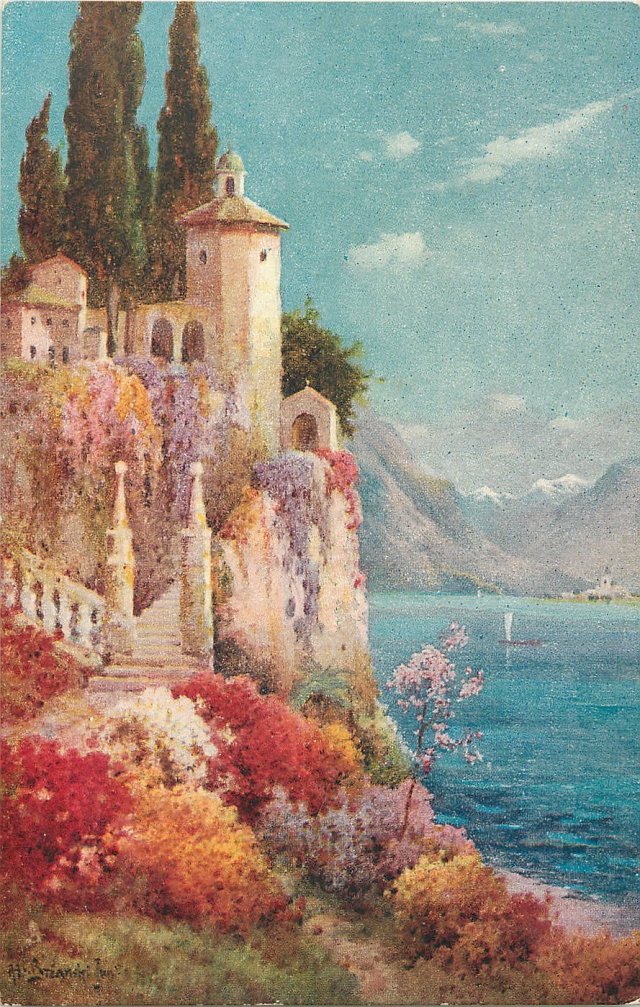
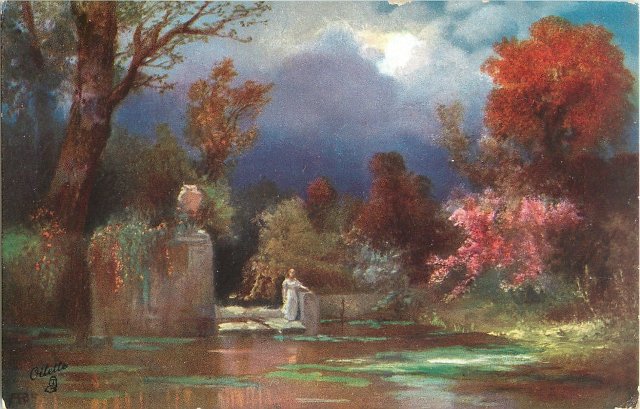
Take the example of Alfred de Breanski He was born into an artistic family: his maternal grandfather was David Roberts, the prominent Orientalist paint, while his father, also Alfred, was a successful landscape artist who specialised in capturing scenes in the Highlands and Welsh mountains.
Born in London in 1877, Alfred was the oldest son in a family of seven children and began to study art early in life, training with his father and uncle along with his younger brother, Arthur who also became a landscape painter
After studying St. Martins School of Art in central LondonAlfred went to France to “finish” his artistic education where he met the elderly James McNeil Whistler. Returning to London he exhibited regularly in all the major galleries including the Royal Academy and at the Royal Society of British Artists.
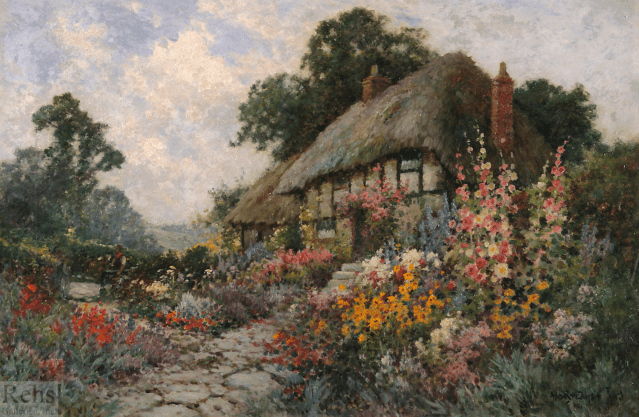
Although his main interest was landscape painting, especially of wilder areas such as the Scottish Highland [you can find dozens of them on-line] he also painted some garden scenes. However, in contrast these are usually rather twee [perhaps feminine?] compared with the more atmospheric feel of his landscapes. Several were exhibited at the Royal Academy in the first decades of the last century. There are more of his paintings on the website of the Rehs Gallery in New York
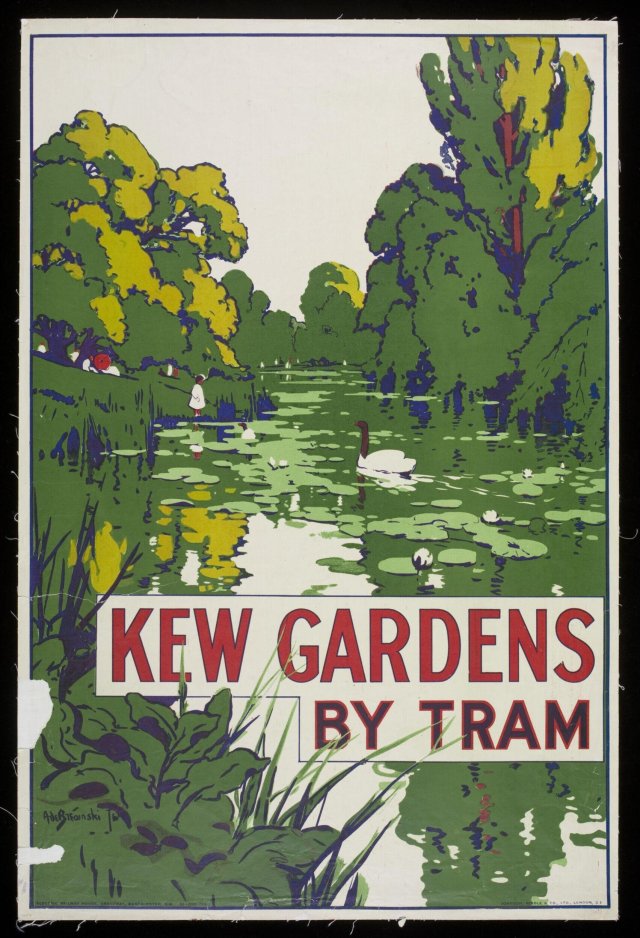
Perhaps as a result of his successful exhibitions he was approached by the Underground Electric Railways Company to design a couple of posters to encourage Londoners to use public transport.
However by the 1920s his work began to seem somewhat old-fashioned. In more recent times, there has been a reassessment of his work as scholars, such as Janet Whitmore begin to explore historical developments beyond the modernist canon. She argues that posters like the one for Kew show how “high art” could be combined effectively with “commercial art,” very much in the spirit of the Parisian poster artists Henri de Toulouse-Lautrec and Jules Chéret.
Alfred de Breanski died in Tonbridge in 1957.
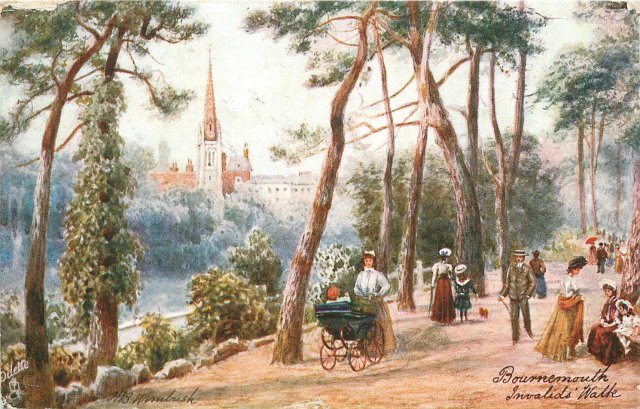
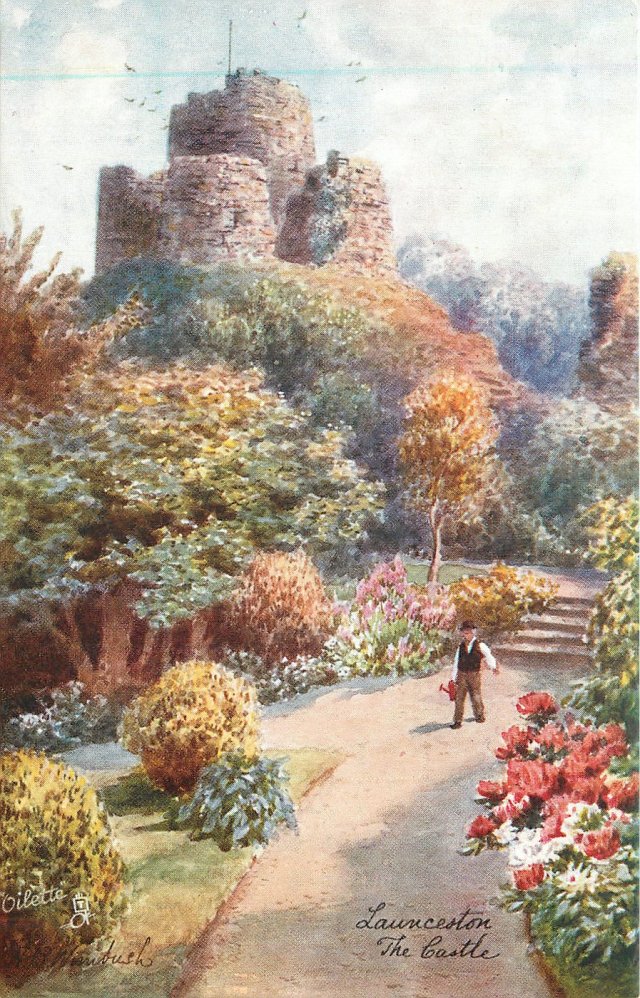
An even more prolific artist was Henry Bowser Wimbush. Born in 1858, by the time of the 1891 census he was clearly making a good living from his work, which included designing more than 1000 postcards for Raphael Tuck & Sons during the early 20th century. Mind you he needed to since he had at least nine children to support.
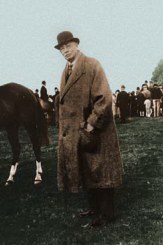
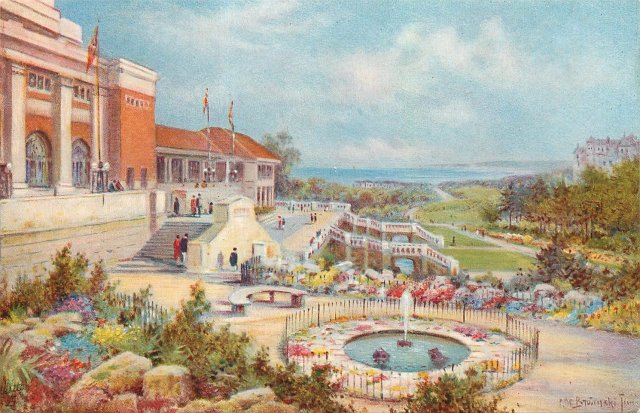
His delicate, atmospheric watercolours— again especially of the Highlands and Lake District, but also coastal scenes, and rural villages—became some of Tuck’s most commercially successful postcard images. Hidden away amongst them were a few of public parks and gardens – particularly in seaside resorts like Bournemouth and Paignton, or spa towns like Harrogate Buxton and Leamington.
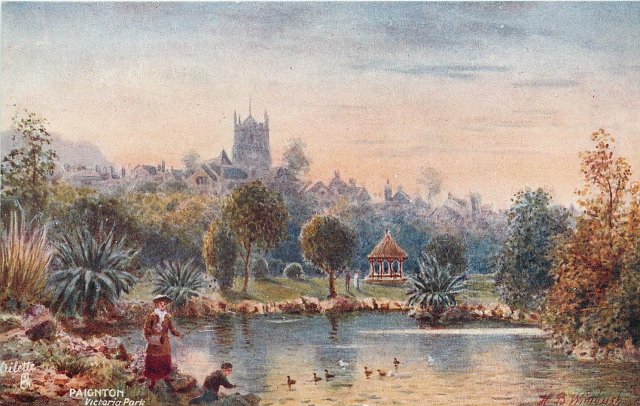
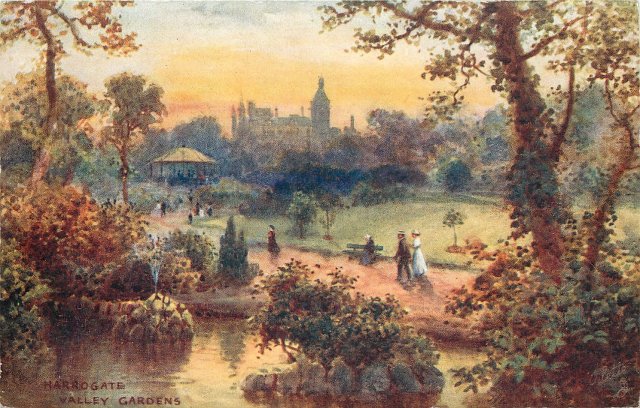
But like most of the other artists covered in this post he also travelled and painted more exotic locations such as the Riviera. He also designed a small number of other cards from Rio de Janeiro and Rotorua in New Zealand, but since there are very few, with no others from the same countries, I wonder if these were done from sketches drawn by others, but given to more established artists to produce a more acceptable finished design.
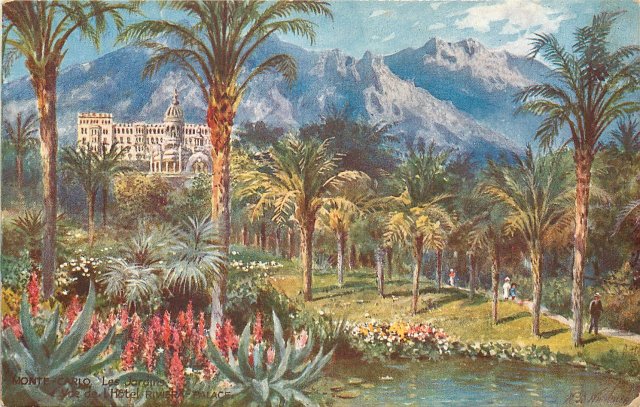
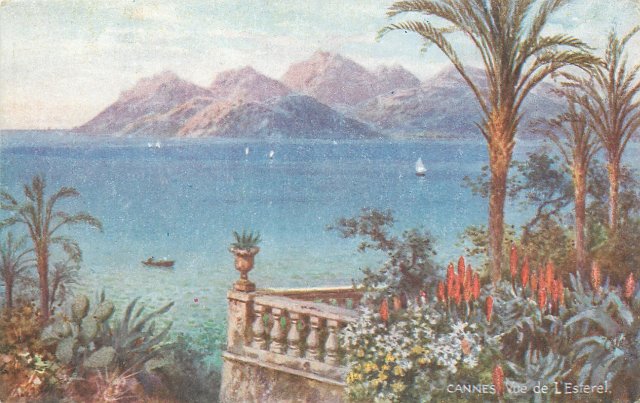
Wimbush also illustrated a few travel books, although again the paintings are mainly coastal scenes. The image below is a rare exception.
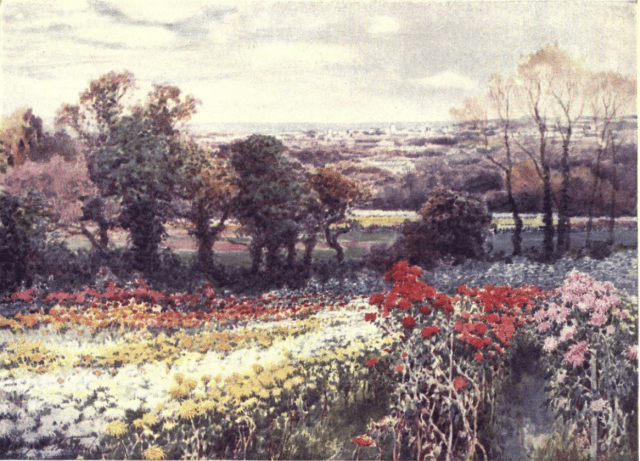
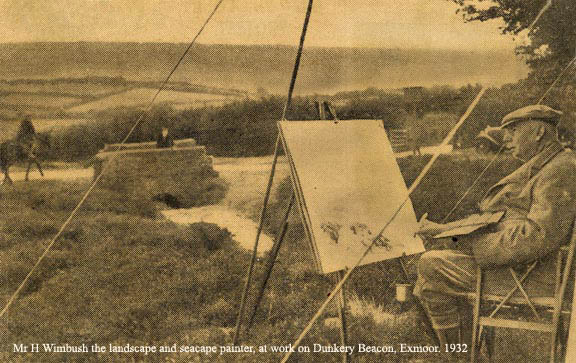
Despite his output Wimbush remains quite a shadowy figure, although there is a little more information on a family website, which reveals that his daughters also became artists, as did at least one of his grandchildren.
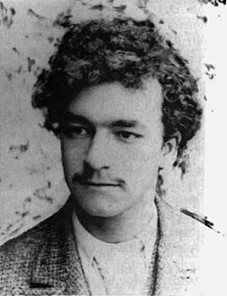
A fellow Tuck artist for about 40 years was Charles Flower who had a very interesting life. Born in Merton in 1871, he went to the Royal College of Art before taking a job as the illustrator for the catalogue of the archaeological finds on the Wiltshire estate of General Augustus Pitt Rivers (1827-1900) founder of what was to become the Pitts-River Museum in Oxford.
After 4 years there he applied, I’d guess unsuccessfully, for the post of draughtsman for the Egyptian Exploration Fund because in 1902 he began a rather itinerant existence.
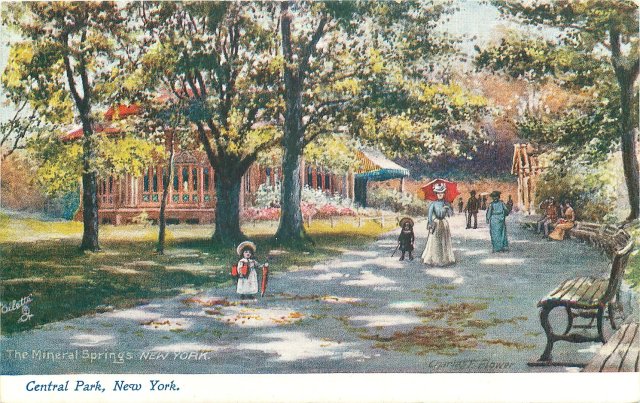
In 1902 he travelled across the Atlantic visiting the Americas, both North and South, including Buenos Aires, Rio de Janeiro, New York, Toronto, Ottawa, Montreal, and Quebec. On his return he set out for Europe, spending most of his time in Germany, and sketching or painting everywhere he went.
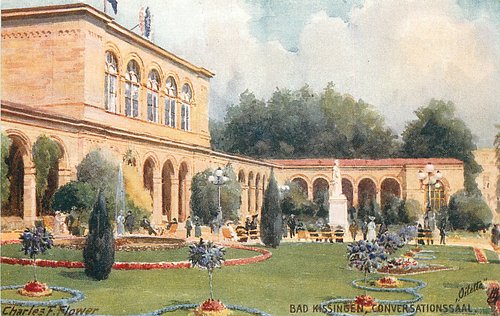
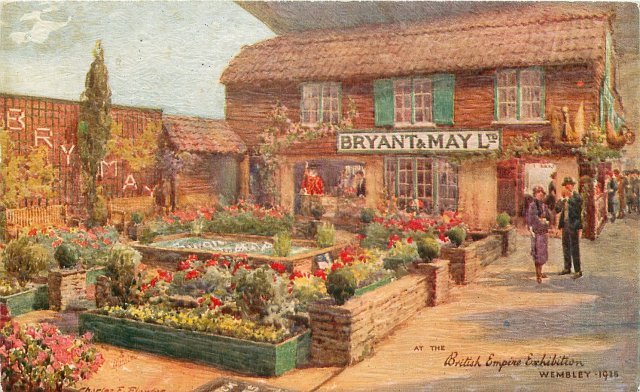
It was the work from these travels that he was later able to capitalise on, by turning them into postcard images for Tuck, mainly in their ‘Oilette’ series. In all he produced over 300 designs. While the majority of these are architectural scenes or townscapes there are also a number of landscapes and gardens
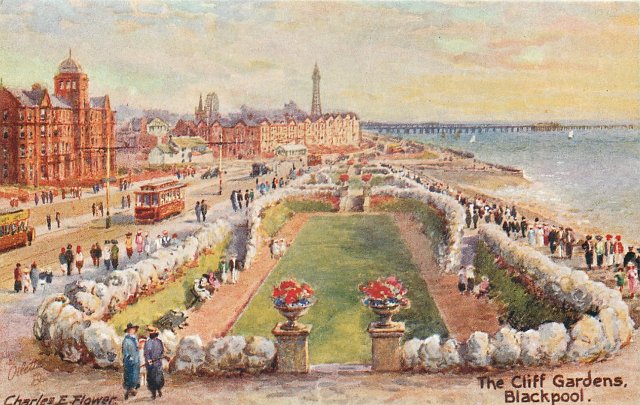
In 1907 Flower moved to Warborough in Nottinghamshire where he continued working until his death in 1951.
There’s more information about Charles Flower and his life on the website of the Warborough and Shillingford Society.
Another extremely prolific postcard artist was Alfred Robert Quinton. Born in Peckham, London in 1853 he studied at Heatherley’s School of Fine Art and from there became an apprentice engraver, but soon decided to concentrate on becoming a professional artist instead. After a spell of working mainly in oils he switched to watercolour and soon began exhibiting at the Royal Society of British Artists and the Royal Academy although his later work was refused by the Academy because they disapproved of his ‘commercialisation’ of art.
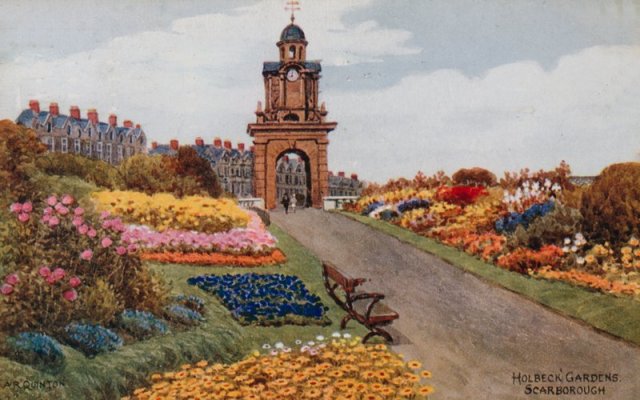
Holbeck Gardens, Scarborough
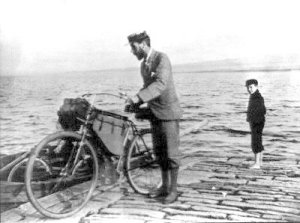
From the early 1880s Quinton regularly travelled throughout Europe, and in 1895, he set out with a friend to cycle from Land’s End to John O’Groats. He kept a diary of his travels publishing a few articles accompanied by his own illustrations in the ‘Illustrated Sporting and Dramatic News’. These are available via the British Newspaper Archive but sadly none of the images are of high enough quality to include here. Other paintings from this trip were later used as book illustrations.
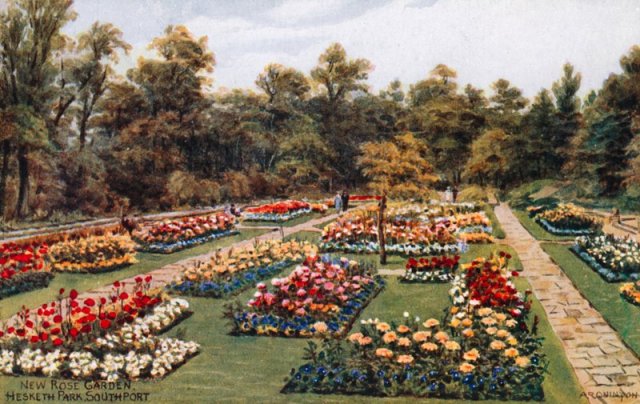
Once he was established as an artist Quinton made a good living from his painting, buying a large house in Finchley and spending his summers travelling, taking photos and sketching and the winters turning these into paintings. Alongside this he received commissions to illustrate books, including Hilaire Belloc’s The Historic Thames ( although these were mainly landscapes and riverscapes), and a couple by the Rev Peter Ditchfield including his The Cottage and Village Life of Rural England. (see this earlier post for more on Ditchfield.)
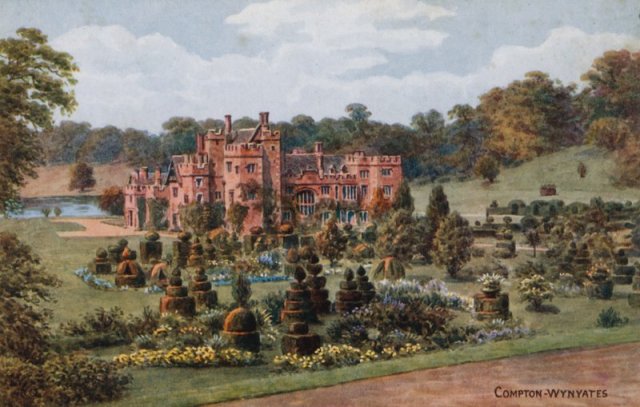
Quinton was also asked by Raphael Tuck to provide watercolours of Village Crosses for a series of postcards, but by then his work had come to the attention of the rival Sevenoaks-based firm of Joseph R. Salmon. They offered him work recording picturesque places in Britain and this turned into a very successful and profitable partnership, with Alfred producing around 2,000 images for Salmon before he died in 1934. His work is highly collectible.
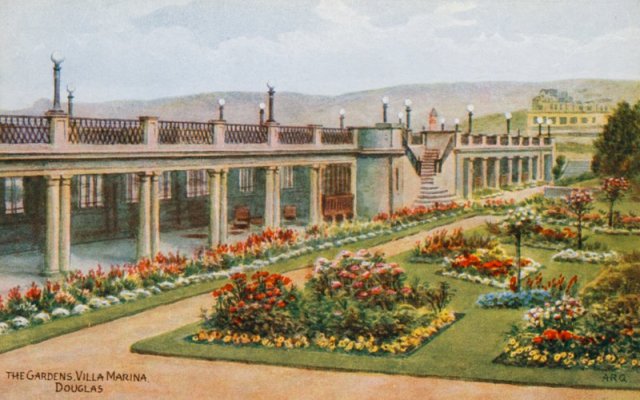
For more on Quinton see (1992) and the article about him on the my daily art display blog. The best gallery of his work is on the Meisterdrucke website which has 1143 images.
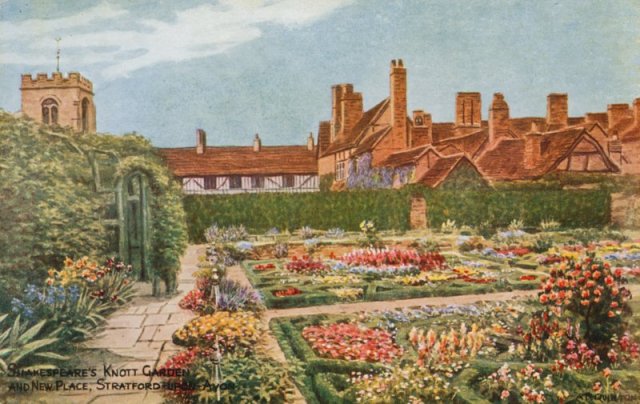
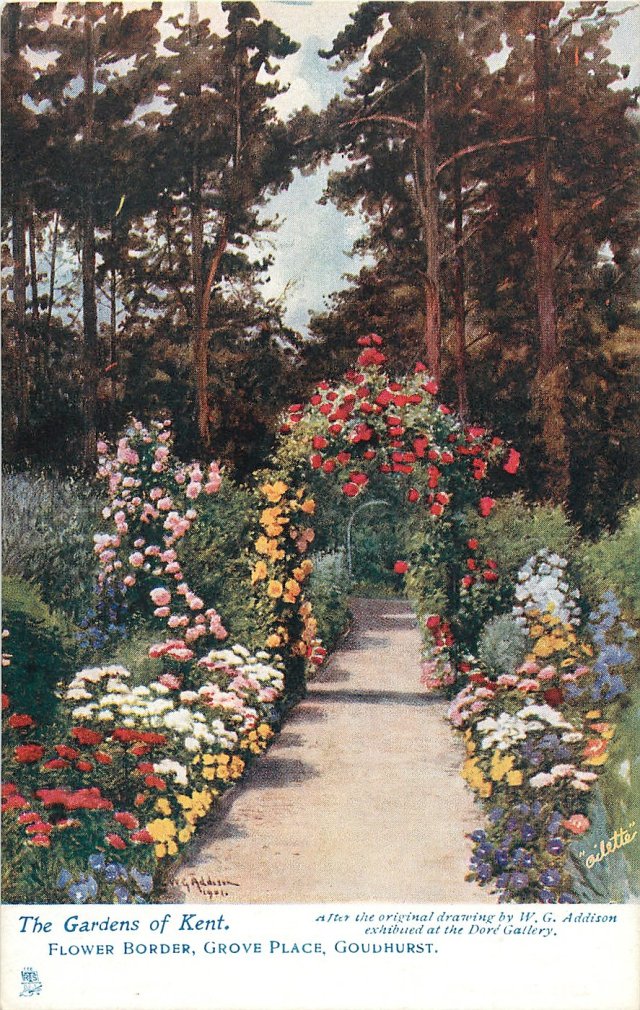
In addition to these four reasonably well-known male artists I discovered a whole group of others who worked for Raphael Tuck’s postcard empire, and produced garden-related postcards, but about whom I can trace very little information.
Amongst them are:
William Grylls Addison (1853–1904) — a landscape/genre painter who exhibited at the Royal Academy and lived in Kent. He was clearly more interested in gardens than most and several of his paintings were published in the Gardens of Kent series.
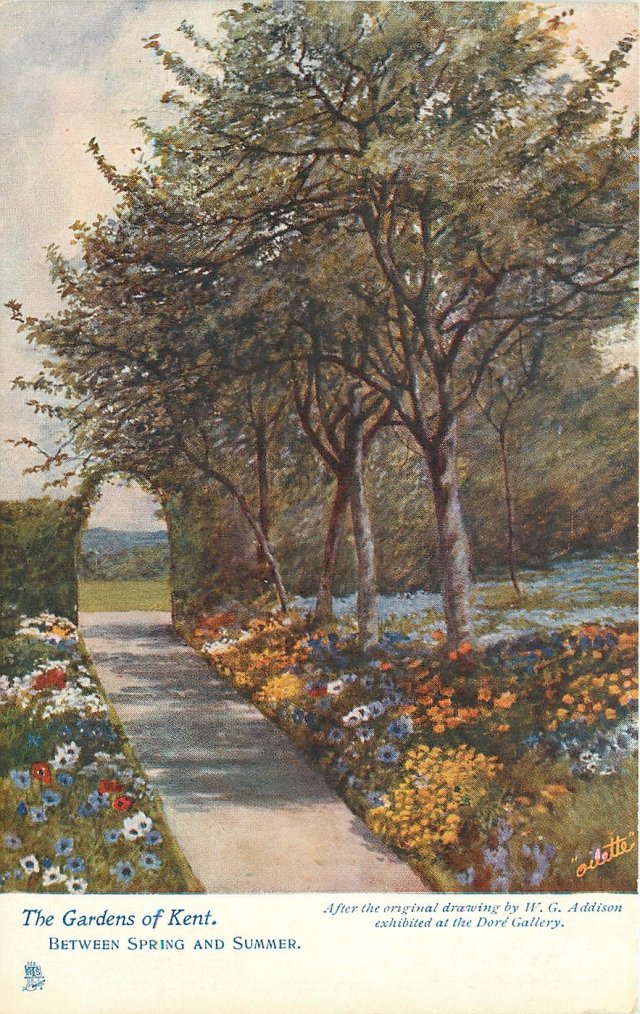
Ernest Llewelyn Hampshire was a London based artist, born in 1882 who studied at Clapham School of Art, at Heatherley’s, and at the Central School of Arts and Crafts, before ore exhibiting at all the usual galleries. However Census records show that he then worked as an architectural assistant in the government’s Office of Works, and presumably designing for postcards in his spare time. He died in 1944
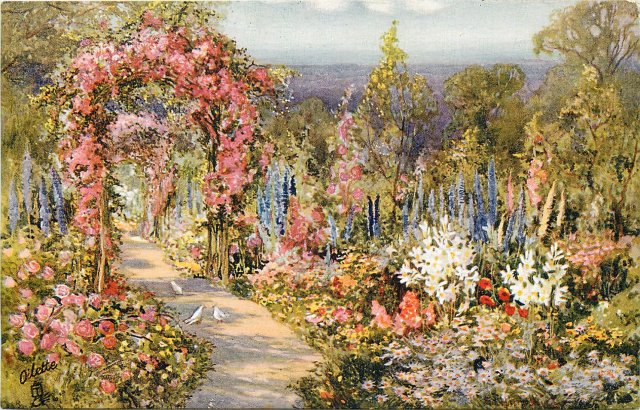
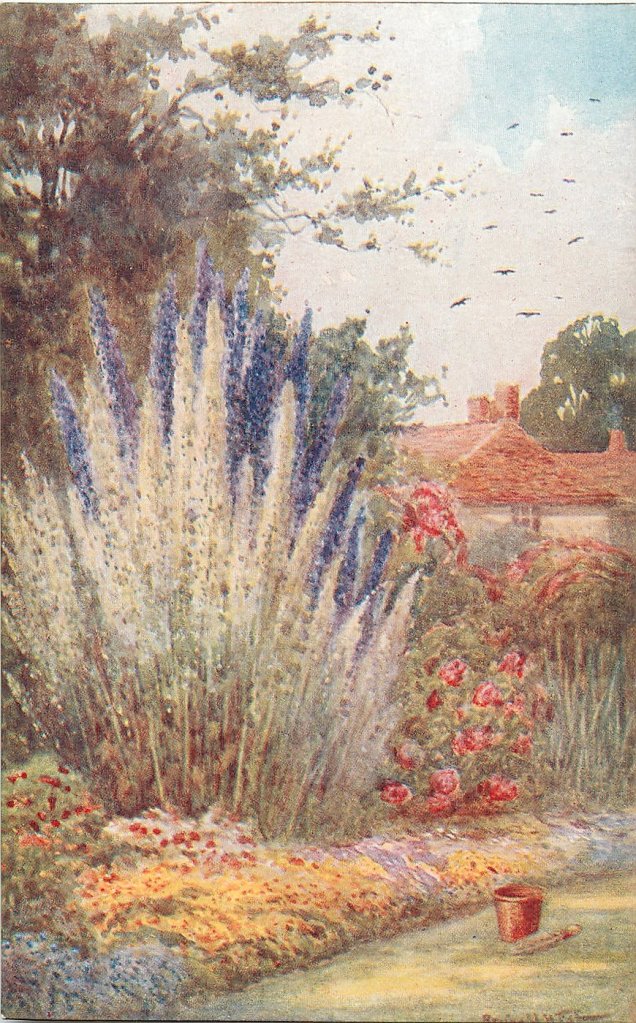
Reginald West painted marine scenes as well as gardens. One of his paintings revealed his address in Christchurch but other than that I can’t trace him.
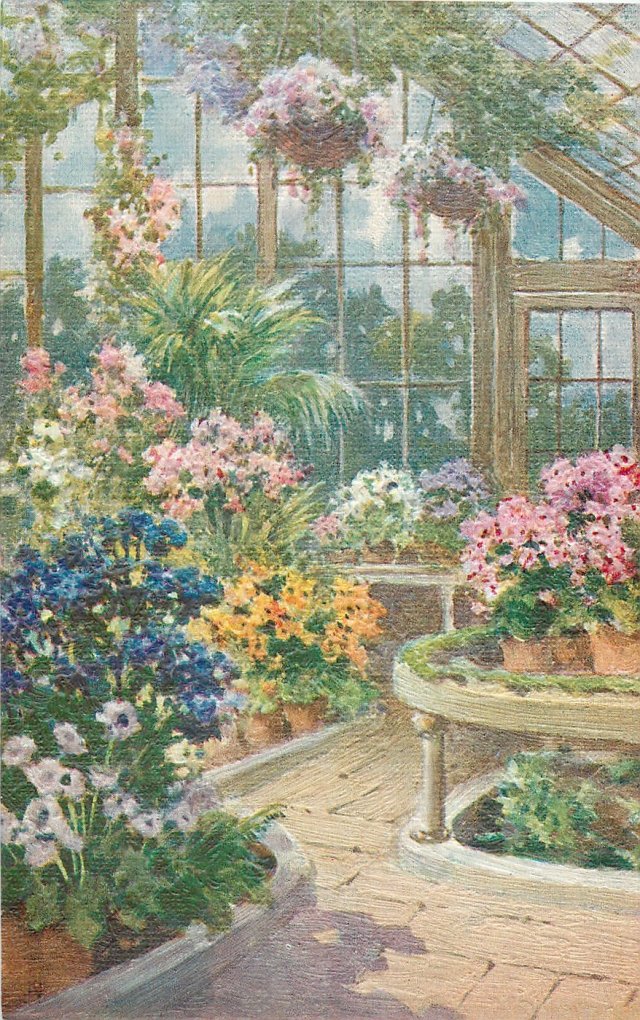
Sydney Shelton proved slightly easier to track in the census. He was born in 1861 in Bloomsbury and was still living there at the time of the 1921 census, and described as an artist/painter but I have uncovered little else about him,
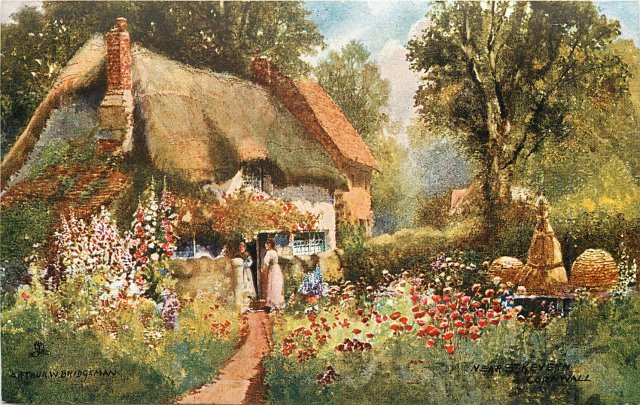
And finally there area list of other complete or almost complete unknowns… Arthur Bridgeman, A Coates, AF Armitage, S Barrett, Fred Hines, JA Heyermans, J Fulleylove, John Macpherson, and M Townsend
So if you know anything about any of them please drop me an email. Otherwise just enjoy the images on the postcards!


 The Garden History Blog

You must be logged in to post a comment.