
Do you remember the first time you saw a Willow Pattern plate? I’d guess it was when you were a child and that probably like me you asked yourself at least some of the same questions as this writer did in 1849...
Who is there…who has not inquisitively contemplated the mysterious figures on the willow-pattern plate? Who, in childish curiosity, has not wondered what those three persons in dim blue outline did upon that bridge? Whence they came, and whither they were flying? What does the boatman without oars on that white stream? Who people the houses in that charmed island?—or why do those disproportionate doves for ever kiss each other, as if intensely joyful over some good deed done?
I’d add one more question of my own: Why are there so many variations of the pattern?
So do you know the answer to any of those questions? If not read on…and if you think you do then read on and prepare to be disillusioned!
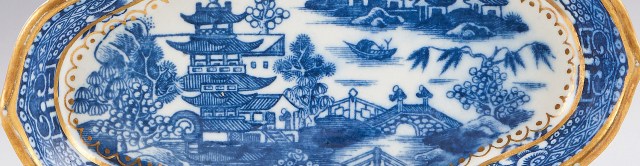
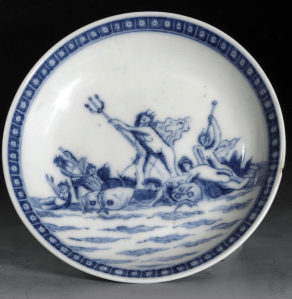
When consignments of Chinese porcelain first arrived in the west via Portuguese and Dutch merchants in the early 16thc, they were so unlike any European pottery that they created a sensation.
That’s largely because until the 18thc Europeans only had local brown clays to work with, so could not make anything as delicate, so pale in colour or fine in texture which made them almost see-through. as the Chinese imports. These were also hand-painted, with the most popular colouring being obtained from cobalt and known as “blue and white ware”.
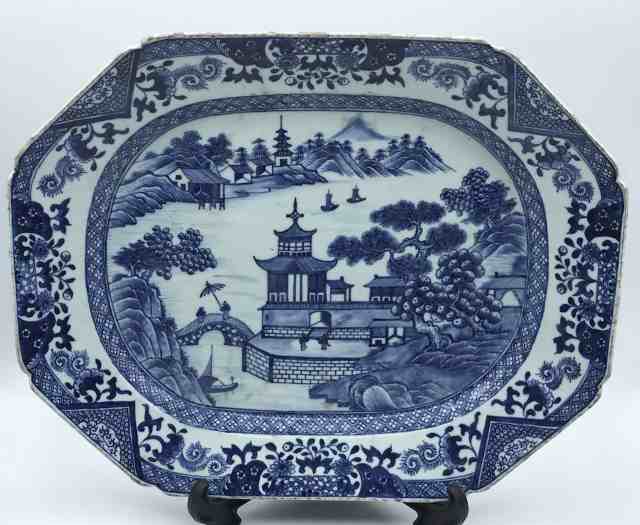

It wasn’t until 1710 that the Meissen factory in Saxony managed to make porcelain with local clays that Europe began to catch up with China. Other pottery factories, including many in Britain, followed, but, as explained in a very readable account – The Arcanum by Janet Gleeson – it took a long time before they could replicate the quality of Chinese wares. However what the ceramics industry in Britain did do from the mid-18thc onwards was to adopt a new technique of transfer printing patterns onto plain white wares rather than hand painting designs. This allowed highly complex patterns, to be put on quickly and cheaply. Although other colours – notably brown, black and pink – were tried for the decoration it was the same shade of cobalt blue used by the Chinese that was then, and remains now, the most popular.
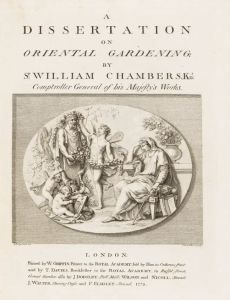 We’re used to Chinese-style buildings being part of 18thc garden, but porcelain was an equally significant aspect of the fashion for Chinoiserie that swept western Europe as China was being discovered by the west.
Trade through the East India Company, voyages like that of Admiral Anson [1740-44] and books such as William Chambers Dissertation on Oriental Gardening (1773) all helped ensure that both genuine and imitation Chinese designs and objects were very fashionable.
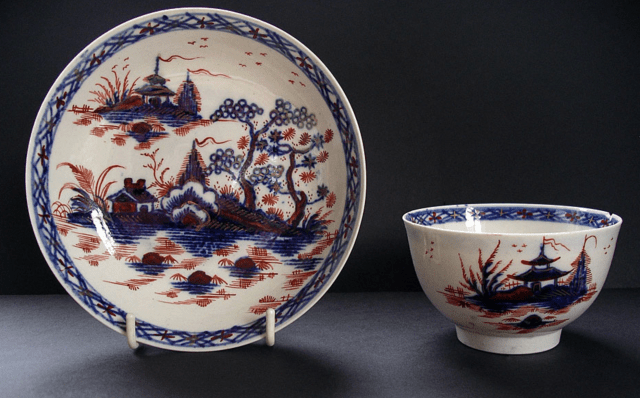
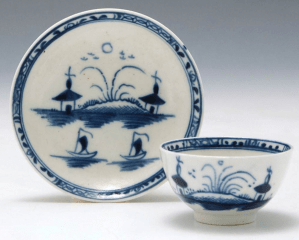
One sign of this was the way that western merchants sent designs over to China to be put on porcelain – anAt the same time European artisans were taking and adapting Chinese [and other Asian] designs for use in all of the decorative arts, including ceramics.
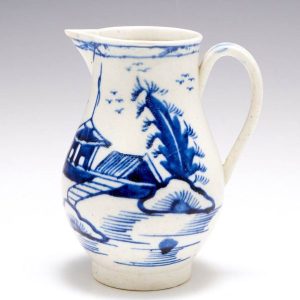
They used pagodas and pavilions with “flicked-up” roofs, elaborate fretwork bridges, stylised exotic birds, trees, and plants, figures dressed in “oriental” styles , and often with lakes or waterside locations. While all these were based on original Chinese designs the various elements were re-arranged and adapted at will.
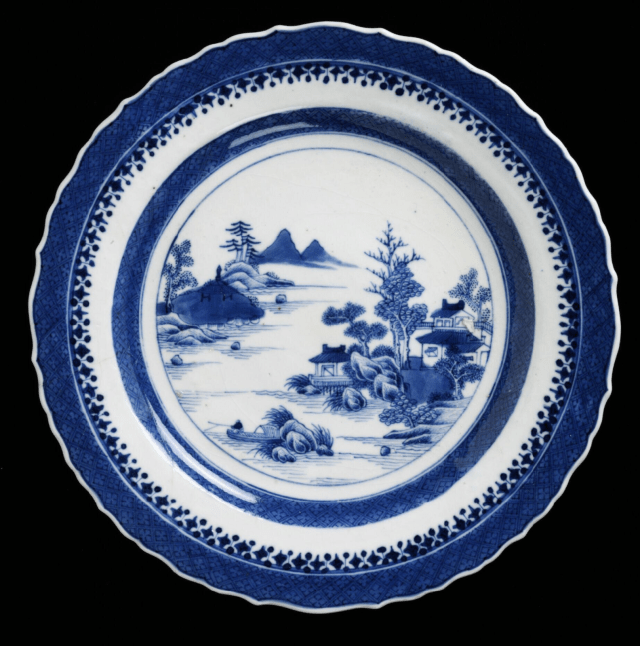
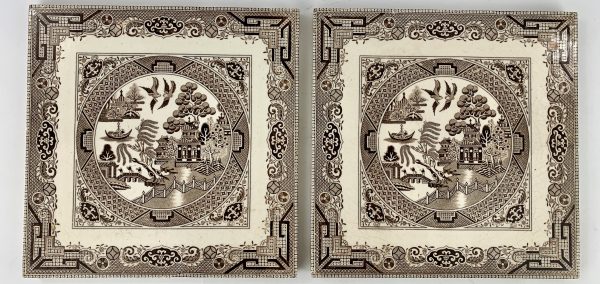
There’s no sense of any story or narrative being involved in this process , and in fact, some elements of the Willow Pattern design don’t get fixed in place immediately, with, for example, the two birds not always included until well into the 19th century.
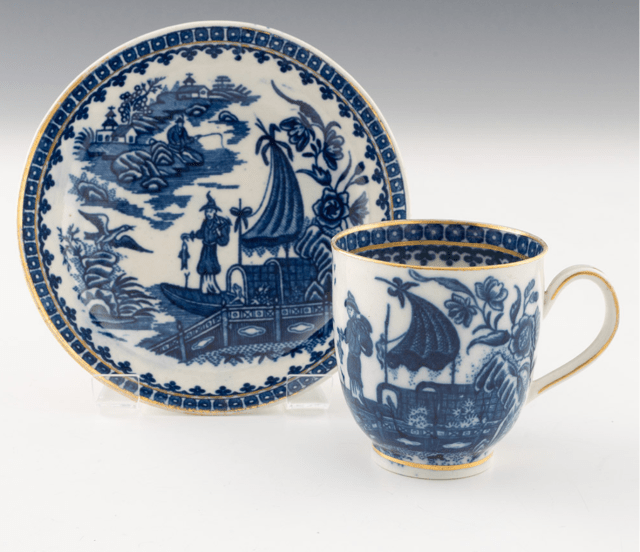
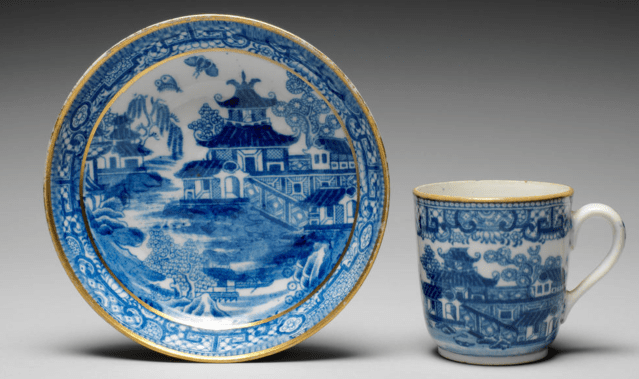
Nor, as you can see from these other pieces, is the Willow Pattern the only design that was tried, although there are many similarities. The “oriental” motifs were arranged in different forms and layouts, sometimes simple but often really quite complex assemblages to create a wide variety of scenes and settings. The ceramics factories often gave the resultant patterns Chinese names such as Mandarin or Nankin for example but it’s not until c.1780 that the specific design we now know as the Willow Pattern first appeared.
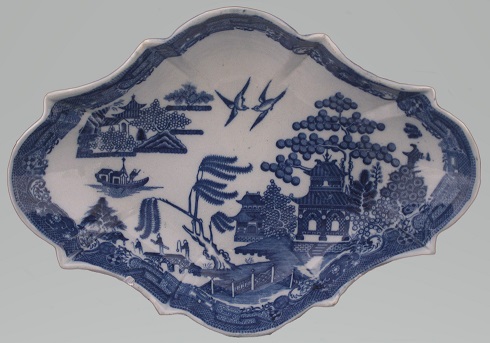
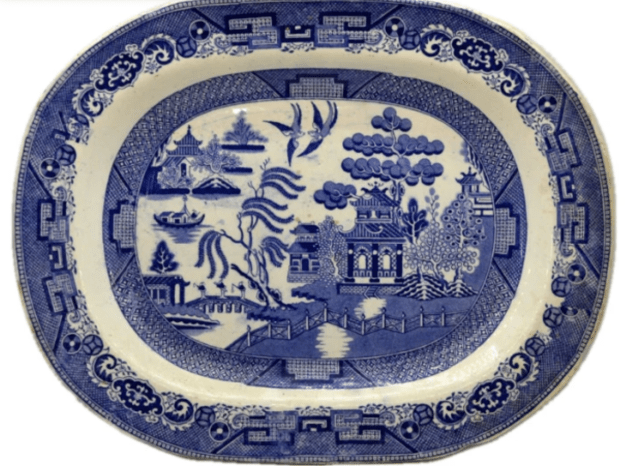
There is some uncertainty about its exact origins but the general consensus seems to be that it was devised by Thomas Minton who worked at the Caughley factory in Shropshire before moving to work for Josiah Spode at his factory in Staffordshire, in 1784. What nobody seems to have pinned down with any accuracy is how and why Minton and/or Spode settled on this particular arrangement of a pagoda structure, three figures on a bridge, a figure on a boat, an island, two flying birds and, of course, a weeping willow tree. As there was no copyright protection for designs until the mid-19th century, everyone was free to produce or adapt it to whatever combination they chose. The result was that by the late 1800s there were as many as 50 different British ceramic factories producing wares with some variant of the Willow Pattern, and by the early 20th century this number had risen to over 100.
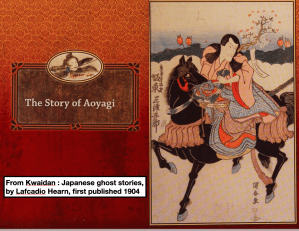 There are those who have argued that the Willow pattern isn’t really based on a Chinese story at all but was inspired by a poignant Japanese fairy tale called “The Green Willow” based on a 15th century Noh play. It tells of Tomodata, a young samurai who falls in love with a mysterious maiden named Green Willow, who is actually the human spirit of a willow tree. They marry but after 3 years when her willow tree is cut down she dies leaving him with just just a stump to mourn.
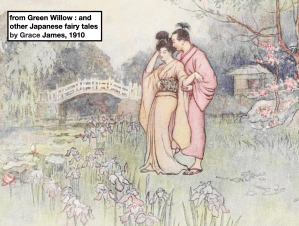 The story is first published in the west by Lafcadio Hearn in 1904 and then popularised for children in 1910 by Grace James. Having read both versions I can’t see why anyone would think it has such to do with the Willow Pattern other than the fact that it’scentred around a lovelorn couple and a willow tree. Nor can I find any reference to this story in English before these books, so Minton and Spode couldn’t possibly have known about it.
The first telling in English of a story related to the Willow Pattern comes in Bentley’s Miscellany in 1838, edited by Charles Dickens. Characterised by stereotypical Chinese names, language and behaviours it was thought at the time to be amusing but would definitely not pass the offensiveness test today. However, rather than being the source of the Willow Pattern legend it was almost certainly a story especially created to explain the design.
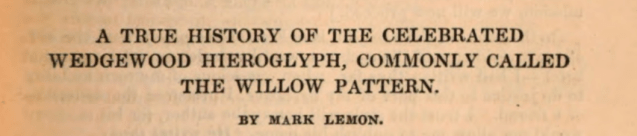
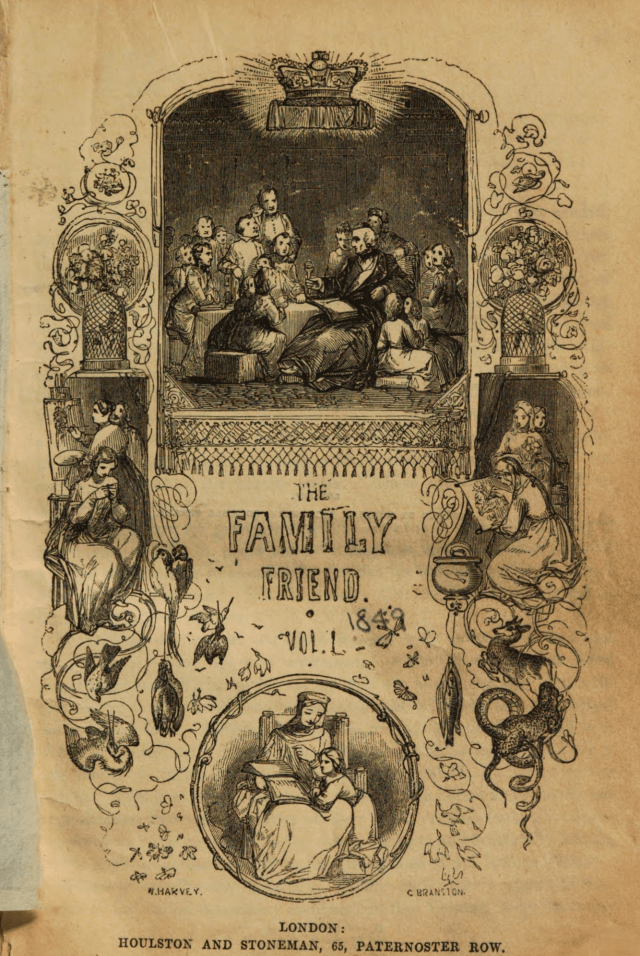 The Willow Pattern story that is generally accepted today seems to date back, in British documentary sources at least, to 1849. It was then that two long articles called ‘The Story of the Common Willow Pattern Plate’ were published in The Family Friend magazine.
In it, after asking the basic questions that I quoted in the opening paragraphs of this post, the author slowly revealed a very complex narrative which has been whittled down in more modern retellings to become the standard interpretation of the pattern.
So here it is!
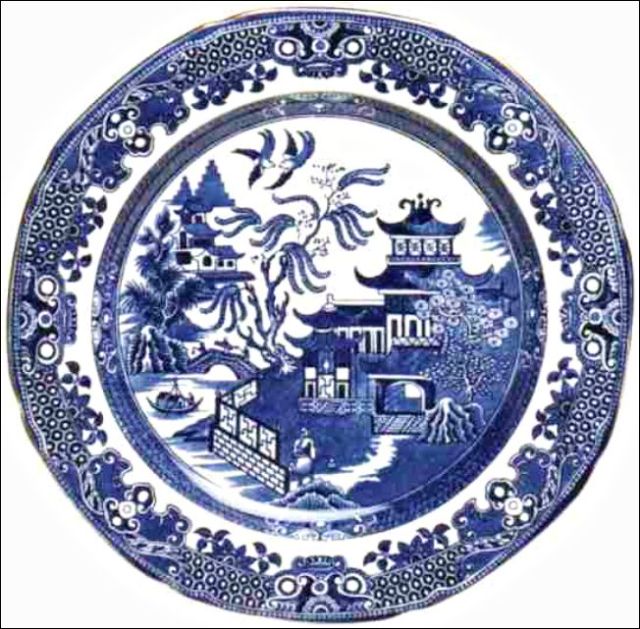
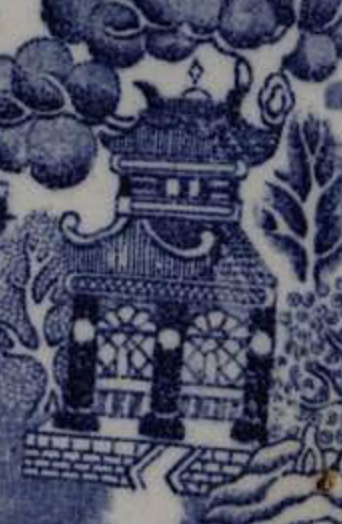 Once upon a time there was a Mandarin whose only daughter was the beautiful Koong-se. He also employed a secretary, Chang who, while he was attending to his master’s accounts, fell in love with Koong-se. She returned his love, much to the anger of the Mandarin, who regarded the secretary as unworthy as a future son-in-law. In the Family Friend version the pavilion in the centre of the plate belongs “to a mandarin of great power and influence, who had amassed considerable wealth in serving the emperor in a department corresponding to our excise. The work, as is the case in other places besides China, was performed by an active secretary, named Chang, while the business of the master consisted in receiving bribes from the mer-chants, at whose smuggling and illegal trade he winked an eye.”
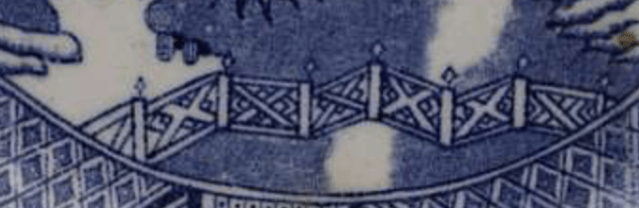
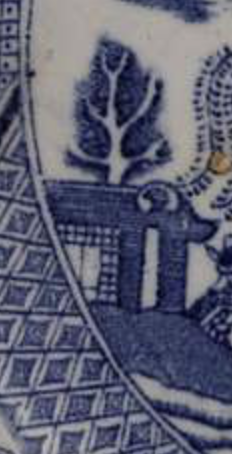
Chang’s job was to fix the books in case the emperor’s inspectors came to check them. When this job was done Chang was dismissed, along with Kong-se’s maid who had not reported the love affair to the Mandarin. Family Friend tell us that he “forbade his daughter to go beyond the walls of the house; the youth was commanded to discontinue his visits upon pain of death, and to prevent his chivalrous courage any chance of gratification, he ordered a high wall of wood to be built across the pathway from the extremity of the wall to the water’s edge.”
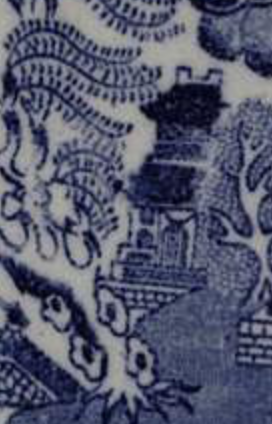 To make matters even more difficult for the lovers the Mandarin “also built a suite of apartments adjoining his banquet-room, and jutting out over the water’s edge, with terraces upon which the young lady might walk in security. These apartments having no exit but through the banquet-hall, in which the mandarin spent the greatest part of his time, and being com-pletely: surrounded by water, the father rested content” BUT to complete the disappointment of the lovers, he went still further “and betrothed his daughter to a wealthy friend, a Duke of high degree, whom she had never seen. The Duke was her equal in wealth and in every respect, but age which greatly preponderated on the gentleman’s side. The nuptials were, as usual, determined upon without any consultation of the lady; and the wedding was to take place ” when the Peachtree should blossom in the spring.”
The Duke sent a casket of jewels to his future bride which the mandarin hands over to his daugtjhet, congratulating her upon her good fortune, telling her the Duke would soon be arriving to celebrate the marriage. Koong-see’s hopes all but vanished but somehow she contrived to send a message to her lover: ‘Gather thy blossom, ere it be stolen.’
The duke arrived at the pavilion with Family Friend tells us “his servants beating gongs before him, and shouting out his achievements in war. The number of his titles was great, and the lanterns on which they were inscribed, were magnificent. Owing to his rank, he was borne in a sedan, to which were attached eight bearers, showing his rank … The old mandarin gave him a suitable reception, and then… The gentlemen then sat down to the introduction feast according to custom, and many were the ” cups of salutation” which were drank between them, till at last they became boisterous in their merriment..
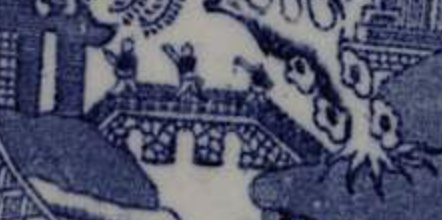
That evening Chang borrowed the robes of a lowly domestic servant, and managed to passed through the guests unseen. He came to Koong-se’s room, and I’m sure after scenes which Family Friend declined to tell its readers about, she gives him the box of jewels before they escape past the drunken Mandarin and Duke and reach the bridge next to the willow tree. Unfortunately at the last moment they were spotted and raising the hue and cry, the Mandarin staggered out and chased after them himself.
Family Friend describes the figures on the bridge: “The first is the lady Koong-see, carrying a distaff, the emblem of virginity; the second is Chang, the lover, bearing off the box of jewels; and the third is the old Mandarin, the lady’s father, whose paternal authority and rage are supposed to be indicated by the whip which he bears in his hand.”
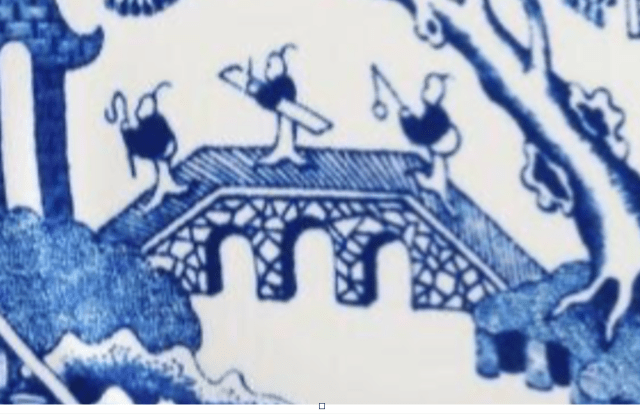
 Of course the couple outran the drunken old Mandarin, and they made their way to the riverside house of the maid who had been had dismissed for conspiring with the lovers. There they hid.
Meanwhile the Mandarin and the Duke vowed vengeance, and threatened to execute Chang when he caught him, not for stealing Koong-see but for stealing the jewels. They sent out spies and eventually one night one of them saw Chang and reported where he was hiding. The Mandarin sent troops to search the property but when they arrived Chang had jumped out of the window and was swept away by the ragging torrent. Koong-se obviously thought that he had drowned and was distraught.
However the Madarin suspected a trick and although he ordered the soldiers away he had a cunning plan…
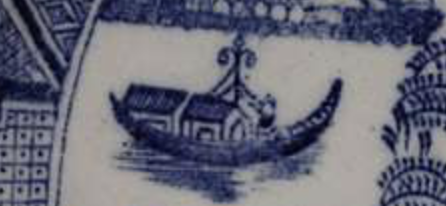
As the Mandarin had guessed he had been tricked because of course Chang hadn’t drowned, and instead returned as soon as he could in a small boat. But when the Mandarin and his soldiers soon came back the maid played her part detaining them in conversation while Koong-se leapt out of the rear window and joined Chang in the boat as he sailed it away to safety. Once again the mandarin vowed vengeance.
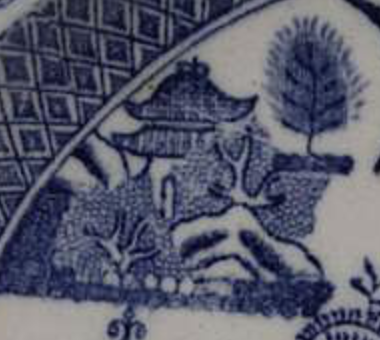
The couple ended up living happily on a far away island where Chang began to make a living as a writer. That was his undoing because he became too successful and soon his fame reached the ears of the Mandarin.
He sent his henchmen over to the island where they killed Chang and set fire to the house, killing Koong-se who was inside.
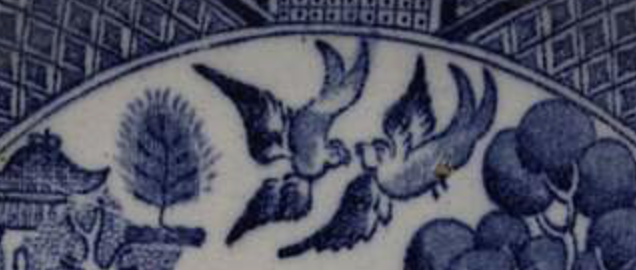
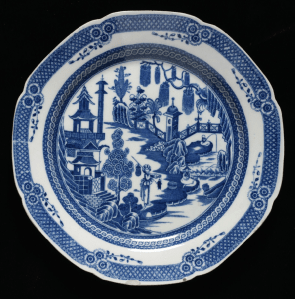
The Gods, seeing their plight, immortalised them as two doves which you can see flying together at the top of the Willow Pattern. So now we can all; breathe a sigh of relief at the story having a happy ending… and, of course knowing what we’re eating our dinner off!
For more information: There’s an exhibition about the Willow Pattern at the Spode Museum until August 2026; Patrick O’Hara traces the backstory in “The Willow Pattern That We Knew”: The Victorian Literature of Blue Willow” in Victorian Studies Vol. 36, No. 4 (Summer, 1993), pp. 421-442
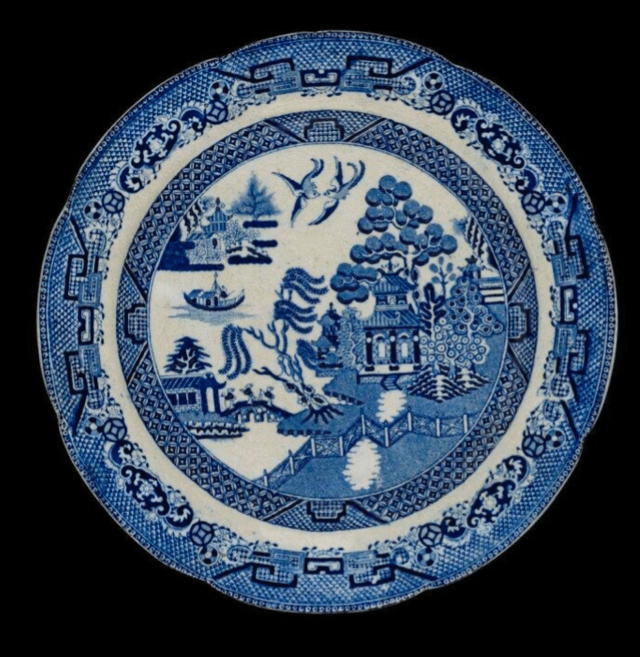
Willow Pattern plate c1815 V&A


 The Garden History Blog
You must be logged in to post a comment.