Daffodil Day

King_Alfred_daffodils

Happy Daffodil Day!

Daffodil Day is celebrated annually on March 22nd  and has been a key fundraising event organised by cancer charities across the world since the 1950s because the show of bright colour so early in the year  represents hope and a sign of renewal.

I suspect we all feel that when we see them. Maybe it’s the time of year when we need some strong cheerful colour around us – but in that case why don’t we feel the same way about equally colourful and loud forsythia?

What is it about daffodils?  They’re planted everywhere and anywhere, often vulgar and brash in colour and are probably our commonest bulb in both senses. Yet it’s rare to find someone who dislikes their show and their often brazen visual intrusion.  Perhaps it’s because as Picasso said: “no one has to explain a daffodil. Good design is understandable to virtually everybody”.  The fact that most people with “taste” prefer the smaller wild species is no reason to stop the rest of us liking a bit of golden vulgarity!

Continue reading

Posted in Uncategorized | Tagged , , , , , , , , , , , , , | Leave a comment

Josiah Wedgwood and a plateful of Green Frogs

A view of the terrace at Enville

It’s now just over ten years since the Wedgwood Collection, one of the most important industrial archives in the world and a unique record of over 250 years of British art, was saved by the Art Fund from sale and  dispersal.

It was gifted to the Victoria and Albert Museum and in 2019 they entered into a partnership with the World of Wedgwood to house the more than 80,000 works of art, ceramics, manuscripts and photographs in a purpose built free-to-visit gallery at Barlaston in the heart of the Potteries, and not far from Josiah Wedgwood’s home and factory at Etruria.

The collection offers a lot of evidence of the 18th century’s  love of gardens and designed landscapes thanks largely to an Anglophile Empress.

Continue reading

Posted in Uncategorized | Tagged , , , , , , , , , | Leave a comment

Whiteknights and the spendthrift Duke

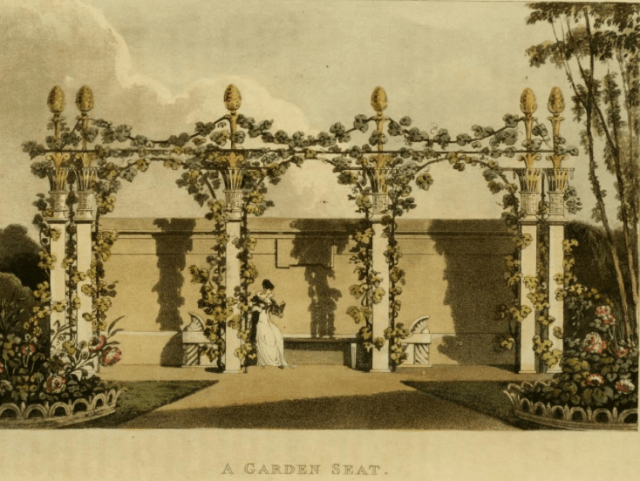
The Gothic Bower

A few weeks ago, purely by chance,  I came across an illustrated guide written in 1816 for  a garden called Whiteknights which was in its day probably the most famous garden in the country.  The guide was so intriguing that since the estate is just a couple of miles from the centre of Reading I decided to pay a visit  and see what, if anything was left.

Purchased in 1798 for George Spencer-Churchill, the Marquis of Blandford and heir to the Dukedom of Marlborough,  Whiteknights became the site of reckless extravagance and outrageous entertainment. George was a magpie, collecting art, furniture, books, wine and rare plants and laying out magnificent gardens.

As you might remember from this earlier post he was so renowned a plantaholic that he had a family of Australian plants named in his honour.    Unfortunately  he was also such a spendthrift that he went bankrupt in 1819 and was forced to retire to Blenheim Palace [what a hardship!].  Whiteknights was later sold, and the house soon demolished with the ground divided up and developed. It’s  now  the campus of Reading University but hidden away there are still a few traces of the Park’s past splendour.

Continue reading

Posted in Uncategorized | Leave a comment

The Maharaja and his German gardener

The Maharaja

When was the last time you needed a passport to visit a garden?  Or indeed had to walk past heavily armed  police to go in? We ran into that problem on my recent visit to south India, although luckily the passports  weren’t locked in the safe in our hotel as recommended but in the car, or we’d have been refused admittance.

The garden we were visiting was Brindavan, a huge formal garden on the outskirts of Mysore, that was laid out between 1924 and 1932. Like us, you might be wondering why we needed passports , but perhaps a look at some of the long distance views of the garden later in this post will give you a clue.

Mysore is, unlike all the other Indian cities I’ve visited, amazingly green. It has tree-lined streets, broad avenues with wide shrub filled verges and several gardens in the city centre. Like Brindavan much of this is due to the foresight of a reforming maharaja and his chief ministers, and the trust they placed in a Kew-trained German-born gardener and planner I’d never heard of but who, I’ve since discovered,  is probably the most influential European gardener ever to work in India.

Continue reading

Posted in Uncategorized | Leave a comment

William Nesfield: soldier, artist & landscape designer

© The Tabley House Collection Trust

There can’t be many great landscape gardeners who, as a young man,  fought against Napoleon in the Peninsular War or against the Americans in the War of 1812. Yet one who did both went on to become a well-known artist and then  one of the leading garden designers of the 19thc,  with over 250 sites including some of the most important  in the country under his belt by the time he died in 1881.

He was William Andrews Nesfield usually mainly remembered for his complicated colourful geometric parterres but who was  actually a far more nuanced and sophisticated designer than he is often given credit for.

Mamhead Park by Nesfield , from the Nesfield Archive in Australia scanned from Country Life 8th April 1993

Continue reading

Posted in Uncategorized | Leave a comment