Fishing Temples 2: the 18th century

detail from 'Pisho Bury' by Jan Drapentier in Henry Chauncy's Historical Antiquities of Hertfordshire, 1700 'http://www.furneuxantiquemaps.com

detail from ‘Pisho Bury’ by Jan Drapentier in Henry Chauncy’s Historical Antiquities of Hertfordshire, 1700 ‘http://www.furneuxantiquemaps.com

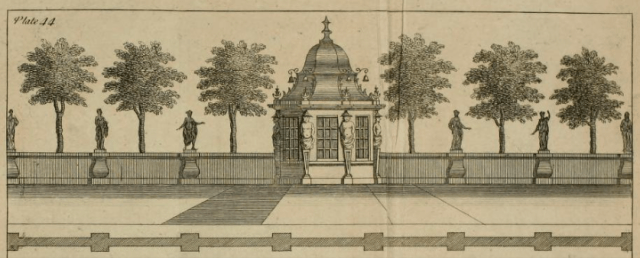
Last week’s post was about the earliest surviving garden buildings designed for fishing which dated from the 16th and 17thc. After I’d published it I realised that I’d missed out some tiny but atmospheric details from some plates by Jan Drapentier for Henry Chauncy’s Historical Antiquities of Hertfordshire, published in 1700.

detail from 'Pisho Bury' by Jan Drapentier in Henry Chauncy's Historical Antiquities of Hertfordshire, 1700 'http://www.furneuxantiquemaps.com

detail from ‘Pisho Bury’ by Jan Drapentier in Henry Chauncy’s Historical Antiquities of Hertfordshire, 1700 ‘http://www.furneuxantiquemaps.com

The quality isn’t brilliant but I thought  I’d include a couple in this post before going on to  show how  as the 18th century progressed fishing temples became more sophisticated, often doubling up as boathouses or places to eat.  Perhaps this is associated with the shift from formal gardens to designing the  landscape in a new way, and particularly with an increasing emphasis on the importance of water.

detail from 'Little Offley' by Jan Drapentier in Henry Chauncy's Historical Antiquities of Hertfordshire, 1700 'http://www.furneuxantiquemaps.com

detail from ‘Little Offley’ by Jan Drapentier in Henry Chauncy’s Historical Antiquities of Hertfordshire, 1700 ‘http://www.furneuxantiquemaps.com

Tiny detail from Bedwell Parke, by Jan Drapentier in Henry Chauncy's Historical Antiquities of Hertfordshire, 1700

Detail from ‘Bedwell Parke’, by Jan Drapentier in Henry Chauncy’s Historical Antiquities of Hertfordshire, 1700

Whatever the reason the result is a collection of amazing garden and landscape buildings. So read on to find out more about some of them. Continue reading

Posted in Uncategorized | Tagged , , , | Leave a comment

Fishing Temples 1 : the earliest survivals

Charles Cotton's Fishing Temple in Dovedale, Derbyshire http://images.google.fr/imgres?imgurl=https%3A%2F%2Ftheincompleatangler.files.wordpress.com%2F2014%2F07%2Ftempblog1.jpg&imgrefurl=https%3A%2F%2Fincompleatangler.com%2Ftag%2Ftemple%2F&h=951&w=713&tbnid=zt5AYZkoMLImJM%3A&docid=n46J805cY046bM&itg=1&ei=DOmmV4aPEMKqa4mAo7AN&tbm=isch&client=safari&iact=rc&uact=3&dur=628&page=2&start=15&ndsp=25&ved=0ahUKEwiGxZ3M6a7OAhVC1RoKHQnACNYQMwhIKBQwFA&bih=601&biw=1215

Charles Cotton’s Fishing Temple in Dovedale, Derbyshire
https://incompleatangler.com/tag/temple/

Its August and I’ve been sitting admiring my lake – how’s that for showing off?  It’s about an acre in extent and stuffed full of hideous fat carp.  It’s an attraction for local fishermen and there’s often one sitting on the bank although they hardly ever catch anything and when they do they put them back. Being vegetarian I have no interest in catching fish at all  and I’m happy to just sit and look at the water and all the waterlilies we’ve planted. But lovely tho’ my lake is, I was a little envious  of a little riverside lodge in Dovedale, which was up for sale recently.   Built in 1674 in honour of his friend Isaak Walton author of The Compleat Angler, Charles Cotton’s one-roomed fishing temple looks a rather nice place to sit and contemplate, as does Bourne Mill near Colchester

so even tho I don’t fish, and don’t even understand why anyone would want to do it, this is the first of a few posts dedicated to fishing temples and lodges. Today’s looks at the few survivors from the 16th and 17th centuries. Continue reading

Posted in Uncategorized | Tagged , , , , , , | Leave a comment

Welwitschia mirabilis: “the ugliest plant in creation”?

Life on a welwitschia mirabilis plant in the Namib Desert, David Marsh, Feb 2016

Life on a Welwitschia mirabilis plant                        in the Namib Desert, David Marsh, Feb 2016

What a mouthful that is! Even worse when you realise it’s the Latin name of a bizarre plant ‘discovered’ by a man born in the Austrian Empire of Slovak origin, who worked for the Portuguese monarchy in one of their African colonies and ended up being buried in London.

Actually bizarre is a bit of an understatement: how many plants do you know that only have two leaves, live on fog and sometimes have to be kept in a cage!

The caged welwitschia, David Marsh, Feb 2016

The caged Welwitschia, David Marsh, Feb 2016

OK I admit that’s a bit of a cheat because, like the Wollemi pine, it’s to protect the plant from humans rather than the other way around!

But why am I writing about Welwitschia on a blog about Britain’s parks and gardens? Read on to find out…

Weltwischia from a pianting by Baines, in Transactions of the Linnean Society, 1863

Welwitschia from a painting by Thomas Baines, in Transactions of the Linnean Society, 1863

Continue reading

Posted in Uncategorized | Tagged , , | Leave a comment

Artificial Stone 4: Post-Coade potteries

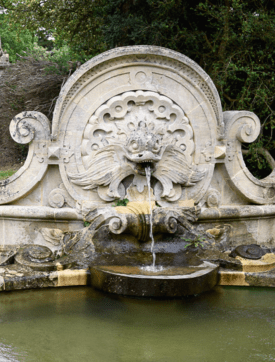
Detail of a Triton fountain by J.M. Blashfield http://www.jardinique.co.uk

Detail of a Triton fountain by J.M. Blashfield
http://www.jardinique.co.uk

While Eleanor Coade’s factory was the dominant player in the artificial stone market in the late 18th and early 19thc there were others. A few using their own magic mixtures and from the 1820s onwards others began using the new invention of Portland cement. So when William Croggan went bust in 1833 there were several other entrepreneurs ready and able to move in and pick up the pieces.

This post is about two of them – Mark Blanchard and John Marriott Blashfield whose careers ran in parallel through the mid-late 19thc. Their  architectural and decorative faux stone and terracotta work can be found all over the country in buildings like the V&A, as well as structures like Chelsea Bridge, and their  garden statuary, urns and other  ornaments are in many historic gardens and are now very collectable.

from Blanchard's catalogue, 1869

from Blanchard’s catalogue, 1869

Read on to find out why….

Continue reading

Posted in Uncategorized | Tagged , , , , | 1 Comment

Artificial Stone 3: Coade broken

The entrsance to Coade and Sealy's exhibition gallery, © The Trustees of the British Museum

The entrance to Coade and Sealy’s exhibition gallery, © The Trustees of the British Museum

In two earlier posts we have seen the rise and triumph of Eleanor Coade’s artificial stone business. [Catch up on them at:   http://wp.me/p4brf0-vR6  &   http://wp.me/p4brf0-vR8 ]  Eleanor was a successful entrepreneur dominating the market in architectural decoration and garden ornaments in later Georgian England. This was partly thanks to her own skills and partly thanks to the talent of her chief designer, John Bacon.  After Bacon died in 1799 Eleanor chose a new business partner – her cousin John Sealy and the business was renamed Coade and Sealy. But was it to continue on an upward curve?

At first it seemed so and Coade and Sealy went from strength to strength but by 1833 the business went bust. What went wrong? Read on to find out what happened to destroy Eleanor’s Coade’s enterprise and take down such an iconic name.

Coade Stone factory yard on Narrow Wall Street, Lambeth, London, c1800.

Coade Stone factory yard on Narrow Wall Street, Lambeth, London, c1800.

Continue reading

Posted in Uncategorized | Tagged , , , , , , , | Leave a comment