Hardwick Park – the Circuit Walk

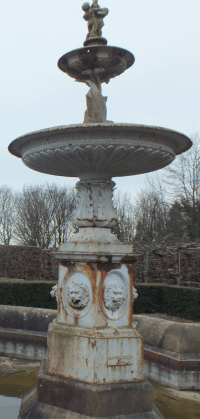
Neptune on the serpentine river from https://www.tripadvisor.co.uk/Attraction_Review-g940865-d2487051-Reviews-Hardwick_Park-Sedgefield_County_Durham_England.html#photos;geo=940865&detail=2487051&ff=67648446&albumViewMode=hero&albumid=101&baseMediaId=67648446&thumbnailMinWidth=50&cnt=3&offset=-1&filter=7

Neptune on the serpentine river from https://www.tripadvisor.co.uk

This is a follow-on from last week’s post about Hardwick Park in County Durham, one of the great 18thc circuit walk gardens, now in the later stages of a very successful restoration programme.

There are several descriptions of the circuit walk, the first dating from 1770. It was later described  in William Hutchinson’s  History and Antiquities of the County Palatine of Durham, published in 1794. This was just after William Russell had acquired the estate from John Burdon, [Extracts from it are in italic]. There is also a guide dating from 1800. Links to them are given at the end of the post.   Images referenced as from  Reawakening are taken from the dvd about the restoration The Reawakening of a Sleeping Beauty, produced by the Friends of Hardwick Park.  Read on to find out more….

Continue reading

Posted in Uncategorized | Tagged , , , , , , , , , | 2 Comments

Hardwick Hall Park

David Marsh, July 2015

View through one of the openings on the Serpentine Bridge, Hardwick Park,                  David Marsh, July 2015

First things first. No…. this post is not about THAT Hardwick Hall but the one in County Durham. Maybe not so many famous connections, and definitely not such an interesting mansion but with much more interesting grounds which include the largest collection of structures designed by James Paine, the great 18thc architect. I visited in July 2015 with Catherine Grezo, the Project Officer for the County Council , and Tony Smith, the  Council’s Countryside Manager, and met James Paine himself even tho he died in 1789…. intrigued to know how?  …then read on!

Hardwick Park Hotel with the Grand Terrace in front, from the south side of the lake David Marsh, July 2015

Hardwick Park Hotel with the Grand Terrace in front, from the south side of the lake
David Marsh, July 2015

Posted in Uncategorized | Tagged , , | Leave a comment

Robert Gauen & his ingenious horticultural inventions No.1

screenshot 2

from Robert Gauen’s  “The Art of ornamenting…”                             The Gardener’s Magazine Vol.3 1828.

And here’s a picture starter for 10?   What on earth is this contraption for?  If you’re a regular reader of this blog then think back a few weeks…and there is another clue below.

from xxxxx xxxx

from Tom Carter’s, The Victorian Garden, p.97

The object, whatever it is, was invented in the 1820s by Robert Gauen, a gardener and nurseryman from Hampshire and is recorded in John Claudius Loudon’s The Gardener’s Magazine.  Read on to be …. impressed? bemused? surprised? amused? or at least find out more about this and other ingenious products of Mr Gauen’s extremely  fertile imagination because this is not the only piece of horticultural gadgetry that he devised.

Continue reading

Posted in Uncategorized | Tagged , , , | 2 Comments

Cannas

The Indian Reed from Robert THornton's Temple of Flora

The Indian Reed from Robert Thornton’s Temple of Flora

This posts picks up from last week’s on Robert Thornton’s  Temple of Flora. One of the exotic plants that Thornton’s writes about is “the Indian Reed”or Canna indica. Although often called a canna lily, the canna is actually a member of the ginger family [Zingiberales] along with bananas and maranta.

Although no longer rare cannas still have an exotic air even though they are actually quite hardy – especially the newer hybrids –  and with flowers in the hotter part of the spectrum – predominantly red but ranging from pink, through orange to yellow – they are regularly used in ‘tropical’ bedding displays, or to add  a ‘hot’ touch to a border.

Read on to find out how this American rhizome moved from being a mundane food crop to being a colourful addition to our gardens….

canna-banner-image

Continue reading

Posted in Uncategorized | Tagged , , , , , , , , | 2 Comments

Robert Thornton & The Temple of Flora

The Queen Plant

The Queen Plant

Dr Robert Thornton was the brains behind one of the most impressive and quirky of all flower  books: The Temple of Flora. Despite not being either an artist or a professional botanist, he was fascinated by the rapid development in botanical knowledge of his time and  convinced that Britain should be in the worldwide vanguard of both the arts and the sciences.  He was also, one suspects, appropriately enough for a Valentine’s day post, at least mildly in love with George III’s wife, Queen Charlotte.

Robert Thornton, by John Russell, 'Portarit Pianter to the King'

Robert Thornton, by John Russell, ‘Portrait Painter to the King’

Writing at the time of the French Revolution and then Napoleon, Thornton was an ardent conservative, royalist and patriot, and  intended The Temple of Flora to  be a book in ‘which in Point of Magnificence is intended to exceed all other Works of a similar Nature on the Continent’. It was also designed to prove that Britain and its system of government were naturally the best in the world. Thornton, like Sir Joseph Banks, was a pioneer of  botany with an imperial purpose.

Read on to see if he succeeded, and to take a closer look at some of the plates from his magnificent but wallet-breaking magnum opus. Continue reading

Posted in Uncategorized | Tagged , | Leave a comment