Percy – The Nation’s Head Gardener

Cover photo from Timothy O'SullivanPercy Thrower: A Biograpy

Cover photo from Timothy O’Sullivan       Percy Thrower: A Biography

Percy Thrower was a household name during his long career in gardening programmes on radio and television.  A natural broadcaster, with quiet enthusiasm and a very hands-on practical approach, he built a substantial following amongst adults and children alike. 

Always cutting a fairly formal figure in jacket and tie, he was usually seen with a pipe in his hand, even when actually gardening.  His biographer may have called him” a mild mannered sergeant-major”, but Peter Seabrook, one of his successors on Gardener’s World said “Percy was comfortable to watch on television… He was a lovely man and he smiled from the inside”. Alan Titchmarsh, another of his successors,  says it was Percy who inspired him to take up gardening.

Read on to discover how he became so influential and why, as a result, he was nicknamed the Nation’s Head Gardener.

Continue reading

Posted in Uncategorized | Tagged , , , , , , , , | Leave a comment

Garden Menageries 3 … Osterley

A male gold pheasant: a bird standing on a mossy rock in profile to right, with a crest and a long dappled tail; plate for 'Birds ... from the Menagerie at Osterley Park' (1794). Hand-coloured etching © The Trustees of the British Museum

A male gold pheasant from ‘Birds … from the Menagerie at Osterley Park’ (1794). 
© The Trustees of the British Museum

Continuing with my occasional theme of menageries in the garden,  todays’s post looks at Osterley Park in west London and also reveals how garden history interacts with wider current research.  The East India Company at Home project  has been trying to put the country house and estate into its global and imperial context and has  made a special study of Osterley, in  particular looking  how its owners acquired and used exotic Asian commodities in  the 18th and 19thc. This included birds for their garden menageries.

Continue reading

Posted in Uncategorized | Tagged , , , , , , , , , , , , , | Leave a comment

Gazetteer of War Memorial Parks and Gardens

DSCF3331 - Version 4This is not one of my normal slightly irreverant posts but a more serious one to try and spread the word about Parks and Gardens UK’s publication on-line of  the first Gazetteer of UK War Memorial Parks and Gardens. It’s amazing it hasn’t been done before, because it seems of such obvious ‘national’ interest, but it has been finally been put together, by volunteers, as part of the Gardening in Wartime project. This is a joint initiative between the Garden Museum and Parks & Gardens UK, which has  focussed  on the untold story of gardens and gardening during and after the First World War.DSCF3331 - Version 2DSCF3331 - Version 3

This first version of the Gazetteer has over 400 entries on it from across the United Kingdom. We hope it will inspire others at a local level to contribute information about their war memorial parks and gardens for inclusion. You can find the full gazeteer and related articles at:

http://www.parksandgardens.org/projects/gardening-in-wartime/839-gazetteer-of-war-memorial-parks-and-gardens

In today’s post I’m going to highlight a few of the lesser known memorial gardens and landscapes and hope that it will inspire you to take a look yourself…and maybe suggest others which haven’t been included.

Continue reading

Posted in Uncategorized | Tagged , , , , | Leave a comment

Almost everyone’s least favourite tree…

article-1309450-0B0EB85C000005DC-940_634x486

Daily Mail, 8th Sept 2010

Shouldn’t be too hard to decide what that is!  Horror stories abound – and it must be one of the few plants ever legislated about. Yet it all started out innocuously enough on a beautiful country estate in Mid-Wales in the 1880s.  I’m referring, of course,  to that chance cross between the Nootka cypress and the Monterrey cypress which currently rejoices in the botanical name of  x Cupressocyparis leylandii although it’s better known as just Leylandii.

Read on to discover the amazing Welsh estate where it all started, why it almost didn’t happen, and  then  how the monster was encouraged in the name of horticulture!

Continue reading

Posted in Uncategorized | Tagged , , , | 2 Comments

Five vicars and some roses…

Most Interesting Show" from A Summer Rose Show.Illustrated London News, 23rd June 1884

Most Interesting Show” from A Summer Rose Show.Illustrated London News, 23rd June 1884

Over the holidays I’ve been planting new roses and thinking how nice it will be when they flower this summer…. that led to me to thinking about rose shows. If you’ve ever been to one then you have several Victorian clergymen to thank.  One was the  Rev Henry Honywood D’Ombrain about whom I wrote recently. You might be surprised to learn that the Rev.Henry  had any time to spare after helping start gladi-mania, his ministry, his journalism, his gardening, hybridizing and exhibiting but the industriousness of Victorian gardening clerics was seemingly endless.

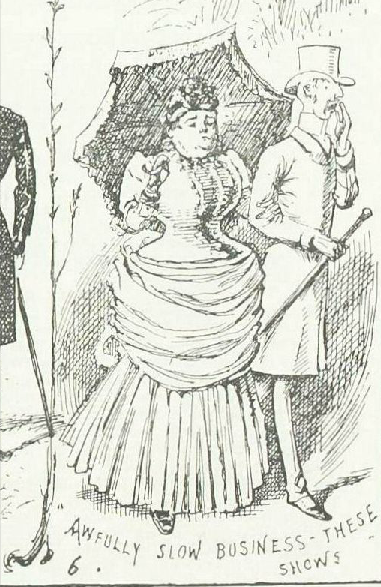
"Awfully slow business these shows" from A Summer Rose Show, Illustrated London News, 23rd June 1884

“Awfully slow business these shows” from A Summer Rose Show, Illustrated London News, 23rd June 1884

In  December 1876 D’Ombrain and Canon  Reynolds Hole called a meeting of rose enthusiasts at the Adelphi Terrace in London. There were 5 clergy amongst the 20 or so attendees.

images-1


“The proceedings were enthusiastic and unanimous” and as a result  the National Rose Society was formed.

So who were these  rose-loving vicars ?

Continue reading

Posted in Uncategorized | Tagged , , , , , , , , , , , , , , , , , , | Leave a comment