Aranjuez

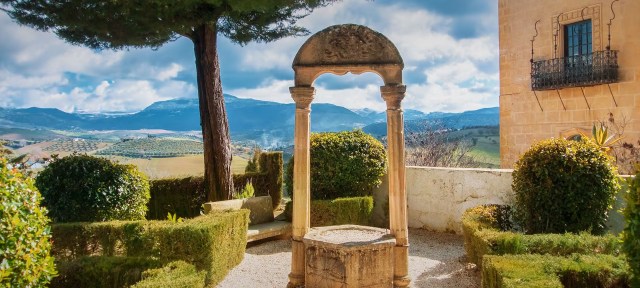
I caught part of Joaquim Rodrigo’s concerto for guitar on the radio the other day [listen to part of  it here if you don’t know it] and it took me back to a visit I made pre-pandemic to the site that inspired him: the Palace and gardens complex at Aranjuez near Madrid.

It was partly  created during what is known as the Golden Age of Spain in the mid-late 16thc and then largely completed in the later 18thc.  Quite rightly it is on the UNESCO World Heritage list  with a  protected area covering over 20 square kilometres,   including  the palace and its gardens which, incidentally,  contain more amazing fountains than I’ve ever seen before in one place.

Continue reading

Posted in Uncategorized | Leave a comment

Captain Bligh, the Breadfruit and two Nelsons.

The tomb of William Bligh at the garden Museum

On a recent  visit to the Garden Museum in the former church of St Mary next to Lambeth Palace,  it was hard to miss  the impressive tomb of Admiral William Bligh, which stands in the middle of their courtyard.  Better known by his more junior rank of Captain his  name will be forever linked with the Mutiny on the Bounty.

You are probably  familiar with one or other of the film versions of that story – the first starring Charles Laughton as Bligh from 1935 or the later versions  with Trevor Howard in 1962 and Anthony Hopkins in 1984.  But there’s more to Bligh than that, much of it quite surprising.

And what do you know about breadfruit? And who are the two Nelsons? One’s obvious the other not so…

Continue reading

Posted in Uncategorized | Leave a comment

The Fero-Plant and other “rustic adornments”

Short of space in your home? Love indoor plants but haven’t got enough room to grow many? Want to have goldfish …or maybe frogs or snakes as pets? How about a budgie or a parrot? Any good at DIY? If the answer to any of these questions is yes then you need a Fero-plant.

As its deviser said introducing it to the world: “If a thing of beauty is a joy forever, then whoever adds to the number of beautiful things increases human happiness. And if the “thing” be of one’s own making, and capable of changes and modifications limited only by taste and time, it becomes an almost unlimited source of pleasure.”

Read on to find out how  you can get one of these unlimited sources of pleasure… Continue reading

Posted in Uncategorized | Leave a comment

Does Marie Antoinette haunt the gardens of Versailles?

In 1901 two highly respectable academic women – the first principal of St Hugh’s College, Oxford and her deputy – met Marie Antoinette in the gardens of  Versailles. That’s quite a challenging thought  considering the Queen of France had actually been executed  over 100 years earlier.

S0 how did it happen? Here’s the beginning of the story in the words of one of them

“After some days of sight-seeing in Paris, to which we were almost strangers, on an August afternoon, 1901, Miss Lamont and I went to Versailles. We had very hazy ideas as to where it was or what there was to be seen. Both of us thought it might prove to be a dull expedition. We went by train, and walked through the rooms and galleries of the Palace with interest…We sat down in the Salle des Glaces, where a very sweet air was blowing in at the open windows over the flower-beds below, and finding that there was time to spare, I suggested our going to the Petit Trianon. My sole knowledge of it was from a magazine article read as a girl, from which I received a general impression that it was a farm-house where the Queen had amused herself.”

“It was a most enjoyable walk” until….

Continue reading

Posted in Uncategorized | Leave a comment

Poisoning Pests, Plants… and People

Two weeks ago I wrote about the history of biological controls in gardening and noted that these days they were once again most people’s preferred way of tackling disease and pests. However no one in Victorian England – or indeed most of the 20th century – would’ve believed the lengths to which many of us 21st-century humans go to protect the planet, the plants, other creatures and ourselves. Instead  they  relied on chemicals which were dangerous in the extreme.

Until  1851 you could buy arsenic, opium, or strychnine an almost any other poison  you could  think of  from your  local chemist.  No questions asked. After all laudanum – a polite way of concealing opium – was the pain relief of choice, while  arsenic was used as a cosmetic as well as for controlling rats and mice. Both they and many other poisons were often used mixed with other substances to form homemade pesticides.  But if you thought that was bad were the 20thc answers to pest control such as DDT  any better?

However one thing is for sure pests and diseases didn’t stand much chance against such an armoury , unfortunately nor did many humans.


Continue reading

Posted in Uncategorized | 2 Comments